Paula Trigueiros (2023). Common variables of a good problem: contributions of inclusive design in and beyond academia. In: Human Systems Engineering and Design (IHSED 2023): Future Trends and Applications. AHFE Open Access, vol. 112, pp. 156–161. https://doi.org/10.54941/ahfe1004125
Design education today faces the complexity of social challenges. Young designers often tend to dive straight into creating abstract drawings and developing conceptual discourses without addressing the core purpose of the design. This lack of a clear purpose can demotivate designers. Drawing upon the author's experience and inclusive design examples, this paper delves into the pedagogical significance of formulating a "good problem". By examining common variables found in the manipulation of everyday objects, including interactions with individuals with disabilities during academic exercises, students have discovered a wellspring of inspiration. The paper advocates for the pivotal role of inclusive design within academia and its potential to fuel innovation in tackling societal challenges. Moreover, it highlights the wide-ranging impact of design solutions born from demanding circumstances, offering benefits to diverse groups of people. By bridging the realms of academia and real-world application, this study seeks to nurture critical reflection and contribute to the enhancement of inclusive design processes.
Design education faces increased complexity due to social challenges, which serve as both a source of stimulation and a hurdle. Similar to half a century ago, the field of design cannot afford to ignore the problems it has con- tributed to and must actively contribute to their resolution (de Bont, 2021). In the 21st century, Meyer and Norman (2020) express concerns regarding the inadequate response of educational institutions to the prevailing con- text, a sentiment shared by Victor Papanek as far back as 1971 (Papanek, 1971). Paradigm shifts have been so significant that many long-standing assumptions in the field of Design can no longer be upheld (Redström, 2020). Therefore, at present, there is a timely need for an inclusive approach to design education, although it may also appear to be a challenging decision (Trigueiros, 2022). We have observed certain similarities and pedagogi- cal advantages in methods employed in the university context of Inclusive Design, as identified by Herriot and Jensen (2013). Drawing from inclusive practices and methods discussed by the author, it is contended that these
Common Variables of a Good Problem: Contributions of Inclusive Design 157
approaches can be both educational and motivating for students. In this text, our main focus will be on the observation phase that leads to the formulation of the problem equation, specifically examining straightforward design briefs within the realm of product design graduation.
“WHAT IS THE PROBLEM?”
At the outset of a fresh project, it is a typical tendency for young designers to promptly engage in creating abstract drawings and formulating concep- tual discussions. However, in the absence of a clear objective that serves as a foundation for comprehensive research and argumentation, they often grasp onto superficial aspects of objects without genuinely questioning them. Conversely, a sense of purposelessness can be disheartening and diminish motivation (Trigueiros & Burrows, 2007). The problem equation repre- sents a pivotal moment in the design process as it aids in identifying and embracing the challenges and requirements right from the start. “What is the problem?” – we may ask.
Inclusive Design exercises often involve interacting and observing people. This direct interaction is a source of inspiration and helps in overcoming the initial hesitation commonly experienced by students. The objective of this approach, which involves engaging with the real world and real individuals, is to discover a purpose for the project, which we refer to as a ‘good prob- lem’. Most importantly, instead of creating a replica of themselves, students confront the preferences and perspectives of other individuals. At this stage, the target audience ceases to be an abstract concept and may have a specific name and a face.
This gives rise to a prevailing notion that each one of us possesses some degree of design acumen (Jones, 2014). In reality, ideas and solutions mate- rialize through the act of observing specific situations and grappling with challenges encountered in task execution. Conversely, the empowering sense of being able to effect change and enhance the world can significantly motivate young students (Trigueiros & Burrows, 2007).
Ryan (2018) challenges Dieter Rahm’s principles of Good Design, reimag- ining them as prerequisites for Better Design. This assertion underscores the multifaceted and situational nature of our connection with the material world, as well as the progression of our consumer expectations beyond the functional and pragmatic considerations of an initial equation. In addition to the aforementioned pedagogical impacts, a ‘good problem’ may introduce an innovative element to the existing equation, thereby presenting opportunities and advantages. The observation and involvement of people with disabili- ties often introduce variables that had not been previously considered in the design of existing solutions. Consequently, certain student’s proposals stand out due to the (perceived) originality of their perspective, such as a product designed “to assist the visually impaired” or cater to individuals with disabil- ities. However, upon analyzing potential solutions, it becomes evident that those variables can be applied to other situations and users, thereby gen- erating opportunities for innovation, encouraging the consideration of new iterations.
158 Trigueiros
THE COMMON VARIABLES We will discuss two academic exercises of Inclusive Design, focusing on sim- ple tasks performed with the hands. The first one, of short duration, aimed to raise awareness of human diversity in the creation of everyday solutions. The second exercise involved an investigation into the users and was dedi- cated to older people. Both exercises confront common variables related to hand mobility, finger mobility, or the lack thereof. We compared each of the student proposals with the approaches taken by professional designers in existing market products, in order to discuss similarities and motivations.
Dedeta1 and Pintxos al Dedo2 Dedeta was an idea of a young student, designed to overcome difficulties in writing for those who are missing one or more fingers required to hold a pen (Figure 1a). The rigid body of a pen is removed, and its flexible ink cartridge is wrapped around any remaining finger or other suitable part. The writing tip, which serves its functional purpose, is positioned at the end. This arrangement of the functional component in relation to the hand enhances the coordination of writing movements. The proposal emerged directly from the problem at hand: “When certain fingers, particularly the thumb, are absent, how can a pen be gripped by hand?” After identifying the variable of hand/finger grip, the solution was derived by utilizing existing components of the pen, leading to the incorporation of a helical spring. This concept was visually conveyed through several drawings showcasing various hand configurations, along with the creation of a prototype.
The adaptability of the solution enables it to accommodate various finger and hand configurations. This feature demonstrates its inclusive potential, as it can be utilized and beneficial for writing tasks by individuals with or with- out hand disabilities. The simplicity of Dedeta makes it an effective solution. Its potential for broad applicability and wide-ranging impact categorizes it as a good problem. We can observe this same formulation in other products, both within the mainstream market and in specialized niches.
Figure 1: (a) “Dedeta”( M. Ribas) and (b)”Pintchos al dedo”(Photo R. Alonso).
1The name ‘Dedeta’ results from the fusion of portuguese words: ‘finger’ and ‘pen’ and was given by the autor, M Ribas in 2002. 2Designed by Rodrigo Alonso, received the Chilean Design Award in 2009.
Common Variables of a Good Problem: Contributions of Inclusive Design 159
To exemplify this line of thinking, we have an original and playful pro- posal called Pintxos al dedo by R. Alonso, which revolves around the concept of enjoying snacks with finger-held cutlery (Figure 1b). According to the description provided by the author, it embraces the “pleasurable indulgence of eating with one’s hands and sharing.” Apart from its practical utility and straightforward usage, the description highlights the symbolic aspects asso- ciated with the gestures and attitudes involved in this finger-focused dining experience.
In comparison to Dedeta which also involves dressing the fingers, Pintxos represents the opposite end of the practical needs’ spectrum. It is worth noting that products designed for individuals with disabilities often tend to reside at the other end of the spectrum, lacking options and alternatives that address a broader range of needs and expectations placed on products (Jordan, 2002).
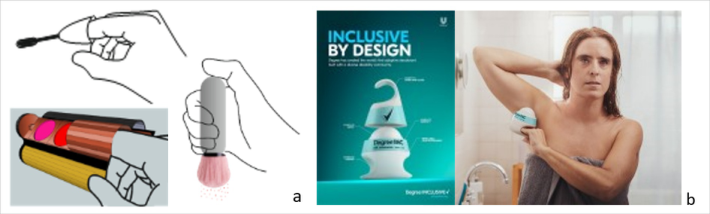
Makeup Kit and Degree The Makeup Kit3 emerged from a comprehensive academic project that encompassed the typical phases of a design endeavor (Figure 2a). As an Inclusive Design work, it commenced with awareness-raising activities that involved simulations and firsthand testimonies. In this particular case, the student, observed the challenges faced by older women when applying makeup, particularly concerning the intricate details and reduced dimensions of the makeup components. Instead of individual and separate items, the student devised a compact Kit that consolidates various makeup elements within a roller. It can be held with one hand while utilizing a finger-dressed mascara brush or applying eyeshadow with another finger. This solution was deemed a good problem due to the significant role makeup plays in boosting the self-esteem of older women, irrespective of their abilities - an observa- tion emphasized by the author in her initial research involving real users. The proposed solution encompasses multiple features that facilitate its use by individuals with limited motor skills, enabling them to accomplish intri- cate tasks with ease, even if they have reduced dexterity in their hands and/or fingers.
We draw a parallel between this kit and Degree INC4 (Figure 2b), a pack- aging design for a roll-on deodorant specifically aimed at facilitating its use for individuals with upper limb limitations and visual impairments, “designed for and with a diverse community” (Maril, 2021). Alongside incorporating embossed information, this packaging design actively engages the hand to enhance the application of the product. Its hook-shaped lid facilitates easy opening, allowing it to be hung and used with just one hand. Additionally, the proposal encourages reuse by enabling the replenishment of the contents.
DISCUSSION
The two initial projects identified a shared variable related to the challenges encountered when manipulating everyday objects, and they both arrived at similar solutions in formulating this equation: if one lacks or is unable to use other fingers to grasp and control the object, the finger itself becomes wrapped with the object. This equation can be generalized, wherein the object becomes an extension of the body or limb itself, akin to an “object to wear” imparting specific instrumental functionalities. By reducing the size and dis- tance of the object/interface, it enhances control and introduces additional dimensions to the user experience.
Those examples share a common aspect in both the problem equation and the design solution: the method of securing the object by involving or wear- ing the fingers or hand. It is important to note that these examples are not presented as “universal” proposals, as that would be a fallacy, but rather as alternative formulations. They embody inclusive proposals because they provide choices for individuals with different disabilities. As Bispo astutely pointed out, the inability to choose from various product options and solu- tions is itself a central aspect of the stigmatizing stereotype that restricts individuals with disabilities not only to physical spaces but also confines them to a predetermined set of expectations and activities deemed suitable for them (Bispo, 2018).
CONCLUSION
These examples demonstrate different approaches to promoting inclusion through design. On one hand, we have proposals specifically targeting indi- viduals with disabilities, which as it turns out, can be utilized by anyone. On the other hand, we recognize that many other products, based on the same concept of attaching themselves as an extension or augmentation of limbs, can address gaps in the availability of alternatives for individuals with ampu- tations or limitations in finger movement. To achieve this, one simply needs to view the world through the same lens. Inclusion is fostered by increasing awareness and providing a range of alternatives to choose from. Moreover, it emphasizes the importance of incorporating awareness into the design pro- cess, creating products and solutions that cater to a more diverse range of
4Source: www.theroereport.com
Common Variables of a Good Problem: Contributions of Inclusive Design 161
potential users. This line of reasoning emerged from isolating the initial vari- able in the “problem equation”– not only as a pedagogical tool but also from a critical analysis perspective of the design of other products in the market.
We believe that just as we acknowledge the pedagogical value of immersing students in the real world, there would be potential for inclusion and inno- vation through the sharing of best practices from academia with companies and designers.
ACKNOWLEDGMENT
This paper was supported through the Multiannual Funding of the Land- scape, Heritage and Territory Laboratory (Lab2PT), Ref. UID/04509/2020, financed by national funds (PIDDAC) through the FCT/MCTES.
REFERENCES
Bispo, R. (2018). Design contra o estigma. https://hdl.handle.net/10400.8/3058 de Bont, C. (2021). Furthering Victor Papanek’s Legacy: A Personal Perspective. She Ji: The Journal of Design, Economics, and Innovation, 7(2), 262–281. https://do i.org/10.1016/j.sheji.2020.08.010 Herriott, R., & Jensen, B. G. (2013). Students’ responses to inclusive design. Design
Studies, 34(4), 438–453. https://doi.org/10.1016/j.destud.2013.01.005 Jones, P. H. (2014). Systemic Design Principles for Complex Social Systems. Em G.
S. Metcalf (Ed.), Social Systems and Design (pp. 91–128). Springer Japan. https: //doi.org/10.1007/978-4-431-54478-4_4 Jordan, P. (2002). Designing Pleasurable Products. CRC Press. Maril, M. (2021, 04). Degree Is Launching Inclusive Deodorant For People With Disabilities. 7 Game-Changing Beauty Products You Can Use With One Hand- The Zoe Report. https://www.thezoereport.com/beauty/beauty-products-for-one- handed-accessibility Meyer, M. W., & Norman, D. (2020). Changing Design Education for the 21st Cen-
tury. She Ji: The Journal of Design, Economics, and Innovation, 6(1), 13–49. https://doi.org/10.1016/j.sheji.2019.12.002 Papanek, V. (1971). Design for the Real World: Human Ecology and Social Change.
Pantheon Books. Redström, J. (2020). Certain Uncertainties and the Design of Design Education. She Ji: The Journal of Design, Economics, and Innovation, 6(1), 83–100. https://doi. org/10.1016/j.sheji.2020.02.001 Ryan, C.-L. (2018). (99+) 10 Principles for Better Design | LinkedIn. https://www.li
nkedin.com/pulse/10-principles-better-design-chirryl-lee-ryan/ Trigueiros, P. (2022). Inspirando Designers—Mapeamento inspi- rador da Inclusão pelo Design (MID). FA-ULisboa. https://www. dropbox.com/s/8ta93axzmmad3hn/20220131_InspirandoDesigners _referencial_MID_PTrigueiros_.pdf?dl=0 Trigueiros, P., & Burrows, A. (2007, abril 1). Thinking better...creating for all. Proceedigns of INCLUDE 2007. INCLUDE 2007 - International Conference on Inclusive Design, Royal College of Art, London. https: //www.rca.ac.uk/research-innovation/research-centres/helen-hamlyn-centre/k nowledge_exchange/include-conferences/include-publications-and-proceedings/
LISTED IN THE AHFE DIGITAL BOOKSTORE CATALOGUE
Explore the complete digital volume
Human Systems Engineering and Design (IHSED 2023): Future Trends and Applications
Read this individual research paper free through the original publisher, or explore the full digital proceedings book.
ISBN 978-1-958651-88-9
Explore this ISBN in the AHFE Bookstore ↗Listed in the July 2026 bookstore catalogue; search by ISBN to confirm current availability · Digital book purchase optional