Marjaana Kangas, Katriina Heljakka (2024). AI Play in Higher Education: Students’ perceptions of play and co-creation of knowledge with generative AI. In: Human Factors in Design, Engineering, and Computing. AHFE Open Access, vol. 159, pp. 92–101. https://doi.org/10.54941/ahfe1005571
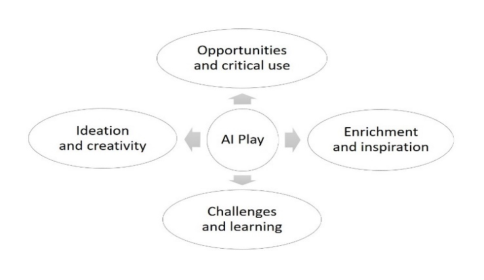
Playful learning approaches are expected to take a leading role in digital transformation in higher education (HE) (Tonkin, 2019; Whitton, 2022). Artificial Intelligence (AI) is changing the world impacting education, necessitating the development of new skills (Einola & Khoreva, 2023) meaning that aspects of teaching, learning, and knowledge building are set to radically change, and there is a need to strengthen the capacity of learners to engage with the world around them, especially through imagining and envisioning the future in the digital age (e.g., UNESCO, 2020). It is believed that through play individuals can learn to manage the unforeseen (Pors & Andersen, 2015). Therefore, in order to harness the power of play and digitalization for creativity and innovations, learners and employees need new playfulness-based and creative digital literacies. While generative AI (e.g. ChatGPT) is being widely explored, it has been mainly investigated through the functionality of the technology, and not the possibilities for engendering playful learning. Consequently, research on AI-human interaction as playful knowledge co-creation is entirely lacking.This study addresses this challenge by tapping the research on playful learning in the context of HE and educational sciences. Playful Learning (PL) refers to learning activities embedded with playful engagement and exploration, seeking learners to be active participants in their learning process. It recognizes creativity, emotions, narrativity, collaboration, and embodiment as essential elements of learning, complemented by appropriate tools and pedagogical strategies (Kangas et al., 2017). Here, the use of playful tools refer to co-creation with generative AI. During their playful learning process, 17 HE students co-created educational play-based activities and used generative AI in their designs. This knowledge co-creation was conducted as part of a Playful and game-based learning course in collaboration between two Finnish universities. One aim of the course was to increase HE students’ awareness of the potential of playfulness and AI in future pedagogies through playful learning activities. We asked: How do students understand play and non-play, and how do they see generative AI in their playful learning process? Data consists of students’ writings in which they reflected their ideas about play and non-play and the use of AI in the task. Our study contributes to the areas of playful learning, educational sciences, and emerging research on the applications of generative AI used as part of higher education. The findings indicate that the students' perspectives on play could be divided into five different dimensions: 1) openness and freedom, 2) well-being and joy through play, 3) enjoyment of the use of imagination 4) potential for skill development, and 5) playful social interaction. As the opposite of play, the students see a lack of imagination, bleakness, and a kind of greyness. The findings also indicate that generative AI provides a useful tool for playful learning in the HE context due to its potential for 1) Challenges and learning, 2) Ideation and creativity, 3) Opportunities and critical use, and 4) Enrichment and inspiration. Based on our findings, the AI Play framework was constructed, including facets of playful exploration and co-creation combined with critical thinking, which illustrates the dimensions of AI Play as part of HE students’ playful learning.
Play encompasses transformative power. Play as a multifarious concept has been defined in many ways. Here we lean on a definition given by Heljakka (2024, pp. 77–78), who states that: “Play is a voluntary, open- ended (unstructured), or goal-driven (structured) activity that enhances emotional, physical, mental, cognitive, or social well-being by producing enjoyment and gratification for players of any age, in which the human being employs imagination, creativity, or skill to explore various objects, artifacts, environments, systems, or assemblages of them in order to communicate and interact with oneself or others productively or unproductively. To put it in simple terms, play can consist of goal-oriented action, like in association with games, or more open-ended exploration, such as free play with toys. Contemporary play may take many forms: it can be solitary or social, embedded in the physical, digital, or imaginative, exercised both offline and online as part of leisure, work, and playful learning, extended with play(ful) things, tools, technologies and media, and engaged in by players of different ages, even between individuals of different generations.”
Playful approaches denote applications of play in various areas of life, such as education. In addition to numerous other benefits, it is believed that through play, individuals can learn to manage the unforeseen (Pors & Andersen, 2015). Whereas play implies action, playfulness has been
AI Play in Higher Education: Students’ Perceptions of Play and Co-Creation 93
conceptualized as a mental state, a precondition to play (see, e.g., Heljakka, 2013; Kangas, 2010; Sicart, 2014). Playfulness is associated with being open to playing with ideas and new possibilities (Craft, 2011; Kangas, 2010). Whitton (2022, p. 30) defines playfulness as an attitude of mind that “embodies a willingness to engage in activities in a light-hearted, joyful, open, mischievous, and comedic manner”. Playfulness is a key element in playful learning (Kangas, 2010; Whitton, 2022) and it has positive effects on an individual’s creativity, problem-solving, social interaction skills, management of risk-taking, emotional intelligence, and well-being (Bateson & Martin, 2013; Whitton & Langan, 2019). Playful minds are flexible, and flexibility in thinking alongside resourcefulness and resilience are competencies that are highly relevant in today’s changing world (Heljakka, 2023).
Strengthening learners’ capacity to engage with the world around them, especially through imagining and envisioning the future in the digital age (e.g., UNESCO, 2020), is necessary. Play is critical for exploring opportunities, imagining possible futures (Egan, 2005; Whitton, 2022). To harness the power of play and digitalization for creativity and innovations, learners and employees need new playfulness-based and creative digital literacies. This means that aspects of teaching, learning, and knowledge- building are set to radically change.
Our research is centred on the concept of playfulness as a lifelong learning approach. We view higher education, or HE, as a domain of adult learning within the framework of university education. This research focuses on HE students’ reflections on play and its meaning in their life, and the co-creation of knowledge with generative AI which is seen as a part of students’ playful learning. The research builds on existing theories of play, playfulness, and adult playful learning and is inspired by sociocultural and socio-material approaches integrated into the literature on playable technologies (Heljakka, 2024). It views learning and play largely as social, contextual, and mediated interaction (Ludvigsen et al., 2010). This approach highlights the heterogeneity within system components and the importance of considering relationships and mediations (Fenwick, Edwards & Sawchuk, 2015), rather than viewing playful things and playful individuals in isolation. Our study specifically investigates the role of play and playfulness in the context of learning in teacher education, emphasizing the importance of playful learning approaches as key learning objectives for future teachers. It is particularly interested in the potential of digital technologies in learning processes, with a specific focus on the use of Artificial Intelligence (AI) in playful learning. Artificial Intelligence (AI) has come to the forefront of societal concerns and is changing the world impacting organizations, work, and education, necessitating the development of new skills, including AI literacy (Ng et al., 2021; Long & Magerko, 2020). AI is becoming more integrated and interactive in workplace ecosystems (Einola & Khoreva, 2023). According to Ng et al. (2021, p. 10) “AI literacy combines the ideas of data science, computational thinking and multi-disciplinary knowledge to interplay AI literacy and AI thinking”. Long and Magerko (2020) define AI literacy as a set of competencies that enables individuals to critically evaluate AI technologies, communicate and collaborate effectively with AI, and use AI
94 Kangas and Heljakka
as a tool. In this research, our focus is on students’ AI use, and communication and collaboration with AI in their learning tasks. While generative AI (e.g., ChatGPT) is being widely explored, it has been mainly investigated through the functionality of the technology and not the possibilities for engendering playful learning; that is, research on AI-human interaction as playful knowledge co-creation is, so far, entirely lacking.
Our study addresses this challenge by tapping the research on playful learning in the context of HE and educational sciences. The study contributes to the areas of PL, educational sciences, and emerging research on the applications of generative AI used as part of HE. In our teaching, including the playful learning methodology, we encouraged students participating in higher education to creatively explore current AI applications to perform a challenge presented at a university course in Finland.
Our paper is structured as follows: First, we introduce playful learning as an approach in education and link it with society’s rapid digital transformation. We motivate the research by discussing why playful learning approaches should be considered as part of research investigating the use of AI in higher education. The next section explains our methodology, followed by the findings. In the discussion that follows, we synthesize our findings and offer a framework mapping out the dimensions of AI Play as part of playful learning in HE. We also propose the concept of AI Play literacy to be used when defining various AI literacies. In the conclusions, we bring attention to the limitations of our study and suggest ideas for future work.
BACKGROUND
In the research, playfulness is defined as a playful mindset, whereas play indicates an activity. Both are potentially important and positive contributors to individuals’ experiences and learning (Lockwood & O’Connor, 2017). Playful approaches are more important in our society than ever; they are expected to play a leading role in digital transformation in higher education (HE) and working life (Tonkin, 2019; Whitton, 2022). Playful approaches include possibilities to learn through failures, practice resilience, use one’s imagination, and be involved in a process where the outcome is unknown – all these are needed for the future working life (OECD, 2018; Heljakka, 2023; Jørgensen et al., 2023; Kangas, 2010; Whitton, 2022).
Playful learning (PL) refers to learning activities embedded with playful engagement and exploration, seeking learners to be active participants in their learning process. It recognizes creativity, emotions, narrativity, collaboration, and embodiment as essential elements of learning, complemented by appropriate tools and pedagogical strategies (Kangas, 2010; Kangas et al., 2017). Traditionally, PL pedagogy engages learners’ bodies and minds, utilizing various tools such as toys, playful objects, artefacts, and technologies. These tools signify the existence of a playful learning environment and encourage or develop playfulness (Whitton, 2018). Here, the use of playful tools refers to co-creation with generative AI. In earlier work, generative AI applications, such as ChatGPT, have been conceptualized as AI toys that afford playful experimentation (Heljakka,
AI Play in Higher Education: Students’ Perceptions of Play and Co-Creation 95
2024, p. 26). “Generative AI refers to a subset of artificial intelligence that involves deep learning models capable of producing new content, such as text, images, or audio, based on the data they have been trained on” (IBM 2024). These models, such as GPT-3, BERT, and DALL-E, produce outputs by identifying patterns and structures within their training data, which allows them to generate new, similar content in response to a prompt.
As a relatively new area of research, playful learning in the HE context puts emphasis on values of openness and democracy, risk-taking, entering a playful mindset, and intrinsic motivation (Nørgård et al., 2017; Whitton, 2022). However, although there are some studies on playful learning in the HE context (Whitton, 2022), there is no research on the role of generative AI and its role in playful learning in HE or teacher education. The goal of the study is twofold: First, the goal is to explore how students understand what is play and what is non-play, and what the meaning of play is in their life. Second, the goal is to investigate how students perceive generative AI and its role in the co-creation of knowledge in their playful learning process. The research questions are as follows: 1) How do students understand play and non-play, and 2) How do they see generative AI in their playful learning process?
METHOD
The research follows qualitative case study methodology (Stake, 1995, 2006), where the primary interest is to obtain insights regarding a particular situation or a specific case. Case studies allow for the examination of unique situations and intricate phenomena within their real-life contexts, offering insights into how these are perceived and constructed. This method was appropriate for the research as the phenomenon and its context were intertwined and could not be studied separately (Baxter & Jack, 2008).
Data has been collected from a Playful and Game-based Learning course (5 Credits) organized at the Faculty of Education, University of Lapland, Finland, in collaboration with the University of Turku. Altogether, 17 HE students (15 female, 2 male) participated in the course, during which their task was to co-create in small groups play-based educational contents and pitch the idea in a short video. Based on the provided learning materials, each group’s task was to brainstorm an idea that combines playfulness, a natural environment, and tourism in some way. Data consisted of students’ two different sets of writings on which they reflected their ideas about play and non-play and the use of AI in the task. The length of the writings (N = 15) on play/non-play varied between 117–348 words whereas thoughts about AI were reflected in an essay as a part of the course performance (N = 17).
The study followed the ethical principles for scientific research established by the Finnish National Board of Research Integrity (https://www.tenk.fi), and the Data Protection Act. Informed consent was obtained from each participant. The whole data was analyzed using a thematic analysis method using NVivo. The unit of analysis was a quotation, varying from one sentence to a multi-sentence excerpt.
96 Kangas and Heljakka
FINDINGS In order to capture a broader understanding of higher education students’ understanding and perceptions of play, we challenged them to reflect on how they see play in their own lives and what they consider the opposite of play. Based on the analysis, we were able to categorize experiences of play, which we later used to compare students’ experiences of the use of AI.
First, the students’ perspectives on play could be divided into five different dimensions: 1) openness and freedom, 2) well-being and joy through play, 3) enjoyment of the use of imagination 4) potential for skill development, and 5) playful social interaction, which are elaborated on in more detail in the following.
Openness and freedom. Many students felt that play means for them openness and the freedom to be themselves; to try new things without restrictions. Play provides the opportunity to immerse themselves in situations and be open to new experiences without the fear of failure or the need to follow specific patterns: Play means the freedom to be myself and to experiment. (Student 13). This category is in line with understanding the concept of play and its role in our lives as a disposition characterized by a high level of autonomy and intrinsic motivation.
Well-being and joy through play. The findings indicate play is seen as a significant contributor to well-being, reducing stress, and offering a respite from daily challenges. Play balances the mind, bringing joy and good spirits. It helps in sustaining energy and prevents boredom. I remember from my childhood how I could make even distressing situations easier through play. If I was scared, I would pretend to be the strongest and bravest superhero in the world. For all these reasons, play has an important role in supporting a person’s well-being and mental health. (Student 12). These notions support research findings on the specific meaning of play for one’s emotional wellbeing and health (Tonkin, 2019).
Enjoyment of the use of imagination. Students also view play as intellectual playfulness, an effort where one can enjoy intellectual challenges and problem-solving. It is a way to have fun and let the imagination run free. When I play, I have complete freedom to explore and test different ideas and, through this, develop my own perspectives without the fear of failure (Student 14). Using imagination involves thinking of things as possible and generating new patterns of meaning; it’s tied to one’s emotions (Egan, 2005).
Potential for skill development. Play is seen as a way to develop oneself and one’s skills. It enables continuous self-improvement and the learning of new things. Play is an opportunity to use and develop social and everyday life skills, imagination, creativity, perseverance, and persistence (Student 1), which are essential for personal growth and development.
Playful social interaction. Play is seen as an active and interactive activity. It involves enjoyable and free-spirited interaction with others. For me, play means enjoyable and free-spirited activities with others. For example, joking about things and amusingly analyzing them with friends is play for me (Student 6). This highlights the social, light-hearted and joy-bringing nature of play.
AI Play in Higher Education: Students’ Perceptions of Play and Co-Creation 97
As the opposite of play, the students see a lack of imagination, bleakness, and a kind of greyness. Non-play is also characterized by a lack of joy in activities and overall in life. Doing is seen as highly serious, non-autonomous, and externally controlled activity. The opposite of play, in my opinion, is passive activity, where one cannot use their own imagination at all and someone else decides what is done and how. In such activity, creativity, freedom, and joy are far away (Student 12).
Second, the student responses related to the use of generative AI in their coursework. These responses were interpreted through the lens of AI-human interaction and playful knowledge co-creation. We asked “How do students see generative AI in their playful learning process?” The findings can be summarized into four main categories: 1) opportunities and critical use, 2) challenges and learning, 3) ideation and creativity, and 4) enrichment and inspiration.
Opportunities and critical use. Students learned that AI-generated ideas offer great opportunities but need to be critically evaluated and refined. While AI provided a foundation for ideation, it required oversight and adjustment to make the ideas appropriate and relevant. We learned that using AI for ideation is beneficial, but the ideas need to be further developed and critically evaluated to make them functional and educational (Student 5). These notions refer to a need for critical AI literacy in the playful learning with AI. In light of play theories (e.g., Sutton-Smith, 1997), opportunities and the critical use of AI can be interpreted as the possibility to determine the rules within the game.
Challenges and learning. The students faced challenges in using AI for group tasks due to a lack of prior knowledge. Difficulties in using AI led to a learning process, which taught them how to form precise questions and commands to obtain useful responses from the AI. This learning process highlighted the importance of understanding how to interact effectively with AI systems. The experiences related to challenges remind us that playing is not entirely about enjoyment, but also activities that engage and move us on a cognitive level through problem-solving, resulting in skill-building (see e.g., Heljakka, 2024).
Ideation and creativity. The students also reported that AI, particularly tools like ChatGPT, provided valuable ideas that enriched creative projects. Although generative AI did not provide direct answers, it offered a basis for further development and ideation, proving to be a valuable tool in sparking creativity and exploring new possibilities. Play is inherently connected to imagining possibilities and exploring opportunities to accomplish tasks in new and improved ways (Whitton, 2022).
Enrichment and inspiration. The use of AI in educational settings was seen as enriching and rewarding. It opened up new possibilities for project development and provided students with diverse ideas and inspiration that enhanced their creative projects. The students noted that if the prompts were well-structured, AI could provide comprehensive and creative responses. The process involved iterative refinement to improve the quality of the final output. The following excerpts illuminate the students’ thoughts about AI as co-creation of knowledge and playing with ideas using AI.
98 Kangas and Heljakka
We used it for task ideation. I found AI to be a good source of inspiration for ideas, which we then developed into the final task concept. Using AI was rewarding because it provided many ideas that we wouldn’t have come up with on our own. These ideas and perspectives enriched our creative project. It was interesting to experience how technology can be utilized as a tool in the creative process. It created new opportunities and helped in developing our ideation.
DISCUSSION
Creativity, emotions, narrativity, collaboration, and embodiment have been noted as central aspects of playful learning, complemented by appropriate tools and pedagogical strategies (Kangas, 2010; Kangas et al., 2017). In this study, we asked first: What is play, and what is non-play? and second: how do HE students perceive using generative AI in their playful learning process? The students associated play with openness and freedom, well-being and joy, potential for development, enjoyment of the use of imagination, and playful social aspect. Non-play was associated with a lack of imagination, bleakness, serious, non-autonomous, and externally controlled activity.
The data consists of students’ writings in which they reflected their ideas about using AI in the task. The students perceived that using AI for ideation is beneficial, but the ideas need to be further developed and critically evaluated to make them functional and educational. The findings indicate that the use of AI in educational settings helped students develop critical thinking and creativity despite initial challenges and the need for careful integration and refinement of AI-generated ideas, conceptualized here as skills related to AI literacy (Ng et al., 2021). We believe that the playful learning process involving the use and communication with AI requires not only AI literacy but also AI Play literacy, which includes an awareness and understanding of the role of play in that process, and skills to use AI in a playful way.
Our findings provide insights into understanding the potentials of playful learning and AI in higher education. Specifically, we approached the phenomenon from the viewpoint of knowledge co-creation and playful learning with AI, and concluded with the novel term of AI Play. Based on their literature review, Heyder and Posegga (2021) present a taxonomy that includes functional, critical, and sociocultural aspects of AI literacy, but lacking perspectives on play. We highlight an interactive and co-creative approach to understanding AI through playful learning and use the term ‘AI Play’ to depict the co-creation process in which learners communicate, collaborate, and co-create knowledge playfully with (generative) AI to learn.
Based on our findings, we constructed the AI Play framework (Figure 1), including facets of playful exploration and co-creation combined with critical thinking, which illustrates the dimensions of AI Play as part of HE students’ playful learning.
AI Play in Higher Education: Students’ Perceptions of Play and Co-Creation 99
Figure 1: Dimensions of AI play as part of playful learning in HE.
Conceptually, AI Play is grounded in learning and play theories that emphasize interaction, context, and situational factors. The context and situational aspects of AI Play provide a rich environment for learners to explore and experiment, fostering creativity and innovation. By incorporating these elements, AI Play not only facilitates cognitive development but can also support the emotional and social dimensions of learning, making it a comprehensive approach to integrating AI in educational settings.
CONCLUSION
Playful learning approaches are gaining more interest in higher education. This study sought to explore playful learning in the context of a course in Playful and Game-based Learning, during which a multidisciplinary and multinational team of teachers reinforced student learning assisted by playful learning approaches. Our interest in using AI as part of HE led to the exploration of students’ own perceptions of their experiences using AI applications guided by their own ideas. During their playful learning process, HE students co-created educational play-based activities and used generative AI in their designs. This playful knowledge co-creation, that is, AI Play was conducted as part of the course in collaboration between two Finnish universities. One aim of the course was to increase HE students’, that is, future teachers’ awareness of the potential of playfulness and AI in future pedagogies through playful learning activities.
Our study suggests that learners and future employees need new playfulness-based and creative learning experiences and digital literacies, including AI Play literacy. Cautiousness and critical thinking are a fundamental part of learning with AI, but learning with generative AI benefits from playful approaches including playful co-creation. Ng et al. (2021) point out that in future, new pedagogical strategies and theoretical models need to be developed to develop numerous learning skills in the context of AI literacy. In this research, based on the findings, the concept and framework for AI Play were defined, and AI Play literacy was suggested. We see AI Play as a central part of AI-supported knowledge co-creation in future learning. AI acts as
100 Kangas and Heljakka
both a tool and a companion for the learner in the playful learning process. However, further research is definitely needed.
The limitation of the study is its relatively small sample of student reflections analyzed as data. In this first-hand approach, however, we were able to gather important information on students’ perceptions of using generative AI as part of their learning experience. Based on the findings of the study we developed the dimensions of AI Play as part of playful learning in HE framework, which will guide the following steps in our research, exploring the possibilities of AI Play and using AI as part of playful learning in a more rigorous manner.
Ideas for future work include applying the knowledge gained in the area of entrepreneurship education to see how students in this academic realm perceive the employment of AI in playful coursework. What our playful learning approach using AI presented in this paper allowed us to see is that AI Play activities and AI Play literacy skills related to these activities are crucial components of playful minds growing in the context of HE. There is existing research on young children’s exploration with AI through playful experiences (e.g., Su, Ng, & Chu, 2023). Our paper offers a first-hand perspective on how higher education students perceive play and the co-creation of knowledge with generative AI, and proposes the concept of AI Play to describe this process from the viewpoint of the playful adult learner.
REFERENCES
Bateson, P. P. G., & Martin, P. (2013). Play, playfulness, creativity and innovation.
Cambridge University Press. Clifford, C., Paulk, E., Lin, Q., Cadwallader, J., Lubbers, K., and Frazier, L. D. (2022).
Relationships among adult playfulness, stress, and coping during the COVID-19 pandemic. Current Psychology, 1–10. Craft, A. (2001). Little c creativity. In A. Craft, B. Jeffrey, & M. Liebling (Eds.), Creativity in education (pp. 45–61). London: Continuum. Egan, K. (2005). An imaginative approach to teaching. San Francisco: Jossey-Bass. Einola, K., & Khoreva, V. (2023). Best friend or broken tool? Exploring the co-
existence of humans and artificial intelligence in the workplace ecosystem. Human Resource Management, 62(1), 117–135. Fenwick, T., Edwards, R. & Sawchuk, P. (2015). Emerging approaches to educational research: Tracing the socio-material. Routledge. Heljakka, K. (2013). Principles of adult play (fulness) in contemporary toy cultures:
From wow to flow to glow. School of Arts, Design and Architecture, Aalto University. Heljakka, K. (2023, January). Building playful resilience in higher education: Learning by doing and doing by playing. In Frontiers in Education (Vol. 8, p. 1071552). Frontiers Media SA. Heljakka, K. (2024, February). How Play Moves Us: Toys, Technologies, and
Mobility in a Digital World. Doctoral dissertation. (Article-based) Annales B 658, University of Turku. Heyder, T. & Posegga, O. (2021). Extending the foundations of AI literacy. ICIS 2021 Proceedings, 9. IBM (2024) What is AI? https://www.ibm.com/topics/artificial-intelligence.
AI Play in Higher Education: Students’ Perceptions of Play and Co-Creation 101
Jørgensen, H. H., Schrøder, V., & Skovbjerg, H. M. (2023). Playful Learning, space and materiality: An integrative literature review. Scandinavian Journal of Educational Research, 67(3), 419–432. Kangas, M. (2010). Creative and Playful Learning: Learning through Game Co-
Creation and Games in a Playful Learning Environment. Thinking Skills and Creativity, 5(1), 1–15. Kangas, M., Siklander, P., Randolph, J., & Ruokamo, H. (2017). Teachers’ engagement and students’ satisfaction with a Playful Learning environment. Teaching and Teacher Education, 63, 274–284. Lockwood, R., & O’Connor, S. (2017). Playfulness in adults: An examination of play
and playfulness and their implications for coaching. Coaching: An International Journal of Theory, Research and Practice, 10(1), 54–65. Long, D. & Magerko, B. (2020). What is AI Literacy? Competencies and Design Considerations. CHI 2020, April 25–30, 2020, Honolulu, HI, USA. Ludvigsen, S., Lund, A., & Rasmussen, I. (2010). Introduction: Learning across
sites; new tools, infrastructures and practices. In Learning across sites (pp. 13–26). Routledge. Ng, T., Leung, J., Chu, S., Qiao, M. (2021). Conceptualizing AI literacy: An exploratory review. Computers and Education: Artificial Intelligence, 2, 100041. Nørgård, R. T., Toft-Nielsen, C., & Whitton, N. (2017). Playful Learning in higher
education: developing a signature pedagogy. International Journal of Play, 6(3), 272–282. OECD. (2018). The future of education and skills. https://www.oecd.org/ education/2030/E203020Position20Paper%20(05.04.2018). pdf Pors, J. G., & Andersen, N. Å. (2015). Playful organisations: Undecidability as a scarce resource. Culture and Organization, 21(4), 338-354. Sicart, M. (2014). Play matters. MIT Press. Su, J., Ng, D. & Chu, S. (2023). Artificial Intelligence (AI) Literacy in Early Childhood Education: The challenges and opportunities. Computers and Education: Artificial Intelligence, 4, 100124. Sutton-Smith, B. (1997). The ambiguity of play. Harvard University Press. Tonkin, A. (2019). Playing for a healthy brain. In Tonkin, A., & Whitaker, J.
(Eds.). Play and playfulness for public health and wellbeing. (pp. 20–33). Ox-on: Routledge. UNESCO (2020). Humanistic futures of learning: Perspectives from UNESCO Chairs and UNITWIN Networks. https://unesdoc.unesco.org/ark:/48223/pf 0000372578/PDF/372578fre.pdf.multi Whitton, N. (2022). Play and learning in adulthood. Reimagining pedagogy and the
politics of education. Palgrave. Macmillan. Whitton, N. & Langan, M. (2019). Fun and games in higher education: an analysis of UK student perspectives. Teaching in Higher Education, 24(8), 1000–1013.
LISTED IN THE AHFE DIGITAL BOOKSTORE CATALOGUE
Explore the complete digital volume
Human Factors in Design, Engineering, and Computing
Read this individual research paper free through the original publisher, or explore the full digital proceedings book.
ISBN 978-1-964867-35-9
Explore this ISBN in the AHFE Bookstore ↗Listed in the July 2026 bookstore catalogue; search by ISBN to confirm current availability · Digital book purchase optional