Minna Takala, Taina Tukiainen, Vesa Salminen, Jyri Sarkkinen (2023). Impacts and Indicators of Regional Innovation Ecosystems Supporting Sustainable Development. In: Human Factors, Business Management and Society. AHFE Open Access, vol. 97, pp. 40–49. https://doi.org/10.54941/ahfe1003881
Ecosystems are recognized to play an increasingly important role in the implementation of EU innovation policies. Assessing and measuring the impacts of regional innovation ecosystems is elementary for development. A framework for analysis requires versatile data and ecosystem specific reviews. Since 2014, European Union has recommended European regions to enhance their innovation development activities based on Smart Specialisation. Smart Specialisation is a place-based approach characterised by the identification of strategic areas based both on regional strengths and potential of the economy. It aims to enhance prosperity of European regions by accelerating research, development and innovation activities as well as supporting Entrepreneurial Discovery Process (EDP) with wide stakeholder involvement.EU’s Regional Innovation Scoreboard 2021 assesses the innovation performance of European regions on a limited number of indicators. The last edition of the scoreboard shows that innovation performance has increased for 225 regions out of the total of 240 regions over the period since 2014. The most innovative regions are typically in the most innovative countries. However, in Finland the indicators and level analysis are conducted at large area level, and it does not extend to regions. This creates challenges for both development and monitoring practices for regional innovation strategies. The challenge remains on how to enhance, measure, and assess innovation ecosystem development practices at regional level especially in the institutionally thin regions with relatively low RDI and EDP performance with moderate innovation capabilities. ESPON has studied Entrepreneurial Governance practices to support RDI activities especially related to societal innovation themes - climate, energy, food, health, security, and transportation. In these development themes also lagging regions can create enabling conditions for testing new innovative products and services. The paper shares early results of on-going Häme Goes into Ecosystems HGiE –project which aims to enhance sustainable innovation ecosystem development. The paper introduces a framework for measurement and assessment, with selected indicators, and desired impacts of a regional innovation ecosystem. Häme Portfolio management tool is used to support open innovation practices providing an opportunity to measure and evaluate on-going activities
Ecosystems are recognized to play an increasingly significant role in the implementation of EU innovation policies. Assessing and measuring the impacts of regional innovation ecosystems is elementary for development. A framework for analysis requires versatile data and ecosystem-specific reviews.
Since 2014, European Union has recommended that European regions enh- ance their innovation development activities based on Smart Specialisation. Smart Specialisation is a place-based approach characterized by the identifi- cation of strategic areas based both on regional strengths and the potential of the economy. It aims to enhance the prosperity of European regions by accelerating research, development, and innovation activities and supporting Entrepreneurial Discovery Process (EDP) with wide stakeholder involvement (EU Commission 2021).
EU’s Regional Innovation Scoreboard 2021 assesses the innovation per- formance of European regions on a limited number of indicators. The most
Impacts and Indicators of Regional Innovation Ecosystems 41
innovative regions are typically in the most innovative countries. However, in Finland, the indicators and level analysis are conducted at a large area level, and it does not extend to regions. This creates challenges for both develo- pment and monitoring practices for both regional innovation strategies and regional innovation ecosystems. The challenge remains on how to enhance, measure, and assess innovation ecosystem development practices at the regi- onal level, especially in the institutionally thin regions with low RDI and EDP performance with moderate innovation capabilities (Asheim et al. 2019, EU 2023, Tukiainen et al. 2020). ESPON (2022) has studied Entrepreneurial Governance practices to sup- port RDI activities especially related to societal innovation themes - climate, energy, food, health, security, and transportation. In these themes also lagging regions can create enabling conditions for testing new innovative products and services.
This paper shares the early results of the ongoing Häme Goes into Ecosystems HGiE –project which aims to enhance sustainable innovation ecosystem development. The paper introduces a framework for innovation ecosystem measurement and assessment, with selected indicators, and desi- red impacts of a regional innovation ecosystem. Häme Portfolio management tool is used to support open innovation practices providing an opportunity to measure and evaluate both strategy implementation and regional innovation ecosystem performance.
THEORETICAL FRAMEWORK The concept of the innovation ecosystem has been used to describe various entities formed around business and innovation activities. The business envi- ronment is complex and rapidly changing, and ecosystem development has been perceived to best meet this challenge. Ecosystem innovation and develo- pment bring competitiveness and profitability to the participating companies and other stakeholders (Gomes et al. 2018, Salminen et al., 2022).
In the current agricultural digital ecosystem, numerous isolated, often non- interoperable solutions exist. Better management of this data could bring added value through data for various participants in the agriculture business and also measure the change and influence of development work (Kalmar et al., 2022). Making larger volumes of data from ecosystem partners availa- ble in a trustworthy way, opens exciting opportunities for that federated data ecosystems that will be the basis for a thriving economy and makes possible value creation for enterprises, citizens alike, and also for societies (Hecker et al., 2022).
Europe has been given guidelines that regional development should concentrate on the development of smart specialization. Smart Specialization in the region has contributed in a positive way to the focus and prioriti- zation of innovation strategies and impacted the innovation performance of the regions. However, it has been recognized that neither inter-regional collaboration, Sustainable Development Goal implementation nor economic transformation are yet a norm in the Baltic Sea Region (Takala & Tukiainen, 2022).
RESEARCH QUESTIONS The lack of sufficient data, assessment, and available measuring systems cre- ate challenges for both development and monitoring practices for regional innovation strategies and regional innovation ecosystems.
The objective of this paper is to analyze challenges and describe experie- nces in regional ecosystem assessing and measuring systems enabling effective utilization of data and the renewal of business. The main research questions are
1. Is the success of the regional smart specialization strategy dependent on the ecosystem approach? 2. How is the set of indicators constructed and data collected from the region? 3. How is the regional assessment and measuring system built up?
The set of indicators and a way to collect the data and concept for the development of the regional assessment and measuring system is based on literature analysis, previously conducted pilots, and practical work on Häme Region.
In 2020-2021, the OECD assessed the governance system in Finland. They focused on identifying assets, preconditions, and gaps within the wider public sector policy-making and steering system in Finland that may hinder or help implement an anticipatory innovation approach in the Finnish con- text. One of the agency mechanisms assessed was data and measurement. The study recommended connecting anticipatory data sources in continu- ous sense-making and framing of issues, integrating alternative data sources into ecosystem steering functions, and providing transparency and dynamic upgrading of indicator development and monitoring practices.
In our study, we seek to apply the innovation ecosystem impact and indicator models to the development of a regional innovation ecosystem.
INDICATOR SYSTEM AND DATA COLLECTION The Regional Innovation Scoreboard is based on the European Innovation Scoreboard which provides information annually related to innovation per- formance across Europe. In 2022 European Innovation Scoreboard was based on the indicator framework, which consists of 32 indicators grouped under 12 dimensions such as attractive research systems, firm investment in research and development, and use of information technologies. Betw- een 2015 and 2022, the EU improved its relative position towards all global competitors except China.
However, the EU’s innovation divide remains. The performance groups are geographically concentrated, with the Innovation Leaders and Strong Inno- vators being in Northern and Western Europe, and most of the Moderate and Emerging Innovators in Southern and Eastern Europe. Also, in leading innovation countries there are well-performing areas, as well as so-called thin regions with limited innovation performance (Asheim 2019).
The regional innovation scoreboard (RIS) is a regional extension of the European innovation scoreboard (EIS), assessing the innovation performance
Impacts and Indicators of Regional Innovation Ecosystems 43
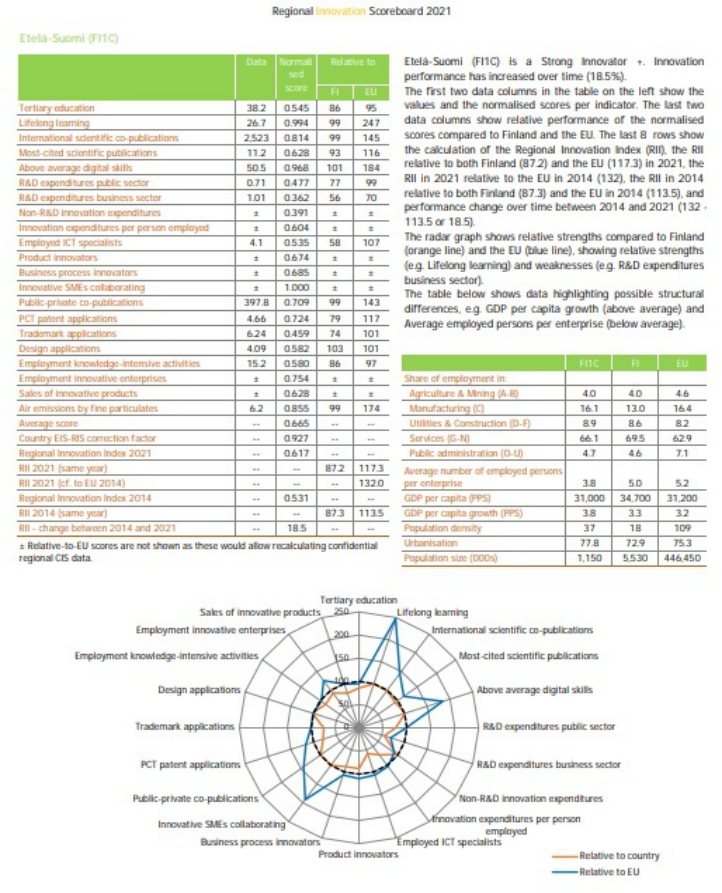
of European regions on a limited number of indicators. The RIS 2021 pro- vided a comparative assessment of the performance of innovation systems across 240 regions of 22 EU countries, Norway, Serbia, Switzerland, and the United Kingdom. The last edition of the scoreboard shows that innovation performance has increased for 225 regions out of the total of 240 regions over the period since 2014. However, the regional innovation scoreboard extends to the NUTS2 level providing from five regions – Helsinki-Uusimaa Region (FI1B), Southern Finland (FI1C), Western Finland (FI19) Northern and Eastern Finland (FI1D), and Åland (FI20). Southern Finland where Häme Region is located next to Helsinki-Uusimaa Region which is Innovation Leader, only second to Stockholm in Sweden.
The Innovation Scoreboard focuses on education, scientific and other publications, RD expenditures, innovators, SME collaboration, patents, tra- demarks, designs, sales of innovative products, and employment (Figure 1). In the year 2021 new indicators were added to cover individuals who have above basic overall digital skills, innovation expenditures per person emplo- yed, employed ICT specialists, and the first climate-related indicator about air emissions in the industry. Statics Finland collects the data. For the Häme Region some of these indicators are inaccessible. Statistics Finland does not provide data at the regional level (NUT3).
Indicators focus on deliverables by universities and research centres. Rese- arch and development institutions at Häme Region are Häme University of Applied Science HAMK, Lammi Biological Centre by Helsinki University and two locations – Haapastensyrjä and Jokioinen - of Natural Resources Insti- tute Finland (LUKE). The main technological research centre VTT has no facilities at Kanta-Häme. There are some collaborative projects with other institutions and companies. However, there are no statistics available at the regional level about research centre activities and currently it is impossible to estimate the volume of the collaboration.
Impacts and Indicators of Innovation Ecosystems The recent study (Laasonen et al. 2022) on impacts and indicators by the INNOVA project has produced information and tools to support the asses- sment of the impact of innovation ecosystems. Assessing and measuring the impacts of different kinds of ecosystems is challenging and requires a wide range of data and ecosystem-specific reviews. The framework and case stu- dies provide a basis for the impact assessment of innovation ecosystems science/research-driven, business-driven and regionally-rooted innovation ecosystems that were described and analyzed. In addition, ecosystem deve- lopment and maturity were also considered: 1. early stage, 2. experimental phase, 3. expansion/stabilization phase and 4. renewal phase.
The results of the statistical analysis show a strong link between compa- nies’ participation in innovation ecosystems and better firm-level innovation performance. When examining the impacts of innovation ecosystems, special attention should be paid to the extent to which innovation ecosystems incre- ase RDI cooperation between organizations and generate innovations that benefit society more broadly. The recommendations of the study emphasize
the long-term nature of innovation policy and its monitoring, and the impor- tance of cooperation between RDI funders, as well as impact-oriented policy formulation and implementation (Laasonen et al. 2022).
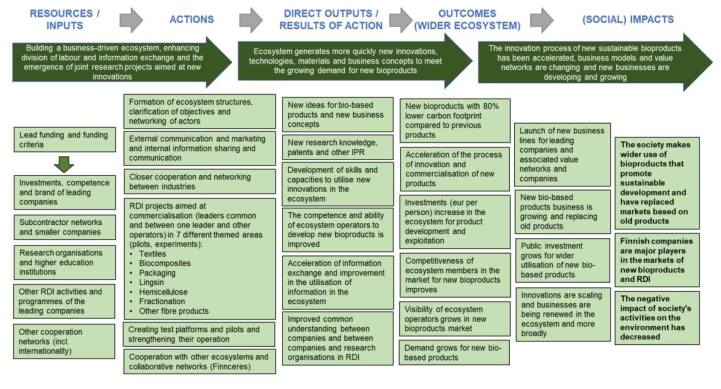
The ecosystem assessment framework consists of resources/inputs, actions, direct outputs/results of action, outcomes to the wider ecosystem, and social impacts. And it consists of qualitative and descriptive data (See Figure 2). The case studies did not provide many straightforward indicators. The diver- sity of indicators and the existence of different indicators at different stages of the life cycle must be taken into account: from the preconditions of the
Impacts and Indicators of Regional Innovation Ecosystems 45
Figure 2: Expand fibers impact logic and ecosystem model based on case study data (Laasonen et al. 2022).
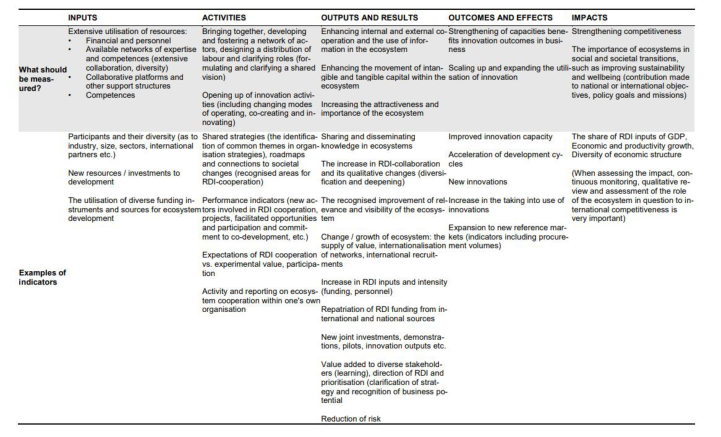
ecosystem to the competitiveness of the national economy. The potential list of indicators identified in the study is presented in Figure 3.
The main observations of the INNOVA study (Laasonen et al. 2022) were the following
Innovation policy, both nationally in Finland and at the EU level, is increasingly motivated by large-scale societal changes and their accelera- tion (so-called mission-based and transformative innovation policy) which
Figure 3: Common measurement perspectives identified for ecosystems (Laasonen et al 2022).
also changes the focus of examining and evaluating the effectiveness of innovation policy.
The assessment of innovation ecosystems must be based on the impact paths set by each ecosystem itself. From the perspective of innovation policy, the impact paths should be viewed from the perspective of the wider societal impacts they generate.
The systematic and long-term monitoring of ecosystems is required in to support instruments to develop the credibility, transparency, and development of innovation ecosystems in national innovation policies.
Instruments aimed at strengthening and developing ecosystems can be justified, especially from the perspective of transformative innovation policy. The new ‘ecosystem policy’ does not however provide a com- plete solution nor does it eliminate the need for other innovation policy instruments.
The ecosystem perspective in the broad sense then is still evolving. Fin- land has the opportunity to strengthen cooperation in the implementation of mission-based and transformative innovation policies with other EU countries from the perspective of examining effectiveness.
The main recommendations of the INNOVA study (Laasonen et al. 2022) are
Recommendation 1: Innovation ecosystems take a long time to emerge and they need to be nurtured and supported by adopting a long-term approach to innovation policy.
Recommendation 2: Achieving broad societal impacts requires inno- vation policy instruments that strengthen innovation ecosystems based on different impact paths and starting points (science, business, and regionally-rooted innovation ecosystems).
Recommendation 3: Innovation ecosystems receiving public funding should be expected to formulate their expected impacts and impact paths (including the impacts and key results and their possible causal connections).
Recommendation 4: Verification of the effectiveness of innovation ecosy- stems requires cooperation between RDI funders and the development of nationally harmonized monitoring methods.
Recommendation 5: Finnish RDI funders and ecosystem actors should intensify international cooperation to improve the impacts of innovation ecosystems.
Entrepreneurial Governance and Use of Regional Data ESPON, an EU-funded program, conducted a recent study on Entrepre- neurial Regional Governance: societal innovation beyond spatial frontiers (ESPON 2022). Based on the study they recognized that some regional public authorities demonstrate entrepreneurial behavior when pursuing social and environmental benefits for their communities. Addressing especially societal innovation opportunities related to climate, energy, health, food, security, and mobility. In an innovation-scarce environment, regional authorities
Impacts and Indicators of Regional Innovation Ecosystems 47
connected temporarily with private-sector innovators from regions with higher potential for societal know-how flow, adopt external know-how, and ‘pollinate’ their regional markets with new opportunities. These opportuni- ties are discovered by local firms, who in turn respond with actions adding societal value in regional markets.
Regional public authorities assemble and synthesize information distribu- ted across space, time, and types of legal entities to extract social, economic, and environmental value for their communities. This is a crucial difference from traditional innovation policies. Every region is capable to tap into the existing societal innovation flows and repurpose acquired know-how for the benefit of local communities, adjusting to spatial and structural conditions. This is the nature of the entrepreneurial action: creating a self-reinforcing societal value out of undervalued and/or unrecognized resources through access to spatially external know-how with societal value. (ESPON 2022) The Häme Region was one of the entrepreneurial regions identified in the ESPON study. We were invited to share our experiences related to Häme Port- folio management practices were shared at the EU Regions Week in October 2022.
EXPERIENCES FROM HÄME REGION SmartHäme 2025 – smart specialization strategy for the Häme Region was approved by Regional Council in November 2021. Strategy is implemen- ted via several development projects. Häme Goes into Ecosystem -project started in January 2023 and it aims to enhance the implementation of the regional development program Sustainable Growth in Häme 2022-2025, strengthen both research, development, and innovation (RDI) and Entrepre- neurial Discovery Process (EDP) activities across Häme Region. The aim is also to increase RDI activities and innovation ecosystem collaboration among stakeholders (corporate, entrepreneur, university, government, and 3rd sector) and funding. The aim is also to accelerate support for new innovative pro- ducts and services, strengthen capabilities, and creation of new jobs and entrepreneurial regional development practices together with regional, nati- onal, and international stakeholders. Activities consist of experimenting with new open/hybrid ways of working with innovation camps, Fast Expert Teams sessions, demos, and pilots, coaching for RDI/EDP funding, benchmarking, and reports on innovation ecosystem development.
The project is conducted in four work packages. The first work package focuses on the creation of a systemic operational model for the regional inno- vation ecosystem. The second work package provides support and facilitation of ecosystem activities. The third work package develops anticipatory stee- ring practices for RDI supported by indicators and measurement. This paper focuses on the third work package. The fourth work package includes project management and communication.
The Häme Portfolio can be used to support SmartHäme 2025 strategy work and regional ecosystem development. It provides information on com- panies, public and private RDI organizations, and associations thus suppor- ting networking and partnerships. The tool is open to all interested people,
based on open innovation principles. The Häme Portfolio can be used for evaluation and assessment, and it provides long-term data for indicators and measurement. Reporting and monitoring practices are very flexible, and they can be further developed to support decided actions. It is also possible to link development projects to strategies to follow up on implementation. Projects can be linked to each other, and the aim is to encourage innovative activities. (Takala et al. 2022) There is ongoing data collection from multiple sources to provide better visibility to available RDI data and the innovation ecosystem framework will be used to assess and analyze the related activities. The aim is also to test various digital solutions for data sharing.
DISCUSSION AND CONCLUSION We should measure what we value. Elke de Ouden (2012) shares her views of value. According to Ouden, it is important to distinguish the level at which value is perceived. Four distinct levels of value are relevant in the context of innovation: value for users, value for organizations, value for ecosystems, and value for society. Transformational innovation addresses value for all four levels at the same time. Understanding the issues in society also provides a basis for many new transformational innovations. We should also address value from economi- cal, social, psychological, and ecological perspectives. There is a growing awareness of the business opportunities in ‘doing good’. Social responsibility is no longer only about charity and philanthropy, but about creating value for people, organizations, and society at the same time (Ouden 2012). This needs to reflect in indicators and impact assessments.
Sustainability will be an even more important theme in the future (Stan- kova 2021). Recently published Dasgupta Report and Policy Brief for Finland (Pouta et al. 2023) challenges us to rethink previously used indicators and impact assessment practices. A climate indicator among the European inno- vation Scoreboard gives a good example of this shift toward sustainability.
For Finland to develop and act on anticipatory strategies for carbon neu- trality, the pilot case study on carbon neutrality highlighted the need to prioritize creating responsibility and urgency to act, collaboration and coh- erence, capacity development, and integration of green fiscal practices into the mainstream.
In the study, we will use the innovation ecosystem framework for indica- tors and impact, as a tool to design, describe, manage, and assess the regional innovation ecosystem measurement system. The application of the model allows us to apply lessons learned and recommendations from the INNOVA and ESPON studies.
ACKNOWLEDGMENT
We would like to thank the colleagues with whom we have collaborated, your contribution and encouragement have been valuable. We would like to acknowledge Häme Region and Häme University of Applied Science (HAMK).
Impacts and Indicators of Regional Innovation Ecosystems 49
REFERENCES
Asheim, B. T., Isaksen A. Trippl, M. (2019) Advanced Introduction to Regional Innovation Systems. Cheltenham: Elgar. ESPON (2022) Policy Paper: Entrepreneurial Regional Governance: societal inno-
vation beyond spatial frontiers. https://www.espon.eu/policy-paper-entrepreneur ial-regional-governance-societal-innovation-beyond-spatial-frontiers European Commission (2021) Study on prioritisation in Smart Specialisation Strategies in the EU. Luxembourg: Publications Office of the European Union. European Commission (2023) Regional innovation scoreboard (europa.eu). Gomes, L. A. V., Ana Lucia Figueiredo Facin, A. L. F., Salerno, M. S. & Ikenami,
R. K. (2018). Unpacking the innovation ecosystem construct: evolution, gaps and trends. Technological Forecasting & Social Change, 136, 30–48. Hecker, D., Voss, A., Wrobel, S. (2022) Data Ecosystems: A New Dimension of Value Creation Using AI and Machine Learning. Chapter13 in Designing Data Spaces Book, pp 222. Editors Otto, B., Hompel, M., Wrobel, S. Springer Publishing https: //doi.org/10.1007/978-3-030-93975-5 (read 27.01.2023). Kalmar, R., Rauch, B., Dörr, J., Liggesmeyer, P. (2022) Agricultural Data Spaces,
Chapter17 in Designing Data Spaces Book, Editors Otto, B., Hompel, M., Wrobel, S. Springer Publishing. https://doi.org/10.1007/978-3-030-93975-5 Laasonen, V., Nyman, J., Fornaro P., Lähteenmäki-Smith, K., Kolehmainen, J., Koski, H. and Ranta. T. (2022) Impacts and indicators of Innovation Ecosystems - A Framework for Analysis Publications of the Government’s analysis, assessment and research activities 2022:23. OECD (2022a), Anticipatory Innovation Governance Model in Finland: Towards a
New Way of Governing, OECD Public Governance Reviews, OECD Publishing, Paris. https://doi.org/10.1787/a31e7a9a-en. OECD (2022b) OECD Summary Report: Anticipatory Innovation Governance: towards a new way of governing in Finland. OECD. Ouden, E. (2012) Innovation Design - Creating Value for People, Organizations and
Society. Springer. ISBN: 978-1-4471-2267-8. Pouta, E., Hiedanpää, J., Iho, A., and Kniivilä, M. (2023) Politiikkasuositus: Luonnon monimuotoisuus ja talous - Muutospolkuja Suomessa Dasguptan raportin pohjalta. http://urn.fi/URN:ISBN:978-952-380-610-8. Luonnonvarakeskus. Salminen, V., Ruohomaa, H., Takala, M. (2022) Future Ecosystem Ensuring Compe-
titiveness in Continuous Co-Evolution. AHFE International Open Access Publish- ing, Human Factors, Business Management and Society, Volume 56/2022, Editor Vesa Salminen, pp. 1–9 DOI: 10.54941/ahfe1002245 Stancova, K. C. (2021) Addressing sustainability challenges and Sustainable Development Goals via Smart Specialisation. Towards a theoretical and conceptual framework. Luxembourg: Publications Office of the European Union. Takala, M., Tukiainen (2022) AHFE International Open Access Publishing, Human
Factors, Business Management and Society, Volume 56/2022, Editor Vesa Salmi- nen, pp. 17–24 DOI: 10.54941/ahfe1002247. Tukiainen, T., Hongisto, P. (2020) Sustainable Baltic Sea Region – Towards Economic Transformation by Smart Specialisation Strategies. Aalto University. Helsinki: Unigrafia.
LISTED IN THE AHFE DIGITAL BOOKSTORE CATALOGUE
Explore the complete digital volume
Human Factors, Business Management and Society
Read this individual research paper free through the original publisher, or explore the full digital proceedings book.
ISBN 978-1-958651-73-5
Explore this ISBN in the AHFE Bookstore ↗Listed in the July 2026 bookstore catalogue; search by ISBN to confirm current availability · Digital book purchase optional