Heikki Ruohomaa, Vesa Salminen, Heidi Ahokallio-leppala (2025). Embracing New Culture in the Pressure of New Technology. In: Human Factors, Business Management and Society. AHFE Open Access, vol. 176, pp. 257–269. https://doi.org/10.54941/ahfe1006323
New technology (XR-technology, Artificial intelligence (AI) e.g.) are supporting educational institutional operations throughout all processes. To realize the importance of organization culture and its sub-cultures will be essential when education institutes implement new technology or scale its educational products to global markets.The objective of this research activity has been to analyze education institutes on how they embrace cultural approach in the pressure of new technologies. They bring new opportunities as well as challenges when implementing them. The analysis of the development of the educational institutions has concentrated on sorting out How the organizational culture should be observed, analyzed and studied during the transition of technology?How to manage the subcultures of organization?What does it mean for the business model of university?The article outlines the importance of human factors, team cohesion, organization culture and its subcultures. In this research it has been verified that the organization culture is formed of several subcultures, and it is important to manage them in integrated way during digital transformation.
The amount of data is predicted to increase exponentially, so that within two years 90% of all the data in the world. This development is predicted to continue (Reinsel, 2018).
Extended Reality (XR) has been emerging for some time, but a definitive breakthrough has yet to occur. The technology is ready, and devices are available on the market. However, the technically superior solution does not always succeed if it fails to provide the best user experience. User experience is crucial and a prerequisite for the success of new innovations.
In the early days, incomplete and poorly functioning XR solutions hindered the technology’s adoption, creating a perception of poor user experience. The potential and expectations for XR technology are exemplified by the fact that 63% of Europe’s 5,000 higher education institutions have experimented with XR technology, and 25% of 19 million students have experienced XR implementations. XR technologies are now
sufficiently developed for broader utilization, but their adoption requires user-centered design and development.
The EU is preparing an XR ecosystem under the leadership of Siemens, aiming to establish a common market and regulation for XR implementations across Europe. In Finland, approximately 400–500 companies use XR technology, but only 10% are internationally oriented.
A common obstacle is the integration of new technologies into existing practices, leading to failed integration into business operations. During the transition phase, operational methods need to evolve to realize real benefits. This requires understanding companies’ processes, employees’ needs, and the nature of their tasks.
Educational institutions have developed their own implementations and gained experience with XR technology for building expertise. However, development has been fragmented, and there has been limited success in scaling XR productions and implementations.
Significant opportunities exist to enhance the competitiveness of educational institutions by leveraging XR technology in product development, supply chains, and new business models. The research project aims to enhance the use of XR and related technologies in education and business and improve the scalability of XR implementations in global markets.
New business models at education will be based on XR-technology and data. The availability and usability and up-to-date data play a central role, where new digital technical solutions are relevant, but also deficiencies in the “rules of the game” related to the use of data can become an obstacle. This is why the discussion of Data Space and Fair Data Economy has come to the discussion in Europe.
Key issues to launch XR-technology supported services/product, that could be scaled to global market should include following elements with cultural aspects:
1. Sharing Platforms: XR technology and platforms. 2. User Experience: Customer orientation and pedagogy. 3. Business Models: Sustainable business models and exports Since the question is about management of change from the linear growth toward exponental growth of XR-technology based services/ products.
THEORETICAL FRAMEWORK Increase the Amount of Data
The 90% of the data, in the world has been created in the last two years alone, daily basis 2.5 quintillion bytes of data is collected. It can be seen that “the average rate per capita of data-driven interactions per day is expected to increase 20-fold in the next 10 years as our homes, workplaces, appliances, vehicles, wearables and also implants become data enabled”(Reinsel, 2018). ‘The digital economy indirectly promotes industrial upgrading through technological innovation and human capital’ (Ding et al., 2021).
Embracing New Culture in the Pressure of New Technology 259
The growth rate of data can vary in different fields and applications, but in general it is estimated that the amount of data will grow exponentially (Reinsel et al., 2018).
This increase in data volumes has enabled the development of more in- depth analyzes and forecasting models, which in turn can improve the vitality of education institutes, the availability of services and the quality of life of customer/students.
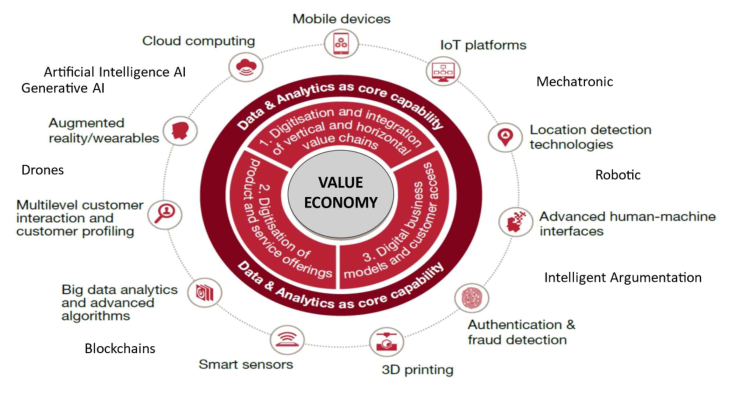
Data Based Technologies Towards Value Economy New data-based technologies (e.g. XR-technology) are on market with reasonable prices, which increase that availability of data and the possibilities to analyze and make decisions based on data. This will make a huge change and give possibilities towards sustainable products/services, sustainable supply chains, and sustainable business models.
Figure 1: Framework for contributing digital technologies (modified from PwC, 2016).
The value economy represents a shift in how we define success and value. To thrive in this new landscape, businesses must rethink their models, success metrics and organizational values. As multidimensional value becomes the ultimate currency, understanding and mastering this new paradigm is critical for sustainable growth and societal impact (Abeysinghe, 2023).
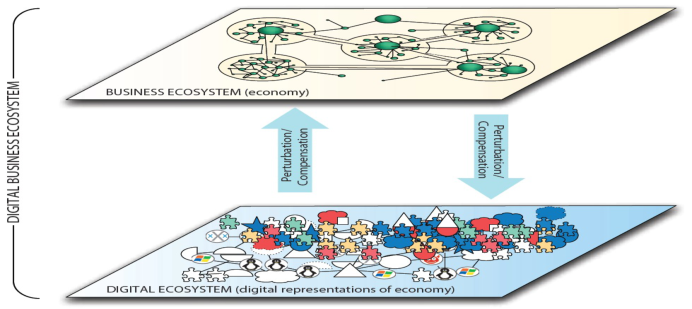
Digital- and Business Ecosystems One approach on the development of the ecosystems is co-evolution; where ecosystem member organizations or parts of the ecosystem evolve in alignment. An example of co-evolution is a Digital Ecosystem and a Business Ecosystem evolution, which Moore (2003) introduces as the Digital Business Ecosystem (DBE). An ecosystem is both a structure and a process of interaction through which complementary actors create value together.
An ecosystem strategy is a strategic alignment of the return on value between the parties to a networked business. (Salminen et al., 2022) ‘Ecosystem- based innovation process is divided into three stages: Strategic Ecosystem, Innovation Ecosystem and Implementation Ecosystem’ (Ruohomaa, 2020) Ecosystems can co-evolve in a structural level in addition to species, roles and functions.
Figure 2 illustrates a Digital Business Ecosystem structure where the business ecosystem and digital ecosystem are coupled to form a viable dynamic innovation ecosystem. The digital ecosystem influences enterprises, their social and business networks, and the business ecosystem affects the organisms of the digital ecosystem.
Figure 2: Digital business ecosystem (DBE Book, 2007).
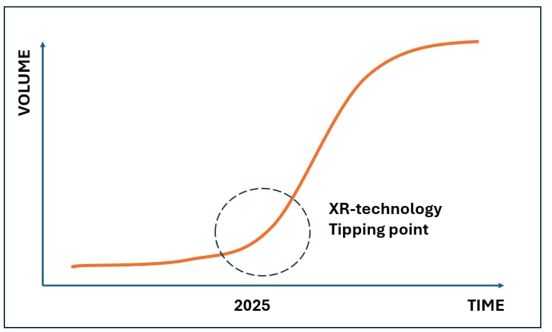
Data Based Technologies S-Curves Digitization is an increasingly relevant option while education institutions are trying to renew them- selves and their operations to remain competitive (Figure 3). However, implementing digitization is not only a short-term- project; it is a long-term transformation that should be lead.
The leadership and organisational culture perspective is very important in this change management initiative. Such technologies like Artificial intelligence and XR-technologies can be adapted.
However, the main question remains, what changes are about to happen in our educational institutions and how applying digitization makes it possible to remain competitive and even further increase competitiveness.
As the increase of data and many new technologies begin from linear to exponential growth, the reform of education and the development of business models for educational organizations will also shift from linear to exponential growth. In this new situation, ecosystem development is thought to be the most effective way to manage this continuous co-evolution. In new type of learning environments, the virtual world and the real world are mixed, (Ahokallio-Leppälä et al., 2022).
Embracing New Culture in the Pressure of New Technology 261
Figure 3: Rapid adaptation of new internet-related technologies.
The Change of Organizational Cultures in Digital Transition ‘By providing insight into various cultures, it raises awareness of how culture guides the way managers look at problems, the solutions they find, the way they deal with others, and how others may react’ (Schneider et al., 2003).
‘Digital Technology and its impact on organizational structures, job roles, people’s competences, and customer needs is ever changing. With a digital mindset. employees across the organization are equipped to seize the opportunities of dynamic world’ (Neeley, & Leonardi, 2024). The industry 4.0 educational concept should step towards learning factory with specifies that needs to be learnt, process with which it needs to be learnt, and by competent facilitator to the process of learning with necessary content after capacity building ‘In near future organizations will have conversational interfaces for all type of processes, products, and services’ (Baier et al., 2024).
‘Learning leaders seeking to harmonize the work, workforce, and workplace tend to focus on organizational and individual performance rather than on a drive to demonstrate the impact and efficiency of specific human resource interventions (Hiipakka, 2023). This harmonized learning philosophy can result in a contextualized, personalized, and relevant learning experience.’
‘Experimentation with virtual and online instruction has opened up routes toward personalizing learning’ (Gratton, 2023). ‘Fong (2022) developed the motivation within changing culturalized contexts model to account for instructional, social, future-oriented, and sociocultural dynamics affecting student’s motivation.’ ‘Several major theories have been established in research on motivation in education to describe, explain, and predict the direction, initiation, intensity, and persistence of learning behaviors’ (Urhahne et al., 2023). ‘Urhane has introduced an integrative framework with expectancy-value theory, social cognitive theory, self-determination theory, interest theory, achievement goal theory, and attribution theory, based on an action model.’
OBJECTIVES AND RESEARCH QUESTIONS The analysis of the development of the educational institutions has been raised the following research questions:
How should the organizational culture be observed, analyzed and studied during the transition of technology?
How to manage the subcultures of organization?
What does it mean for the business model of university?
This research has an action-based approach and uses a method based on grounded theory (Glaser and Strauss, 1999). It is partly constructive, conceptual, and analytical because it introduces a framework of integrating organization cultures when taking XR-technology in use at the educational institutions. Data for this concept creation has been continuously collected from different AI-oriented research and development projects. This action- type research approach may be seen as a type of applied science. Data has also been gathered from interviews and workshops executed during projects on a foresight and scenario planning basis.
HOW THE TRANSITION OF TECHNOLOGY CHANGES THE ORGANIZATION CULTURE The transition of technology can significantly impact organizational culture in various ways during transformation. New technologies for instance facilitate faster and more efficient communication, enabling teams to collaborate across geographical boundaries. This often leads to a more inclusive and diverse organizational culture. The adoption of digital communication tools (e.g., chat platforms, video conferencing) can shift the culture from formal to more informal communication, promoting openness and transparency.
Technology enables remote work, changing the traditional nine-to-five work culture. This flexibility can enhance work-life balance but may also challenge team cohesion and the sense of belonging. The integration of technologies like project management tools encourages agile practices, fostering a culture of adaptability, continuous improvement, and rapid response to change.
Organizations that leverage technology often cultivate a culture of innovation, encouraging employees to experiment, take risks, and embrace a growth mindset. Rapid pace of technological change can also lead to resistance among employees who may feel overwhelmed or threatened, necessitating strong change management strategies to foster a positive culture.
Technology often necessitates ongoing training and development, leading to a culture that values just-in time and lifelong learning and skill enhancement. Online learning platforms and resources can democratize access to training, promoting a culture of inclusivity and knowledge sharing.
The use of data analytics and business intelligence tools encourages a culture of accountability and evidence-based decision-making, where decisions are supported by data rather than intuition alone. Technology
Embracing New Culture in the Pressure of New Technology 263
can enhance employee experience through tailored engagement strategies and personalized learning paths, fostering a culture that values individual contributions.
Digital tools can facilitate real-time feedback, helping to create a culture of open communication and continuous improvement. As organizations adopt new technologies, especially AI and data analytics, there is a growing emphasis on ethical considerations and corporate responsibility, shaping the organizational culture around these values.
Technology transitions often require leaders to adopt a more transformational approach, focusing on inspiring and guiding employees through change while fostering a supportive environment. Remote work and digital recruitment tools can lead to a more diverse workforce, which can enrich the organizational culture and promote inclusivity.
The transition of technology in an organization can lead to profound changes in culture, influencing how employees interact, collaborate, innovate, and grow. Organizations that proactively manage these changes and align their culture with technological advancements are more likely to thrive in a rapidly evolving landscape.
ORGANIZATION SUB-CULTURES AND COMMON VALUES Organizational subcultures refer to the distinct cultures that emerge within specific groups or departments of a larger organization. These subcultures can develop based on various factors: team dynamics, leadership styles, the nature of the work, and the shared experiences of the group members. In the following are analyzed some key aspects and types of organizational subcultures:
Functional Subcultures arise within specific departments, such as marketing, finance, or engineering. Each department may develop its own set of norms, values, and practices based on its unique goals and challenges. Professional Subcultures are shaped by the specific professional identity of employees, such as engineers, accountants, or healthcare professionals. Their education, training, and professional standards influence their behaviors and attitudes. Geographical Subcultures can emerge cultural differences in multinational organizations, on geographic locations, reflecting local customs, values, and practices. Hierarchical Subcultures can develop between different levels of hierarchy based on their roles, responsibilities, and perspectives within the organization. Teams that focus on innovation may foster a culture of creativity, risk-taking, and experimentation, and create innovation subcultures. They can differ significantly from more traditional or risk-averse areas of the organization.
To characterize each subculture every of them has its own set of beliefs and behaviors that members adhere to, which may differ from the larger organizational culture. Subcultures may develop unique ways of communicating, including jargon, rituals, and informal networks. Different subcultures may respond to and be influenced by various leadership approaches, leading to variations in motivation and engagement. Members
of a subculture also often identify strongly with their group, fostering a sense of belonging and loyalty.
When we analyze the impact of different subcultures on organizational dynamics, we can recognize that subcultures can drift to conflict if there are significant differences in values or priorities, but they can also provide diversity of thought and innovation. When implementing organizational change, understanding of existing subcultures is crucial, as they can either facilitate or hinder the process. Subcultures that align with employees’ values and needs can enhance engagement and satisfaction, while misaligned subcultures can lead to disengagement.
Management of subcultures and cultural awareness require recognition and understanding the different subcultures within the organization to foster a more cohesive environment. Encouraging collaboration and communication among different subcultures can help to bridge gaps and reduce conflict. Ensuring that subcultures align with the overall mission and values of the organization is essential for achieving strategic objectives.
Understanding organizational subcultures is vital for effective leadership and management. By recognizing the unique characteristics and dynamics of subcultures, organizations can leverage their strengths, address potential conflicts, and create a more harmonious and productive work environment.
EMPOWERING ORGANIZATION CULTURE FOR COMPETITION Empowering organizational culture is crucial for fostering innovation, enhancing employee engagement, and driving competitive advantage. It is important to cultivate a common culture to define core values and vision for organization and education unit. Core values have to be developed and communicated so that they reflect the organization’s mission and vision. It is essential to ensure that team and individual goals align with these values to create a unified direction.
It is essential to show regularly solicit feedback on the organizational culture and make adjustments as necessary. The performance and impact of cultural initiatives on employees and business outcomes should be measured continuously. An empowering organizational culture is not a one-time initiative but an ongoing commitment. By implementing these strategies, organizations can create an environment where employees feel valued and motivated, leading to enhanced performance and a strong competitive edge in the market. Organizations that prioritize culture are more likely to adapt to changes, innovate, and ultimately succeed in their industries.
HOW TO TAKE BENEFIT FROM ORGANIZATION CULTURES AND CHARACTERISTICS OF SUB-CULTURES Key issues for education institutes to take into account to launch XR- technology supported services/product, that could be scaled to global market should include following elements with cultural aspects:
Embracing New Culture in the Pressure of New Technology 265
1. Sharing Platforms: XR technology and platforms 2. User Experience: Customer orientation and pedagogy 3. Business Models: Sustainable business models and exports.
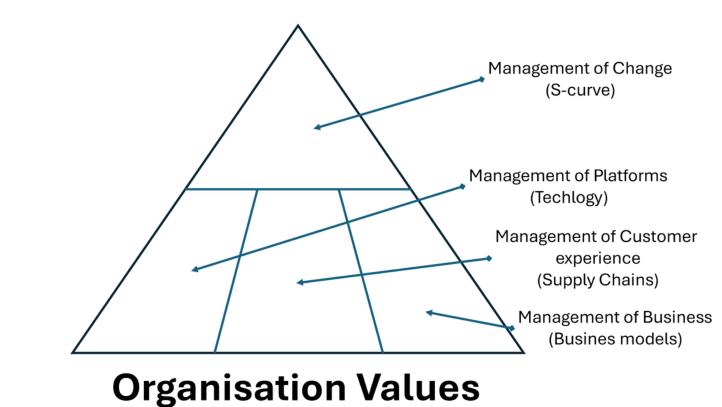
Since the question is about management of change from the linear growth toward exponential growth of XR-technology needs, as well the understanding dynamics of growing /changing business and organization culture based on that.
Figure 4: Pyramid of suborganizations in fast growing organization which take use new technology.
Fast-growing organizations often exhibit distinct characteristics in their organizational cultures and as well all subcultures, that help them adapt to rapid changes, foster innovation, and maintain employee engagement. It is important to recognize fundament characteristics, which help fast-growing organizations navigate the complexities of expansion while maintaining a cohesive and positive workplace culture.
A culture of innovation is often promoted, where creativity and new ideas are encouraged. Employees are motivated to think outside the box and experiment with new solutions. A results-driven culture is common, where high performance is recognized and rewarded. Employees are often set ambitious goals, and there’s a focus on accountability and achieving measurable outcomes.
Fast-growing organizations tend to have agile structures that allow for quick decision-making and adaptation to market changes. They encourage employees to be flexible and embrace change. Employees are often given more autonomy and responsibility, fostering a sense of ownership over their work. This empowerment can lead to higher engagement and motivation. It is also important to promote diversity and inclusion,
recognizing that a diverse workforce can drive innovation and better decision-making.
It is important to understand characteristics, which create a culture that not only values technology and data but also leverages them to enhance organizational performance, employee engagement, and customer satisfaction. Organizations that focus on implementing technological opportunities and data often exhibit specific characteristics in their cultures. Organizations integrate technology into their core processes, ensuring that technology not only supports but also drives business operations implementing automation, workflow management, and digital tools. ICT- centric organizations embrace remote and flexible work arrangements, utilizing technology to maintain productivity and engagement among distributed teams.
There is often a culture of transparency where data and insights are shared openly among teams. This openness fosters trust and encourages collective problem-solving. A culture that emphasizes the use of data analytics for decision-making is prevalent. Employees are trained to leverage data insights to inform strategies, measure performance, and optimize processes.
Organizations that prioritize customer experience tend to have specific cultural characteristics that enable them to effectively understand and meet customer needs. Organizations celebrate and reward behaviors that enhance customer experience. This can include recognition programs, incentives, and performance metrics tied to customer satisfaction. Organizations prioritize building long-term relationships with customers rather than focusing solely on short-term sales. Employees are empowered to make decisions that positively impact customer experience. This includes the authority to resolve issues, provide personalized service, and innovate based on customer feedback. The culture fosters emotional connections with customers by encouraging employees to engage authentically and empathetically. Organizations leverage data analytics to understand customer behavior, preferences, and pain points. Data informs strategies and helps tailor experiences to individual customer needs.
Organizations that focus on earning logic, profitable business models, and financial success often exhibit specific characteristics in their cultures. A culture of strategic thinking is emphasized, where long-term financial goals are established and communicated throughout the organization. Employees are involved in the planning process to foster alignment and commitment. Employees are encouraged to take responsibility for their contributions to the organization’s financial success. This includes ownership of projects, decision-making, and accountability for results. There is an emphasis on understanding and managing risks associated with business decisions. Organizations develop cultures that encourage calculated risk-taking while also implementing safeguards to protect profitability. While focusing on profitability, organizations also cultivate a culture of ethical behavior and corporate social responsibility, recognizing that sustainable profitability is linked to ethical practices and stakeholder trust.
Embracing New Culture in the Pressure of New Technology 267
By fostering these characteristics, organizations can create a culture that not only enhances customer experience but also drives loyalty, satisfaction, and ultimately, business success.
SUPPORING DEVELOPMENT OF INTEGRATING SUBCULTURES All subcultures emphasize readiness for change, innovation, and collaborative learning, while the most significant differences between subcultures relate to the professional competence of the employee group and the related special skills, customer, and stakeholder relationships.
It is essential to identify what are the common factors in all subcultures and strengthen them. It is also important to take into account, utilize and support the specific characteristics of subcultures and thus achieve the best results in relation to the whole. Customer focus, innovation-orientation and renewability are supported by communication between different subcultures. Information exchange and communication between subcultures support customer focus and enable new cultures to emerge at the interfaces of different subcultures.
The education sector is constantly evolving, with new technologies emerging and globalization bringing diverse cultures together. Embracing new cultures in this environment can be both exciting and challenging but education institutes need strategic aligning to manage to navigate through changing environment. It is important to learn about different cultures, their values, beliefs, and communication styles. It is essential to be aware of everybody’s own cultural biases and assumptions. This will help to approach interactions with an open mind and avoid misunderstandings and encourage respectful and inclusive communication in educational settings. This includes being mindful of language, nonverbal cues, and social norms and facilitate projects or discussions that involve students and staff from different cultural backgrounds, promoting teamwork and mutual understanding.
It is important to incorporate learning opportunities and related learning environments, the purpose of which are to enhance significantly engagement, motivation, and knowledge retention and also experience of achieving fun in learning. By leveraging gamification, creativity, interactivity, and supportive environments, educators and trainers can create more enjoyable and effective learning experiences. It have to bear in mind the variety of subcultures, which can experience learning in totally different way and require also different type of pedagogical solutions.
The key is to ensure that the fun elements integrated serve clear educational purposes, maintaining focus on learning objectives while fostering a positive and stimulating atmosphere. Aiming for an enjoyable experience will ultimately lead to greater satisfaction and effectiveness in the learning journey — encouraging learners to embrace knowledge and skills with enthusiasm and creativity.
CONCLUSION
The article described the concept of education institutions in the transition towards new business models that support the XR-based education and learning. Concept of this article is based on literature and several projects’ data and observations.
The article analyzes the rapid breakthrough of new technology (AI, XR technology) in education and the related organizational culture and subcultural features, the consideration of which enables rapid and efficient implementation.
The starting point was that the implementation of new technology enables the rapid scaling of new (XR, AI etc) educational products to rapidly expanding markets.
Key proposition to launch technology- oriented products and AI - supported services that could be scaled to global market, should include following elements with cultural aspects:
1. Sharing Platforms: XR technology and platforms 2. User Experience: Customer orientation and pedagogy 3. Business Models: Sustainable business models and exports Based on the results of the analysis, it can be seen that the organizations different expert groups in the organization have different operating models and cultural differences, which can have significant supporting significance for the organization.
Therefore, it is important for educational institutions to recognize the common features of their cultures, as well as the specific features of subcultures. Therefore, it is essential to
1. Identify and support the common features of all subcultures 2. Preserve/enable/ the specific features of subcultures that support the goals and well-being of the organization.
3. Enable cooperation between different cultures and thus enable innovations and learning that arise at the interfaces of cultures.
However, educational organizations differ in their tasks and goals, so there is no single organization. Instead, it is essential to recognize the presence of different subcultures and recognize it in the rapid change brought about by new ICT-based technologies in educational organizations.
REFERENCES
Ahokallio-Leppälä, H., Ruohomaa, H., Salminen, V. (2022) Change of Education and Training Business in the Age of 5G. AHFE International Open Access Publishing, Human Factors, Business Management and Society, Volume 56, Editor Vesa Salminen, Issue 56, ISBN: 978-1-958651-32, https://doi.org/10.54941/ ahfe1002262. Asanka, Abeysinghe F. (2023) The Value Economy: Why It’s the Next Evolutionary
Step in Digital Transformation Forbes, 2023 https://www.forbes.com/councils/ forbestechcouncil/2023/10/18/the-value-economy-why-its-the-next-evolutionary- step-in-digital-transformation/.
Embracing New Culture in the Pressure of New Technology 269
Baier, P., DeLallo, D., Sviokla, J. (2024), Your organization isn’t designed to work with Gen AI. Harward Business Review, Spatial Issue, How to Thrive in a Gen AI, Fall 2024, November 5th, 2024. Ding, C.; Liu, C.; Zheng, C., Li, F. (2021), Digital Economy, Technological
Innovation and High-Quality Economic Development: Based on Spatial Effect and Mediation Effect. Sustainability 2021, 14, 216. Fong, C. J. (2022), Academic motivation in a pandemic context: A conceptual review of prominent theories and an integrative model. Educational Psychology. Advance online publication. https://doi.org/10.1080/01443 410.2022.2026891 Hiipakka J. (2024), From-L&D-to-Harmonized-Workforce-Development-Learn how organizations can organize and connect to deliver harmonized workforce development. Publisher InfoPro Learning. Glaser, B., Strauss, A. (1999), Discovery of Grounded Theory: Strategies for
Qualitative Research. Aldine Transactions. Gratton, L. (2023) How do We Learn. June 26, 2023 MIT Press. Moore J. F. (1993), “Predators and Prey: A New Ecology of Competition,” Harvard Business Review, vol. 71, 1993, pp. 75–83. Neeley, T., Leonardi. P. (2024), Developing a Digital Mindset-How to lead your
Organization into the Age of Data, Algorithms and AI. Harward Business Review, Spatial Issue, How to Thrive in a Gen AI, Fall 2024, November 5th, 2024. PwC. (2016), 4.0 Industry: Building the digital enterprise. Global Industry Survey. Reinsel, D., Gantz, J., and Rydning, J. (2018), The Digitization of the World from Edge to Core, An IDC White Paper – #US44413318, November Seagate 2018. https://www.seagate.com/files/www-content/our-story/trends/files/ idc-seagate-dataage-whitepaper.pdf Ruohomaa, H. (2020), Ecosystem-based Development in the Transition of Fourth
Industrial Revolution. http://urn.fi/URN: ISBN:978-952-476-931-0 Schneider, S. C., Barsoux, J-L. (2003), Managing Across Cultures. Pearson Education Limited. ISBN 0-237-64663-X. Salminen, V., Ruohomaa, H., Takala, M. (2022), Future Ecosystem Ensuring
Competitiveness in Continuous Co-Evolution. AHFE International Open Access Publishing, Human Factors, Business Management and Society, Volume 56, Editor Vesa Salminen, Issue 56, Date 2022, ISBN: 978-1-958651-32, https://doi.org/ 10.54941/ahfe100224521. Urhahne, D., Wijnia, L. (2023), Theories of Motivation in Education: An Integrative Framework. Educational Psychology Review (2023) 35:45, https:// doi.org/10.1007/s10648-023-09767-9.
LISTED IN THE AHFE DIGITAL BOOKSTORE CATALOGUE
Explore the complete digital volume
Human Factors, Business Management and Society
Read this individual research paper free through the original publisher, or explore the full digital proceedings book.
ISBN 978-1-964867-52-6
Explore this ISBN in the AHFE Bookstore ↗Listed in the July 2026 bookstore catalogue; search by ISBN to confirm current availability · Digital book purchase optional