Uwe Reischl, Alex Honn, Budimir Mijovic (2025). Wildland Firefighter Helmet Air-Supply System for Reducing Smoke Exposure and Heat Stress. In: Safety Management and Human Factors. AHFE Open Access, vol. 189, pp. 168–174. https://doi.org/10.54941/ahfe1006582
The scope and severity of wildfires worldwide have increased during the past several decades. Thousands of firefighters are employed each year to control these fires. The occupational health and safety risks associated with wildland firefighting are significant and numerous. The most common are physical injury, smoke inhalation and heat stress. A prototype helmet air supply system was developed to reduce such risks. The system uses air ducts inside the helmet that channel filtered air to the breathing zone and filtered air over the head of the firefighter. The system was designed to provide a comfortable, discreet, and simple solution for reducing occupational exposure to smoke and heat stress while providing an alternative to the respiratory and heat stress protection options currently available. Methods and Procedures:Airflow for the helmet air supply tubing was evaluated using a digital precision thermoanemometer probe. Air velocity measurements were based on three-minute sampling periods where the digital thermoanemometer recorded air velocities every second for a total of 180 individual measurements. To determine the airflow reaching the breathing zone, the tubing for head cooling was blocked. To determine the airflow for head cooling only, the tubing to the breathing zone was blocked. To determine the combined airflow to both the breathing zone and head cooling, all tubes remained open. To assess the sweat evaporation potential from the head, a thermal manikin head equipped with multiple skull thermocouple probes and including a sweat evaporation liner were used.Results:The data showed that the system provided a combined positive pressure airflow into the helmet of 400 l/min for both the firefighter’s breathing zone and the head. This air volume for the breathing zone is high enough so that a face shield is not needed to provide protection against an incursion of fire smoke into the breathing zone. The thermocouple data showed that the airflow over the head increased the scalp sweat evaporation by 35% in comparison to not wearing a helmet. The system is compatible with all current firefighter protective equipment safety and performance requirements. Additionally, the unit is intended to operate on batteries that are used in standard firefighting communication equipment. Conclusions:The development and testing of the prototype system have shown the potential for improving the health and safety of wildland firefighters in the future. Although the tests were conducted inside a controlled laboratory environment, the fundamental principle of providing fresh air to a firefighters' breathing zone thereby displacing smoke, while also reducing heat stress, appears feasible. The demand for wildland firefighter personnel is increasing throughout the world. Therefore, providing better respiratory protection and improved heat stress management is a common-sense solution. Applications of this technology to other occupations in the future such as construction work and industrial work will be possible.
Climate change has led to an increase in the frequency and severity of droughts worldwide, contributing to a global rise in wildland fires (Li, 2023; Aldersley, 2011; Aldersley, 2116). Since the 1980s, both the size and intensity of these fires have been steadily increasing. In the United States alone, more than 66,000 forest and wildland fires were recorded in 2022 (Burke, 2021; Earth Science Data Systems, 2024), requiring the deployment of thousands of firefighters to protect nearby communities. Wildland firefighting presents significant occupational health and safety challenges (Kondros, 2021; De Vos, 2009). Among the most critical risks are physical injuries, smoke inhalation, and heat stress (Budd 1, 1997; Budd 2, 1997; Budd 3, 1997). This project aimed to design and develop a prototype technology that reduces firefighters’ exposure to smoke while also mitigating the effects of heat stress. A functional prototype system has now been developed to meet these objectives.
WORK ENVIRONMENT The work environment of wildland firefighting differs significantly from that of structural firefighting. While structural firefighting involves intense
physical effort, it typically occurs over shorter durations and involves exposure to known hazardous substances, necessitating the use of specialized respiratory protection such as self-contained breathing apparatuses (SCBAs) and full “turnout gear” (Aisbett, 2012). In contrast, wildland firefighting demands prolonged, high-intensity workloads in unpredictable and often remote environments. Firefighters in these settings are routinely exposed to smoke, dust, and diesel exhaust, yet they are not equipped with respiratory protection. To maintain mobility and endurance during extended operations, wildland firefighters wear much lighter clothing than their structural counterparts. For head and eye protection, they rely on standard hard hats and goggles. To mitigate smoke and particulate exposure, simple cloth face masks are commonly used, though these offer minimal respiratory protection.
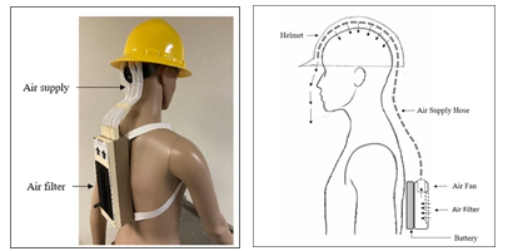
SYSTEM DESIGN To provide an alternative to the limited respiratory protection available to wildland firefighters, an air supply filtration system that also promotes sweat evaporation from the head was developed which can be integrated into existing helmets. The system includes a battery-powered variable-speed air filter that provides airflow directly to a firefighter’s helmet. Tubing leading from the air filter to the helmet provides airflow to the firefighter’s breathing zone while also providing airflow to the space between the helmet suspension straps and the helmet outer shell. This configuration promotes sweat evaporation directly from the head. The two air supply options can be operated independently of each other. The overall system design is shown in Figure 1. To evaluate the actual system performance, air flow was incrementally introduced in five steps ranging from 222 L/min to 680 L/min.
Figure 1: Illustration of the prototype wildland firefighter helmet air supply system designed to reduce smoke exposure and promote sweat evaporation from the head.
Air Flow Airflow through the helmet tubing was measured using a digital precision thermoanemometer probe positioned within the manifold chamber, upstream between the air fan and the tubing connector (manifold). Average airspeed values were calculated based on three-minute sampling periods, during which
the thermoanemometer recorded air velocity once per second, yielding 180 individual measurements per trial. Each test was conducted four times, and the results were averaged. To assess airflow reaching the breathing zone, the tubing designated for head sweat evaporative cooling was sealed. Conversely, to measure airflow for head cooling only, the tubing to the breathing zone was blocked. For total airflow measurements—including both the breathing zone and head cooling—all tubing remained open. Air volume (L/min) was calculated by multiplying the average airspeed (cm/min), as recorded by the thermoanemometer, by the cross-sectional area of the tubing (cm2).
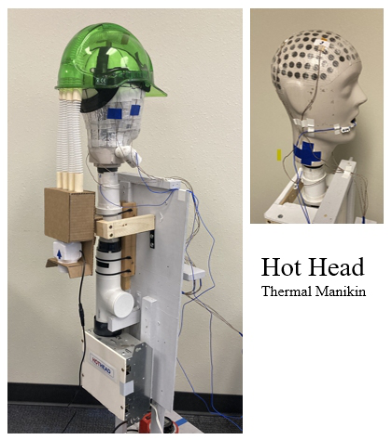
Evaporative Cooling Evaporative cooling from the head was evaluated using the thermal manikin shown in Fig. 2. This system measures heat loss from the head (in watts) and changes in head surface temperature (
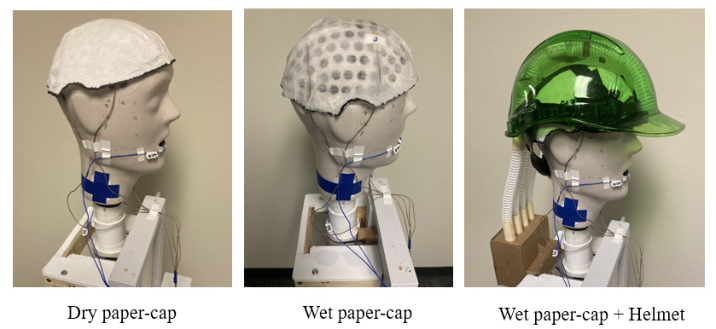
C). Three test configurations were used: 1. Control – dry manikin head, 2. Wet – manikin head moistened with water, 3. Sweating + Helmet – a simulated sweating manikin head wearing a helmet. Sweating was simulated by placing a high- absorbency paper towel, saturated with water, over the manikin’s head to mimic sweat evaporation. The three configurations are illustrated in Fig. 3. Each test was repeated four times, and the results were averaged. Manikin head temperatures were monitored using four thermocouple probes symmetrically taped to the top of the head. All tests were conducted with an air supply rate of 550 L/min and all helmet air ducts open.
Figure 2: Illustration of the thermal manikin used in determing the evaporative heat loss from the head while wearing a construction helmet.
Wildland Firefighter Helmet Air-Supply System 171
Figure 3: Illustration of the thermal manikin head configurations evaluated using a dry paper cap as a control, a wet paper-cap without a helmet, and a wet paper-cap worn underneath the helmet.
RESULTS
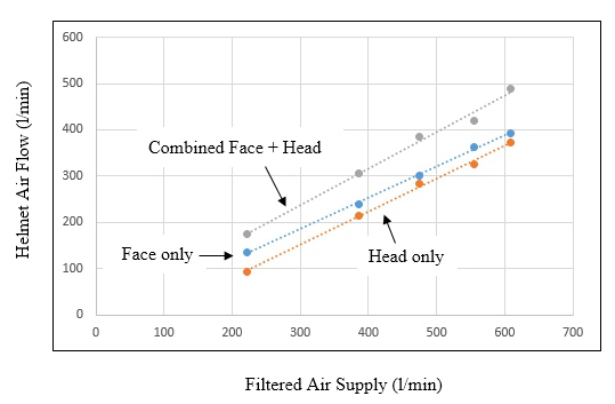
Table 1 summarizes the airflow rates into the breathing zone, the helmet and the combined breathing zone and helmet. Input airflow was increased stepwise from 222 L/min to 608 L/min. The corresponding increases in air flow for the three regions, relative to the input air flow, are illustrated in Fig. 4. Table 2 summarizes the relative heat loss (watts) and skin temperature changes observed for the manikin head and the dry-cap, manikin head with the wet-cap and the manikin head with the wet-cap and construction helmet. The dry-paper cap configuration served as the “control” against which the wet-cap and the three configurations were compared. Airflow was introduced into the helmet and the breathing zones simultaneously at a constant flow rate.
Table 1: Summary of airflow values observed for the three ventilation configurations at five different air-input velocities.
Table 2: Summary of evaporative cooling associated with the dry-paper cap, wet paper-cap and wet paper-cap and helmet.
Table available in the original PDF paper.
Thermal Manikin Head
Relative Change in Heat
Relative Change in
Configuration
Loss (Watts)
Temperature (
C) Dry Cap (Control) 0 0 Wet Cap + 3.2% −16.6% Wet Cap + Helmet + 17.2% −42.0%
Figure 4: Illustration of the linear relationship between system air input and airflow in the breathing zone (face), the internal helmet space (head) and the combined face and head combination.
DISCUSSION
The findings of this study demonstrate that the prototype system delivers filtered air to the firefighter’s breathing zone at a rate exceeding the maximum anticipated respiratory demand of 200 L/min during heavy exertion (Budd 3, 1997). With a flow rate of 400 L/min, the system provides a surplus of filtered air capable of effectively displacing smoke and airborne pollutants from the breathing zone. Additionally, the airflow directed into the helmet enhances evaporative cooling from the head, offering further physiological relief. This dual-function capability—combining respiratory protection with thermoregulatory support—is not currently available in any commercial product.
CONCLUSION
The development and testing of the prototype firefighter respiratory protection system demonstrated the potential for improving the health and safety of wildland firefighters significantly. Although the tests were conducted inside a laboratory, the fundamental principle of providing filtered air to a firefighter’s breathing zone that then displaces smoke and particulate matter, while also providing cooling of the head by sweat evaporation appears technologically feasible. Ultimate commercial development of this technology may lead to further performance improvements making this technology attractive not only for wildland firefighters but also for workers in other fields that require use of protective head ware. While laboratory testing provides a controlled environment to evaluate fundamental performance and feasibility, real-world testing scenarios will be essential to fully validate the effectiveness, durability, and usability of the firefighter respiratory protection system.
Wildland Firefighter Helmet Air-Supply System 173
Field testing in active wildland firefighting operations introduces variables that cannot be fully replicated in the lab, such as extreme temperatures, variable humidity, physical exertion, prolonged use, terrain challenges, and dynamic smoke concentrations. These factors can significantly influence the system’s ultimate performance and firefighter comfort. Deploying a fully functional prototype system into the field will allow the assessment of how well the system can be integrated into existing firefighting gear, its ease of use during high-stress operations, and its impact on communication, mobility, and situational awareness. It also enables the collection of feedback from end-users—the firefighters themselves—which can lead to iterative design improvements that enhance both functionality and user acceptance. For instance, issues related to fit, noise, weight distribution, or cooling efficiency may only become evident after extended deployment in the field. Furthermore, environmental exposure to dust, ash, rain, and mechanical impacts during real firefighting scenarios can reveal important insights about the system’s durability and maintenance requirements. Field testing will also provide critical data on how the technology performs over time, helping to establish maintenance intervals, cleaning protocols, and component longevity—all of which are essential for eventual commercialization. Finally, by testing the system in varied geographical locations and under different wildfire conditions, manufacturers can ensure that the technology is adaptable across a wide range of operational contexts. This comprehensive validation approach will be able to strengthen the case for broader adoption not only by wildland firefighters but also by other professionals in hazardous or high-heat environments, such as industrial workers, construction crews, or emergency responders.
ACKNOWLEDGMENT
The authors wish to acknowledge the contribution by Ms. Maren Mabbutt for her assistance in collecting the thermal manikin performance data.
REFERENCES
Aisbett, B., Wolkow, A., Sprajcer, M., Ferguson, S. A. (2012). “Awake, smoky, and hot”: Providing an evidence-base for managing the risks associated with occupational stressors encountered by wildland firefighters. Applied Ergonomics, 43, 5, 916–925. Aldersey, S. Williams, A. (2016). Impact of anthropogenic climate change on wild
fires across wester US forest. Proc Natl Acad Sci USA, 113, 11770–11775. Aldersey, S., Murray, J., Corneel, S. (2011). Global and regional analysis of climate and human drivers of wildfire, Science of the Total Environment, 409, 18: 3472–3481. Budd, G. M., Brotherhood, J. R., Hendrie, A. L., Jeffery, S. E., Beasley, et al. (1997).
Project Aquarius 5. Activity distribution, energy expenditure, and productivity of men suppressing free-running wildland fires with hand tools. International Journal of Wildland Fire, 7, 2, 105–118. Budd, G. M., Brotherhood, J. R. Hendrie, A. L., Jeffery, et al. (1997). Project Aquarius 6. Heat load from exertion, weather, and fire in men suppressing wildland fires. International Journal of Wildland Fire, 7. 119–131.
Budd, G. M., Brotherhood, J. R., Hendrie, A. L., Jeffery, S. E., et al. (1997). Project Aquarius 7. Activity distribution, energy expenditure, and productivity of men suppressing free-running wildland fires with hand tools, Wildland Fire, 7, 2, 113–144. Burke M., Driscoll, A., Heft-Neal, S., Xue, J., Burney, J., Wara, M. (2021). The risk
and burden of wildfire in the United Sates, Proc. Natl. Acad. Sci. 2021, 118, 2. De Vos, A. J., Cook, A., Devine, B., Thompson, P. J., Weinstein, P. J. (2009). Effect of protective filters on fire fighter respiratory health: Field validation during prescribed burns, 52, 1:76–87. Kodros, JK, O’Dell, K, J, Samet, JM, L’Orange, C, C., Pierce, J. R., Volckens,
J. (2021). Quantifying the Health Benefits of Face Masks and Respirators to Mitigate Exposure to Severe Air Pollution. GeoHealth, 5, 9. Li, T., Cui, L., et al., (2023). Advances in the study of global forest wildfires. J. Soil Sediments, Vol. 23. pp 2654–2668. National Aeronautics and Space Administration (NASA), (2024). Website: https;//
www.earthdata.nsa.gov/topics/hazards/wildfires.
LISTED IN THE AHFE DIGITAL BOOKSTORE CATALOGUE
Explore the complete digital volume
Safety Management and Human Factors
Read this individual research paper free through the original publisher, or explore the full digital proceedings book.
ISBN 978-1-964867-65-6
Explore this ISBN in the AHFE Bookstore ↗Listed in the July 2026 bookstore catalogue; search by ISBN to confirm current availability · Digital book purchase optional