Sedef Süner-Pla-Cerdà (2026). Balancing Automation with Designerly Autonomy: A UX-Driven Design Intervention. In: Human Interaction and Emerging Technologies (IHIET-FS 2026): Future Systems and Design Applications. AHFE Open Access, vol. 235, pp. 70–82. https://doi.org/10.54941/ahfe1007262
This paper focuses on the unique, domain-specific requirements of industrial design tasks and workflows, and the tension between automation and creative autonomy from a user-centred perspective. The presented case is a design project carried out in a UX design course in an industrial design department. The project targeted effective designer-AI collaboration scenarios for specialised tasks, supported by interface designs balancing the benefits of AI automation with designers’ creative control. A mixed-method user study was conducted consisting of a questionnaire (n=105), workflow analysis (n=34) and generative interviews (n=18) to identify the perceived benefits of automation, interaction flaws as barriers to creative control in currently available generative AI tools, and designers’ expectations to enhance AI-supported industrial design workflows. The findings are enriched with novel design interventions from conceptual student projects carried out in the course. These interventions focus on familiar UI design features, enhanced designer-AI communication strategies, personalisation opportunities, transparent and reliable AI contribution, domain-specific automation support, and continuous design workflows. This study contributes to the field of human-AI interaction by proposing grounded, domain-specific interface design requirements and examples to inform future collaborative platform designs that optimise both AI automation and human creative control.
Design, as many creative industries, has been going through a constant transformation driven by technology. Industrial design practice irreversibly changed with the introduction of computer-aided design (CAD) tools in the 1980s and onwards, bringing forth debates about how these tools impact human creativity and intuition with emphasis on maintaining and balancing manual skillsets (Brown, 2009). Artificial intelligence and algorithmic applications in 3D form-giving processes followed, such as topology optimisation and generative design. These tools have been appreciated by engineers and designers for their capabilities in generating and optimising complex structural designs. However, compared to building design and mechanical design, their adoption in industrial (product) design has been minimal, with some explorations of the opportunities afforded by rapid prototyping and digital manufacturing technologies (Dean & Joy, 2020).
Balancing Automation With Designerly Autonomy 71 A bigger boom has been observed recently with swift accessibility of generative AI tools. Generative AI is a subset and application of machine learning, where deep neural networks are trained with large datasets to generate seemingly new outputs on prompt (Feuerriegel et al., 2024). With their ability to quickly generate various media formats such as text, image, animation and 3D models, genAI-supported tools and features have been experimented with and adopted in design workflows. Many studies conducted with designers reveal a sour-sweet experience with AI co-creation tools: while acknowledging the support of text-to-image generation in expanding design ideas, automating certain tasks, and facilitating communication with stakeholders (Ko et al., 2023); shortcomings are reported as inconsistency (Vimpari et al., 2023), lack of originality (Ko et al., 2023), and bias (Kalving et al., 2024) in outputs. Therefore, the benefits come with a cost paid in ownership, agency, privacy, and job displacement anxiety (Uusitalo et al., 2024). Utilisation of genAI tools in industrial design practice has had a similar trajectory as other design fields, but with some domain-specific distinctions. Research has shown that AI tools have been predominantly used in concept development phase for inspiration, ideation, form development, and styling tasks, while their utilisation for embodiment and detailing tasks are limited (Süner-Pla-Cerdà et al., 2025). This gap was addressed by the research community, pointing out limitations in reflecting human-product interaction, ergonomics, function, and structural and manufacturing requirements (Gmeiner et al., 2023). This means human intuition and creative agency are key in developing meaningful and useful products, but barriers exist not only due to the creative limitations of AI models, but also current interaction modalities that hinders human-AI collaboration and fluent design workflows.
With this gap in mind, this paper explores user-friendly interface design requirements for effective designer-AI collaboration. The paper specifically focuses on the domain-specific requirements of industrial design tasks and workflows, and the tension between automation and creative autonomy from a user-centred perspective, seeking to answer these research questions: (1) What are the current experiences, needs and expectations of industrial designers when incorporating AI tools into their workflows? (2) What kind of interaction design strategies can be applied to empower designers by maintaining their creative autonomy while fully benefiting from automation advantages?
The paper presents a design project comprising a user requirements study and consequent conceptual interface design strategies targeting effective designer-AI collaboration scenarios for specialised industrial design tasks. The findings contribute to the field of human-AI interaction by proposing grounded, domain-specific interface design requirements and examples to inform future collaborative platform designs that optimise both AI automation and human creative control.
RELATED WORK
Classic automation research emphasises levels of automation, so the system design problem is not simply whether to automate, but to allocate: “which functions… and… to what extent.” (Parasuraman et al., 2000, p. 286). In human-autonomy teaming, this allocation problem is often re-described as a team design problem: dividing labour while maintaining coordination and shared intent (O’Neill et al., 2022). A recent strand of human-centred AI (HCAI) argues that automation and control should not be treated as a zero-sum trade-off. Shneiderman (2020) proposes a two-dimensional framework, suggesting that the goal is to support high levels of both automation and control.
Achieving high automation and high human control operationally requires at least two enabling conditions: people must trust automation enough to delegate meaningful authority; and have sufficient control mechanisms to exercise agency, intervene, and remain accountable. Trust refers to the confidence that an agent will help achieve goals, and is a key construct in reliance decisions. Automation cannot deliver benefits if users refuse to rely on it, but over-reliance is also unsafe; hence the goal should be appropriate reliance (Lee & See, 2024). Control mechanisms, on the other hand, require strategies to exercise human agency by enabling users to operate, control and steer the highly automated machines through user-friendly interfaces, training and UX designs that build user trust (Shneiderman, 2020).
Automation and control in AI-supported design context focus on developing models or curating workflows and pipelines to automate selected design tasks while maintaining control over others. Styling and form-finding workflows are common for controlling product structure or silhouette while automating style, semantics, or CMF (Du et al., 2024; Lu et al., 2024). Another research thread investigates how LLMs can be integrated into 3D workflows by translating conversational text to parametric rules (Schöfer & Siebel, 2025). There are also many commercially available AI-supported design tools. They are varied in terms of human input and interaction modalities and structures; canvas or whiteboard structures with embedded editing tools (e.g. Vizcom, Adobe Firefly), node-based pipeline interactions that allow simultaneous but independent manipulation of input parameters for greater control (e.g. ComfyUI, Krea, Weavy), or conversational agents working on LLMs for research and ideation (e.g. ChatGPT, Gemini). Previous research demonstrate that designers find text-prompt interfaces a poor match for visual thinking, tool fragmentation creates a burden on creative flow, and linear experience enforced by interfaces does not fit the iterative workflow requirements of creative production (Park et al., 2024). Personalisation by user-curated datasets, seamless inter-platform compatibility, adjustable constraints, 3D integration, and partial editing and refinement are recommended for better creative control (Süner-Pla- Cerdà et al., 2025).
Balancing Automation With Designerly Autonomy 73 It is evident that commercially available platforms fall short of meeting industrial designers’ creative needs and workflow requirements by lacking efficient and effective control mechanisms. Promoting interface design features that maximise automation benefits while allowing for meaningful human control can improve trust in AI and increase reliance on task automation. This study aims to identify meaningful autonomy, control and reliance scenarios, and how they can be reflected in interface design decisions.
METHOD
The present case was conducted as part of user experience design course offered at TEDU Industrial Design Department. The course follows a design thinking methodology combined with supporting lectures and sources: (1) introduction to the problem space, (2) user requirements and problem definition, (3) low-fidelity prototyping and user feedback, (4) high-fidelity prototyping. In 2024-25 Spring semester, the project theme was announced as ‘Designer-Generative AI Collaboration’, focusing on systems that aim to enhance designers’ experience with AI-powered platforms and improve industrial design workflows. Eighteen design students were enrolled in the course who worked as four separate project teams.
A mixed-method user study was planned focusing on the domain expertise, workflows and expectations of designers. The course instructor composed a methodology consisting of online questionnaire, workflow analysis and generative interviews combining attitudinal, behavioural, and imaginative data to uncover the multifaceted aspects of the experience by allowing triangulation of current tasks, thoughts, future expectations. Students prepared research protocols and collected data within a 4-week period. The instructor supervised this process by helping draft questions and research materials and providing feedback on sampling strategies.
Questionnaire The goal of the questionnaire was to learn about designers’ experiences, preferences, opinions and expectations regarding AI-supported tools in design. The questions included current experience, tools used, advantages and drawbacks of using AI in design tasks, and ways to improve designer-AI collaboration. Online questionnaire links were distributed through social media, online professional networks, design student groups, and personal connections. A total of 105 designers and design students participated in the questionnaire.
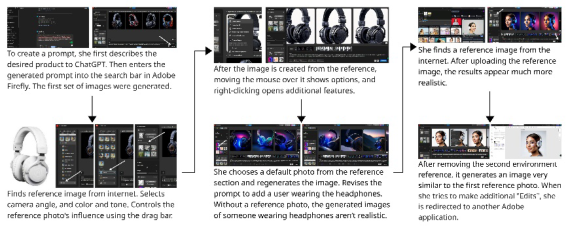
Workflow Analysis Workflow analysis aimed to collect and analyse sample design workflows for obtaining the hands-on experiences and efforts of designers with AI-based tools. Students collected digital records of workflows either in person or through public records of workflows designers had shared in social media platforms to represent the diversity of the tasks and tools used. In total, 34 workflows were collected and documented for analysis (Figure 1).
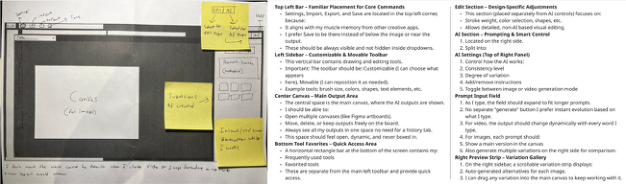
Generative interview technique is part of the generative design research approach which utilises tangible probes and toolkits to explore how users dream of or anticipate future experiences (Sanders & Stappers, 2014). Using probes in research can foster user participation and dialogue between designers and participants (Mattelmäki, 2007). Each team designed paper- based, semi-structured probes resembling different design tools (e.g. CAD modelling, image editor, rendering) on which participants could sketch and note while maintaining an open-ended conversation. A total of 18 generative interviews were conducted (Figure 2).
Analysis The author conducted thematic analysis to identify the perceived and experienced benefits and limitations of automation, and expectations for effective designer-AI collaboration. A combination of inductive and deductive approaches was adopted through selective open-coding (Williams & Moser, 2019) to search for patterns of (1) automation benefits, (2) barriers to creative control, and (3) interface suggestions to enhance collaborative workflows. Themes were triangulated across findings from questionnaire, workflows and generative interviews to obtain a comprehensive and in-depth understanding of user experiences and expectations.
Figure 1: Sample workflow (simplified by the author for brevity).Figure 2: Sample generative interview output.
FINDINGS Benefits of Automation in Design Tasks
Designers emphasise several benefits of AI-enhanced task automation, such as research, problem framing, ideation and creative thinking, product visualisation and presentation. In industrial design, searching for market solutions, listing requirements, sourcing materials, and synthesising this information into viable design decisions are fundamental tasks. Consequently, enhancing research and problem framing is a highly appreciated contribution of LLMs, which provide fast access to cited information, summarise literature, and identify gaps. Despite limitations like hallucinating and requiring manual verification, LLMs remain efficient compared to fully manual research. Additionally, their context windows offer critical perspectives during creative blocks and point out overlooked issues.
Designers appreciate genAI’s speed and ease in creating content which supports ideation and creative thinking. LLMs and image generators (e.g., Vizcom, Midjourney, Firefly) help explore and draft concepts and forms with unprecedented speed and diversity. This is especially useful during early conceptualisation, where inspiration and divergence are prioritised over feasibility and precision. GenAI acts as a brainstorming companion: both a co-creative partner to exchange ideas with, and an assistant to quickly concretise them.
Accelerating product visualisation is also appreciated for non-creative reasons: once design ideas are clear, less creative, routine visualisation tasks take over. For industrial designers, 3D modelling and realistic rendering to communicate colour, material and finish (CMF) constitute major tasks requiring considerable time and effort. Although current 3D model generation is mostly restricted to mesh models with limited-to-no editing capabilities, sketch-to-3D and image-to-realistic render workflows (e.g., Vizcom) take considerable work off designers’ shoulders.
Industrial designers take on significant workload by secondary visualisation tasks to transform their designs into various presentation mediums. As designers of functional products, they often present their work within realistic use contexts for diverse audiences, such as supervisors, colleagues, clients, and recruiters. AI-enriched workflows are reported to be enhancing design presentation by generating user representations and interactions, contextual background images, creating short animations to communicate features, and improving presentation layouts.
Interaction Flaws as Barriers for Creative Control Communicating the Design Intent
The most prominent issue observed is communicating the design intent. Unlike early conceptualisation, where ambiguity is welcome and inconsistency overlooked, detailing requires precise communication and execution. Significant limitations begin when designers have a clearer vision and rationale: designer-AI collaboration suffers from a fundamental communication barrier that inhibits creative expression. Designers struggle
76 Süner-Pla-Cerdà to formulate effective prompts, requiring multiple iterations, and heavy reliance on text-based descriptions that inadequately capture design nuances. This is evident in workflows drafting and modifying LLM prompts for other genAI platforms, using sketches, models, screenshots or found images as input, searching for online reference images, tinkering with parameter settings, and managing multiple platforms and input-output formats for a simple workflow. This friction negates AI efficiency benefits by transforming the process into a laborious ‘translation’ task.
Reliability and Trust Reliability and trust issues stem from inadequate model performance, specifically output unpredictability, inconsistency, and lack of domain understanding. False information, poor visual quality, and inability to accurately reference precedents compromise AI’s reliability. Workflow analysis reveals persistent designer efforts to control consistency, constant verification, post-editing, and fact-checking. This fosters reluctance to rely on AI as a creative partner. Furthermore, visual outputs lack an understanding of physical properties, manufacturing constraints, and ergonomics. Consequently, the collected workflows disproportionately favour ideation and visualisation over detailing and refinement tasks.
Creativity and Ownership Findings suggest designers’ creative autonomy faces significant challenges due to intellectual property and data privacy concerns, arising from plagiarism risks via unacknowledged reproduction of, or contribution to, training data. Furthermore, model training often yields generic rather than innovative outputs, and produces useless results when challenged in unfamiliar domains. Additionally, poor communication stemming from restrictive interaction modalities prevents designers from adequately controlling the co-creation process, risking submission to automation and reduced creative agency. Collectively, these factors undermine automation benefits and alienate designers from their own creative process.
Balancing Automation With Creative Autonomy This section presents patterns from participant suggestions in questionnaires and generative interviews for enhancing collaborative workflows by optimising automation and control. These themes are exemplified by interaction features from student projects. As course deliverables, teams iteratively designed four conceptual systems for specific tasks to improve designer-AI collaboration. Table 1 summarises these projects, covering material selection, CAD detailing, product visualisation, and design presentation. Design intervention strategies extracted from these concepts will be presented to enrich the user study findings.
Table 1: Conceptual interface design projects.
Table available in the original PDF paper.
Project Name and Designers System Description materialic. Ayda Selçuk, Cansın Er, Ekinsu Koyuncu, Eylül Deniz, Kerem Alsan
Educational tool to guide industrial design students in informed material selection by providing suggestions tailored to specific product parts and contexts, supported by technical research, production schemes, and comparative analyses
REMC Carina C. Brutscher, Eylül Açıkgöz, Miray Aktan, Rona Ş. Yurdakan
Desktop software that assists industrial designers in generating and editing 3D models for production efficiency and detailing by providing automated analysis of injection mould feasibility, ergonomically optimised forms, and ideal parting line placements
RendorAI Ceyda T. Aydın, Doğa Bencikli, Sıla Dağ, Zeynep Öcal
Collaborative rendering platform that assists industrial designers in rapidly transforming sketches and 3D models into high-quality visuals without altering the original geometry by adjusting, comparing and blending materials, colours, and finishes Product presentation platform supporting industrial designers to prepare consistent renders and storyboards with precise control of product, environment, user, context, style and framing parameters
Flow Frame Aslı E. Kudaş, İris Arslankılıç, Mert Çiçek, Z. Feyza İnal, Z. Sude Karabağ
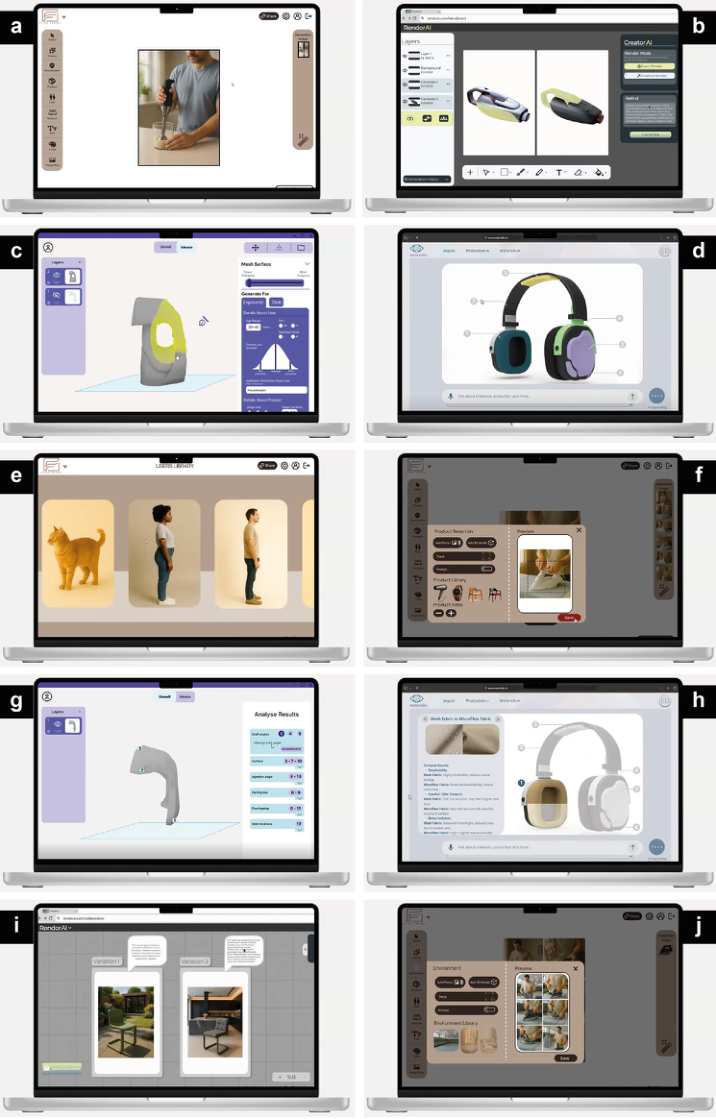
Simple and Familiar UI Design Participants expect AI tools to maintain familiar design software conventions with a large central workspace that minimises distractions. They value consistency with industry standards including layers, canvases, and traditional menu layouts. The interface should be clean, intuitive, and fluid with minimal clutter, allowing designers to focus on their work. For example, Flow Frame resembles graphic design software with a central workspace and controlled editing tools (Figure 3a), RendorAI utilises layer structure (Figure 3b), while REMC uses both layers and a familiar CAD software interface with 3D viewport (Figure 3c).
Enhanced Communication Participants strongly prefer conversational AI interfaces over one-time prompts, desiring in-situ and real-time interaction, immediate feedback, and precise output control. Dynamic interaction mimicking human collaboration and AI sketch development are highly valued. Designers expect AI to understand and accurately interpret commands, better capture their intentions, and maintain detailed editing capabilities to generations.
Figure 3: Sample screens from student projects exemplifying design interventions to enhance AI-supported workflows.
Balancing Automation With Designerly Autonomy 79 REMC allows form iteration while adjusting user characteristics for ergonomics (Figure 3c). Materialic auto-separates inputs into functional parts to recommend suitable materials (Figure 3d). RendorAI auto-separates parts for mixing CMF, allowing independent iteration of CMF and backgrounds via separate text/image prompts (Figure 3b). Similarly, Flow Frame permits independent generation and editing of product, environment, and user components (Figure 3a).
Personalisation Personalisation emerges as a key expectation as designers want tools to remember usage history and adapt to individual working styles. This includes customisable interfaces with personalised toolbars and shortcuts, responses tailored to the designer’s perspective, and systems that learn from past interactions. Designers expect AI to build a cumulative understanding of their preferences, creating a personalised assistant that becomes more relevant and effective over time by contextualising suggestions within the designer’s established patterns and needs. As examples from student projects; Materialic includes a material library that can be expanded by user input, while REMC offers a prompt and 3D model history that learns through user interaction over time. Flow Frame includes designer-created user, environment, and product libraries and individual style palettes (Figure 3e).
Transparent and Reliable AI Contribution Participants emphasise that AI should remain in a supportive role rather than overtaking creative control. They require clear separation between AI and standard tools, manual de/activation, and transparent indicators of AI activity. Designers prefer initiating designs manually, and using AI for repetitive tasks to maintain creative authority. Additionally, robust research capabilities with accurate, cited information are expected. All student projects target post-ideation tasks, with only one including research: Materialic provides a search function for comparative material and manufacturing information with manually verifiable citations and clearly marked AI-generated text. All concepts initiate workflows with a design deliverable (sketch, image, or 3D model), followed by separated manual editing and automated workflows. For example, Flow Frame isolates manual inputs and settings in a toolbar from AI-generated content in a separate column (Figure 3f).
Domain-Specific Automation Support Participants expect specialised design automation, particularly 3D capabilities (modelling, 2D-to-3D conversion, error detection), alongside comprehensive production support for materials, components, manufacturing, and prototype optimisation. They value novel automation for technical tasks like auto-dimensioning, auto-sectioning, presentation assistance, and quality assessment like 3D model feedback and manufacturability evaluation. Furthermore, in-context support for tool usage and unfamiliar domains emphasises that designers expect a dual AI role as a creative assistant and learning facilitator. Exemplifying this in the CAD domain, REMC’s “unveil”
80 Süner-Pla-Cerdà feature analyses 3D models for plastic injection moulding (draft angles, parting lines, wall thicknesses), visually marks problematic parts, and offers a constraint-based regenerate option (Figure 3g). Additionally, Materialic aids component material selection by comparing functional performance, manufacturability, cost, and user experience (Figure 3h).
Continuous Workflows Designers expect seamless transitions between design phases, from ideation to modelling to rendering. They want consistency across iterations with editable multi-format outputs, real-time visualisation, and immediate application of prompt results to models. This desire for workflow continuity reflects frustration with fragmented toolsets, emphasising the need for cohesive experiences that maintain creative momentum. Consequently, most student projects support multiple 3D and image file formats (e.g., *.STL, *.OBJ, *.PDF, *.SVG, *.PSD, *.AI) to facilitate seamless workflows between software tools while preserving editing capabilities. RendorAI’s “collaborate” mode generates a shareable workspace link for multiuser scenarios (Figure 3i). Additionally, all projects utilise consistency management strategies to control generation parameters for workflow continuity. For example, Flow Frame’s independent editing tools allow users to change storyboard elements across frames without compromising consistency (Figure 3j).
DISCUSSIONS This study shows that industrial designers already benefit from genAI, but mostly in phases where ambiguity is acceptable: research/problem framing, ideation, and fast visualisation. These benefits are seen as workflow acceleration using automation to draft, explore and externalise options quickly rather than transferring creative authority, while retaining decision- making control. This is evident in LLMs aiding research synthesis and gap- finding, and image generators enabling rapid concept exploration before feasibility and precision dominate the workflow. However, during detailing and refinement, designers’ autonomy weakens because current tools hinder expressing intent precisely and consistently. This demonstrates that control problems are not only model-level capability limits, but interface and workflow-level: even strong models can yield weak collaboration when the interaction structure forces linear and indirect expression of intent.
This reframes the “automation vs control” tension as an interaction design problem: designers want to delegate work, but only when they can stay accountable for goals, constraints, and acceptance decisions, as consistent with HCAI positions that seek high automation and high human control (Schneiderman, 2020). The design interventions distilled from student concepts respond to this tension by treating “control” not as a single feature (e.g., a prompt box or a slider), but as a workflow property supported by interaction structure, modality, and transparency.
Across the data, loss of control was less about “too much automation” and more about the friction of communicating and steering the system. Prompting often turns into a laborious translation activity, especially for form, CMF,
Balancing Automation With Designerly Autonomy 81 ergonomics, and manufacturing intent. The proposed UX patterns address this by shifting from one-shot prompting to iterative negotiation via familiar workspaces (layers, central canvas), multi-modal input, part-level selection/ annotation, and parameterised controls for targeted regeneration and edits. These strategies aim to operationalise the function allocation problem of automation (Parasuraman et al., 2000) while helping set appropriate expectations for the agent’s role (O’Neill et al., 2022).
Trust with automation is tightly coupled with reliability and transparency. Designers’ trust-related concerns are grounded in issues like inconsistency, unpredictability, and limited domain understanding. These limitations push designers into continuous verification and post-editing, which reduces the willingness to rely on automation beyond ideation. This aligns with the framing of trust as central to reliance decisions, while also emphasising that a sense of control and perceived competence shape adoption (Lee & See, 2004). The results also reflect a well-known concern in automation research: automation does not simply remove work; it redistributes it into monitoring, diagnosing, and recovery roles. In designer-AI workflows, this redistribution appears as prompt iteration, fact-checking, and manual correction.
The patterns extracted from participants and exemplified through conceptual systems respond to three core problems: expressing intent, maintaining continuity, and managing agency boundaries. Through these strategies, this study contributes to the HCAI research with domain- specific control requirements for industrial designers, especially for later- stage convergence tasks (CAD detailing, manufacturability checks, CMF exploration, presentation coherence). Findings demonstrate that meaningful automation in industrial design is not only about ideation speed, but about supporting creative decision-making through better understanding of the constraints and accountability of functional products.
CONCLUSION
This paper investigated how industrial designers balance genAI-driven automation with designerly autonomy, and translated the identified needs into actionable UX patterns. The mixed-method user study surfaced perceived benefits of automation, interaction flaws that currently limit control, and interaction design expectations; while student projects provided concrete examples of interface-level interventions for communication, personalisation, transparency, domain-specific support, and workflow continuity. Together, these contributions position autonomy as something that can be designed through interaction mechanisms, offering grounded guidance for future AI-supported industrial design platforms.
This study was based on a conceptual design exploration. While the design decisions were grounded in the literature and a mixed-method user study, the proposed interface strategies were not implemented as functional prototypes and were not evaluated in use; therefore, their usability, usefulness, and impact on creative control need to be validated. Future work should implement selected interventions and assess their effects on designer autonomy, reliance decisions, and workflow efficiency across tasks and expertise levels.
ACKNOWLEDGMENT
The author would like to thank the students enrolled in the ID430 Design for User Experience course in 2024–25 Spring semester for their invaluable contributions.
REFERENCES
Brown, P. (2009). ‘CAD: Do computers aid the design process after all?’, Intersect: Stanford Journal of Science, Technology and Society, 2(1), pp. 52–66. Dean, L. and Loy, J. (2020). ‘Generative product design futures’, Design Journal,
23(3), pp. 331–349. Du, Y. et al. (2024). ‘A product’s kansei appearance design method based on conditional-controlled AI image generation’, Sustainability 16(20), Article 8837. Feuerriegel, S. et al. (2024). ‘Generative AI’. Business & Information Systems
Engineering, 66(1), pp. 111–126. Gmeiner, F. et al. (2023). ‘Exploring challenges and opportunities to support designers in learning to co-create with AI-based manufacturing design tools’, Proc. CHI’23, Article 226. Ko, H.K. et al. (2023). ‘Large-scale text-to-image generation models for visual artists’
creative works’, Proc. Int. Conf. Intelligent User Interfaces (IUI ‘23), pp. 919–933. Kalving, M., Colley, A. and Häkkilä, J. (2024). ‘Where AI and design meet - Designers’ perceptions of AI tools’, Proc. NordiCHI ‘24, Article 52. Lee, J.D. and See, K.A. (2004). ‘Trust in Automation: Designing for Appropriate
Reliance’, Human Factors, 46(1), pp. 50–80. Lu, P. et al. (2024). ‘A generative-AI-based design methodology for car frontal forms design’, Advanced Engineering Informatics 62, Part C, Article 102835. Mattelmäki, T. (2007). Applying probes – from inspirational notes to collaborative
insights. CoDesign, 1(2), pp. 83–102. O’Neill, T. et al. (2022). ‘Human–autonomy teaming: A review and analysis of the empirical literature’, Human Factors, 64(5), pp. 904–938. Parasuraman, R., Sheridan, T.B. and Wickens, C.D. (2000). ‘A model for types and
levels of human interaction with automation’, IEEE Transactions on Systems, Man, and Cybernetics - Part A: Systems and Humans, 30(3), pp. 286–297. Park, H. et al. (2024). ‘We Are Visual Thinkers, Not Verbal Thinkers!: A thematic analysis of how professional designers use generative AI image generation tools’, Proc. ACM NordiCHI ‘24, Article 35, pp. 1–14. Sanders, E.B.N. and Stappers, P.J. (2014). ‘Probes, toolkits and prototypes: three
approaches to making in codesigning’, CoDesign, 10(1), pp. 5–14. Schöfer F. and Seibel, A. (2025). ‘Augmented design automation: Leveraging parametric designs using large language models’, Proc. ICED ’25, pp. 671–680. Shneiderman, B. (2020). ‘Human-centered artificial intelligence: Reliable, safe &
trustworthy’, Int. Journal of Human-Computer Interaction, 36(6), pp. 495–504. Süner-Pla-Cerdà, S. et al. (2025). ‘Designer experiences and perspectives on the role of generative AI in industrial design’, AI & Society. Vimpari, V. et al. (2023). ‘An adapt-or-die type of situation: Perception, adoption,
and use of text-to-image-generation AI by game industry professionals’, Proc. ACM CHI PLAY, Article 379. Williams, M. and Moser, T. (2019). ‘The art of coding and thematic exploration in qualitative research’, International Management Review, 15(1), pp. 45–55.
LISTED IN THE AHFE DIGITAL BOOKSTORE CATALOGUE
Explore the complete digital volume
Human Interaction and Emerging Technologies (IHIET-FS 2026): Future Systems and Design Applications
Read this individual research paper free through the original publisher, or explore the full digital proceedings book.
ISBN 979-8-950676-11-6
Explore this ISBN in the AHFE Bookstore ↗Listed in the July 2026 bookstore catalogue; search by ISBN to confirm current availability · Digital book purchase optional