Matthias Vogel, Tobias Schmallenbach, Giuseppe Strina (2026). Designing a Generative AI–Supported Modular Quotation Process for SMEs: A Design Science Research Approach. In: Human Factors in Simulation, Software and Systems Engineering. AHFE Open Access, vol. 220, pp. 1–7. https://doi.org/10.54941/ahfe1007688
Small and medium-sized enterprises (SMEs) remain structurally constrained by limited resources, insufficient digital maturity, and a strong dependence on tacit knowledge embedded in individual employees. These constraints become particularly visible in quotation and offer creation, which is often manual, weakly structured, and characterized by information gaps between customer requirements and internal assessment capabilities. This study explores how generative artificial intelligence (GenAI) can support the redesign of SME quotation processes through modularity principles to improve transparency, flexibility, and cognitive ergonomics during early requirements work. Following Design Science Research Methodology, the study applies the stages of problem identification, objective specification, and artifact development. The resulting artifact is a modular quotation framework operationalized via a dual-role GenAI assistant: (1) a customer-facing chatbot that elicits and structures requirements through natural-language dialogue and (2) an internal analytical assistant that decomposes requests into reusable modules and supports initial feasibility and estimation work under human oversight. The artifact was iteratively evaluated through structured self-testing and practitioner feedback from roles in software development and IT project management. Feedback indicates improved requirement clarity and more systematic decomposition of complex requests, while also highlighting limitations related to file processing, budget realism, and interaction guardrails. Overall, the paper contributes a replicable blueprint for AI-enabled modular quotation support in SMEs and derives design implications for human-AI collaboration in software and systems engineering contexts.
SMEs constitute the majority of enterprises in the European economy and operate under pronounced constraints regarding staff capacity, formalized processes, and access to specialized expertise. In such settings, quotation creation is not merely an administrative activity; it is an early-stage decision process that links customer dialogue, technical feasibility assessment, resource planning, and risk management. In many SMEs, quotation work is performed manually, depends on tacit knowledge, and becomes a bottleneck when requests are complex or highly customized. The resulting cognitive workload and coordination overhead can reduce response speed and consistency.
This paper investigates how GenAI can support a modular quotation process that transforms unstructured requests into reusable and transparent building blocks. The underlying assumption is that modularization reduces complexity by separating concerns and enabling systematic recombination of standardized elements into customized offers. In parallel, GenAI can provide scalable natural-language interaction and first-pass analytical support, while human experts retain oversight for accountability and context-specific decisions.
The study addresses two research questions: (RQ1) How can GenAI enhance the efficiency and adaptability of SME quotation processes when combined with modularization principles? (RQ2) How can a dual-role GenAI assistant be designed to support both customer-facing requirement elicitation and internal analysis activities in a coherent workflow?
The contributions are: (i) a conceptual modular quotation framework for SMEs, (ii) a dual-role GenAI assistant design that operationalizes the framework, and (iii) qualitative evaluation insights and design implications for human factors in software and systems engineering.
BACKGROUND AND RELATED WORK Quotation activities can be positioned within quote-to-order processes: they begin with a request for quote (RFQ) and culminate in a decision to place an order. For SMEs, quotation processes are frequently shaped by informal routines and limited documentation. This increases variance in offer quality and introduces risk when key individuals are unavailable. From a service and process engineering perspective, modularity provides a strategy to organize complex processes efficiently by decomposing them into modules that can be designed independently while functioning as an integrated whole.
Process modularity enables customization by recombining standardized sub-processes and by supporting transparency and reuse. In professional services, modularization must accommodate both explicit knowledge (e.g., documented deliverables, work packages) and tacit knowledge (e.g., expert judgment). A practical risk is that excessive standardization can overlook tacit knowledge, leading to misunderstandings when modules are reused across contexts.
GenAI systems, particularly large language models, can generate human- like text and support interactive dialogue. In requirements and software engineering contexts, GenAI has been discussed as a means to identify ambiguities, support traceability, and improve the speed of documentation- related tasks. At the same time, GenAI introduces well-known constraints: non-deterministic behavior, limited interpretability, and potential mismatches between plausible text output and organizational ground truth. These limitations are particularly relevant in quotation work, where errors propagate into scope, budget, and delivery commitments.
RESEARCH METHOD The study follows Design Science Research (DSR), which focuses on the construction and evaluation of artifacts that address relevant problems
Designing a Generative AI-Supported Modular Quotation Process for SMEs 3 in practice. The work adopts a DSR process model comprising problem identification and motivation, definition of objectives, design and development, demonstration, evaluation, and communication. Due to resource constraints, the present work emphasizes the first three stages (problem identification, objectives, artifact design) and conducts an initial evaluation through self- testing and practitioner feedback.
The problem addressed is the lack of scalable, structured, and transparent quotation processes in SMEs under conditions of high customization. Objectives for the solution include: (i) improving requirement clarity early in the process, (ii) decomposing requests into reusable modules that support parallelization and estimation, and (iii) reducing cognitive load through structured interaction patterns while preserving human oversight and decision authority.
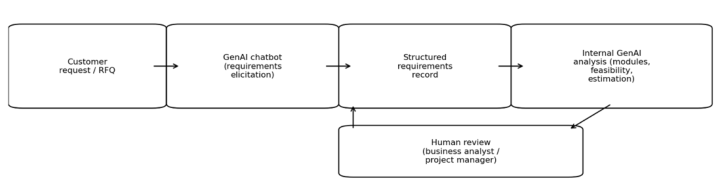
Figure 1 summarizes the conceptual workflow. A customer-facing chatbot collects requirements in natural language, asks follow-up questions, and produces a structured record. The internal GenAI assistant uses the record (and optional company resource data) to propose a modular decomposition, an initial feasibility assessment, and estimation-relevant notes. Human reviewers then adjust modules, correct assumptions, and decide on proposal content before customer-facing communication.
ARTIFACT DESIGN The artifact comprises a modular quotation framework and its operationalization as a dual-role GenAI assistant. The framework structures quotation work into stages that explicitly separate customer interaction from internal analysis and decision-making. This separation aims to reduce context switching and to clarify responsibility boundaries between AI and human actors.
Figure 1: Conceptual workflow of an AI-supported modular quotation process. (Own illustration).
Figure 1 summarizes the conceptual workflow. A customer-facing chatbot collects requirements in natural language, asks follow-up questions, and produces a structured record. The internal GenAI assistant uses the record (and optional company resource data) to propose a modular decomposition, an initial feasibility assessment, and estimation-relevant notes. Human reviewers then adjust modules, correct assumptions, and decide on proposal content before customer-facing communication.
MODULAR QUOTATION FRAMEWORK The modular quotation framework decomposes the offer process into reusable building blocks. In the present context, modules are defined as coherent work packages that can be estimated and recombined. The modularity aims align with established service modularity benefits: reduced effort through reuse and parallelization, improved transparency and reduced complexity, and configurability from a limited set of standardized elements.
Table 1: Aims and effects of modularity in service/offer processes (adapted from the source list used in this study).
Table available in the original PDF paper.
Aim Effect in a Quotation Context Reduction of efforts Resource allocation and estimation can be conducted at module level, enabling parallel work and reducing rework.
Configuration Customized offers can be assembled from a limited set of standardized, reusable building blocks.
Improved transparency and reduced complexity
A structured module portfolio clarifies scope, dependencies, and required decisions for both customer and provider.
Enhancement and improvements
Improvements can be applied to individual modules without redesigning the entire offer process.
Reuse Repeated use of modules supports economies of scale and more consistent quotation quality.
DUAL-ROLE GEN AI ASSISTANT To operationalize the framework, a GenAI assistant was implemented using a rapid customization approach. The assistant operates in two explicit modes, triggered by the prompts “Customer” and “Company”. In customer mode, it behaves as a non-technical consultant, prioritizing approachable language and systematically eliciting goal, features, primary users, timeline, and budget. It provides a structured summary and requests validated contact information. In company mode, it uses the collected request information to produce an internal analysis: modular decomposition, process steps toward a formal offer, and a first-pass cost/time estimation logic based on available resource cost inputs.
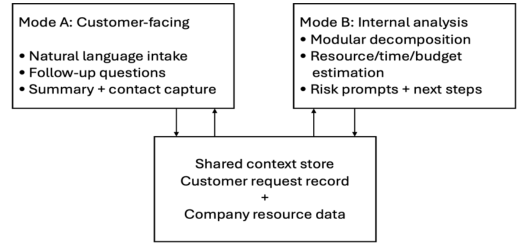
Figure 2: Dual-role GenAI assistant; customer vs. company mode. (Own illustration).
Figure 2 illustrates the dual-role concept. A shared context store links the customer requirements record with internal company resource information. This enables continuity between customer dialogue and internal analysis, while keeping outputs audience-appropriate.
EVALUATION The artifact was evaluated through (i) structured self-testing and (ii) practitioner feedback using think-aloud interaction. The evaluation goal was to validate whether the assistant can (a) elicit and structure customer requirements, (b) generate meaningful technical modules and next steps, and (c) provide estimation-relevant outputs that support internal decision-making.
Self-testing confirmed that the assistant can ask coherent follow-up questions and generate requirement summaries and module breakdowns. Practitioner feedback highlighted that the assistant improves early requirement clarity and supports modular thinking for complex requests. At the same time, several issues were identified: missing capture of contact information in early iterations, overly optimistic budget estimates, responses to irrelevant questions, and limited ability to process uploaded Excel/CSV data without manual transcription.
Table 2: Qualitative evaluation themes and observed issues from self-testing and practitioner feedback.
Table available in the original PDF paper.
Theme What Worked Well Issues / Improvement Needs Requirements elicitation Initially missing systematic capture of customer contact information for follow-up.
Occasional unnecessary technical detail and responses to irrelevant questions could overwhelm users.
Breakdown into technical modules supported planning and communication; practitioners valued the clear structure.
Estimation support
Provided a first-pass view of required work packages and a rough cost/time estimation logic.
Budget estimates were perceived as overly optimistic; Excel/CSV processing limitations required manual input of resource data.
Interaction design
Dual-role (customer vs. company) mode supported different information needs and reduced cognitive switching for users.
Prompting and guardrails needed refinement to avoid repetitive summaries and to keep responses concise.
Based on these findings, iterative refinements were applied to improve interaction conciseness, reduce repetitive summaries, and strengthen guidance for handling irrelevant questions. The design retains the principle that final proposal preparation and commitments remain a human responsibility.
DISCUSSION AND IMPLICATIONS From a human factors perspective, the modular GenAI-supported approach can reduce cognitive load by externalizing and structuring early- stage information processing. By systematically eliciting key variables and transforming them into an explicit module structure, the assistant can improve shared situational awareness between customer, business analyst, and technical staff. This aligns with the observed practitioner perception of improved requirement clarity and better manageability of complex projects.
However, the evaluation also underscores socio-technical risks. GenAI outputs are non-deterministic and may provide plausible but incorrect assumptions. This is particularly critical in cost estimation and feasibility statements, where overconfidence can translate into contractual and delivery risk. Limited interpretability complicates root-cause analysis when errors occur. Accordingly, the artifact is explicitly designed for decision support and not for automated commitments; human review is a mandatory control point.
The study is limited by its early-stage evaluation design and by the use of a rapid prototyping environment. It does not provide quantitative performance measures, and it does not cover full deployment in operational SME settings. Furthermore, modularization itself is variable: modules may represent customer-relevant building blocks, internal work packages, or process steps. In this work, modules primarily represent technical work packages derived from customer requests.
Design implications include: (i) enforce structured capture of contact information and consent within the customer flow, (ii) implement stronger guardrails to reject or redirect irrelevant inputs, (iii) integrate structured resource databases to improve estimation realism, and (iv) adopt transparency practices (e.g., explicit assumptions, confidence notes) to support human oversight and accountability.
CONCLUSION AND FUTURE WORK This paper presented a modular quotation framework for SMEs and a dual- role GenAI assistant that supports customer-facing requirement elicitation and internal analysis under human oversight. Initial evaluation via self- testing and practitioner feedback indicates that the approach can improve requirement clarity and facilitate modular decomposition of complex requests. Key limitations relate to file processing, estimation realism, and the need for interaction guardrails.
Future work should complete the remaining DSR stages through demonstration and evaluation in real SME quotation settings, integrate the approach via an application and GenAI API rather than a prototype-only environment, and assess impacts using process metrics (e.g., quotation cycle time, rework rates, and perceived cognitive workload). Comparative studies between traditional and modular GenAI-supported quotation approaches would further clarify boundary conditions and generalizability.
REFERENCES
Arrieta, A. B., Diaz-Rodriguez, N., Del Ser, J., Bennetot, A., Tabik, S., Barbado, A., Garcia, S., Gil-Lopez, S., Molina, D., Benjamins, R., et al. (2020). Explainable artificial intelligence (XAI): Concepts, taxonomies, opportunities and challenges toward responsible AI. Information Fusion, 58, 82–115. Baldwin, C. Y., & Clark, K. B. (2003). Managing in an age of modularity. In Managing
in the modular age: Architectures, networks, and organizations (pp. 84–93). Bask, A., Lipponen, M., Rajahonka, M., & Tinnila, M. (2011). Framework for modularity and customization: Service perspective. Journal of Business & Industrial Marketing, 26(5), 306–319. Bottcher, M., & Klingner, S. (2011). Providing a method for composing modular B2B
services. Journal of Business & Industrial Marketing, 26(5), 320–331. Dumas, M., La Rosa, M., Mendling, J., & Reijers, A. H. (2018). Fundamentals of business process management. Springer. Ebert, C., Louridas, P., & Ebert, C. (2023). Generative AI for software practitioners.
Business & Information Systems Engineering, 66(1), 111–126. Hevner, A. R., March, S. T., Park, J., & Ram, S. (2004). Design science in information systems research. MIS Quarterly, 28(1), 75–105. Kasneci, E., Sessler, K., Kuchemann, S., Bannert, M., Dementieva, D., Fischer, F.,
Gasser, U., Groh, G., Gunnemann, S., Hullermeier, E., et al. (2023). ChatGPT for good? On opportunities and challenges of large language models for education. Learning and Individual Differences, 103, 102274. Mathieu, V. (2001). Product services: From a service supporting the product to a service supporting the client. Journal of Business & Industrial Marketing, 16(1), 39–61. Mitchell, M., et al. (2023). ChatGPT is a black box: How AI research can break it
open. Nature, 619, 671–672. Natti, S., Ulkuniemi, P., & Pekkarinen, S. (2017). Implementing modularization in professional services: The influence of varied knowledge environments. Knowledge and Process Management, 24(2), 125–138. Ostrom, A. L., Bitner, M. J., Brown, S. W., Burkhard, K. A., Goul, M., Smith-Daniels,
V., Demirkan, H., & Rabinovich, E. (2010). Moving forward and making a difference: Research priorities for the science of service. Journal of Service Research, 13(1), 4–36. Peffers, K., Tuunanen, T., Rothenberger, M. A., & Chatterjee, S. (2007). A design science research methodology for information systems research. Journal of Management Information Systems, 24(3), 45–77. Simon, H. A. (1996). The sciences of the artificial (3rd ed.). MIT Press. Tuunanen, T., & Cassab, H. (2011). Service process modularization: Reuse versus
variation in service extensions. Journal of Service Research, 14(3), 340–354. Wemmerlov, U. (1990). A taxonomy for service processes and its implications for system design. International Journal of Service Industry Management, 1(3).
LISTED IN THE AHFE DIGITAL BOOKSTORE CATALOGUE
Explore the complete digital volume
Human Factors in Simulation, Software and Systems Engineering
Read this individual research paper free through the original publisher, or explore the full digital proceedings book.
ISBN 978-1-964867-96-0
Explore this ISBN in the AHFE Bookstore ↗Listed in the July 2026 bookstore catalogue; search by ISBN to confirm current availability · Digital book purchase optional