Betty Wai Sang Siu, Bing Xiao (2022). Visual attention, memory and persuasion of recycling advertisements among Chinese university students. In: Symposium on Creative Technology and Digital Media. AHFE Open Access, vol. 27, pp. 1–8. https://doi.org/10.54941/ahfe1001434
This research aims to use an eye-tracking methodology to explore the visual attention of recycling advertisements. The data obtained from the eye-tracking, unaided memory recall, and self-report on perceived persuasiveness can help advertisers and designers understand viewers' visual attention patterns and determine the best persuasion method when designing recycling-related advertisements. Findings showed the Pathos posters would result in long-term memory recall and high persuasiveness. However, more research is needed to see effects of using recycling relevant celebrities on the persuasiveness of Ethos posters. Central Slogans and Images were by far the most important aspect of the posters and what people spend the most time viewing. Keywords: Eye-tracking, recycling, public service advertisement, memory recall, persuasion
In China’s 14th Five Year Plan, the government laid out policies to address climate change, pollution, ecological protection. One of the critical pillars of this strategic focus is the widespread adoption of recycling by the public, as evidenced by the government’s recent introduction of the nationwide recycling program. To make sure waste is recycled effectively and adopted on a national scale, effective communication through Public Service Adver- tisements (PSA) plays an essential role in influencing people’s attitudes and behavior towards the subject matter. The goal of any advertisement is to attract the attention of the viewer, persuade and influence their decision- making (Yuniantari et al., 2021), attitude, and behavior (Shirkhodaie & Khalili Palandi, 2020). There are many different methods to assess advertise- ments, and the method chosen depends on advertisement media, message, the target audience of the advertisement (Maheshwari et al., 2015). This research paper aims to understand how to effectively capture visual attention and per- suade the public by using the different methods of persuasion in PSA posters using eye-tracking technology.
Eye-tracking technology has been widely used in different research areas, including visual attention and advertising (Wedel and Pieters, 2006). It is based on Just and Carpenter’s (1976) eye-mind hypothesis, which states that any person’s gaze directly corresponds to the most immediate thought in the person’s mind. In eye-tracking experiments, participants are usually
presented with different stimuli, in this research, recycling advertisement posters. Each poster consists of different elements (image, logo, symbol, text, slogan), called Areas of Interest (AOI). During the experiment, the eye-tracker records the eye movements of the participants, which comes in different metrics, including fixation duration, time to the first fixation, fixation count, and scan path entropy (Borys & Plechawska-Wójcik, 2017). Fixations can be understood as visual attention, and eye-tracking can help researchers understand the stimuli that capture the participants’ attention. According to Duchowski (2017), for the mind to process the stimuli of interest, attention is used to select the sensory input’s psychological capabilities. Any adver- tisement that does not have the viewer’s attention is considered ineffective (Puškarevi´c et al., 2016). Understanding viewers’ attention can help designers and advertisers enhance the communication process between the sender and receiver.
In addition to eye-tracking methods, researchers have also employed other methodologies to understand and measure advertisements’ effectiveness, such as self-reports and surveys to measure memory recall and persuasiveness. Richard et al., (2020) implemented eye-tracking and memory recall to eva- luate visual behavior when viewing environmental-related posters. Similarly, Kong et al. (2019) employed the self-reported memory recall methodology and eye-tracking to understand the effectiveness of tourism-related adverti- sing on online websites and the study found that longer fixation time to a stimulus has a positive influence on memory recall. According to the hiera- rchical model, there is a positive relationship between the visual attention to advertisements and memory recall (Kuisma et al., 2010; Pashler, 1998); one of the main characteristics of an effective advertisement is its memorability (Ambler & Burne, 1999; Kong et al., 2019; Turley & Shannon, 2000).
Advertisers implement different strategies when creating persuasive adver- tisements. One standard persuasion method uses Aristoteles’ Rhetorical Triangle: Pathos, Ethos, Logos (Higgins & Walker, 2012). Advertisements that use pathos appeal, also referred to as emotional appeal (Otamendi & Martin, 2020), aim to use emotional appeal to trigger an emotional reaction from the viewer; advertisements that use ethos appeal try to use a character based on the audience getting a perception of the speaker as reliable and credible (Vu, 2017). One example of ethos advertisement is celebrity endor- sement, where celebrities persuade viewers to buy a specific product or trust a product or service (Knoll & Matthes, 2017). The third way of convincing the target audience is logos appeal which uses logic and rational arguments to persuade the audience. The ideas presented in this method may involve the facts, figures, statistics, events, and the exceptional benefits of the adver- tised product or service (Higgins & Walker, 2012). Pathos, Ethos, Logos are often discussed in commercial advertisements but seldom about their effe- ctiveness in PSA; hence, this research will explore viewers’ visual attention to recycling advertisements and evaluate the advertising effectiveness of the rhetorical triangle in recycling posters. The objective data obtained from the eye-tracking and survey can help advertisers and designers better understand viewers’ visual attention and what appeal is more effective when designing recycling-related advertisements.
Visual Attention, Memory, and Persuasion of Recycling Advertisements 3
The following research questions were formed: RQ1: What AOI attracts the most attention within the three modes of persuasion (Pathos, Logos, Ethos)? RQ2: Which of the three modes of persuasion is most memorable? RQ3: Which of the three modes of persuasion is most persuasive?
METHOD
Following a similar approach as Kong et al., (2019) and Richard et al., (2020), methods used in this research include eye-tracking experiment in a lab environment, and self-report survey to measure memorability and perceived persuasiveness.
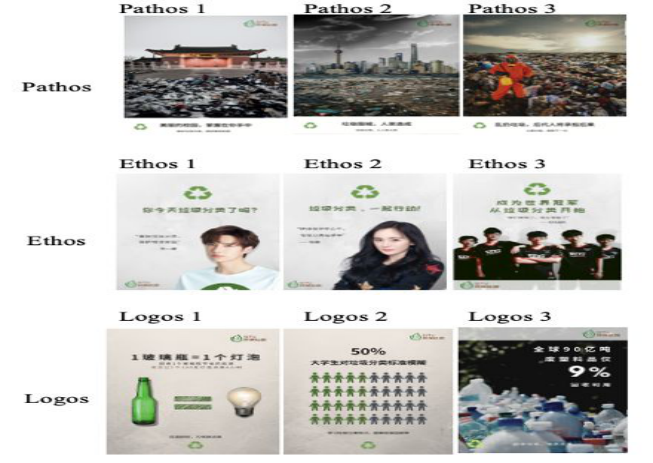
Advertisement Design: The stimulus for the eye-tracking study was expli- citly designed for this research, meaning that no participants had seen the advertisement posters before. Nine advertisement posters were designed: 3 with pathos, 3 using ethos, 3 using logos. Each poster also contained five different areas of interest (AOI), Image, Slogan, Text, Logo, and Sym- bol. Text is differentiated from Slogan with small size font and is used the accompany the Slogan, which is the main message (see Appendix). Since this study is targeting students from a Chinese University, the recycling posters were designed including elements that are relevant to the university students (see Appendix); for example, an image of the target university’s famous entrance was used as one of the design elements, which majority of the students should be familiar with, another poster had an image of the target city’s signature landmark, assuming that the students who are studying in the city would be familiar with the landmark. To control the variables, the size of the AOIs for each poster was consistent, and the layout for each group of persuasion mode was also in a similar form (see Appendix).
Procedure: In total, 41 (20 males and 21 females) students between ages 19–30 participated in this study. Only one participant and one researcher were present during each experiment. The participant was informed about the experimental procedure and that the data collected would be used with confidentiality and for research purposes only. With participants’ consent on participation and confirmation on eye vision requirements, the experiment proceeded with a pre-experiment survey including demographics and the participants’ attitude and intention towards recycling behavior. The partici- pants were asked to find a comfortable position and have minimal movement during the experiment. Because the duration of the participant’s look at the advertisement will directly affect the dependent variable, each picture was shown 8 seconds each. To control for time accuracy, the advertise- ments were shown on a 16-inch screen, with the nine different recycling advertisements in high resolution, shown in random order for each parti- cipant. There was a 3-second transition between each poster leading to a
4 Siu and Xiao
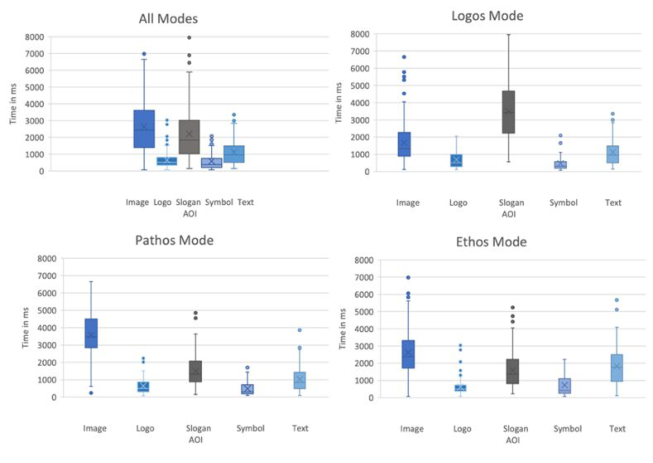
Figure 1: Fixation duration for each method of persuasion.
black page for the participant to readjust their fixations so the first fixa- tion of the following poster will not be affected by the previous poster fixation. The distance between the participant and the screen was 50– 60cm. Following the eye-tracking experiment, the participants were asked to answer a self-report survey, consisting of three open-ended questions: “Briefly describe all the posters you remember,” “Based on the previous question, list (1) the poster you think is most memorable (2) what factor- s/elements made you remember the poster best?”, “Briefly describe what you perceive is (1) the most persuasive poster ad (2) what factors/elements make the poster the most persuasive?”. The memory recall open-ended survey was given to the participants in two instances. The first one was given right after the experiment. The second one was given ten days after the experiment.
RESULTS
Visual Attention For All Modes, the AOI fixation across Logos, Pathos, and Ethos, Image and Slogan have the longest fixation time (not significant enough to differentiate), followed by text and symbols (see Fig. 1). The logo on the corner of the ima- ges received the least amount of attention. However, when examining each mode specifically, there are clear winners in fixation duration amongst each element in the image. For Logos, Slogan attracted the longest fixation time. For Pathos and Ethos, the image attracted the longest fixation time. There- fore, depending on the form of persuasion, the center point of the viewer’s focus will be different.
Visual Attention, Memory, and Persuasion of Recycling Advertisements 5
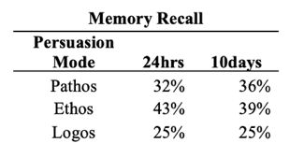
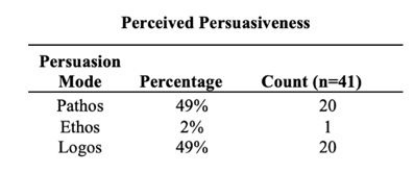
Figure 2: Memory recall of the three modes of persuasion.Figure 3: Perceived persuasiveness of Pathos, Ethos, Logos.
Memory Recall The survey to collect memory recall information was conducted twice for each participant. The first one was given right after the experiment. The second one was given ten days after the experiment (after advertisement exposure). For both instances, after 24 hours and 10 days, Ethos was most memorable, followed by Pathos and, lastly, Logos (see Fig. 2). For logos, the recall percentage remained the same, but for Pathos, the recall increa- sed with more time. While recall for Ethos decreased over time, the absolute percentage of participants recalling Ethos posters was still the highest. The results may indicate that the information processing of Pathos, the emotional appeal, goes to the long-term memory. In contrast, the information processing of Ethos may stay in the short-term memory.
Perceived Persuasiveness Pathos and Logos posters were tied for the most persuasive at 49% each. Only 2% of participants chose ethos as the most persuasive mode (see Fig. 3).
DISCUSSION & CONCLUSION RQ1: This paper defines attention to be the amount of time spent on each AOI of each persuasion method. Encompassing all persuasion modes, image and slogan received the most amount of attention. Text, symbol, and logo received a significantly lower amount of attention. Looking at each persuasion individually, Logos posters got most of their attention via the slogan. Pathos posters relied on the main image, whereas Ethos relied on a combination (though still with image as the AOI with the most attention). The key takeaway here is that regardless of what method of persuasion is used for the posters, the image and the slogan proved to be the most important drivers of attention.
6 Siu and Xiao
RQ2: For memory recall, Ethos is first at 39% whereas Pathos is the second highest at 36% ten days after the experiment. Logos was the least memorable at 25%. While Ethos triggered higher recall, the situa- tion changes when we look at persuasiveness. Only 2% of all participants labeled Ethos posters as persuasive whereas 49% thought Pathos was per- suasive. The author speculates that while the celebrity-based Ethos posters triggered a lot of memory recall, the celebrities themselves did not have any credibility in the recycling domain, leading to such a low persuasion score. Further research can be conducted on the persuasiveness of Ethos-based posters with famous individuals that are relevant in the recycling domain.
RQ3: Effective persuasion requires both memorability and persuasiveness. Without memorability, persuasion will only be temporary and will not translate into long-term views. For pathos, it was the clear winner overall (when the celebrities in Ethos posters are not relevant to recycling). Despite having only 3% less memory recall, it had 49% of participants indicated it is persuasive. Because long-term persuasion and habit changes require both high persuasion and memorability, it will likely be the best performer of the bunch. Logos posters had high persuasiveness but were difficult for participants to recall. This is likely due to the heavy emphasis on text- driven Slogans in logos posters (see Fig. 1).
Based on the results found in this study, pathos was the best method of per- suasion in the posters for strong recall as well as high persuasion to produce lasting behavioral change.
ACKNOWLEDGMENT
I want to express great gratitude to my supervisor for all the support and guidance in my research work. I also want to thank the teachers at the lab for allowing me to borrow the eye-tracking device for an extended period; this allowed me to conduct several pilot studies and improve the methodology before proceeding to the main experiment. Lastly, I would like to thank all the students who participated in the eye-tracking experiment.
REFERENCES
Ambler, T., & Burne, T. (1999). The impact of affect on memory of advertising.
Journal of advertising research, 39, 25–34. Borys, M., & Plechawska-Wójcik, M. (2017). Eye-tracking metrics in perception and visual attention research. China Dialogue. (2022). 14th Five Year Plan, China’s carbon-centred environmental
blueprint. [online] Available at: <https://chinadialogue.net/en/climate/14th-five- year-plan-china-carbon-centred-environmental-blueprint/> [Accessed 15 October 2021]. Duchowski, A. T. (2017). Eye tracking methodology: Theory and practice: Springer. Higgins C. & Walker R. (2012). Ethos, Logos, Pathos: Strategies of Per- suasion in Social/Environmental Reports. Accounting Forum. 36. 194– 208. 10.1016/j.accfor.2012.02.003.
Visual Attention, Memory, and Persuasion of Recycling Advertisements 7
Just, M. A., & Carpenter, P. A. (1976). Eye fixations and cognitive processes.
Cognitive psychology, 8(4), 441–480. Knoll, J., Matthes, J. (2017) The effectiveness of celebrity endorsements: a metaanalysis. J. of the Acad. Mark. Sci. 45, 55–75. https://doi.org/10.1007/s11747- 016-0503-8 Kong, S., Huang, Z., Scott, N., Zhang, Z. A., & Shen, Z. (2019). Web advertisement
effectiveness evaluation: Attention and memory. Journal of Vacation Marketing, 25(1), 130–146. Kuisma J, Simola J, Uusitalo L, et al. (2010) The effects of animation and format on the perception and memory of online advertising. Journal of Interactive Marketing 24(4): 269–282. Maheshwari, P. , Seth, N. , Gupta, A. (2015). ‘Advertisement Effectiveness for
Print Media: A Conceptual Model’. World Academy of Science, Engineering and Technology, Open Science Index 98, International Journal of Economics and Management Engineering, 9(2), 701–706. doi.org/10.5281/zenodo.1100929 Otamendi, F. J., & Sutil Martín, D. L. (2020). The Emotional Effe- ctiveness of Advertisement. Frontiers in psychology, 11, 2088. https://doi.org/10.3389/fpsyg.2020.02088 Pashler H. (1998). Contemporary attention theory. In: Pashler H (ed) Attention.
Hove, East Sussex: Psychology Press, pp. 155–189. Puškarevi´c, I., Nedeljkovi´c, U., Dimovski, V., & Možina, K. (2016). An eye tracking study of attention to print advertisements: Effects of typeface figuration. Journal of eye movement research, 9(5), 1–18. Richard M. Walker, Dannii Yuen-Lan Yeung, M. Jin Lee & Ivan P. Lee (2020). Asses-
sing Information-based Policy Tools: An Eye-Tracking Laboratory Experiment on Public Information Posters, Journal of Comparative Policy Analysis: Research and Practice, 22:6, 558–578, DOI: 10.1080/13876988.2020.1753035 Shirkhodaie, M., & Khalili Palandi, F. (2020). Examining the Effectiveness of Public Service Advertisement through Hormonal Marketing Approach. Journal of International Marketing Modeling, 1(1), 13–20. Turley, L. W., & Shannon, J. R. (2000). The impact and effectiveness of advertise-
ments in a sports arena. Journal of services marketing. Vu, D. (2017). Rhetoric in Advertising. VNU Journal of Science: Policy and Management Studies, 33(2). doi: 10.25073/2588-1116/vnupam.4093 Wedel, M. and Pieters, R. (2006). Eye Tracking for Visual Marketing. Foundations
and Trends in Marketing, 1(4), pp. 231–320. Yuniantari, A. S. D. O., Budiarta, I. W., & Susanthi, I. G. A. A. D. (2021). Representations of the Ideological Identity of Woman Characteristics in Commercial Advertisements. RETORIKA: Jurnal Ilmu Bahasa, 7(2), 115–120.
8 Siu and Xiao
APPENDIX
Figure 4: The stimulus used in the experiment.
LISTED IN THE AHFE DIGITAL BOOKSTORE CATALOGUE
Explore the complete digital volume
Symposium on Creative Technology and Digital Media
Read this individual research paper free through the original publisher, or explore the full digital proceedings book.
ISBN 978-1-958651-03-2
Explore this ISBN in the AHFE Bookstore ↗Listed in the July 2026 bookstore catalogue; search by ISBN to confirm current availability · Digital book purchase optional