Puning Wang, Bing Xiao (2022). Job Search App Design for College Students Based on Emotional Experience. In: Affective and Pleasurable Design. AHFE Open Access, vol. 41, pp. 66–71. https://doi.org/10.54941/ahfe1001782
In the post-pandemic era, the employment pressure of college students is increasing, and their negative emotions are increasing day by day during the job-hunting. Although there are lots of Internet-based job hunting platforms, college students are prone to information anxiety due to a large amount of job information and complicated procedures. On the basis of investigating and analyzing the job-seeking needs of Chinese college students, this paper analyzes the instinct level, behavior level and reflection level, and proposes the emotional design strategy for college students' job-seeking app. And designed an application suitable for college students to apply for jobs, hoping to effectively alleviate the negative mood of college students for job hunting.
In the post-pandemic era, the employment situation of college students is becoming more and more serious. These social status will affect the indivi- dual’s attitude and emotion, especially when facing overload of information, information and demand do not match, which is easy to produce information anxiety (Gu, 2021). Emotionally, college students are most likely to be pessi- mistic and cowardly when faced with employment (Xu et al., 2021). Because most college students lack employment experience, they are always worried that their abilities will not meet the requirements of enterprises or compa- nies. In addition, due to the impact of the epidemic, students’ employment directions and choices have also been greatly reduced, which has led to more and more anxiety among students. Therefore, it is difficult for them to face the employment problem calmly.
Although there are many job search platforms on the Internet today, which allow job seekers to access more information and opportunities, the user acti- vity of these platforms is generally not high, and the platform functions are not fully utilized. In addition, college students do not have enough depth in the application of job search platforms, and they only stay in searching for simple and fragmented job information. Some platforms are too closely follo- wed by emerging career such as product managers, inserting a large number
Job Search App Design for College Students Based on Emotional Experience 67
of training course advertisements, which will create a certain degree of lear- ning anxiety. Therefore, this study starts from the emotional problems of college students in the process of job hunting, based on the theory of emo- tional design, puts forward the design strategy of job hunting products, and carries on the design application.
RESEARCH BACKGROUND The Influence of Emotion on Job-Seeking Behavior
Emotions are involved in the whole process of college students’ coping with employment pressure and job hunting. Most of the studies have less combined emotion and job-seeking behavior, and less attention has been paid to the impact of negative emotions on college students’ job-seeking behavior (Liu et al., 2016).
Negative emotions make job seekers likely to imitate others and rely on others. For example, some college students tend to focus only on famous enterprises and popular positions, without considering their own abilities, advantages, majors and other actual situations. These misbehavior are likely to lead to job hunting failure, if timely adjustment will still be successful job hunting results. Therefore, from the perspective of design, this study hopes to use emotional design to reduce the emotional pressure of job seekers.
Method of Emotional Design Emotions affect how people perceive, behave, and think, and affect everyth- ing we do. The main research on emotional design includes the measurement, analysis and modeling of consumer emotional factors, etc. Many literatures have studied different aspects of emotional design, using a variety of the- ories and methods. However, looking at the large amount of literature on emotional design, we can find that only the Kansei engineering theory and the three-level theory proposed by Donald A Norman can form a theoreti- cal system. In the book “Emotional Design”, based on the three different dimensions, Professor Norman expounded the important position and role of emotion in design, emphasizing that the three levels of Innovative product design will likely arouse surprises and impulses from consumers (Norman, 2005). When it comes to the emotional design of the mobile Internet platform, people may think of some cases of improving user experience through illu- strations and micro-interactions, such as log-in prompts and abnormal states. These can really make users smile and have good results. However, the cur- rent Internet product design tends to have more instinctive layers. This is certainly a point that requires our efforts, but it is much more than that. User experience and emotion will be the focus of the design, so research in this part will be of great value.
RESEARCH ON USER NEEDS To identify the core users and needs of our products, this research was con- ducted through semi-structured interviews and questionnaires. The survey
68 Wang and Xiao
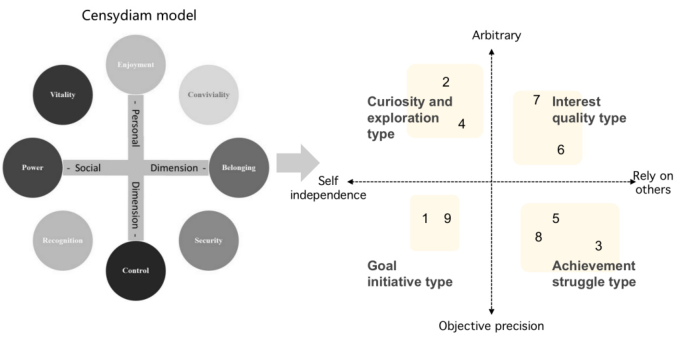
Figure 1: User Grouping Based on CENSYDIAM Model.
was conducted in Shanghai from May to June 2021. We first conducted semi-structured interviews with 9 college students aged 22–25, in order to summarize user types and analyze potential emotional needs in more detail. And through the observation method, we use cameras and tape recorders to record the user’s process of using the job app. Then we distri- buted questionnaires to college students aged 22–25 who were looking for jobs, and collected 200 questionnaires through random sampling, in order to verify the core users and priority of needs summarized by the interviews.
Through in-depth interviews, we divided the nine college students into four groups based on the CENSYDIAM Model (Yu, 2017). They are the novice exploration type, the interest quality type, the goal initiative type and the achievement struggle type (see Figure 1). After sorting out user needs, it is found that the novice exploration type has the most needs. Most of them are applying for a job for the first time, without a clear goal, and want to try a variety of positions. Therefore, we define this group of people as the core users of this product design.
In the questionnaire survey of job search related content, it was found that 60% of the people often changed their job search goals. They are vague about their future career plans and are in a state of confusion. This verifies the conclusion that the main population is the novice exploration type, and more than 50% of the people need job-seeking time planning advice services, career job introductions and job-seeking process reminders. In addition, most people are willing to pay for career planning, mock interviews, and offer options.
In general, in addition to the above high-frequency needs, there are several special emotional pain points for novice exploration users: (1) They don’t know what job they’re really suited for before they apply for it. (2) After the interview, they are anxious to hear the result and ask for advice from those around them. These are all emotional factors that need to be considered in the subsequent design.
Job Search App Design for College Students Based on Emotional Experience 69
SUMMARY OF DESIGN STRATEGY Emotional Design Strategy Based on Instinctive Level
The emotional design method at the instinct level is reflected in the interface vision. For the emotional shaping of products, not only focus on the fun of the default page and the exquisite icons, but also need to run through the function, experience, visual performance, and content.
In the design of the job search platform, in order to form a coherent emo- tional experience, it is not only necessary to improve the efficiency of job search, but also to pay attention to the positive emotional guidance of job seekers. From this we hope to create a fresh and healing emotional atmosph- ere. In terms of color selection, most job search software such as LinkedIn will use blue or green to represent business, professionalism, pragmatism and rationality. But color has an important influence on people’s psychological activities, especially it has a very close relationship with emotions. Blue will create a formal and serious atmosphere, especially with a large number of job descriptions, which will easily increase the psychological burden of users. Therefore, it is necessary to take advantage of other colors in the platform design to help reduce the information anxiety of job seekers.
Emotional Design Strategy Based on Behavioral Level The design of the behavioral level is related to the user’s use. This kind of product puts the function first, and the user will feel pleasure because of the realization of its function in the process of using it. User research and needs analysis are the first conditions to determine functionality (Fan and Wu, 2021). We explore the needs of users from the user journey of job seekers, including: job search planning - preparing resumes - job posting - intervie- wing - waiting for results and selecting offers, transforming user needs into functions and prioritizing them. The core functions include: self-assessment, self-improvement, career recommendation and search, delivery progress tra- cking, etc. By integrating the functions into each module of the APP, four modules of the APP can be obtained.
Emotional Design Strategy Based on Reflective Level The design of the reflection layer mainly creates an atmosphere through details to stimulate users’ special emotions such as curiosity, memory, and dependence (Zhong et al., 2021). In order to alleviate the negative emotions of college students in the process of job hunting, we can start from the esta- blishment of role cards and personal identity satisfaction, so as to create a beautiful emotional transfer for users.
Some functional and emotional motivation can be combined. When users start looking for positions, they still don’t know their ability level. They can link task functions such as ability tests and skill training with role cards. Every improvement in ability can be reflected on the role cards, which can be expressed as Reward badges, growth curves, visual records, and more. Job seekers can also gradually become aware of their strengths and expected posi- tions. On the one hand, it can stimulate the user’s senses and stimulate interest
70 Wang and Xiao
Table 1. Application of emotional design strategy in app design.
Table available in the original PDF paper.
Design Strategy Corresponding design content Status alerts using color psychology Emotional design strategy based on instinctive level
Guided career task test
Emotional design strategy based on behavioral level Emotional design strategy based on reflective level
Points encouragement, personal character cards
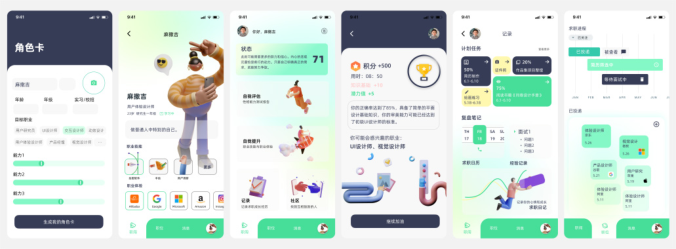
Figure 2: Some pages in prototype design of App. (character card establishment, home page, training feedback, recording, delivery progress).
in use; on the other hand, it can give users recognition and encouragement, and enhance positive psychological guidance.
DESIGN APPLICATION The designed app is named “Zhi Chuang”, which means breaking through the barriers in the job search process. The design strategies summarized above have been applied to application design (see Table 1).
“Zhi Chuang” App will create their own career role cards for new users (see Figure 2). Users can carry out self-assessment according to their own abi- lities, through personality tests, professional skills tests and mock interviews to deepen the understanding of different occupations, which is conducive to preliminary determination of whether they match the job. In this process of continuous self-assessment and understanding, users can find a career that is truly suitable for them, which can effectively reduce the time cost of delivering uncertain positions.
Users can also improve themselves here and complete small tasks or online career experiences directly released by the enterprise. The function of career experience can help college students to understand the work status and con- tent of specific positions more intuitively, which can alleviate the anxiety of the unknown job. If the company needs to recruit, the recruiter can check the job-seeker’s task completion and growth curve at any time. In this way, the potential value and learning ability of this student can be estimated, and
Job Search App Design for College Students Based on Emotional Experience 71
at the same time, the enterprise can implant values through the test task to attract capable and like-minded college students to join.
CONCLUSION
The Internet provides many solutions to college students’ job-hunting pro- blems, but also brings a series of problems. Based on the theory of emotional design, this paper explores and practices the design method of college stu- dent job-hunting App from three aspects of instinct, behavior and reflection, and explores a new mode of anxiety relief in job hunting to help job seekers quickly match positions. It can meet the needs of users from both practical and interesting aspects and provide reference for the future application of emotional design theory in Internet products.
REFERENCES
Fan, J., Wu, Y. (2021). Research and design practice of pet matching APP based on emotional theory. Design, 34(05), pp. 68–71. Gu, J. (2021). The Effect of Employment Risk Perception on Information Anxiety
of College Students under the COVID-19. Library and information guide, 6(03), pp. 31–39. Liu, R., Tan, Y., Qiu, Y., Chen, H. and Yong, J. (2016). Negative emotions influence college students’ job-hunting behavior. Modern trade industry, 37(10), pp. 94–96. Norman, D. (2005). Emotional design. 1st ed. Beijing: Publishing House of Electro-
nics Industry. Xu, Q., Wang, M., Zhang, G. and Cheng, W. (2021). study on countermeasures of employment psychological problems of college students under the new crown pneumonia outbreak. Scientific Consulting, (04), pp. 41–42. Yu, X. (2017). Study on the correspondence between population positioning and
design trend. Design, (03), pp. 44–45. Zhong, C., Xu, A. and Jiang, Y. (2021). Empathy design strategy for children’s pharmaceutical packaging based on emotional hierarchy. Packaging Engineering, (05), pp. 1–13.
LISTED IN THE AHFE DIGITAL BOOKSTORE CATALOGUE
Explore the complete digital volume
Affective and Pleasurable Design
Read this individual research paper free through the original publisher, or explore the full digital proceedings book.
ISBN 978-1-958651-17-9
Explore this ISBN in the AHFE Bookstore ↗Listed in the July 2026 bookstore catalogue; search by ISBN to confirm current availability · Digital book purchase optional