Ruth Chau, Amic Ho (2023). Understanding the Roles of Art and Design Technology in Art Therapy. In: Human Factors in Communication of Design. AHFE Open Access, vol. 90, pp. 186–193. https://doi.org/10.54941/ahfe1003710
The use of art and design technology in art therapy plays an important role in helping individuals express their inner emotions and thoughts. Art therapy is a sort of psychotherapy in which people use art to explore their emotions and ideas, process challenging situations, and enhance their mental and physical health. Art and design technology can be used to facilitate the therapeutic process and help individuals express themselves uniquely and creatively. In addition, art and design technology can provide an opportunity for individuals to learn new skills and obtain a feeling of accomplishment. For example, an individual may use technology to create an animation or web design, which can provide a sense of accomplishment and can help them to feel more confident. Overall, the use of art and design technology in art therapy can provide individuals with an opportunity to express themselves creatively and explore their feelings in a unique and meaningful way. This can help individuals to process difficult emotions and gain a sense of accomplishment, leading to improved mental and physical health.
Art and design technology can allow individuals to express themselves more freely and openly. For example, individuals may find it easier to express themselves using a digital medium such as designing a website or creating an animation. This can be used to help explore and express difficult emo- tions more effectively. Art and design technology also provides a range of tools to help individuals create art that they may not have been able to cre- ate without the use of technology. For instance, computers can be used to generate art using algorithms, allowing individuals to explore their creativity uniquely. This study discusses the potential of using art therapy combined with technology to create a healing environment. Art therapy can be used in virtual reality (VR) and augmented reality (AR) applications to help people work through emotions, trauma, and other psychological issues. These tech- nologies can create immersive experiences that allow people to explore their
Understanding the Roles of Art and Design Technology in Art Therapy 187
feelings and engage in self-expression (Ali & Lalani, 2020). in ways that can be difficult in a traditional therapy session.
THE NEEDS AND DEVELOPMENT OF ART THERAPY The needs and development of art therapy have grown significantly over the years. Art therapy is a kind of therapy that relies mostly on different forms of artistic expression and communication as its main means of treatment. It is used to promote the growth and development of individuals, couples, and families and treat mental health issues such as depression and anxiety. Art therapy is an effective way to help individuals cope with stress, trauma, and other complex problems. Art and design technology can be applied to art therapy in various ways. For example, digital tools can create expressive artwork for individuals to explore their thoughts and feelings. 3D printing can be used to create physical objects that can be used in art therapy sessions. Virtual reality can be used to create simulated environments for art therapy sessions, allowing individuals to explore their feelings in a safe and control- lable environment. By utilising these technologies, art therapists can create a more dynamic and interactive experience for their clients. Overall, art and design technology have revolutionised the field of art therapy. By utilising new tools and techniques, art therapists can create more meaningful experie- nces for their clients and help them explore and express their emotions safely and meaningfully.
HOW ART AND DESIGN TECHNOLOGY WOULD BE APPLIED IN ART THERAPY Art and design technology development has been a long and steady process, with many innovations emerging over the years. From the introduction of the printing press to the invention of the computer, art and design techno- logy have come a long way. It is used to create outstanding visuals, interactive experiences, and music and videos. The needs and development of art therapy have grown significantly over the years. The major means of communication and expression in art therapy is the creation of visual art. It is used to pro- mote the growth and development of individuals, couples, and families and treat mental health issues such as depression and anxiety. Art therapy is an effective way to help individuals cope with stress, trauma, and other complex problems. Art and design technology can be applied to art therapy in various ways. For example, digital tools can be used to create expressive artwork for individuals to explore their thoughts and feelings. 3D printing can be used to create physical objects that can be used in art therapy sessions. Virtual reality can create simulated environments for art therapy sessions, allowing individuals to explore their feelings in a safe and controllable environment. By utilising these technologies, art therapists can create a more dynamic and interactive experience for their clients. Overall, art and design technology have revolutionised the field of art therapy. By utilising new tools and techni- ques, art therapists can create more meaningful experiences for their clients and help them explore and express their emotions safely and meaningfully.
188 Chau and Ho
The printing press has revolutionised the arts and design technologies for centuries, from the first printing press in the 15th century to the invention of the computer in the 20th century. Cui (2017) discussed the revolutionary breakthrough of digital art in the field of professional painting. The paper highlights the advantages of digital painting such as the ability to code art into the computer, allowing for new strokes to be added while keeping the original plan intact. The study investigates the diversified performance of digital painting art and its application in traditional Chinese painting. It was discovered that the percentages of digital media art resources in Chinese pain- ting, practical technology as well as visual experience were, respectively, 50%, 61%, and 73%. (Bobbe, Opeskin, Lüneburg, Wanta, Pohlmann & Krzywin- ski, 2023). Their findings serve as a valuable source of science-based design knowledge for those interested in the practice of creating digital paintings as art. It showcases the new content and creative space that digital art has added to the art of painting, making it a new generation of visual art forms and a current fashion with mainstream art. Therefore, the potential of digital painting art and its application in various traditional art forms. Those who are interested in design science will find this book to be a useful resource since it focuses on the advantages of using digital media in the production of objects and systems as well as their incorporation into our physical, virtual, psychological, economic, and social environments.
The invention of the computer has greatly enhanced the capabilities of the printing press, allowing for mass production of printed works and faster completion of projects. The invention of digital arts media has further incre- ased the scope of art and design technologies and has allowed for a broader range of creative possibilities. Digital arts media includes graphics and ani- mation, video and sound editing, and 3D modelling. This technology has enabled the production of complex works, such as motion pictures and inte- ractive documents. The development of immersive technology has enabled artists and designers to create interactive, immersive experiences. This tech- nology uses virtual and augmented reality to bring people into an immersive 3D world. This technology can be employed to create interactive art, allowing viewers to interact with the artwork and influence the outcome of the work. Immersive technology has many implications for art therapy. It can be used to provide a safe, contained environment in which clients can explore their feelings and thoughts. Through this technology, therapists can help clients to better understand their emotions and to access parts of themselves that they may have difficulty accessing in the physical world. Immersive techno- logy can also be used to create works of art that can help clients process and express their feelings in a more creative, non-threatening way.
ART AND DESIGN TECHNOLOGY CAN BE USED AS TOOLS Art and design technology can be powerful tools for healing and self- exploration. It may serve as a means by which individuals may explore and articulate their innermost feelings, leading to a deeper knowledge of and appreciation for the self. Through art and design technology, people can explore the depths of their innermost feelings and discover more about
Understanding the Roles of Art and Design Technology in Art Therapy 189
themselves. By examining the creative process, they can find new ways to express their emotions, such as drawing, painting, sculpting, and printing. People can also use digital tools such as graphic design, 3D printing, and animation to explore their emotions further. Creating artwork and design outcomes can also be a form of self-reflection and expression. People’s abi- lity to better process their ideas and feelings may be improved via the act of making art, which can also help them get a better knowledge of their own sen- timents. Art can also provide an outlet for people to explore their experiences and express their emotions safely and constructively. The ability to use art and design technology to express emotions can also help people to obtain a better understanding of their relationships with others. People can explore interper- sonal dynamics and communicate their feelings creatively and meaningfully (Ahmad & Ghapar, 2019). Through art, people can build meaningful rela- tionships and develop better communication skills. Overall, art and design technology can be powerful for self-exploration, expression, and healing. It can provide people with a creative outlet to access and express their emoti- ons, allowing them better to understand the self and their relationships with others.
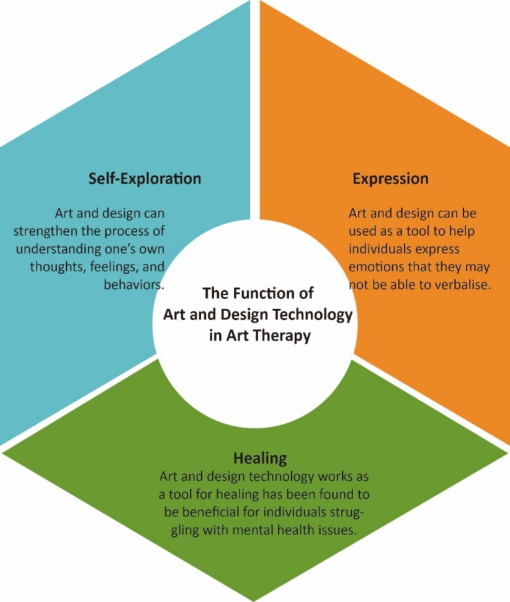
Art and design technology as a tool for self-exploration, expression, and healing has become an increasingly popular topic amongst psychologists and other mental health professionals (Figure 1). Art and design technology can
Figure 1: The function of art and design technology in art therapy.
190 Chau and Ho
provide individuals with an outlet to express emotions that may be difficult to verbalise. This literature review will explore how Art and design technology can be used as a tool for self-exploration, expression, and healing by allowing people to access and express emotions.
Self-Exploration Self-Exploration is a process of understanding one’s own thoughts, feelings, and behaviours. Using art and design technology as a tool for self-exploration is beneficial for individuals who may be struggling with mental health issues such as depression and anxiety. A study by Wright (2013) investigated how individualised art and design interventions can be used for self-exploration. Art and design interventions were effective in helping individuals to identify and reflect upon their emotions and experiences.
Expression Using art and design technology to allow individuals to express emotions can be beneficial for individuals struggling with mental health issues. A study by Blazej et al. (2019) examined how art and design can help individuals express emotions. Art and design can be used to help individuals express feelings that they may not be able to verbalise. Additionally, the interventions can be used to help individuals who may have difficulty verbally expressing emotions.
Healing Using art and design technology as a tool for healing is beneficial for indi- viduals struggling with mental health issues. A study by Chon and Pitha Wala (2020) examined how art and design interventions could be used to help individuals heal from traumatic experiences. According to the findings of the research, interventions using art and design may be utilised to assist people in processing and expressing the feelings that are associated with trau- matic situations. The research also indicated that interventions including art and design may be utilised to assist people in gaining insight into their own experiences, as well as fostering a feeling of serenity and healing in the person.
HOW THE IMMERSIVE TECHNOLOGY BE EMPLOYED IN ART THERAPY One example of how immersive technology is used in art therapy is the application of virtual reality (VR) to help patients with post-traumatic stress disorder (PTSD). In this type of therapy, patients are placed in a safe and con- trolled environment where they can confront their fears and anxieties. They can then work through the emotions associated with their trauma in a safe, controlled setting. This type of therapy is helping many PTSD patients to find relief from their symptoms and to better manage their condition. Some examples of immersive technology have been used in art therapy.
Understanding the Roles of Art and Design Technology in Art Therapy 191
VIRTUAL REALITY ART THERAPY FOR PTSD PROCESS Virtual reality art therapy has been used to help people with PTSD pro- cess their trauma and improve symptoms such as anxiety and depression. There has been a rise in interest in the potential benefits of using virtual reality (VR) in art therapy in recent years. It has been suggested that this technology can be used to help people process traumatic experiences, enh- ance creativity, and improve communication and social skills. Specifically, virtual reality (VR), augmented reality (AR), and other forms of immersive technology have been used in art therapy to help people with PTSD, autism spectrum disorder, dementia, and other mental health conditions. Preliminary research on the use of immersive technology in art therapy has yielded posi- tive results. Some studies of virtual reality art therapy for people with PTSD found that participants reported significant reductions in symptoms such as anxiety and depression. Kothgassner, Goreis, Kafka, Van Eickels, Plener and Felnhofer (2019) reviewed existing research on the effectiveness of Virtual Reality Exposure Therapy (VRET) for treating post-traumatic stress disor- der (PTSD). The review included 15 studies (N = 735) with participants who met the criteria for PTSD, with a mean age of 38.4 and a mean duration of PTSD symptoms of 8.8 years. Results showed that VRET was more effective than controls in alleviating PTSD symptoms (effect sizes were moderate to large). The authors concluded that VRET is an effective treatment for PTSD, and should be considered a viable treatment option for those suffering from PTSD. Also, virtual reality can be used to create immersive environments that help individuals explore their inner thoughts and feelings. It can be used to create simulated scenarios and experiences so that they can explore their per- sonal responses to certain situations and explore how they might react in real life.
Other studies have found that AR art therapy can help improve communi- cation and social skills in people with autism. Augmented reality art therapy has been used to help people with autism develop social and communica- tion skills. In his investigation into art therapy for autistic children, Lee (2019) considers the potential of augmented reality (AR) tools. According to the results, an augmented reality colouring book may help educate young- sters with autism to recognise and respond appropriately to nonverbal social signals. The participants in the study were able to use the augmented reality colouring book to understand and identify the nonverbal social cues from others, such as facial expressions and body language. Furthermore, the use of the augmented reality colouring book also enabled them to learn how to respond appropriately to these cues to enhance their communication skills. The study results suggest that AR technology can be a useful tool for art therapists working with children with autism.
Additionally, immersive art therapy has been used to help people with dementia reconnect with memories and emotions. Wei, Zhong and Gao (2022) provided a mini-review of how art therapy practices are being used in museum education. It highlights the potential of art therapy to foster creativity, self-expression, and social connection by engaging visitors in the museum setting. The article examines how art therapy can be used
192 Chau and Ho
in museums, including interactive programs, artworks, and educational activities. It also discusses the benefits of art therapy, such as its ability to help visitors explore their identity and to cope with trauma. Finally, the arti- cle identifies potential challenges and research needs related to the use of art therapy in museums. The article concludes that museums have the potential to be a powerful platform for art therapy and that further research is needed to explore and develop the full potential of this approach.
3D printing can be used to create tangible artefacts that can be used to explore physical sensations, such as touch and movement. It can also be used to create physical models of ideas or concepts that can be used to explore emotional states and behaviour. Augmented reality can be used to create inte- ractive experiences that allow individuals to explore their own emotions in a safe and controlled environment. It can also be used to provide feedback and insights into how their emotional states may be influencing their behaviours and decisions. Digital painting can be used to explore creative expression and to express emotions that may be difficult to express in words (Cui, 2017). It can also be used to explore different perspectives and to gain new insights into oneself. Art and design technology can be used to facilitate self-exploration and to help individuals gain a better understanding of themselves. It can be used to explore emotions, behaviours, and motivations and to gain a deeper understanding of the self. However, it is important to note that more research is needed to understand the potential of immersive technology in art therapy fully. While initial studies have been promising, there is much to be learned about the efficacy of this technology in different contexts and populations. Additionally, further research should explore the ethical implications of using immersive technology in art therapy and the potential risks and benefits.
CONCLUSION
The printing press and the digital arts media have come a long way since their invention and have enabled various new and exciting ways to express oneself and explore one’s emotions. The development of immersive technology has further increased the possibilities of art therapy, allowing therapists to use this technology to help clients explore their thoughts and feelings in a safe and controlled environment. With immersive technology, art therapy can help improve the lives of those who need it.
The literature review has explored how Art and design technology can be used as a tool for self-exploration, expression, and healing. The use of art and design technology is beneficial for individuals struggling with mental health issues. Art and design interventions can help individuals identify and reflect upon their emotions and experiences, express emotions, and heal from traumatic experiences.
In conclusion, there is excellent potential for immersive technology to be used in art therapy to help people with various mental health conditions. Preliminary research suggests that virtual reality, augmented reality, and other forms of immersive technology can help reduce symptoms of PTSD, improve communication and social skills in people with autism, and help people with dementia reconnect with memories and emotions. Further research is needed
Understanding the Roles of Art and Design Technology in Art Therapy 193
to fully understand the potential of this technology in art therapy, as well as the risks and benefits associated with its use.
REFERENCES
Ahmad, M. F., & Ghapar, W. R. G. W. A. (2019). The era of artificial intelligence in Malaysian higher education: Impact and challenges in tangible mixed-reality learning system toward self-exploration education (SEE). Procedia Computer Science, 163, 2–10. Ali, G., & Lalani, N. (2020). Approaching spiritual and existential care needs in
health education: applying SOPHIE (self-exploration through ontological, pheno- menological, and humanistic, ideological, and existential expressions), as practice methodology. Religions, 11(9), 451. Bobbe, T., Opeskin, L., Lüneburg, L. M., Wanta, H., Pohlmann, J., & Krzywinski, J. (2023). Design for communication: how do demonstrators demonstrate technology?. Design Science, 9, e3. Chon, H., & Pitha Wala, B. (2020). Social Innovation and CoCreation through
Design: utilising natural resources to facilitate sustainable development. Cui, J. (2017, July). Research on digital painting art and its diversified performance. In 2017 3rd International Conference on Economics, Social Science, Arts, Education and Management Engineering (ESSAEME 2017). Atlantis Press. Kothgassner, O. D., Goreis, A., Kafka, J. X., Van Eickels, R. L., Plener, P. L., &
Felnhofer, A. (2019). Virtual reality exposure therapy for posttraumatic stress disorder (PTSD): a meta-analysis. European journal of psychotraumatology, 10(1), 1654782. Lee, I. J. (2019). Augmented reality coloring book: An interactive strategy for teaching children with autism to focus on specific nonverbal social cues to promote their social skills. Interaction Studies, 20(2), 256–274. Plevoets, B., & Van Cleempoel, K. (2019). Adaptive reuse of the built heritage:
Concepts and cases of an emerging discipline. Routledge. Wei, Z., Zhong, C., & Gao, Y. (2022). Art therapy practices in museum education: A mini review. Frontiers in Psychology, 13. Wright, A. N. (2013). Exploring the funkadelic aesthetic: intertextuality and
cosmic philosophizing in funkadelic’s album covers and liner notes. American Studies, 52(4), 141–169.
LISTED IN THE AHFE DIGITAL BOOKSTORE CATALOGUE
Explore the complete digital volume
Human Factors in Communication of Design
Read this individual research paper free through the original publisher, or explore the full digital proceedings book.
ISBN 978-1-958651-66-7
Explore this ISBN in the AHFE Bookstore ↗Listed in the July 2026 bookstore catalogue; search by ISBN to confirm current availability · Digital book purchase optional