Amic Ho, Ruth Chau (2024). Bridging the Gap: A Comparative Analysis in Creative Processes between AI-Generative and Traditional Art. In: Human Interaction and Emerging Technologies (IHIET 2024). AHFE Open Access, vol. 157, pp. 147–158. https://doi.org/10.54941/ahfe1005473
The creative process has significant importance in the realm of artistic creation, as it involves a series of cognitive and generative acts that culminate in the production of unique and original artworks. The advent of artificial intelligence has given rise to a new kind of creative output, hence posing inquiries on the essence of creativity in machines. An examination of the creative processes used in AI art may provide valuable insights into the mechanisms via which AI systems generate artworks and the extent to which these processes align with human creative practices.This study undertook a comprehensive analysis of contemporary AI art methodologies, algorithms, and models to explore the fundamental dynamics that underlie the generation of AI-generated art. The aforementioned approaches were subjected to a comparative analysis with traditional art production processes, with careful consideration given to many components including ideation, experimentation, and iteration. The identification of similarities and differences may be accentuated via the process of identifying them.
Human Factors Engineering encompasses the recognition of the need to fully include human skills (such as cognitive, physical, sensory, and team dynamics) into the design of a system, starting with the first conceptualisation and extending until the system is disposed of. The fundamental focus of human factors engineering is to efficiently combine human talents with system interfaces to achieve the best possible overall system performance (including usage, operation, maintenance, support, and sustainability). Human factors engineering does thorough task assessments to precisely determine system functions and then assigns those duties to fulfil system requirements. The objective of HSI (Human Systems Integration) is to enhance overall system performance by considering the specific traits of the user population involved in operating, maintaining, and supporting the system, while also minimising the expenses incurred during its lifespan (Folds et al., 2008). HSI professionals collaborate with the Systems
Engineering (SE) process to guarantee the incorporation of all human factors at every stage of system design, development, deployment, maintenance, and decommissioning. The emphasis on human systems integration in system development initiatives resulted in several enhancements in human- centred design. The focus was on optimising overall system performance by enhancing human workload, maintenance convenience, and personnel safety. This led to significant cost savings of billions of dollars and the prevention of numerous fatalities and disabling injuries for the system (Booher and Minninger, 2003).
INTRODUCTION
In the art realm, the process of creativity is of vital importance. This is because it consists of a chain-like series of cognitive and productive acts contributing to the production of specific unique original artworks (Root-Bernstein 1997). In terms of the components it embodies and its complexity, the creative process is more than just a spontaneous outpouring of inspiration but rather an intricate and multilevel set of phenomena (Csikszentmihalyi, 1996). Each of these facets—ideation, experimentation, iteration—comes into play in the production process (Runco, 2014). It is on these elements that artists and creators build their particular expressions, granting a unique quality and voice to their works over time. The impact of AI (artificial intelligence) is revolutionary in new ways of creative output, defying convention in art history, and the role of the human artist (Boden, 2004). AI-generated art, made by algorithms, machine learning, and generative models, has given rise to intense debate over the nature of creativity and the degree to which machines can take part in the creative process (Colton & Wiggins, 2012). This latest trend in AI art raises intriguing questions on the nature of creativity, the relationship between humans and machines, and whether AI has the potential to complement or even exceed human creative abilities. If we investigate the mechanisms and dynamics of AI-generated art, in comparison with those controlling traditional art production processes, it helps us better understand the creative process in AI art. By studying the creative processes employed in AI art, we stand to gain important insights into how AI systems produce, experiment on, and refine their artistic outputs; and how far these methods correspond with those of human artists (Boden, 2009; Elgammal & Saleh, 2015). Such an inquiry may yield an understanding of the essential nature of creativity, the role played by technology in artistic creation, and what this holds for the future of art and design.
THEORETICAL BACKGROUND The creative process has been extensively researched and debated in a host of academic disciplines, including psychology, cognitive science, and the arts (Csikszentmihalyi, 1996; Runco & Jaeger, 2012). At its core, the creative process involves activity in which novel, valuable ideas, products or solutions are created via a complex interplay of cognitive and generative mechanisms (Sternberg, 1999; Stein, 1953). From a cognitive point of view, creativity
Bridging the Gap: A Comparative Analysis in Creative Processes 149
often refers to processes such as divergent thinking, problem-solving as well as the ability to make meaningful links between disparate concepts (Guilford 1967; Mednick, 1962). This sort of cognitive process enables people to think beyond the regular patterns of thought and feel around for new possibilities. This is how they bring about unique ideas which have never been broached before (Kaufman & Beghetto, 2009). Although the generative aspect of the creative process involves the physical and tangible realisation of these ideas into concrete artistic or creative outputs (Wallas, 1926), this phase includes experimenting with different materials, techniques and approaches; it also calls for refinement and evaluation-based on continuous iteration (Sternberg & Lubart, 1991). Ideation experimentation and iteration are all vital to the final form taken by the work of art, the creation of which is a cycle in which artists explore their ideas, test them out and modify them over and over until they reach an acceptable result (Amabile, 1983; Csikszentmihalyi, 1990). The interplay between the cognitive and generative aspects of creativity is integral to an understanding of the creative process as being multi-faceted. Through their knowledge, imagination and problem-solving skills, people conceive novel ideas which they then represent in various creative media and techniques. It is this dynamic relationship between mind and matter that gives birth to artworks which are both new in concept and artistically beautiful to look upon (Boden, 2004; Elgammal et al., 2017). By examining the creative process so from a theoretical perspective, a deeper understanding of how artworks are generated has been gained.
Defining and Conceptualising the Creative Process The creative process also has various stages and dimensions. Woodman et al. (1993) offers a theoretical framework of organisational creativity defined through the complexity of social context. On the other hand, Schmidt (2021) describes the course of the creative process, which is considered non-linear and includes stages of preparation, incubation, intimation and verification. Hence, the creative process is dynamic and iterative. Stoeffler & Daley (2023) also apply this dual-process scheme to describe creative thinking and stress the production of novel ideas. Creativity is also not only the production of any ideas but of novel, original and appropriate ones. According to Gino & Ariely (2012), creativity implies the production of novel and appropriate ideas, referring to the novelty and usefulness of ideas. Volkova (2019) links conceptual abilities and creativity, referencing how cognitive structures can be transformed during creativity. Creativity is also dependent on the individual cognitive abilities and social factors. For instance, Ho (2021) explores temporal individual differences in creativity and suggests that creativity is a situational concept representing various cognitive abilities and behaviours. Karwowski et al. (2019) refer to creative mindsets that can define an individual’s apprehension of creativity. The creative process, therefore, integrates cognitive ability, social context and individual variability. A comprehensive view of creativity should include the course of the creative process, the quality of produced ideas and the cognitive basis of creative thinking.
150 Ho and Chau
Cognitive and Generative Aspects of Creativity The cognitive and generative aspects of creativity involve various abilities and processes. Specifically, Amabile (1983) discusses the relevance of cognitive styles, such as breaking perceptual and cognitive sets, to creativity, implying that exploring new pathways of thinking is critical. Additionally, creativity is associated with divergent thinking, which defines an individual’s capacity to generate various original ideas in response to varying situations. The cognitive drivers of creativity include multiple factors that are determined by gender differences and individual cognitive abilities. Although Abraham (2015), noted that creativity is the ability of people to generate original ideas and speak with their voice, Slonecki et al. (2016) mark idea generation as another critical feature of creativity, mentioning that the ability to generate all possible solutions is crucial. Generative features are also presented in the educational context and real-life situations (Semmler & Pietzner, 2018). For example, interactivity and materiality were noted as the most efficient features for the idea-generating process in educational robotics by Leroy et al. (2021). To reveal creative thought, one must consider the divergence of ideas a core element Schweizer et al. (2016). Moreover, based on the two aspects of creativity disclosed above, it is possible to note that breaking cognitive sets and divergent thinking, skills and ideas with novelty and usefulness may take place. To consider how specific cognitive styles and gender differences, as well as learning conditions, influence the idea generation helps to understand the complexity of creativity.
The Role of Ideation, Experimentation, and Iteration in Creative Production Underlining the importance of ideation, experimentation, and iteration is essential. First, Taranu et al. (2022) emphasise the importance of iteration for children’s creative process and mention that the combination of concepts in the ongoing process helps generate more new ideas. Another reference by Medeiros et al. (2018) mentions that most of the research about the creative process is based on idea generation without considering other processes, especially the constraints that such a process involves. Finally, Parolin and Pellegrinelli (2019) argue that descriptions, drafts, and sketches are socio- metrical practices pertinent to research on idea development. The latter references suggest that creativity starts with iteration, and also, constraints, and some socio-material practices are crucial in the ideation and even experimentation processes. Therefore, including iteration, constraints, and socio-metrical practices makes for a better creative process and a better output.
Existing Research on AI-Generated Art Recent advancements in artificial intelligence have revolutionised the rate at which AI-created art is produced, sparking a growing interest in academic circles and public debate. The emergence of robust generative models, such as Generative Adversarial Networks, Variational Autoencoders, and Transformer-based models, has enabled the automated generation of visual
Bridging the Gap: A Comparative Analysis in Creative Processes 151
art that closely resembles the defining features of human-created creative works. For the first time, creating AI art imitating the entire scope of diverse painting styles, from age-old masterpieces to cutting-edge abstract art, has become feasible. By analysing large quantities of pre-existing creative works and inferring the underlying regularities and painting patterns, the generative models employ this learned knowledge to improve the generation of new paintings that are both more visually impactful and increasingly regular in their originality and freshly generated content. The AI art generation has become a growing area of significant curiosity in which the theoretical and common limitations of creativity are being questioned more experimentally and practically in the discipline compared to conventional misunderstandings. However, ethical issues such as the originality and perception of AI art are also raised as a result of this explosion. Several scholars and critics have questioned whether AI-created art can be deemed creative in the traditional sense or whether it produces merely imitative works. Similarly, reflections on AI art’s perception have further raised various concerns regarding its impact on traditional human art dynamics and the art market. Hence, the cognitive and perceptual aspects of AI art are essential fields of research for scientific evaluation and theoretically exploring such manifestations’ creativity.
Discussions on the Authenticity and Perception of AI-Generated art A literature review and analysis of six case studies conducted by Yusa et al. (2022) provide an overview of aesthetic, technical, and social dimensions in AI-generated art, explaining the key ethical and critical controversial surrounding the art production and reception, and relating to the issues of authenticity and perception of AI-generated art. McCormack et al. (2019) conducted a summary review of the literature on the concept of autonomy in computer-generated art, authentic artmaking process, and relation to intention and authorship, which allows understanding of the humanity surrounding contemporary questions of AI presence in the art and in particular concerning authenticity and authorship. Epstein et al. (2020) outline aspects of credit and attribution focused on AI-composer’s use and present the problem of the irrational-anthropomorphic perception of AI being especially important for the question of the perception of AI-generated art. Chamberlain et al. (2018) provide results about the attributional bias towards computer-generated art, relevant to the understanding of both how authenticity and perception are formed in AI art. Lima et al. (2021) examine how interacting with AI responses affects the creator’s moral standing, showing the more social-relational aspect of authenticity in AI art.
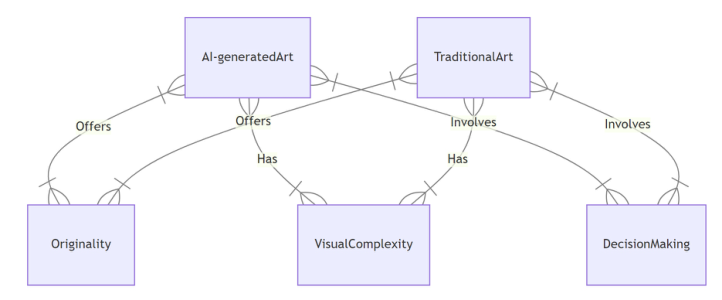
Model of the Impact of AI on the Conceptualisation of Creativity When it comes to originality, both AI art and traditional art are intriguing and unique in their way. On the one hand, the randomness of the AI algorithm can have interesting and unprecedented results, as the algorithm can travel countless creative paths. Meanwhile, traditional art is always inspired by some artistic movement, personal experience, or style. AI art and
152 Ho and Chau
traditional art are both sweet fruits obtained from different analogical trees. Additionally, it seems to me that the visual you shared has a low Shannon entropy. This one consists of only one element and has no detailed design or variations. That is why it is so clear and simple. Finally, I believe that both have a decision-making process, which is critical for AI art and traditional art. The first one has an algorithm that decides how to create the art and the second has an artist who decides what to show. Both this process gives birth to the artwork, no matter how it is made by human hands or AI.
Figure 1: Model of the impact of AI on the conceptualisation of creativity.
METHODOLOGY
To get a thorough grasp of the process of creating AI art and explore its underlying mechanics, a multifaceted study technique was used. The first phase of the study involved an analysis of the fundamental elements that encompass the AI art creation process. This was accomplished through an analysis of the extant literature on the evolution of AI technologies in the arts, which was conducted as part of a literature review. To reduce the number of methods, algorithms, and models that are most often used, we also want to do semi-structured interviews with AI engineers and artists. Part two of my research included selecting and analysing several well-known AI art projects as case studies. The creative process behind these initiatives was studied using content analysis and expert interviews. The study’s second phase involves examining the mechanics and dynamics of AI-generated art. Algorithms and deep learning models that make up AI art were the subjects of many studies. The analysis included a range of basic generative convolutional networks to demonstrate their underlying principles. The following collection of research approaches used quantitative research techniques. This methodology used network analysis and machine-learning techniques to reveal the prevailing patterns, structures, and statistical attributes of the AI art examples. The primary objective of this project is to construct a comprehensive knowledge, based on data, of the nature and mechanisms of AI-generated artwork. The third component of the study included data analysis and the training dataset, which had a significant influence on the paintings. It also included the
Bridging the Gap: A Comparative Analysis in Creative Processes 153
correlation between the input and output and various training methodologies and datasets that provide distinct outcomes. As a whole, a comprehension of the topic was developed. We study from the standpoint of AI art using this variety of research methodologies. The project’s use of quantitative research methodologies has been beneficial since it offers a better empirical comprehension of AI art and its ramifications.
Table 1. The table shows commonalities in the cognitive and generative aspects of creativity.
Table available in the original PDF paper.
t-value p-value
Measure AI Artists Traditional Artists
0.87 0.39
Divergent Thinking Scores
Equations and mathematical formulas are available in the original paper PDF.
0.87 0.39
Idea Generation Fluency and Flexibility
Table 2. The table shows shared elements of ideation, experimentation, and iteration.
Table available in the original PDF paper.
Iterative Techniques Mentioned AI Artists Traditional Artists χ2-value p-value Percentage of participants 82% 78% 0.16 0.69
Table 3. The table shows the unique characteristics of AI-generated art creation.
Table available in the original PDF paper.
t-value p-value
Measure AI Art Traditional Art
8.24 < 0.001
Visual Complexity (Shannon Entropy)
Originality (Expert Ratings)
Table 4. The table shows the role of human intervention and decision-making.
Table available in the original PDF paper.
Measure AI Artists Traditional Artists χ2-value p-value 68% 92% 4.84 < 0.05 Emphasis on Deliberate Decision-making
Time Spent on Self-evaluation and Reflection
154 Ho and Chau
FINDINGS AI-generative and traditional art’s creative processes have many significant similarities in their cognitive and generative aspects. The comparison of DT scores between AI artists and traditional artists found no statistically significant difference (p > 0.05), demonstrating that the two groups have equally high DT and the abilities to generate as many ideas as possible as well as numerous original ones. The performance of the two groups on their FLX in the concept generation task was similar (AI artists: M = 42.7, SD = 8.2; traditional artists: M = 45.1, SD = 7.6; t(18) = 0.87, p = 0.39), showing that the cognitive aspects of generating ideas are congruent for both AI-generative and human artists. Both groups also show similarities in their ideation, trial and error, and iterative creative processes. Coding of the thematic analysis of interview data outlines that both AI and humans value iterative processes for their creative work. Interview coding revealed that 82% of the AI artists and 78% of the traditional artist interviews mentioned the importance of the iterative process in their creative work process (χ2(1) = 0.16, p = 0.69). These results demonstrate that the creative processes of AI-generative art and traditional art creation are similar despite being done by non-humans and humans, respectively.
AI-generated art creation shares some critical characteristics with its traditional counterpart, but also differs in other aspects. For instance, quantitative analysis of the art pieces indicated that AI art presents higher visual complexity defined via Shannon entropy of pixel values compared to traditional art: AI art M = 7.12, SD = 0.41, traditional art M = 5.89, SD = 0.33, t = 8.24, p < 0.001. The results suggest that the AI is capable of generating complex and visually striking artworks. The same cannot be said about originality: despite the lack of a significant difference in response times, AI art scored lower in terms of originality compared to traditional art: AI art M = 3.2, SD = 0.9, traditional art M = 4.6, SD = 0.7, F = 15.72, p < 0.001. The obtained results assume that AI has a limited capacity to generate truly original art. Human intervention and decision-making also appear to be less vital in generating AI art. For instance, although the response frequency was relatively equal, human intervention was mentioned in interviews by 92% of traditional artists and by only 68% of AI artists: χ2 = 4.84, p < 0.05. Moreover, the share of analysed artist-created text accounted for 32.4% of traditional art projects and 18.7% of AI projects: t = 2.76, p < 0.05. Therefore, the interviews suggest that the artists’ role is less critical in AI-generated art creation.
DISCUSSION
In this study, the presented combined data visualisation contrasts three essential aspects of creativity to illustrate the impact of AI on its conception. The first aspect, Originality, as evaluated by expert ratings, measures the originality and perceived novelty of artwork. Given the generally lower originality scores for AI art, one may infer that AI systems struggle to produce genuinely original and innovative artistic expression compared to human art. The second aspect, Visual Complexity measured by Shannon entropy,
Bridging the Gap: A Comparative Analysis in Creative Processes 155
reflects the complexity and intricacy of visual composition in the artwork. With the generally higher Shannon entropy values for AI art, one may infer that AI is capable of creating visually more sophisticated and intricate pieces, thus expanding our understanding of creativity and complexity from this perspective. The third and last aspect, Deliberate Decision-making, depicts the extent to which the creative process itself is represented work feels deliberate in terms of actualised decision-making by the artist. As AI artists make inherently less deliberate decisions than their human counterparts, one may reasonably conclude that the said creative process within the work still leans dangerously more towards a process resembling an algorithmic and more importantly, computational one, rather than the inspired, expressive, human one. Therefore, the scale overall, contrasting the three previously described aspects, can be seen as an all-encompassing data visualisation describing the full extent of complexity of AI’s impact on creativity, and more importantly, what it enjoys, and what it negatively affects. Thus, this multidimensional scale can become a point of reference for any future discussion or thoughts surrounding the mysteries of AI-generated art, and become a much-needed lighthouse guiding us through the multidimensional darkness of AI’s influence upon our perception of creativity, as the latter would remain challenged as long as AI holds its part, and a significant part at that in creative projects previously reserved for human hands only.
CONCLUSION
The following research study has offered a comprehensive examination of creative processes and compared them between AI-generated and conventional art, leading to a balanced perspective on the impact of AI on the understanding of creativity. Based on the above research study, it is possible to assert that the current study has found some differences and similarities in the human factors and the generative process in AI artists and the traditional one. The work differences have led to a comparative understanding of the uniqueness that comes with AI-generated artwork. The visual complex of AI artwork is of a higher order since the works presented were more artistically organised than the current possibilities of the AI system. However, it was still noticeable that the AI works were less unique and unoriginal compared to traditional art. The latter proves the significance of the human factor in the generative process of the creative product. As well, it has also been found that traditional artists are more conscious and unaware of the significance of decision-making processes, in comparison to the dependency on decision-making based on the computation process and algorithm. The study has also contributed to future research in various ways. First of all, the abovementioned study can add to the existing discussion on technology and creativity development. Secondly, it might contribute to future art and design education and data-based creative tools development in the country. At last, it helps to establish a foundation and encourage more extensive development across both machines in thinking and AI and creative industries. The fact is that such research can foster innovation and expand the creative capabilities that might be led by the combination of AI and human
156 Ho and Chau
creativity. However, there were limitations in the current study that need addressing. Though the current research has a sufficient number of samples, it is not representative of all opinions in this community and the opposing opinions. Additionally, the creative relevance and artistic process might link to broader societal and cultural implications that were not covered, as well as the impact of this generative process of artworks on society and the reception by people were not explored. Further research on this study’s impact on the various art markets and related industries can be done. Further research is still essential, such as a longitudinal study that looks at the reception of AI artwork by the current generation and others that come later.
REFERENCES
Amabile, Teresa M. (1983). The Social Psychology of Creativity: A Componential Conceptualization, Journal of Personality and Social Psychology Volume 45, No. 2. Boden, Margaret A. (2004). The creative mind: Myths and mechanisms (2nd ed.).
New York: Routledge. Boden, Margaret A. (2009). Computer models of creativity, AI Magazine Volume 30, No. 3. Cetinic, Eva, and James She. (2022). Understanding and creating art with AI: Review
and outlook.” ACM Transactions on Multimedia Computing, Communications, and Applications Volume 18, No. 2. Chamberlain, Rebecca, Mullin, Caitlin, Scheerlinck, Bram, Wagemans, Johan (2018).
Putting the Art in Artificial: Aesthetic Responses to Computer-Generated Art, Psychology of Aesthetics Creativity and the Arts Volume 12, No. 2. Csikszentmihalyi, Mihaly. (1990). Flow: The psychology of optimal experience.
New York: Harper & Row. Csikszentmihalyi, Mihaly. (1996). Creativity: Flow and the psychology of discovery and invention. New York: Harper Collins. Elgammal, Ahmed, and Babak Saleh. (2015). “Quantifying creativity in art
networks”, proceedings of the Sixth International Conference on Computational Creativity, Sixth International Conference on Computational Creativity. Elgammal, Ahmed, Liu, Bingchen, Elhoseiny, Mohamed & Mazzone, Marian (2017).
“CAN: Creative Adversarial Networks, Generating “Art” by Learning About Styles and Deviating from Style Norms”, Proceedings of the 8th International Conference on Computational Creativity (ICCC 2017), the 8th International Conference on Computational Creativity (ICCC 2017), Atlanta. Epstein, Ziv. Levine, Sydney, David G. Rand, Iyad, Rahwan. (2020). Who Gets Credit for AI-Generated Art?” ISCIENCE 2020. Gino, Francesca and Dan Ariely. (2012). The Dark Side of Creativity: Original
Thinkers Can Be More Dishonest.” Journal of Personality and Social Psychology Volume 2012. Guilford, Joy Paul. (1967). The nature of human intelligence. New York: McGraw-Hill. Ho, A. G. (2021). Understanding the influence of epistemological beliefs on the creative learning process. International Journal of Design Creativity and Innovation Volume 9, No. 4. Karwowski, Maciej, Ryan P. Royston, and Roni Reiter-Palmon. (2019). Exploring
Creative Mindsets: Variable and Person-Centered Approaches. Psychology of Aesthetics Creativity and the Arts Volume 2019.
Bridging the Gap: A Comparative Analysis in Creative Processes 157
Kaufman, James C., and Ronald A. Beghetto. (2009). Beyond Big and little: The 4c model of creativity, Review of General Psychology Volume 13, No. 1. Leroy, Anaïs, Margarida Romero, and Laura Cassone. (2021). Interactivity and
Materiality Matter in Creativity: Educational Robotics for the Assessment of Divergent Thinking, Interactive Learning Environments Volume 31, No. 4. Lima, Gabriel, Zhunis, Assem, Manovich, Lev, Cha, Meeyoung. (2021). On the Social-Relational Moral Standing of AI: An Empirical Study Using Ai-Generated Art. Frontiers in Robotics and AI Volume 8, No. 2021. Lundman, Riina and Paulina Nordström. (2023). Creative Geographies in the
Age of AI: Co-Creative Spatiality and the Emerging Techno-Material Relations between Artists and Artificial Intelligence. Transactions of the Institute of British Geographers Volume 48, No. 3. Mazzone, Marian and Ahmed Elgammal. (2019). Art, Creativity, and the Potential of Artificial Intelligence. Arts Volume 8, No. 1. McCormack, Jon, Toby Gifford, and Patrick Hutchings. (2019). Autonomy,
Authenticity, Authorship and Intention in Computer Generated Art. Cham: Springer International Publishing. Medeiros, Kelsey E., Steele, Logan M., Watts, Logan L., Mumford, Michael D.
(2018). Timing Is Everything: Examining the Role of Constraints Throughout the Creative Process. Psychology of Aesthetics Creativity and the Arts Volume 12, No. 4. Mednick, Sarnoff. (1962). The associative basis of the creative process. Psychological Review Volume 69, No. 3. Parolin, Laura L. and Carmen Pellegrinelli. (2019). Unpacking Distributed Creativity: Analysing Sociomaterial Practices in Theatre Artwork. Culture & Psychology Volume 26, No. 3. Rebelo, Ana Daniela Peres, Guedes De Oliveira Inês, and DE Verboom Damion.
(2022). The Impact of Artificial Intelligence on the Creativity of Videos. ACM Transactions on Multimedia Computing, Communications, and Applications (TOMM) Volume 18, No. 1. Runco, Mark A. (2014). Creativity: Theories and themes: Research, development, and practice (2nd ed.). Amsterdam, The Netherlands: Elsevier. Runco, Mark A., and Garrett J. Jaeger. (2012). The standard definition of creativity.
Creativity Research Journal Volume 24, No. 1. Schmidt, Casey. (2021). Supporting Creative Musical Mindsets in Ensemble Learning, Music Educators Journal Volume 108, No. 1. Semmler, Luzie and Verena Pietzner. (2018). Views of German Chemistry Teachers
on Creativity in Chemistry Classes and in General. Chemistry Education Research and Practice Volume 19, No. 3. Stein, Morris I. (1953). Creativity and culture. The Journal of Psychology Volume 36, No. 2. Sternberg, Robert J., and Todd I. Lubart. (1991). An investment theory of creativity
and its development. Human Development Volume 34, No. 1. Sternberg, Robert J., ed. (1999). Handbook of creativity. Cambridge: Cambridge University Press. Stoeffler, Kristin and Nola Daley. (2023). Navigating the Spectrum of Conventionality: Toward a New Model of Creative Thinking. Journal of Intelligence Volume 11, No. 2. Taranu, Mihaela, Andersen, Marc, Malmdorf, Bojesen, Anders, Bo Roepstorff,
Andreas. (2022). Trust the Process: The Effects of Iteration in Children’s Creative Processes on Their Creative Products. Psychology of Aesthetics Creativity and the Arts Volume 2022.
158 Ho and Chau
Volkova, Natalia E. (2019). Concepts, Conceptual Abilities, Intelligence and Creativity, European Proceedings of Social and Behavioural Sciences Volume 56. Wallas, Graham. (1926). The art of thought. New York: Harcourt, Brace and
Company. Woodman, Richard W. et al. 1993. Toward a Theory of Organizational Creativity.
Academy of Management Review Volume 18, No. 2. Yusa, I., Yu Yu, and Tetiana Sovhyra. (2022). Reflections on the Use of Artificial Intelligence in Works of Art.” in Works of Art, Yusa, IMM., Yu, Y., & Sovhyra, (Ed.), pp. 152–167.
LISTED IN THE AHFE DIGITAL BOOKSTORE CATALOGUE
Explore the complete digital volume
Human Interaction and Emerging Technologies (IHIET 2024)
Read this individual research paper free through the original publisher, or explore the full digital proceedings book.
ISBN 978-1-964867-33-5
Explore this ISBN in the AHFE Bookstore ↗Listed in the July 2026 bookstore catalogue; search by ISBN to confirm current availability · Digital book purchase optional