Michel Muschkiet, Tobias Wulfert (2022). Holistic Customer Experience in Smart City Service Systems – A Conceptual Model. In: The Human Side of Service Engineering. AHFE Open Access, vol. 62, pp. 271–278. https://doi.org/10.54941/ahfe1002567
Through the multiplicity of different actors, smart cities offer many physical and digital touchpoints where interactions with customers can occur for the creation and delivery of smart services. Integrating these touchpoints at different levels offers the potential to foster innovation and stimulate service creation by bringing together different resources. At present, however, service production and delivery in cities is mostly highly parcelled out and isolated by individual providers. A strong competitive spirit is particularly evident in the use of the multitude of data in smart cities, due to its high value when being transformed into valuable smart services. The isolated consideration of services can be one of the central weaknesses of today's cities, leading to a declining attractiveness as a place to stay and consume. Increasing online competition, related changing consumer behavior, and the COVID-19 pandemic are leading to a growing decoupling of work, leisure and shopping from physical locations and thus from the city as a place where services are provided. To strengthen the development of a city, it is necessary to attract customers back by making the experience attractive as a combination of different value contributions, e.g. integrating retail services with smart solutions for the search of nearby free parking spaces, toward an integrated customer experience in cities. Meanwhile it has been argued that customer experience in cities is more holistic than the experience in single service encounters, there is a lack in research in exploring how customer experience in cities can be conceptualized. In this work, we therefore present city experience as an integrative concept which bundles the experiences from various activities in the city toward a holistic customer experience. Following the Design Science Research process suggested by Peffers et al. (2007), examining smart service literature in the field of smart cities and 141 real-world smart city services from the perspective of their contribution to customer experience, we develop a conceptual model which depicts the central determinants of city experience. Our model deepens knowledge in the field of consumer-oriented value creation in smart cities providing an integrative perspective on customer experience, smart cities and smart services. We consider our insights significant for research, as our integrative framework deepens the understanding of a holistic customer experience as a solution to the above-described problems. It provides a basis to further theorize on customer experience in smart cities and on how to design and integrate smart services to create it. Further, our work can help practitioners involved in smart cities in the design of new smart services as well as the evaluation of existing services with respect to their contribution to the city experience. Accordingly, this integrative perspective on smart city services organizes the state of the art of smart service research in a novel way and enhances understanding on the role of smart services to contribute to an overall customer experience. By taking on this view, our research provides important perspectives and results that could significantly contribute to solving the ongoing challenges according to a city’s attractiveness and development.
As a result of technological advancements and rapid urbanization, smart cities have emerged as initiatives consisting of multiple actors which are focu- sed on creating smart services to improve customers’ quality of life (Lipkin, 2016; Giourka et al., 2019). As complex and multilayered smart service systems, smart cities offer many physical and digital touchpoints where inte- ractions with customers can occur. These touchpoints can be integrated at different levels to stimulate service creation by bringing together different resources, such as data (D’Aniello et al., 2020; Kühne and Muschkiet, 2021). At present, however, service design and delivery in cities is mostly highly parceled out and isolated by individual providers (Nam et al., 2011). In con- sequence, smart cities are lacking in collaboratively designing and integrating smart services to exploit the potential for customer-oriented value creation (Muschkiet et al., 2022). This isolated consideration of services could be iden- tified as one of the central weaknesses of today’s cities. Increasing online
competition, related changing consumer behavior, and the COVID-19 pan- demic are leading to a growing decoupling of work, leisure and shopping from physical locations and thus from the city as a place to stay and a place where value emerges (Zwermann, 2021). These developments have negative impacts on the attractiveness of cities for customers (Baersch et al., 2021). To strengthen the development of cities, it is necessary to attract customers back by making the experience attractive as a combination of value contributi- ons across customers’ activities in their daily lives toward a holistic customer experience (Polese et al., 2019; Källström, Persson and Westergren, 2021). Meanwhile it has been argued that customer experience in cities is more holi- stic than the experience in dyadic service encounters, such as in retail stores, there is a lack in research in exploring how customer experience creation in complex service systems (i.e., smart cities) can be conceptualized (Lipkin, 2016). Consequently, this work aims to answer the following research que- stion: How can a holistic customer experience in smart city service systems be created?
To answer this question, we develop a conceptual model for a holistic customer experience, which we call city experience, as an orientation for an integrative service design in smart cities, following the DSR process provided by Peffers et al. (2007). Therefore, we propose an integrative view on litera- ture in the fields of smart city, smart services, and customer experience as a basis for our model’s design and analyze 40 real-world smart city services to identify the central determinants of a city experience.
RELATED LITERATURE To achieve their overall aim of improving customers’ quality of life, smart cities involve a variety of stakeholders from manifold inter-disciplinary domains, such as energy, mobility, health and education, to create value with and for customers using information technologies (Chourabi et al., 2012; Lim, Kim and Maglio, 2018). Being considered as smart service systems, smart cities are complex socio-technical systems which are focused on co- creation of value, with smart services being a central element of interaction in a continuous process of collaboration between customers and public and private companies (Böhmann, Leimeister and Möslein, 2014; Polese et al., 2019; D’Aniello et al., 2020). The term smart service involves actions, pro- cesses, and performances, enabled by smart products that serve as boundary objects and leverage value co-creation for customers through service, based on digital interactions with service providers (Allmendinger and Lombreglia, 2005; Beverungen et al., 2019). Smart services play a key role in delive- ring consumer-centric value to improve customer experience (Betzing, 2018). Customer experience has been traditionally conceptualized as a customer’s internal and subjective response to any direct or indirect contact with a com- pany (Meyer and Schwager, 2007). It involves “the customer’s cognitive, affective, emotional, social, and physical responses” (Verhoef et al., 2009, p. 32) to an organization and is shaped by the combination of all experie- nce clues perceived by the customer – consciously and unconsciously (Berry, Carbone and Haeckel, 2002). In today’s complex service landscapes, such
Holistic Customer Experience in Smart City Service Systems – A Conceptual Model 273
as in cities, customer experience is not limited to such dyadic relationships between customers and a single service provider, but is formed by the diver- sity of a customer’s value-creating interactions with multiple actors (Betzing, Beverungen and Becker, 2018; Becker and Jaakkola, 2020). It appears as a unique phenomenon dependent on different stimuli which are inside or out- side of the service providers’ control and interpreted through the customer’s individual social and cultural contexts (Verhoef et al. 2009; Akaka and Vargo 2015). Most studies on customer experience focus on a dyadic view and a par- ticular set of firm-controlled touchpoints, with a lack of attention to the way experience emerges in smart service systems. Thus, our work aims to close this gap by conceptualizing the holistic customer experience in smart cities as an example of smart service systems, which span the life of customers and all their consumption worlds within the physical space of a city.
DESIGN SCIENCE RESEARCH APPROACH Our research design follows DSR, which offers a suitable approach to create meaningful and practitioner-oriented artifacts, to develop a conceptual model describing customer experience in smart city service systems (Hevner et al., 2004). The city experience model represents a “general solution concept” (Van Aken, 2004, p. 226), that is applicable to a variety of integrated servi- ces (class of problems) in the context of smart cities and should assist in the design and evaluation of integrated smart city services. A design science project should traverse three cycles (rigor, relevance, design) (Hevner et al., 2004). The design cycle of our conceptual model is grounded in existing lite- rature on service science and smart city (rigor cycle) and based on the model of customer experience creation in the context of retail services (Verhoef et al., 2009). It is informed by 40 smart service cases from smart cities all over the world (relevance cycle). For the design of our artifact, we follow the pro- cess as suggested by Peffers et al. (2007). The procedure model consists of six consecutive and iterative phases (1) identify problem, (2) define obje- ctives, (3) design and development, (4) demonstration, (5) evaluation, and (6) communication (Peffers et al., 2007) that are detailed for our research endeavor in the following: The (1) research problem was already described in the introduction and theoretical foundation. Further, we explored its practi- cal relevance working on a smart service platform initialized by a smart city project in a medium-sized German city. The project participants identified the need to understand the overall customer experience in cities as a stra- tegic orientation to guide customer-centered service design and integration. Therefore, we defined the need for related concepts and determined the (2) objective of this research as developing a model of holistic customer experie- nce in smart city service systems. For the (3) design of the model, we examined a set of 40 international real-world services from an integrative perspective regarding their contribution to a holistic customer experience and derived ten city experience determinants. The services were taken from the bee smart city database that provides overviews of globally realized smart city projects across different application fields, such as smart economy and smart environ- ment (Lombardi et al., 2012; bee smart city, 2022). We enriched our study
274 Muschkiet and Wulfert
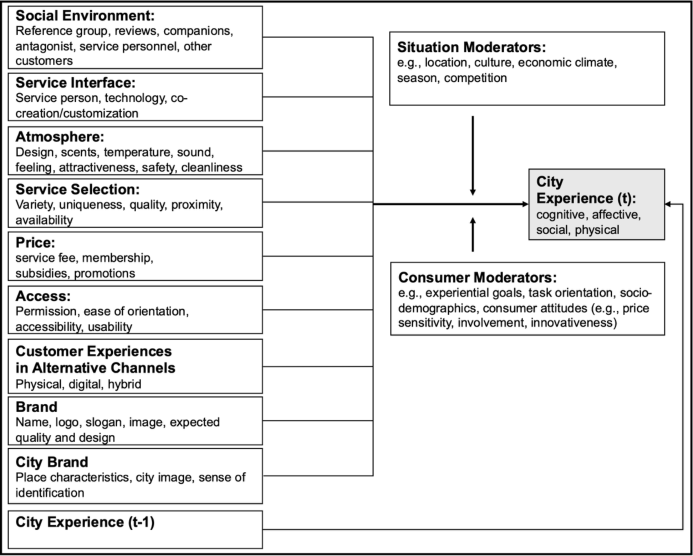
Figure 1: City experience model.
with a literature research of existing customer experience models to develop a basis for the model design. We (4) demonstrate the conceptual model using the integrated case of the mentioned smart service platform. The (5) evalu- ation of the developed model is done in the discussion section based on this case, using informed arguments (Hevner et al., 2004). Our research results are (6) communicated in this and related research (Schütte, Muschkiet and Wulfert, 2022).
CITY EXPERIENCE MODEL We define city experience from a service design perspective as the customer’s internal and subjective responses to all interactions he/she has with a city and its actors in the continuous process of value co-creation (Becker and Jaakkola, 2020). As an extension to the dyadic conceptualization provided by Verhoef et al. (2009), our conceptual model (Figure 1) provides a systemic view on customer experience. It depicts determinants that can be addressed by a variety of city actors on different levels of aggregation, ranging from single service cues to a broader focus of customers’ journeys or activities in their daily lives, and that can elicit different subjective responses depen- ding on individual consumer and situation moderators (Becker and Jaakkola, 2020). The city experience is influenced by the customer’s social environment (Verhoef et al., 2009). It includes a customer’s perceived interactions and rela- tionships with a place or other people (e.g., service personnel, antagonists) in the environment (Hart, Stachow and Cadogan, 2013). Antagonists directly
Holistic Customer Experience in Smart City Service Systems – A Conceptual Model 275
participate in value co-creation in multi-sided services, such as lost and found services or incident reporting platforms. The service interface forms the cen- tral point of contact between a customer and a service. The customer interacts with service personnel or a technical system (e.g., interface of a kiosk system, smartphone app) to co-create and consume a service (Verhoef et al., 2009; Paukstadt, Strobel and Eicker, 2019).
Atmosphere represents the atmospheric conditions in the physical envi- ronment of a customer, for example the perceived attractiveness and sensory stimulations (e.g., sound, temperature) (Källström, Persson and Westergren, 2021). Services which influence the city experience according to the latter include umbrella sharing services and solutions to analyze the air quality in the city. The service selection in a city includes the unique product and service assortment of stores, the variety of available courts on a booking platform for sport facilities, or the set of mobility solutions and free parking spaces close to the customer’s current location. The price of a service or product is determined by a pricing model, such as a transactional fee which the custo- mer pays for using or customizing a service, a membership with a subscription model, or promotions. The customer’s access to services can reflect the physi- cal accessibility, including the ease of orientation in the city, mobility options and parking conditions (Hart, Stachow and Cadogan, 2013; Källström, Pers- son and Westergren, 2021). Further, the usability of technical components has an impact on the access to a service. Another factor is the permission of customers to access and consume a service (e.g., gym membership to unlock digital key). Further determinants of city experience include the brand related to a certain product, service, store or restaurant (Verhoef et al., 2009; Kilian, 2011) or the city brand itself (e.g., image, sense of identification, place cha- racteristics) (Källström, Persson and Westergren, 2021). With an increasing convergence of the digital and physical worlds, the city experience is consi- dered as a composition of the experiences in all channels that the customer uses as part of his or her urban activities (Bolton et al., 2018). The sum of the individual experience in the channel regarded and the customer experie- nce in alternative channels contributes to the overall city experience. Looking at the individual experiences from a process perspective, the city experience manifests itself as a bundle of individual service experiences. A customer’s expectations of an experience at a time (t) are influenced by previous experie- nces, such as the city experience (t-1) (Verhoef et al., 2009). As city experience has been conceptualized as a subjective and context-specific phenomenon, the customer’s responses to the described offering-related stimuli depend on a variety of situation moderators and consumer moderators, including cul- tural and seasonal factors or the customer’s attitudes, task orientation and socio-demographic variables (Verhoef et al., 2009). These contextual factors can make some determinants more or less recognizable or they can affect the evaluative outcomes of particular experiences (Becker and Jaakkola, 2020).
DISCUSSION AND CONCLUSION In contrast to the widely researched dyadic view on customer experience (e.g., in single retail encounters) there is a lack of attention in research to
276 Muschkiet and Wulfert
conceptualize and depict the holistic customer experience in smart service systems (e.g., in smart cities), which is characterized by the variety of a custo- mer’s value-creating interactions with multiple actors. Building on this gap, we developed a conceptual model of a holistic customer experience in smart city service systems – the city experience. Our work supports researchers and practitioners in the design and evaluation of customer-oriented smart servi- ces. Our results show that smart city services address a wide-ranging set of factors that form a holistic city experience. However, the examined services are mostly implemented as isolated solutions and not integrated to reflect and create the city experience as a bundle of individual experiences in the city. Thus, we propose to align service design to the overall goal of creating this holistic experience.
A practical example of service integration was used to illustrate and vali- date the set of determinants from our model for creating a holistic experience. One of this work’s authors is involved in the development of a customer experience-oriented smart service platform in a medium-sized German smart city. The goal of the project is to support collaboration among a multitude of city actors in the design and integration of smart services on a focal platform to create valuable city experiences. Using a single city account and a mobile app, customers can get access to personalized services and recommendati- ons that combine different activities within the city to build an optimized experience. For example, customers can discover different neighborhoods by scanning QR codes at popular sights and additionally earn rewards to receive personalized offerings and vouchers for nearby shops. Another example is the combination of a search function for the product assortment in multiple sto- res across the city and a recommendation system which presents the best store and travel options based on product availabilities and the customer’s current location and preferences. As there is a lack of attention in research in exami- ning technical approaches to support such an integrated service design with a focus on city experience, we call for research that defines requirements for such systems and provides solutions to enhance the creation of personalized and holistic customer experiences in smart city service systems.
REFERENCES
Allmendinger, G. and Lombreglia, R. (2005) ‘Four strategies for the age of smart services’, Harvard Business Review, 83(10), pp. 131–145. Baersch, S. et al. (2021) ‘Local Retail Under Fire: Local Shopping Platforms Revisited
Pre and During the Corona Crisis’, in WI 2021. Essen, Germany. Becker, L. and Jaakkola, E. (2020) ‘Customer experience: fundamental premises and implications for research’, Journal of the Academy of Marketing Science, 48(4), pp. 630–648. bee smart city (2022), https://www.beesmart.city/solutions (Accessed: 11 January
2022). Berry, L.L., Carbone, L.P. and Haeckel, S.H. (2002) ‘Managing the Total Customer Experience’, MIT Sloan Management Review. Betzing, J.H. (2018) ‘Beacon-based customer tracking across the high street: Perspe-
ctives for location-based smart services in retail’, in AMCIS 2018. New Orleans, USA.
Holistic Customer Experience in Smart City Service Systems – A Conceptual Model 277
Betzing, J.H., Beverungen, D. and Becker, J. (2018) ‘Design Principles for Co-Creating Digital Customer Experience in High Street Retail’, in MKWI 2018. Lüneburg, Germany, pp. 2083–2094. Beverungen, D. et al. (2019) ‘Conceptualizing smart service systems’, Electronic
Markets, 29(1), pp. 7–18. Böhmann, T., Leimeister, J.M. and Möslein, K. (2014) ‘Service-Systems-Engineering: Ein zukünftiges Forschungsgebiet der Wirtschaftsinformatik’, WIRTSCHAFT- SINFORMATIK, 56(2), pp. 83–90. Bolton, R.N. et al. (2018) ‘Customer experience challenges: bringing together digital,
physical and social realms’, Journal of Service Management, 29(5), pp. 776–808. Chourabi, H. et al. (2012) ‘Understanding Smart Cities: An Integrative Framework’, in HICSS 2012. IEEE, pp. 2289–2297. D’Aniello, G. et al. (2020) ‘Knowledge-Based Smart City Service System’, Electronics,
9(6), p. 965. Giourka, P. et al. (2019) ‘The Smart City Business Model Canvas—A Smart City Business Modeling Framework and Practical Tool’, Energies, 12(24), pp. 4798–4814. Hart, C., Stachow, G. and Cadogan, J.W. (2013) ‘Conceptualising town centre image
and the customer experience’, Journal of Marketing Management, 29(15–16), pp. 1753–1781. Hevner, A.R. et al. (2004) ‘Design Science in Information Systems Research’, MIS Quarterly, 28(1), pp. 75–105. Källström, L., Persson, S. and Westergren, J. (2021) ‘The role of place in city centre
retailing’, Place Branding and Public Diplomacy, 17(1), pp. 36–49. Kilian, K. (2011) Determinanten der Markenpersönlichkeit: relevante Einflussgrössen und mögliche Transfereffekte. 1. Aufl. Betriebswirtschaftlicher Verlag Gabler. Kühne, B. and Muschkiet, M. (2021) ‘Analyzing Actor Engagement in Data-Driven
Business Models Innovation in the Context of Smart Cities by Creating a Common Understanding’, in AHFE 2021. New York, USA. Lim, C., Kim, K.-J. and Maglio, P.P. (2018) ‘Smart cities with big data: Reference models, challenges, and considerations’, Cities, 82, pp. 86–99. Lipkin, M. (2016) ‘Customer experience formation in today’s service landscape’,
Journal of Service Management, 27(5), pp. 678–703. Lombardi, P. et al. (2012) ‘Modelling the smart city performance’, Innovation: The European Journal of Social Science Research, 25(2), pp. 137–149. Meyer, C. and Schwager, A. (2007) ‘Understanding Customer Experience’, Harvard
Business Review, 85(2), pp. 116–126. Muschkiet, M. et al. (2022) ‘Making Data Valuable for Smart City Service Systems
- A Citizen Journey Map for Data-driven Service Design’, in WI 2022. Nürnberg, Germany. Nam, T. et al. (2011) ‘Smart cities and service integration’, dg.o ‘11, College Park, Maryland: ACM Press, p. 333–334. Paukstadt, U., Strobel, G. and Eicker, S. (2019) ‘Understanding Services in the Era of
the Internet of Things: a Smart Service Taxonomy.’, in ECIS 2019, Stockholm and Uppsala, Sweden. Peffers, K. et al. (2007) ‘A Design Science Research Methodology for Information Systems Research’, Journal of Management Information Systems, 24(3), pp. 45–77. Polese, F. et al. (2019) ‘Smart City as a Service System: A Framework to Improve
Smart Service Management’, Journal of Service Science and Management, 12(01), pp. 1–16.
278 Muschkiet and Wulfert
Schütte, R., Muschkiet, M. and Wulfert, T. (2022) ‘Smart City Experience: von isolierten Services zu Smart Service-Ökosystemen’, in Bruhn, M. and Hadwich, K. (eds) Forum Dienstleistungsmanagement. Heidelberg: Springer, pp. 1–25. Van Aken, J.E. (2004) ‘Management Research Based on the Paradigm of the Design
Sciences: The Quest for Field-Tested and Grounded Technological Rules’, Journal of Management Studies, 41(2), pp. 219–246. Verhoef, P.C. et al. (2009) ‘Customer Experience Creation: Determinants, Dynamics and Management Strategies’, Journal of Retailing, 85(1), pp. 31–41. Zwermann, B. (2021) ‘So retten wir die City’, Der Handel, pp. 36–40.
LISTED IN THE AHFE DIGITAL BOOKSTORE CATALOGUE
Explore the complete digital volume
The Human Side of Service Engineering
Read this individual research paper free through the original publisher, or explore the full digital proceedings book.
ISBN 978-1-958651-38-4
Explore this ISBN in the AHFE Bookstore ↗Listed in the July 2026 bookstore catalogue; search by ISBN to confirm current availability · Digital book purchase optional