Lingyan Zhang, Xinyi Chen, Yun Wang, Zuyao Zhang, Jihong Zhu, Xuan Dong (2023). Assessment of wine bottle packaging based on design aesthetics: An eye-tracking experiment. In: Ergonomics In Design. AHFE Open Access, vol. 77, pp. 62–72. https://doi.org/10.54941/ahfe1003363
To evaluate the aesthetic characteristics of wine bottle packaging pattern design, this study conducted an eye-tracking experiment. 10 participants were invited to accept the experiment using a within-subjects multi-factor experimental method. The subjects' browsing time, fixation duration, eye-movement sweeping path, and subjective evaluation were collected during the experiment and analyzed in combination with hotspot maps. The data showed that: (1) in graphic dimension, wine bottle packaging design without bottom cover (total browsing time=2562ms), with texture (t=4813ms), and irregular composition (t=3516ms) can better attract users' attention time. (2) in color dimension, wine bottle packaging design with high brightness, high saturation, and warm colors can better attract users' attention time (t=5578ms). (3) in text dimension, the wine bottle packaging design with serif fonts (t=4328ms) is more attractive to users' attention time. (4) in modeling dimension, the wine bottle packaging design with rounded shape (t=3891ms) is more attractive to users' attention time. The results show that wine bottle packaging with no bottom cover, textured, irregular composition, serif fonts, and rounded shape attracts users' attention more and receives higher scores on users' subjective evaluation of aesthetic indicators. This study provides an empirical study of wine bottle packaging design based on design aesthetic elements, which provides a guiding basis for enhancing the competitiveness of wine bottle packaging in the market.
The packaging is the surface of the product and is usually the only pro- duct that consumers experience prior to purchase (Marsh and Bugusu, 2007). Consequently, distinctive or innovative packaging can boost sales in a compet- itive environment. The package may be designed to enhance the product image and/or to differentiate the product from the com-petition. As one of the packaging systems, product outer packaging has long played a major role in protecting the quantity and quality of products and facilitating display, transportation and storage (Xu et al. 2021). In the past, people’s eyes were mainly focused on the performance and value of the product itself, and
Assessment of Wine Bottle Packaging Based on Design Aesthetics 63
the demand for the added value of the product packaging was low. But with the change of public consumption concept, the external packaging gradually evolves into an important purchase indicator, and also becomes an important factor to stimulate consumers’ purchasing behavior (Tian, 2018). Excellent food packaging can provide users with accurate and clear product informa- tion, as well as a pleasant and comfortable consumption and use experience, while bringing a differentiated, personalized and emotional shopping and use experience, thus increasing user stickiness and enhancing brand value (Francesca and Matthew, 2016).
Chinese Baijiu has a long history and unique national cultural connota- tions in China. Chinese Baijiu packaging is not only a carrier for storage, protection, portability and transportation, but it also plays an important role in the visual sensory experience of consumers (Yuan and Peng, 2017). In recent years, a large number of bottle packaging design studies have shown that different design elements convey different brand impressions, and con- sumers judge brand value through the aesthetics of the design, which may influence their willingness to purchase (Limon et al. 2009). For example, the results of a study on Coca-Cola packaging showed that aesthetically pleasing packaging significantly increased the response time of consumer choice responses, and they were preferred over well-known brand products in standardized packaging, despite higher prices (Reimann et al. 2020).
The purpose of packaging is to ensure that products can be seen and con- sidered to help shoppers select from the shelf (Wang and Chou, 2011). The consumer’s ability to find a product (package findability) is directly affe- cted by the quality of pack-age design when various goods are displayed on the shelf (Mu and Wang, 2012). Visual guidance plays an important role in this segment, and based on the way it guides the design of the outer packa- ging of liquor, effective packaging design can attract consumers’ attention, improve their experience, and prolong their stay in front of the product, thus bringing sales opportunities (Cheverton, 2004) Eye-tracking experiments are widely used and have been importantly applied in user psychology resea- rch, user experience, packaging design, etc. A large amount of research data can prove that eye-tracking experiment is feasible in the study of wine bottle packaging design.
In summary, packaging is an important factor that influences the purch- ase decision, and the aesthetic factors of wine bottle packaging design vary in the time of attraction to the user’s gaze. An increase in gaze time will result in higher returns, and the more effective the packaging is in stimu- lating the consumer’s vision, the more impressive the product will be (Pine and Gilmore, 1999). Therefore, it is an important task for designers and wine marketers to optimize the findability of wine bottle packaging through design aesthetics factors. In this study, an eye-tracking experiment will be designed to conduct eye-tacking experiments on the aesthetic elements of wine bottle packaging design, to record and quantify the changes in consu- mers’ eye-movement trajectories when viewing wine bottle packaging during the shopping process, to obtain the application patterns of design aesthetic elements on wine bottle packaging, and to further propose design suggestions for wine bottle packaging.
AESTHETIC FACTORS OF BOTTLE PACKAGING DESIGN The promotion of products can not be separated from the packaging, the good or bad packaging has a certain impact on the sales of products, the well pattern of the packaging can better attract people’s attention and improve the efficiency of advertising. For packaging design, its aesthetic features contain a variety of factors, and all have specific aesthetic value, such as graphic, color, text, shape, etc., which affect the actual benefits of packaging design.
Graphic In packaging design, graphic is the most important visual expression langu- age, which is an important factor to convey the image of goods. Graphic design has a strong visual impact in product packaging design, which makes the package attract the attention of consumers in a very short time, and then achieve the function of promotion. This study focuses on the visual guidance effect of the relationship between the figure-ground, texture and composition in the packaging design.
Figure-ground is a relationship between visual subject and background, which is interdependent and can be transformed under certain conditions. The issue of figure-ground relationship has a very wide range of applications in art design. This experiment classifies the relationship between the bottom of the figure into two kinds: the background of the image covering the bottle and not covering the bottle.
Texture, generally refers to the pattern or line on the surface of the object, different kind of texture gives a different sense of hierarchy and highlighting the visual effect. However, it is also somebody believed that the packaging without texture is more simple. Therefore, this experiment will set up two kinds of bottles with and without texture.
Composition, through regular composition to play a role in balancing the visual effect of the picture, is a common practice in packaging design, and most regular composition practices are to keep the packaging pattern as sym- metrical as possible. This experiment will design both regular composition and irregular composition to explore which composition is more attractive to users’ attention.
Color Among the various visual elements of modern packaging design, the most active and influential factor is color, which as a modeling language can fully demonstrate the brand and personality of the product. Color has three basic characteristics: brightness, saturation, and hue.
Brightness refers to the brightness of a color. The color matching of high brightness shades creates elegant and bright tones, which are often used in some food packaging. Saturation refers to the degree of purity of color, which indicates the proportion of color components contained in the color. Hue is to be able to more accurately represent the name of a certain color shade. The overall design details of the packaging color is generally composed of multiple hue-assisted configuration.
Assessment of Wine Bottle Packaging Based on Design Aesthetics 65
Table 1. Aesthetic factors of package design.
Table available in the original PDF paper.
Category Characteristic Level I Level II Graphic Figure-ground cover without cover Texture texture without texture Composition regular irregular Color Brightness high low Saturation high low Hue warm cool Text Font serif sans serif Modeling Shape square round
Text Text is an indispensable element in packaging design. As an extension of graphics in graphic design and the main carrier in the process of information dissemination, commodity packaging needs to convey product information through text. The western alphabet system is divided into two categories: serif and sans serif. Serif fonts have extra decorations at the beginning and end of the strokes of the characters. Sans serif fonts do not have these extra decorations.
Modeling In this study, modeling mainly refers to bottle body design. Relevant stu- dies have shown that the shape of the package and the ratio of the length can affect people’s preference for the product, which in turn affects market sales (Raghubir and Greenleaf, 2006). Therefore, this study will design two kinds of bottle shapes with large differences in styles, square and round, for experimental comparison.
Based on the above factors, the aesthetic factors level of packaging design is divided, and the aesthetic factors is obtained as shown in Table 1.
EXPERIMENT DESIGN In order to understand how the aesthetic factors of package design attract the consumer’s attention, this study will take an eye-tracking experiment, using the aesthetic factors as the independent variable, the Subjective response and the eye-tracking index as the dependent variable, to conduct an empirical study.
Apparatus The experiments were conducted using an I track-60 (EYETECH, USA) por- table eye-tracking device and its processing and analysis software, recording the data of the participant’s eye movements with a sampling rate of 60 Hz and a 24-inch display, and presenting the material guided to the system that comes with the eye-tracking device.
Participants 10 participants were invited to perform the experiment, including 5 males and 5 females, with an average age of 31.80 ± 3.52. To prevent practice effects, none of the participants were exposed to the experimental test sample, and none of the participants were visually impaired.
Material Based on the table of aesthetic factors, the researcher designed a group of Chinese Baijiu packaging. The experimental variables were strictly controlled in this material, and all variables were kept consistent except for the inde- pendent variables set in each group. The experimental materials are shown in Table 2.
Table 2. Experimental material diagram.
Table available in the original PDF paper.
Category Characteristic Level I diagram Level II diagram
Graphic Figure-ground cover without cover
Texture texture without texture
Composition regular irregular
Color Brightness high low
Saturation high low
Hue warm cool
Text Font serif sans serif
Modeling Shape square round
Assessment of Wine Bottle Packaging Based on Design Aesthetics 67
Assessment Criteria This study will combine subjective and objective data to jointly evaluate each group of package designs. The subjective data include package preference and purchase intention, preference for subjects to evaluate according to a 5-point scale, and purchase intention for users to answer how much they are willing to spend on each group of package designs. Objective data were obtained from eye-movement data, mainly heat zone map, total browsing time, total gaze time, first gaze duration time, and average sustained gaze time. The specific evaluation indexes and their meanings are shown in Table 3.
Assessment Criteria The experimental task is an untimed task in which the participants sits in front of a monitor and browses through the package of white wine presented on the monitor. Before the experiment starts, the following prompt will be presented on the screen: The experiment is about to start. Suppose you are in a store and need to buy a bottle of Chinese Baijiu, and the salesperson provides you with a picture book of Chinese Baijiu. The browsing process is open-ended and you can switch between pictures according to your reading habits and press enter to turn the page.
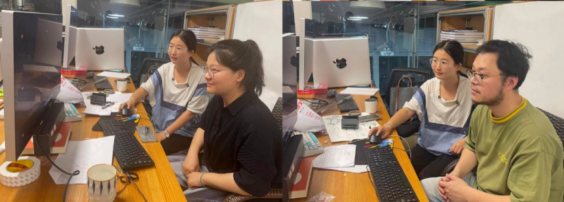
Procedure After the experimenter made sure everything was ready, the participants were allowed to sit in front of the eye-tracking device about 70 cm for calibra- tion and adjust the sitting posture. Use the calibration interface to check the accuracy of the eye-tracking effect. After passing the accuracy check, start the formal experiment, and the participant operates according to the experimental task. The experiment avoids reminders and needs to be com- pleted independently by the participant, and the experimenter records all self-reports and questions during the experiment. During the experiment, the experimenter always observes the user to ensure that the user’s eyes are within the controllable range of the eye-tracking instrument, and keeps a record of the whole experiment. Until all the experimental material is presented, the experiment is finished. The experimental scenes are shown in the Figure 1.
Table 3. Experiment assessment criteria.
Table available in the original PDF paper.
Criteria Segmenting Index Explanation Preference How much consumers like each package.
Subjective assessment Purchase intention How much consumers are willing to pay for this item. Eye movement
First sustained gaze on certain areas of visual interest.
Heat zone map represents the attention distribution and show.s the cumulative number of gaze of the subjects Total browsing time The time spent by the subjects in viewing each picture was recorded. Total gaze time The total gaze time of the subjects while viewing the pictures was recorded. First gaze duration time Average sustained gaze time Mean value of sustained hosting time for a specific region of visual interest.
Figure 1: Experimental scene.
Unrelated Variable Control To reduce the order effect, the material in the experiment will appear using a random order to partially offset the effect of experimental order. To reduce the line of sight error, a picture with a black background and a central white dot will be added between every two experimental diagrams to refocus the subjects’ gaze at the same location to prevent line of sight error.
RESULTS AND DISCUSSION
The eye-movement responses of the experimental participants to the test samples were collected, and the test processing data such as eye-movement hot spot map eye-movement gaze time, etc. A total of 10 participants’ eye-movement data were recorded, and all of them were valid samples. The information of the collected data was summarized and analyzed, and the following results were obtained.
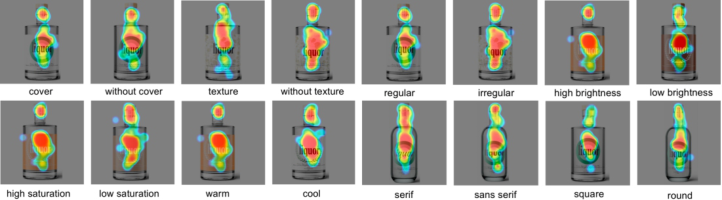
Heat Zone Map The hot zone map is a common form of eye-movement data, which can intui- tively reflect the participants’ attention to each area of the test sample, and the results of this experiment are shown in Figure 2. For the regular com- position, the focus of attention is more concentrated, while for the irregular composition, users’ attention is more scattered.
Figure 2: Heat zone map.
Assessment of Wine Bottle Packaging Based on Design Aesthetics 69
Eye Movement Data The experimental results were statistically analyzed by superimposing the eye-movement gaze times of the 10 participants to take the mean values, and the results are shown in Table 4. From the total browsing time, the following conclusions can be drawn: (1) in graphic dimension, the wine bottle packa- ging design without graphical underlay (total browsing time = 2562ms), with texture (t = 4813ms), and without regular composition (t = 3516ms) is more attractive to users’ gaze time. (2) in color dimension, the wine bottle packa- ging design with high brightness, high saturation, and warm colors is more attractive to users’ gaze time (t = 5578ms). (3) in text dimension, the wine bottle packaging design with serif font (t = 4328ms) is more attractive to users’ gaze time. (4) in modeling dimension, the wine bottle packaging design with rounded shape (t = 3891ms) is more attractive to users’ gaze time.
From the perspective of the first gaze duration and the average continu- ous gaze duration, the first gaze duration of the low brightness wine bottle packaging is the longest, probably because the low brightness packaging will give people the feeling of not seeing clearly, so they will pay attention for a longer time when they first gaze. This may be related to the design of the experimental material. In this experiment, white was chosen as the bottom color, and the presence of white as the background color was lower because the user’s gaze was more focused, resulting in the longest total gaze time for the cool color packaging in this experiment.
Subjective Assessment The subjective ratings of the 10 participants were averaged and the results were obtained as shown in Table 5. In terms of the aesthetic ratings, (1) in the graphic dimension, the participants thought that the wine bottle package designs without graphic underlay (score = 3.7), with texture (s = 3.2), and without regular composition (s = 3.2) were more aesthetically pleasing. (2)
Table 4. Eye movement data statistics (ms).
Table available in the original PDF paper.
Total gaze time
Category Characteristic Level Total browsing time
First gaze duration time
Average sustained gaze time Graphic Figure-ground cover 2125 912.4 1920.2 617.1 without cover 2562 539.1 2109 459 Texture texture 4813 718.6 1857.8 496.9 without texture 3516 615.6 1813.8 414.1 Composition regular 2125 912.4 1920.2 617.1 irregular 3516 615.6 1813.8 414.1 Color Brightness high 5578 537.6 1649.9 469.4 low 3125 1072.1 2023.5 771.8 Saturation high 5578 537.6 1649.9 469.4 low 3547 573.4 2740.5 486.6 Hue warm 5578 537.6 1649.9 469.4 cool 5218 856.3 3000.7 543.9 Text Font serif 4328 646.9 2165.6 413.2 sans serif 4125 681.2 1910.8 510.9 Modeling Shape square 3516 539.1 2109 459 round 3891 798.6 1707.8 733.9
Table 5. User subjective evaluation results.
Table available in the original PDF paper.
Category Characteristic Level Preference Purchase Intention(yuan) Medium
in the color dimension, the participants thought that the wine bottle package designs with low brightness (s = 2.8), low saturation (s = 3.0), and cool colors (s = 3.1) were more aesthetically pleasing. (3) in the text dimension, the parti- cipants thought that the wine bottle packaging design with serif font (s = 2.9) was more beautiful; (4) in the shape dimension, the participants thought that the wine bottle packaging design with roundness (s = 3.0) was more esthe- tical. It can be seen that all the results, except for the color dimension, are consistent with the total viewing time results for eye movements.
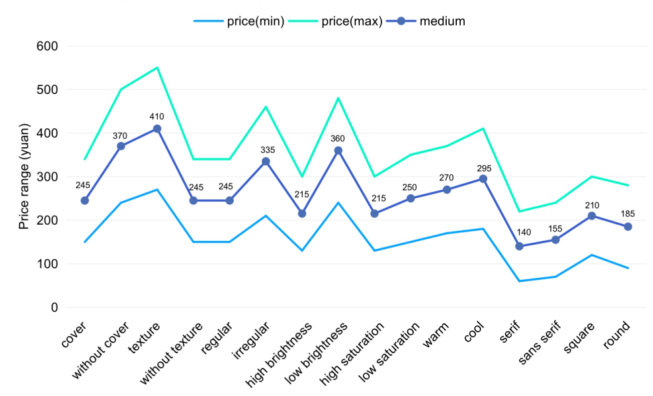
When asked about the purchase intention, the participants provided the price range they were willing to buy, and the median value was taken for the results, and a line graph was drawn as shown in Figure 3. The results
Assessment of Wine Bottle Packaging Based on Design Aesthetics 71
show that the subjects were willing to pay the highest price for the textured version of the wine, which also shows that the texture can adjust the graphic and color hierarchy of the product packaging to enhance the quality of the product, thus deepening the user’s impression of the product and promoting the sales of the product.
CONCLUSION
In summary, to investigate how the aesthetic factors of wine bottle packaging design affect consumers’ visual attention allocation, an eye-tracking experi- ment was designed in this study, in which 10 participants were invited to the experiment. The results of the experiment showed that wine bottle packaging without cover base overlay, textured, irregular composition, serif fonts, and rounded shapes attracted users’ attention more and received higher scores on users’ subjective evaluation of aesthetic indicators. Eye-tracking technology provides some indicator references for the study of wine bottle packaging design, enabling designers to gain a deeper understanding of consumers’ attention allocation characteristics and likability needs, and thus find new design directions. However, there are still some limitations in this study, such as the small number of participants and the fact that it only explores Chinese consumers’ perceptions of baijiu packaging design, and the number of subje- cts can be expanded in the future to do a larger empirical study to make the results more generalizable.
ACKNOWLEDGMENT
Supported by Design–AI lab of China Academy of Art (CAADAI2022A001).
REFERENCES
Cheverton, P. (2004) “Key Marketing Skills: Strategies, Tools, and Techniques for Marketing Success”, in: Kogan Page, London. second ed. Francesca, Z. Matthew, P. (2016) Food Design Thinking: A Branch of Design
Thinking Specific to Food Design, Journal of Creative Behavior Volume 50 No. 3. Limon, Y. Kahle, L. Orth, U. (2009) Package design as a communications vehicle in cross-cultural values shopping. Journal of International Marketing, Volume 17 No. 1. Marsh, K. Bugusu, B. (2007). Food Packaging—Roles, Materials, and Environmental
Issues, Journal of Food Science Volume 72. Mu, C. Wang, R. (2012) Displayability: An assessment of differentiation design for the findability of bottle packaging, Displays Volume 33 No. 3. Pine, B. J., Gilmore, J. H. (1999) “The Experience Economy: Work is Theatre &
Every Business a Stage”, in: Harvard Business School Press, Boston. Raghubir, P. Greenleaf, E. A. (2006) Ratios in proportion: what should the shape of the package be, Journal of Marketing Volume 70 No. 2. Reimann, M. Zaichkowsky, J. Neuhaus, C. (2010) Aesthetic package design: A beh-
avioral, neural, and psychological investigation, Journal of Consumer Psychology Volume 20 No.4. Tian, F. (2018). Prsonalization and Customization Be come the New Trend of Consumption. Packaging andPrinting Industry Will Usher in New Changes, DigitalPrinting Volume 10.
Wang, R. Chou, M. (2011) Differentiation in the arched surface of packaging: its inflfluence on the fifindability of logo typography displays, Displays Volume 32 No. 1. Xu, G. Zhang, L. Li, S. (2021). Differentiation of Liquor Packaging Design Based on
Eye Movement Analysis, packaging engineering Volume 42 No. 24. Yuan, E. Peng, Y. (2017) Rational Construction of Integrated Materials in Packaging Design of Liquor, packaging engineering Volume 38 No. 4.
LISTED IN THE AHFE DIGITAL BOOKSTORE CATALOGUE
Explore the complete digital volume
Ergonomics In Design
Read this individual research paper free through the original publisher, or explore the full digital proceedings book.
ISBN 978-1-958651-53-7
Explore this ISBN in the AHFE Bookstore ↗Listed in the July 2026 bookstore catalogue; search by ISBN to confirm current availability · Digital book purchase optional