Lingyan Zhang, Shuangying Chen, Yun Wang, Jiqing Fu, Qianxi Zhang, Jiarui Liu (2024). Application and Prospect of Mixed Reality in Design Experiment Teaching. In: Ergonomics In Design. AHFE Open Access, vol. 129, pp. 148–162. https://doi.org/10.54941/ahfe1004820
This study aims to explore the application of mixed reality in experimental safety teaching, designing and implementing a mixed reality-based experimental teaching method to enhance the effectiveness of experiments and user experience. Through field visits to design laboratories and expert interviews, this research analyzes the existing problems in design experimental teaching and real user needs. It proposes a multi-level, multi-dimensional mixed reality innovation design experiment platform construction method from teaching to dialogue, from human-computer interaction to perception, from creation to manufacturing, and from communication to thinking. Finally, this study uses the intelligent cockpit interface experience perception mixed reality experimental platform as an example to confirm that mixed reality technology can provide an immersive learning experience. This research provides theoretical support and practical reference for the application of mixed reality in experimental safety teaching, and offers prospects for future teaching design and research.
The construction of the mixed reality system for design experimental teaching aims to address the challenges and opportunities faced by current students in the field of design experimentation. Design, as an innovation discipline confronting life, production, and ecology, considers experimentation as a vital component. Experimentation is not only an extension of theory but also a process of applying practice to verify potential possibilities. Design experiments are processes rather than results; they embody the construc- tion of design imagination and serve as an exploratory experiment into the uncertainties of design.
Currently, design experiments still adhere to traditional models conducted within physical spaces. Traditional physical tools confine designers to the 1.0 phase of manual creation. The advent of computers shifted the creation process to the 2.0 phase of virtual expression. The emergence of mixed reality technology propels designers into the 3.0 phase, where virtual and physical worlds coalesce.
In the present era, the knowledge structure of design disciplines is tran- sitioning from traditional clusters of culture, philosophy, aesthetics, form,
Application and Prospect of Mixed Reality in Design Experiment Teaching 149
structure, and craftsmanship towards emerging knowledge systems such as big data, intelligence, algorithms, industry chains, and ecosystems. Concur- rently, novel knowledge unit courses, such as human-computer interaction, creative programming, sensory engineering, AIOT prototype design, data visualization, data intelligence services, business innovation, and social inno- vation, continue to emerge. Design experiments hold significant importance in design education; they assess and validate the feasibility and effective- ness of design outcomes, methods, or principles. They aid designers in understanding user needs, testing design solutions, and guiding design deci- sions. Additionally, design experiments provide empirical evidence for design research, propelling the development and innovation of the design discipline.
Teaching design experiments has always been a central topic in design edu- cation, serving as a crucial means of cultivating students’ innovative thinking and problem-solving abilities. Traditional safety training for experiments primarily relies on classroom teaching and textbook knowledge. However, this approach often struggles to realistically simulate complex experimental scenarios, limiting students’ adaptability when facing actual design prob- lems. Furthermore, traditional laboratory teaching is frequently constrained by spatial, equipment, and resource limitations, hindering the provision of diverse and realistic learning experiences.
In the current era of rapid technological advancement, the rise of Mixed Reality (MR) technology presents limitless possibilities for the field of design education. MR technology has transformed human-machine perception and behavior, profoundly influencing the reform of design teaching methods. With its innovative characteristics, MR technology brings unprecedented possibilities to experimental teaching, merging the virtual world with the real environment to create an entirely new perceptual experience. It provides students with highly interactive and personalized learning scenarios.
This paper focuses on the application of mixed reality technology in design experimental teaching, addressing existing issues within the design experi- mental teaching scenario. It analyzes the essential elements in constructing a mixed reality design experimental teaching system and explores how mixed reality technology can alter the traditional modes of design experimental teaching. The paper concludes by presenting the design and development of a mixed reality-based design experimental teaching system, aiming to pro- vide students with a more intuitive and comprehensive design experimental teaching experience.
RELATED WORKS Current State of Mixed Reality Research
With the rapid global advancement of artificial intelligence technology, mixed reality emerges as a new technology in contemporary times. Its unique inter- active approach enters our field of vision by introducing real-world scene information into virtual environments, forming an interactive feedback loop between the virtual world, the real world, and the user. The development of mixed reality technology has transformed human activities from natural plat- forms to digital virtual spaces, leading to a shift in perception and behavior.
This profound impact extends to the transformation of societal production methods, influencing lifestyles, behaviors, perception modes, and thinking modes.
Technological advancements such as virtual reality, augmented reality, and mixed reality, which rapidly blend virtual and real elements, have introduced novel experiential modes to users through varying degrees of integration between digital information and the real environment (Chu Leyang, 2019).
The introduction of the concept of the “metaverse” by Elon Musk in 2022 has once again made the fusion of virtual and real a focal point of research in the field of human-computer interaction. To date, numerous groups and enterprises worldwide have emerged to develop mixed reality systems. Prominent players in terms of technological maturity and influence include Microsoft, Magic Leap, Meta, Apple, among others. These technol- ogy companies have extensive deployments in the field of mixed reality and are dedicated to the research and application of mixed reality technology. Microsoft’s HoloLens glasses, currently in their third generation, are already in use in the market, and much of the ongoing research related to mixed reality is based on the HoloLens platform.
In addition to Microsoft’s HoloLens, an increasing number of mixed reality devices have entered the consumer market in recent years. For example, in June 2023, Apple released its first mixed reality headset, the Apple Vision Pro, which is set to be launched in early 2024. The introduction of Vision Pro is expected to usher in a new wave of enthusiasm for mixed reality.
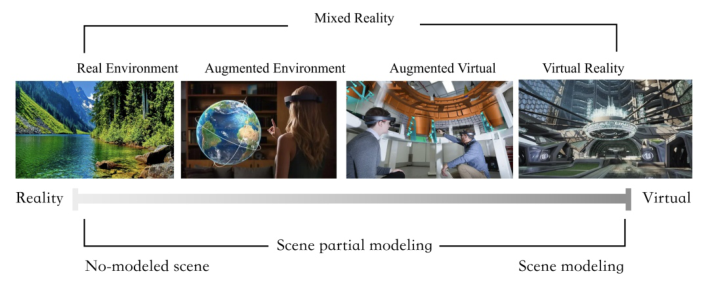
Mixed reality technology, as an interactive technology that integrates vir- tual and real elements, has made significant progress in various fields in recent years. The invention of the Sensorama simulator by Morton Heilig in 1956 is considered an early virtual reality device. In 1968, Ivan Suther- land, considered the father of computer graphics, and student Bob developed the first computer graphics-driven head-mounted display (HMD) and head position tracking system, named “Sword of Damocles.” This marked a sig- nificant milestone in the technological development of virtual reality. In the early 1980s, stereoscopic display and 3D graphics technology began to emerge, providing necessary tools for creating virtual worlds and forming the foundation for complex interactions in mixed reality environments. In 1994, Milgram and Kishino published a groundbreaking paper, “A Tax- onomy of Mixed Reality Visual Displays,” defining the concept of “mixed reality” and the “mixed reality continuum” model (Figure 1), clearly delin- eating the boundaries between “mixed reality,” “augmented reality,” and “virtual reality.” The continuum presents a range from completely real to completely virtual, with any environment not falling into these extremes termed as “mixed reality.”
In June 2023, Apple released its first headset, Apple Vision Pro, equipped with multiple cameras, enabling users to operate and control it through ges- tures, eye movements, or voice commands for work, entertainment, and communication. This signifies the arrival of another wave of excitement for mixed reality.
Application and Prospect of Mixed Reality in Design Experiment Teaching 151
Figure 1: Definition of mixed reality.
Current State of Design Experimental Teaching In the field of design, experimentation serves as a method for design research, aiming to validate the effectiveness of design theories, methods, or principles. It aids designers in gaining a better understanding of user needs, testing design solutions, and guiding design decisions. Simultaneously, design experiments contribute empirical evidence to design research, propelling the development and innovation of the design discipline. Design experiments are conducted at various stages of the design process.
A crucial stage in design education is prototype production. In tradi- tional industrial design education, student proposals are often limited to the computer-aided design phase, lacking the ability to fully perceive and replicate the design model in a real environment. The presentation of pro- posals cannot incorporate the latest capabilities, such as high-definition 3D spatial displays and natural gesture interaction. In such cases, students may opt for physical model production to express design concepts. However, tra- ditional prototype production in laboratories, particularly stages involving high-risk activities like clay model making and woodworking model produc- tion, requires the use of high-risk equipment, posing significant operational risks that necessitate supervision by professional technicians. Moreover, tra- ditional prototype production typically takes 1–2 weeks, and the irreversible nature of the process, combined with limited equipment in physical labora- tories, impedes students’ ability to quickly iterate design proposals, meeting the demand for repeated experiments and rapid proposal iteration.
Another scenario involves conducting design experiments during the design phase to validate the feasibility of proposals and test whether certain design principles can enhance user experience. In such cases, a well-defined experimental plan is necessary, encompassing the design methodology, exper- imental materials, and experimental conditions. Additionally, design vari- ables need to be manipulated based on experimental requirements. For instance, when testing the impact of different layouts on user reading experi- ence, various layouts can be designed and tested with different user groups. However, design experiments involving user testing often incur substantial human and time costs, with low repeatability and susceptibility to significant
influences from the real environment. As a result, the sample size for such design experiments is typically limited.
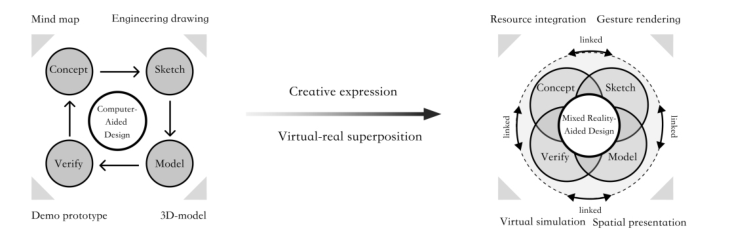
Figure 2: Design stages assisted by different technologies.
Application of Mixed Reality Technology in Experimental Teaching Mixed reality technology is primarily employed in experimental teaching by providing a simulated environment that is both safe and interactive. This environment allows experimenters to undergo thorough simulation and practice before engaging in actual operations, significantly enhancing the effectiveness of teaching. Serving as a bridge between the virtual and real, developers utilize augmented reality technology to create diverse mixed real- ity teaching scenarios. In recent years, major universities worldwide have delved into in-depth research in this area. For instance, researchers and edu- cators at the University of Michigan have designed safety training programs using virtual reality and augmented reality technologies. Stanford University, focusing on medical education applications, utilizes virtual reality technol- ogy for surgical and clinical skills training. While its primary focus is on providing hands-on training for surgery and clinical skills, the technological implementation and application approach are inspirational for laboratory safety education, especially in simulating emergency medical situations and laboratory safety responses.
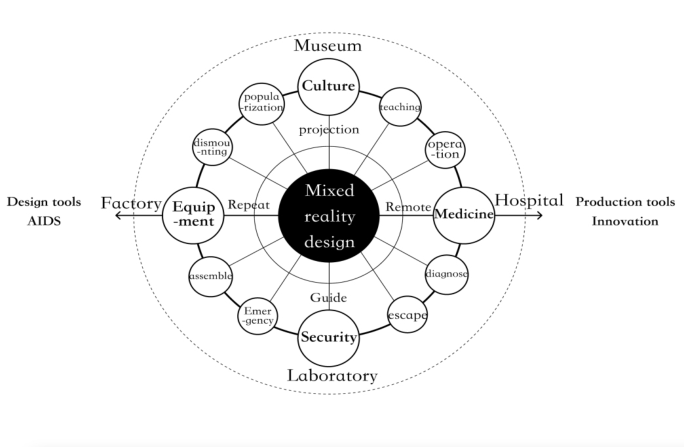
In terms of applied research, a wealth of case practices has been accu- mulated. Mixed reality design has played a role in many fields. Taking equipment, culture, security, medical and other major vertical application scenarios as examples, mixed reality has played an auxiliary and optimiza- tion role in all of them, as shown in Figure 3. For example, Sun (2016), based on the combination of arts and engineering education philosophy, con- ducted research on the reform of industrial design experimental teaching. They advocated integrating engineering and technical knowledge into pro- fessional courses, student and teacher research, and across overall teaching and practice. Acting as a bridge between the virtual and real, developers have constructed various mixed reality applications. For example, the precise 3D models presented by HoloLens and its capability to manipulate virtual holographic images in a real environment have been applied to experimental teaching in cerebral anatomy (Moro et al., 2021). Furio (2013) developed
Application and Prospect of Mixed Reality in Design Experiment Teaching 153
a mobile mixed reality system for the knowledge learning of various tourist attractions, and used the mobile augmented reality system to show the rele- vant knowledge of different tourist attractions to students, so as to complete the learning of the story and architectural appearance of tourist attractions. Chuah et al. (2013) from the University of Florida developed an augmented reality teaching assistant system for training basic reception skills for psy- chology doctors. Using a mixed reality approach, the system overlays images of psychological patients onto real scenes. Psychologists can then train psy- chological diagnosis by engaging in verbal communication and observing expressions of psychological patients. Jong (2013) of the University of Twente published an article in the journal Science indicating that the combination of virtual-real computer simulation environment can significantly improve research-based learning.
Figure 3: Experimental application of mixed reality.
While the above applications of mixed reality systems enable immersion in constructed scenes and interaction with virtual objects, they also have certain shortcomings, such as insufficient simulation of the authenticity of virtual objects and a lack of multi-level scene construction. Based on the analysis of existing research related to mixed reality in experimental teach- ing, the following issues are identified: single-point trigger teaching displays with limited effects and poor user experience, lack of analysis of complete teaching processes, emphasis on information representation but neglect of whether knowledge is effectively conveyed, insufficient context derivation triggered by user psychology and cognition, leading to a mismatch between the human-computer interaction mode of augmented reality systems and the needs of experimental teaching. Current research overly focuses on new
interactive technologies and displays, overlooking the role of educational sup- port systems in education itself. This disconnection results in a misalignment between the functionality of educational support systems and educational teaching needs. Mixed reality technology is rapidly driving innovation in the design field, and traditional experimental methods are no longer sufficient to meet the increasingly diverse and complex design requirements. Mixed reality technology provides limitless possibilities for achieving more intuitive, personalized, and immersive design experiments.
In order to deeply understand the development of design experiment teach- ing in specific situations and improve the quality of experiment teaching, this study selected two common design experiment types, prototype mak- ing experiment and design test experiment, carried out field visits and expert interviews, so as to obtain a more comprehensive cognition of the current sit- uation of design experiment teaching and obtain the development and design strategy of mixed reality system of design experiment teaching.
Table 1. Research procedure.
Table available in the original PDF paper.
Stage Method Object Aim Phase 1 Field trip Prototyping LABS: wood workshop and car building lab Gain an in-depth understanding of the physical environment, equipment configuration and student activities of the design laboratory in order to obtain an intuitive perception of the actual workplace and provide substantial basic information for research. Phase 2 In-depth interview
Design lab instructor
Understand the experience, views, and teaching philosophy of the design lab leader or instructor in order to find a path to integrate mixed reality into the design experiment.
Field Trips and Research Firstly, we visited two prototype labs at the China Academy of Art. The first is the carpentry workshop, dedicated to woodworking and craftsmanship. Typically utilized for design education and skills training, this lab is closely related to various disciplines such as industrial design, architectural design, and handicrafts. Students and enthusiasts can learn prototype-making meth- ods using wood as a material, including the use of woodworking tools, wood selection and processing, and the design and fabrication of wooden products. The second is the clay model processing workshop in the automotive lab,
Application and Prospect of Mixed Reality in Design Experiment Teaching 155
which serves multiple purposes. Clay models are crucial tools in the auto- motive design process, and by creating clay models in the workshop, design teams can validate and showcase conceptual designs. This aids in understand- ing the appearance, proportions, and overall shape of the design, enabling designers to intuitively evaluate the practical effects of their design concepts.
Figure 4 shows on-site inspection images of the carpentry workshop. As depicted, the model-making process involves a considerable number of power tools such as electric saws, electric sanders, electric drills, and various hand tools like files and chisels used for trimming and shaping wood edges. These tools have sharp surfaces, requiring careful handling during use. Additionally, we observed some high-risk equipment labeled with danger warnings. These instruments can only be used under the guidance of the instructor responsible for laboratory safety. The wooden chair shown in the picture is crafted by students using these tools during class.
Figure 4: Wood workshop field trip pictures.
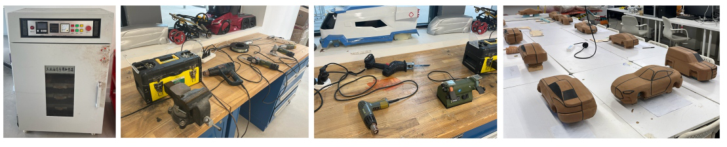
Figure 5 depicts the automotive experimental workshop, showcasing an array of manual and electric equipment scattered across the workbenches. Additionally, an industrial-grade heater specifically designed for clay model processing is present. In the product design process, especially in clay model fabrication, the creation of product models has become an indispensable stage. Product model fabrication involves transforming flat product sketches into three-dimensional forms, providing a tangible representation of the product that serves as the foundation for further refinement and develop- ment of design proposals. The automobile model featured in the image is crafted by students in the classroom using the clay model heater and tools.
Figure 5: Automotive lab.
As revealed in our interviews, similar to the carpentry workshop, the spe- cialized equipment in the automotive lab is only allowed to be operated and utilized under the guidance of professionals. The fabrication process involves high temperatures, precise measurements, and poses elevated risks. It also demands a significant amount of time, with low repeatability.
Expert In-Depth Interview In this study, expert in-depth interviews played a crucial role in gaining insights into the actual operation of design laboratories and understanding the challenges students face during design experiments. This helped identify a feasible path for integrating mixed reality systems into design experiment teaching. In-depth interviews facilitated comprehensive communication with experts, offering a thorough understanding of their perspectives, experiences, and opinions, providing rich detailed information, and uncovering the atti- tudes and needs of the target audience. This diversity-oriented approach was considered throughout the research.
The interview outline for user interviews consisted of two parts. The first part focused on the teaching context, covering topics such as teaching philosophy, primary objectives in design experiment teaching, facilities and equipment used, the role of advanced or specific equipment, main teaching methods and strategies, and details about the operation of specific experimen- tal equipment. The second part addressed the integration of mixed reality systems, exploring the effectiveness of mixed reality or virtual simulation in improving teaching efficiency and safety. It also delved into expectations regarding the enhancement of various aspects of the design laboratory and identified stages in the design experiment process suitable for mixed reality intervention.
Expert in-depth interviews were conducted for two visited laboratories, involving a total of four participants, including two senior workshop instruc- tors from the carpentry workshop and two senior experimental engineers from the automotive laboratory. Each interviewee shared specific insights and experiences from their teaching practices. With the consent of the inter- viewees, the entire interviews were recorded to authentically capture their thoughts for subsequent analysis.
Table 2 provides a summary of selected interview records. The interviews yielded valuable information, revealing that existing design laboratory teach- ing predominantly follows a curriculum-based approach, emphasizing the integration of theoretical knowledge with practical design tasks. However, traditional design experiment courses still exhibit limitations. For instance, in the carpentry workshop course, detailed knowledge of intricate joint struc- tures must be taught at the beginning, a type of knowledge that is challenging to acquire through online resources and requires the expertise of experienced craftsmen. Precision is crucial during actual production, with tolerances requiring accuracy down to the thickness of an A4 paper. In the automotive laboratory, students focused on smart mobility may engage in experiments such as prototype development or design testing. For example, in the design testing of car cabins, many cabin designs cannot be physically present in the teaching space due to the high space occupancy, maintenance costs, lack of experiment technicians, significant construction funds, and insufficient equipment. The rapid iteration of intelligent cabin designs further exacerbates this challenge, making it impossible to obtain the latest data for constructive research. Therefore, students rely on books, images, and other materials for learning, making it difficult to form an intuitive understanding of data. In
Application and Prospect of Mixed Reality in Design Experiment Teaching 157
light of this, the introduction of mixed reality systems can effectively improve the current state of design experiments. However, alignment with the actual needs of students and design laboratories is essential.
Table 2. Interview summary.
Table available in the original PDF paper.
Sort Interview Excerpts The actual teaching situation related
The industrial clay we use in our laboratory has a heating and softening temperature of 60 degrees Celsius. One major concern is that some students might open the machine box before the tempera- ture decreases to a touchable level, which poses a significant safety risk.
Many of the electrified equipment in our facility is not directly accessible to students. If they need to use such equipment, they can contact me, and I will assist them with operations like wood cutting. “Laboratory safety is an aspect we prioritize greatly. We provide detailed safety training to ensure students understand how to use tools and equipment correctly and adhere to safety regulations in the laboratory.” Integration of mixed reality systems related
While we have not yet implemented a mixed real- ity system, we are considering introducing it into the laboratory to provide a more immersive learn- ing experience. Through virtual simulations, students can gain a more intuitive understanding of design principles, and it can expedite the efficiency of design experiments.
In laboratory teaching, one challenge we face is the limitation of equipment and resources, making it difficult to offer a sufficiently diverse range of learn- ing experiences. We are actively seeking solutions to enhance the availability of the laboratory.
I believe utilizing new technology to assist students in design experiments is quite beneficial. Sometimes, when students are working on models simultane- ously, I find it challenging to assist all of them effec- tively. If there could be virtual technology to provide assistance, that would be excellent.
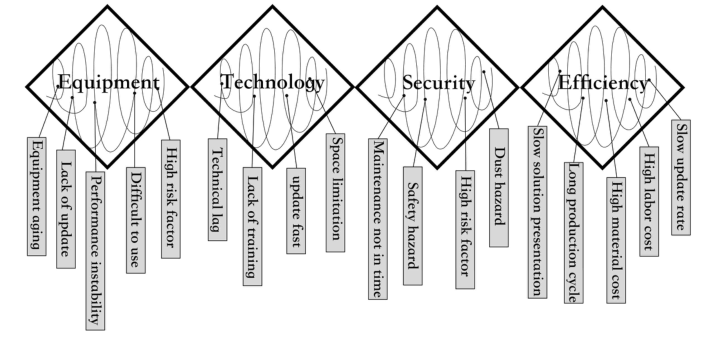
Through on-site inspections of design laboratories and in-depth interviews with experts, we have identified the shortcomings of existing design exper- iments, mainly in terms of equipment, technology, safety, and efficiency, as shown in Figure 6. In terms of equipment, the update rate of fixed assets in the laboratory cannot keep up with the latest technology, and many devices have a long service life, potentially leading to aging issues, decreased performance, and poor stability, thus affecting the experimental results. Regarding technol- ogy, software in the design field is updated frequently, but the laboratory may not promptly update or acquire the latest versions, resulting in a lag in techno- logical advancement. Concerning safety, there may be instances of inadequate or non-standard equipment maintenance, with many high-difficulty devices
posing usage risks. Regarding efficiency, the laboratory’s model-making pro- cess is slow and consumes a significant amount of manpower and materials, making it difficult to quickly manifest design concepts. These factors may all affect the effectiveness of design experiments.
Figure 6: The inadequacy of the design laboratory.
Construction of Design Experiment Model Based on Mixed Reality Compared to traditional design laboratories, design experiments assisted by mixed reality offer advantages such as enhanced practical experience, expanded creative space, increased efficiency, and safety. Mixed reality tech- nology combines the virtual world with the real environment, allowing students to engage in practical operations and experiences in virtual envi- ronments, thus avoiding potential safety hazards in traditional experiments and improving operational efficiency. Moreover, it can create diverse virtual scenes and experiences, providing students with broader creative space and design possibilities, thereby stimulating their creativity and imagination.
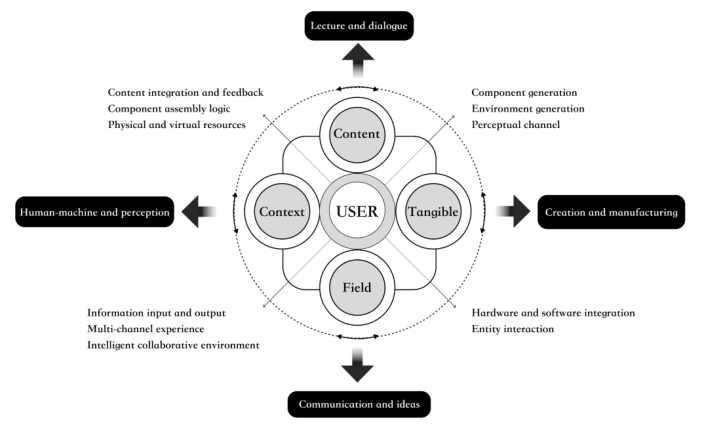
Therefore, the design experiment model based on mixed reality technology should be constructed from multiple aspects, relying on the design profes- sion and design teaching as the foundation, creating a multi-layered and multi-dimensional virtual simulation innovation platform from teaching to dialogue, from human-machine interaction to perception, from creation to manufacturing, from communication to ideation. It aims to build an open and inclusive mix reality innovation platform, promoting the cultivation of more competitive and innovative design talents in the digital age.
(1) Teaching and dialogue: Utilizing virtual simulation platforms to show- case design cases and product prototypes, simulate and restore classic indus- trial design works, lead students to “travel through time” and engage in dis- cussions with design masters, promoting students’ learning comprehension and fostering innovative thinking.
(2) Human-machine interaction and perception: Students can conduct human-machine interaction tests in virtual simulation environments, perceive
Application and Prospect of Mixed Reality in Design Experiment Teaching 159
the characteristics of products in terms of form, material, color, etc., simu- late the user experience of products in different scenarios, and improve the human-machine performance efficiency of products.
(3) Creation and manufacturing: Students can conceive, design, and eval- uate product ideas in virtual simulations, verify the engineering performance of products, and simulate manufacturing processes, helping students learn and master advanced manufacturing technologies and processes.
(4) Communication and ideation: Establishing a virtual simulation design cloud platform, where students can share design works, conduct design salons, academic seminars, etc., providing opportunities for students to show- case their ideas, engage in in-depth discussions with experts, and stimulate creative inspiration and innovative thinking.
By building a multi-dimensional innovation platform, it contributes to the development and innovation of design intelligence and manufacturing. The overall framework is illustrated in Figure 7.
Figure 7: Design experiment model driven by mixed reality.
APPLICATION OF MIXED REALITY IN DESIGN EXPERIMENT TEACHING Intelligent Cockpit Interface Experience Perception Mixed Reality Experimental Platform
To address the challenge of conducting user experience experiments from the perspective of automotive design students, this study developed an Intel- ligent Cockpit Interface Experience Perception Mixed Reality Experimental Platform. The experimental system faithfully reconstructs the spatial relation- ships of the in-car cabin and constructs a model database of digital human users. The platform provides in-depth explanations through videos, texts,
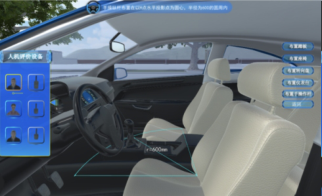
and real-case interpretations of in-car cabins, enhancing students’ impres- sions of professional design. Students can use mouse operations to set the dimensions of the cabin and import real data of digital human users into the system, creating a realistic simulation experience with intuitive data sample collection results. Subsequently, by collecting data samples and constructing simulation models, students identify the focal areas of design. They integrate prior knowledge of experience design theory and conduct targeted design experiments to collect data samples as required. This process involves con- structing feasible solutions for intelligent cockpit design while examining specific knowledge points. The evaluation process satisfies both objective criteria for user experience assessment and the professional requirements of identifying design innovation focal points. Figure 8 illustrates the demonstra- tion of the Intelligent Cockpit Interface Experience Perception Mixed Reality Experimental Platform.
Figure 8: Interactive steps in the intelligent Cockpit design experimental platform.
To assess the practical effectiveness of the Intelligent Cockpit Interface Experience Perception Mixed Reality Experimental Platform, the system was officially launched in 2020. Prior to participating in this virtual simulation experiment course, students majoring in product design and industrial design were required to have a systematic understanding of relevant courses, such as automotive cabin design principles, human-computer interaction, materi- als and technology, as well as a knowledge foundation in advanced courses like product semantics, system design, and service design. In terms of profes- sional competence, students were expected to have a profound understanding of human-computer interface interaction, user experience analysis, product function definition, and scenario creation.
The platform has been utilized in three rounds of teaching applications, consisting of 2 hours per week for a total of 16 hours per semester. Approxi- mately 100 students participate in this course each academic year, benefiting around 800 students majoring in product design and transportation design at design colleges. The platform aims to enable students to master the lay- out dimensions required for user experience perception in scenarios with subtle differences. It also equips them with a comprehensive understanding of reasonable parameter ranges, allowing them to apply this knowledge to innovative practices in backend design.
In addition to objective scoring based on parameter options, this experi- mental platform allows students to make subjective evaluations by selecting
Application and Prospect of Mixed Reality in Design Experiment Teaching 161
different colors, materials, and textures for objects in the in-car cabin interface. This online data selection feature facilitates a more convenient subjective scoring of design parameters, showcasing the innovative and exper- imental nature of design-oriented virtual simulation courses. It provides students with a more autonomous and diverse choice space, fully unleashing the creativity inherent in design.
CONCLUSION AND PROSPECT Mixed reality constructs a new field of design and manufacturing between human senses and cognition, blending our perception of the real and the virtual. As we traverse this intertwined realm of the digital and physical worlds, we are no longer constrained by the limitations of reality. This study extensively explores the application of mixed reality technology in design experimental teaching, with a specific focus on laboratory safety instruc- tion. Through on-site investigations of design laboratories, expert interviews, and the development and application of two mixed reality design experi- ment platforms, we have successfully unveiled the significant potential of mixed reality technology in enhancing students’ awareness of experimental safety and operational skills. The high satisfaction among students regarding the use of mixed reality technology in the design experimental teaching sys- tem attests to its outstanding performance in providing immersive learning experiences, sparking interest in experiments, and promoting safety aware- ness. This not only validates the practical application of mixed reality in the field of experimental safety instruction but also offers crucial insights for future teaching design and research. By integrating technology with design experimental teaching, mixed reality technology presents a unique opportu- nity for cultivating students’ innovative thinking, practical skills, and safety responsibility. This study not only expands the methodology of design exper- imental teaching but also indicates new directions for the development and application of mixed reality technology in the education domain. Whether it’s the fusion of technology and art or the interaction between humans and machines, the mixed reality design and manufacturing realm propels us into a journey filled with contemplation and exploration.
ACKNOWLEDGMENT
This project is funded by the General Research Project of the Zhejiang Provin- cial Department of Education “Research and Application of Smart Home Product Design Pathways Driven by AIGC Technology” (Y202354062).
REFERENCES
Chu Leyang, Chen Weidong, TAN Yue, et al. (2019). Reshaping experience: Extended Reality (XR) technology and its Application in Education: A discus- sion on the trend of “integration of education and new technology”. Journal of Distance Education, 37(1): 17–31.
Chuah J. H., Lok B., Black E. (2013). Applying Mixed Reality to Simulate Vulnerable Populations for Practicing Clinical Communication Skills. IEEE Transactions on Visualization and Computer Graphics, 19(4): 539–546. DeJong T., Linn, M. C., Zacharia Z. C. (2013). Physical and virtual laboratories in
science and engineering education. Science, 340(6130): 305–308. Furió D., Gonzalez-Gancedo S., Juan M. C., et al. (2013). Evaluation of learning outcomes using an educational iPhone game vs. traditional game. Computers & Education, 64: 1–23. Milgram P., Kishino F. (1994). A taxonomy of mixed reality visual display[J]. IECE
Transactions on Information and Systems, 77(12): 1321–1329. Moro, C., Phelps, C., Redmond, P., & Stromberga, Z. (2021). HoloLens and mobile augmented reality inmedical and health science education: A randomised controlled trial. British Journal of Educational Technology, 52(2), 680–694 Sun Wentao and Li Mingyue (2016) Research on Educational Reform of Indus-
trial Design Experiment Based on Educational Concept of Combing Arts and Engineering. Art and Design: Theory Edition, 2016, 0(3): 135–137.
LISTED IN THE AHFE DIGITAL BOOKSTORE CATALOGUE
Explore the complete digital volume
Ergonomics In Design
Read this individual research paper free through the original publisher, or explore the full digital proceedings book.
ISBN 978-1-964867-05-2
Explore this ISBN in the AHFE Bookstore ↗Listed in the July 2026 bookstore catalogue; search by ISBN to confirm current availability · Digital book purchase optional