Wenling Xu, Yun Wang (2023). The Value Co-creation Service Mode Design of Online Technology Market. In: Ergonomics In Design. AHFE Open Access, vol. 77, pp. 439–449. https://doi.org/10.54941/ahfe1003402
Technology is now the primary force behind economic growth and increased productivity in the era of the digital economy. The online technology market is the main platform for technology trading and is a new strategic industry. The service mode of the online technology market can improve user service and enable the co-creation of user value. At first, a thorough review of the literature is performed to investigate the online technology market, service design and mode, value co-creation theory and its application. Second, it classifies various online technology market types and the service modes of various platforms using a comparative analytical approach, and it draws conclusions about how these service modes will develop. Eventually, the design subjects, design factors and processes, and design forms in the technology transaction process of the online technology market are studied, the service mode design model of the online technology market is developed, and the design results are generated. This essay encourages the growth of service design for the online technology market by offering useful concepts and workable recommendations for the service mode.
As a result of the innovation-driven development strategy and the demands of the digital economy, the networked and globalized economic structure as well as the industrial technology system are gradually being improved. The modern technology market has evolved from a single technology trading market to a system trading service market that incorporates the functions of technology trading, technology service, investment and finance, talent develo- pment, industrial activities, science and technology consultation, innovation and entrepreneurship, etc.
Online technology markets can increase the capacity for innovation among firms, academia, and research, speed the transformation of technological advancements into productivity, and promote social and economic deve- lopment. The majority of the current online technology market, however, suffers from problems like a convoluted customer care process, a dearth of customer features, an incorrect supply-demand match, a subpar transaction
experience, and inefficient communication. As a result, there is insuffici- ent value generation and platform efficacy overall, inefficient technological transactions, and a dearth of efficient connections between the participants.
This study gives an overview of the development direction of the online technology market by analyzing the development state and service mode of the existing online technology market and relevant online platforms. The value co-creation theory is used to construct the service mode design model for the online technology market, which elaborates on a number of design subjects, design factors, design processes, design forms, and design results. This model increases the rate of technology transactions for users, meets their needs for transactional services and creates a better online technology marketplace service mode.
LITERATURE REVIEW
Research Status of Online Technology Market A virtual market that can facilitate the listing, searching, and exchange of knowledge assets is the online technology market (Bakos, 1998). It is made by utilizing contemporary network technology, which can transmit data about technology supply and demand, hasten the development, dissemination, and application of scientific and technological advances, promote the rational allocation of scientific and technological resources, and increase the compe- titiveness of economy and technology (Xie, 2004). It is more open and linked, more efficient, and has reduced transaction costs.
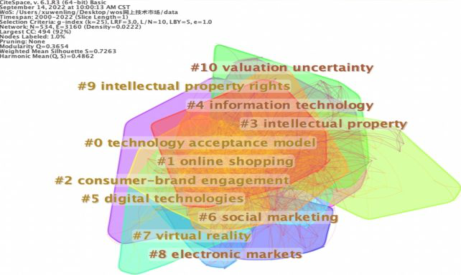
In this study, recent literature on the online technology markets was extra- cted from literature databases like wos and visualized using Citespace (see Figure 1). By combining and evaluating the information from keyword clu- sters, the research on the online technology market and services may be divided into the following three main research directions: 1. Social and eco- nomic planning, 2. Information technology architecture, 3. User behavior and experience.
Online technology markets have received very little research in the context of design; rather, the current focus of research is mostly on the academic fields
Figure 1: Visual analysis of citespace literature (from citespace, 2022).
The Value Co-Creation Service Mode Design of Online Technology Market 441
of economic management and computer engineering. There aren’t enough efficient services for user-to-user information exchange and conversation. There is no active link matching capabilities, no overall ecological network of the platform, no defined service mode, and a subpar sense of customer tran- saction experience. Therefore, the online technology market’s service mode needs to be improved.
Service Design and Service Mode The process by which the service provider offers the service recipient the service content (product, information, experience, etc.) via a variety of channels or ways is referred to as the service. The core of service design is successfully organizing and arranging the many components of a service system, such as personnel, facilities, products, and information (Vargo et al., 2008). As a result, the service mode may be viewed as the foundation for designing and developing services as well as the means through which service users can cooperate and jointly produce value (Wang et al., 2009). The service mode is a multi-player, integrated service process with a range of themes, goals, and situations. It also functions as a complete service system. Among service parti- cipants, it can promote collegiality, teamwork, and value creation. Since there are three parties for the participants—the technology supply side, the techno- logy demand side, and the technology intermediary side—the service method of the online technology market has certain distinctive features. The online technology market has to improve its user service mode since users have a variety of needs for its business operations, service policies, and resource allocation.
Application of Value Co-Creation Theory The idea of value co-creation states that “value is created by numerous par- ticipating topics, and all participating subjects can be seen as the integration of resources.” The essence of value co-creation is the interaction between co-creators.
The theory of value co-creation is now widely used in the service sector, such as information services, intelligence services and knowledge services. Value co-creation theory has also been used to platform ecology and mode construction, and the findings of previous studies have established the the- oretical underpinnings for its application to the service mode design of the online technology market. The value co-creation for the services mode of the online technology market is a dynamic process of resource integration, information interaction, and technology transaction involving a number of stakeholders, including the online technology market, businesses, univer- sities, research institutions, technology intermediaries, and governmental organizations, using the online technology market as the primary medium. This study will introduce the theory of value co-creation from the perspe- ctive of service design in order to construct the service mode design model for the online technology market.
442 Xu and Wang
METHODOLOGY
This study uses a comparative analysis method to investigate both the online technology market and the online platform service mode. In order to assess the current condition and potential development of the online technology market service mode, a few representative platforms are being used as examples.
Analysis of Online Technology Market The online technology market is currently being built in one of two ways: market-driven or government-led. The government-led online technology market is generally subject to government macro-control and serves the public good. Countries like China, Japan, and Korea serve as examples. On the other hand, market-driven online technology markets are typically foun- ded, guided by market demand, and led by technology intermediaries, with a greater degree of spontaneity and activity, more flexible operating modes, and more diversified alternatives. Countries like the US and the UK serve as examples.
According to market research and comparative study, the current online technology market demonstrates the following characteristics: 1. The popu- larity of technical companies is growing. 2. Supply chain management for technology, such as the Lucent. 3. Technical operations that are specialized, such as the U.S. National Technology Transfer Center (NTTC) 4. Services that use integrated technology, such as the British Technology Group (BTG). 5. Technology industry networking, such as the Enterprise Europe Network (EEN).
Furthermore, research shows that the following issues are the most com- mon in the online technology market: 1. A number of online technology markets that is focused on public interest and government has a low level of marketization. A number of online technology markets that leans primarily toward markets is very polarized 2. The existence of knowledge asymmetries and the absence of efficient mechanisms for exchanging information 3. A lack of active connection matching and pro-active service awareness 4. The supporting value-added services are inadequate, and the services offered by the various websites are similar 5. The user base is weak and the user reten- tion rate is low 6. The service mode has not yet created a system, and the platform’s ecological network is missing.
Comparison of Online Platform Service Modes Three stages of development—resource-based passive service mode, demand- based active service mode, and shared intelligent service mode—have led to the current service mode of the online platform.
With the online platforms serving as an example, the majority of online platforms are still in two service modes: resource-based passive service mode and demand-based active service mode. Yet, certain pertinent online plat- forms have better developed service modes and are either already using or moving toward shared intelligent service modes. We choose sample platforms and divide them into two main categories for comparison: trading platforms
The Value Co-Creation Service Mode Design of Online Technology Market 443
and technology platforms. We compare and evaluate the service modes of online platforms related to technology or trading (Table 1).
When compared to one another, we see that technology platforms have the following benefits: 1. Focused user types and closely linked subjects 2. Special field types and vertical ecology 3. A high level of professionalism 4. Exact docking to meet demand and supply. Yet, there are also the following disa- dvantages: 1. Strong constraints and dominance of the transaction chain line 2. The lack of rich category diversity 3. The ecosystem’s sluggish market 4. The outcomes of the transformation are insufficient. The following are some advantages of trading platforms: 1. A wide vari- ety of user types, robust supply-demand docking links 2. A wide range of services and a relaxing environment 3. A market that is eco-rich and offers a variety of commodity types 4. A strong sense of user initiative and excellent communication skills.
The development of technology trading platform represented by online technology market is relatively slow, and there are several problems as follows: 1. The field is not precisely vertical enough 2. Transactions betw- een online and offline are disconnected 3. The technology is not advanced enough, the beauty of technology is not enough 4. Lack of professionalism, poor precision of supply and demand docking 5. There is no service; the connection between the subjects is too far.
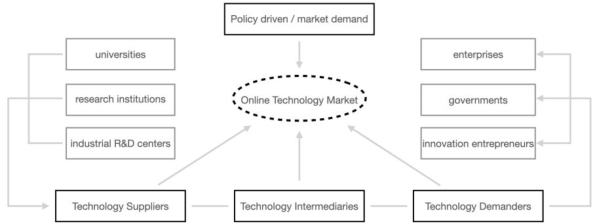
Online Technology Market Service Mode By examining the online technology market and the online platform service mode, we can see that the fundamental service mode of the current online technology market is to encourage the development of technology through policy driven or market demand (see Figure 2).
The technology intermediary serves as the driving party and the sup- ply and demand sides of technology serve as the major body to complete around the online technology market itself in the specific technology tran- sactions of the market represented by the UK and the US. The transaction
Table 1. Comparison of online platform service modes.
Table available in the original PDF paper.
Platform Type Service Objectives Platform Mode
Trading Platforms
commodity transaction type Provide merchandising services, facilitating transactions, etc. service transaction type Provide information inquiry, product reservation, service experience and evaluation technology transaction type Provide technology services and facilitate technology transactions Technology Platforms
technology business type Provide technical innovation, promotion and cooperation services research crowdsourcing type Provide services to discover ideas and find ways to solve problems domain operation type Provide services to showcase results and seek cooperation
444 Xu and Wang
Figure 2: Online technology marketplace design subjects (drawn from the author, 2023).
process starts off connected in series and moves toward overall networking as the service system is first developed. The platform is at the center of the platform-centered online technology market that China represents, and the intermediaries and supply and demand sides of the technology are only able to use the platform to release and match information about supply and demand without developing a fully-fledged service mode. Information asym- metry still exists, the assisting service function is not flawless, and the general service qualities are not emphasized.
In general, the online technology market’s service system is still in its early stages of development. The online technology market’s service mode should fully include the advantages of various platforms, combine those advantages with their own platform service mode, and accelerate the development of the service mode.
DESIGN MODEL Design Subjects
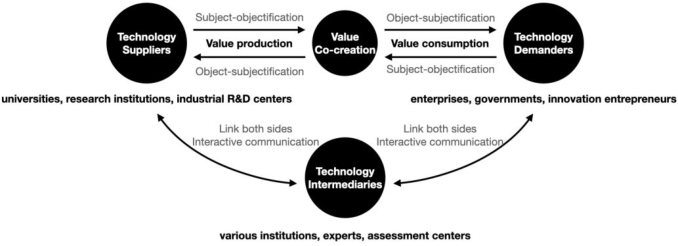
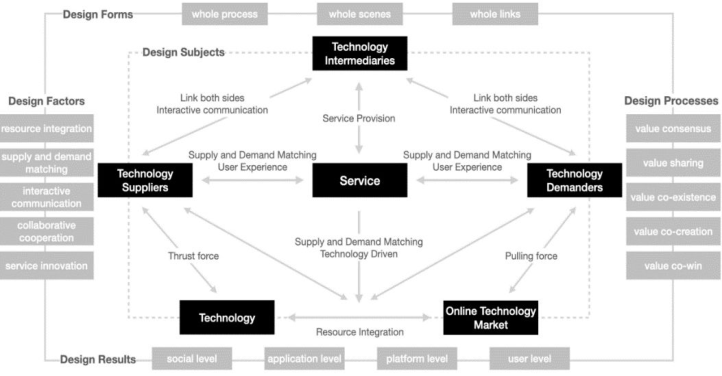
Under the user-led value logic, the online technology market can be divi- ded into three types of users: technology suppliers, technology demanders, and technology intermediates. All participants in the online technology mar- ket have the capacity to innovate value co-creation and resource integration. Technology suppliers are the main consumers of industry-university-research innovation, including universities, research institutions, industrial R&D facilities, etc. The technology demanders includes businesses, government, innovators and entrepreneurs. The technological intermediaries are made up of a wide variety of businesses, subject matter specialists, evaluation facilities, etc.
According to the conventional view, the producer is the only one who creates value, and people would analyze and study businesses and custo- mers as the relationship between subject and object. Yet, the relationship between subject and object is fluid in the Internet age. Furthermore mobile and diverse, value creation themes are numerous. This is true for both the technology supplier and the technology demander in the online technology market. The technology supplier identifies and matches the value demand of the technology demander, communicates its value proposition through
The Value Co-Creation Service Mode Design of Online Technology Market 445
value creation, and searches for the technology demander’s value recognition through the transfer of rights all at once. The technology demander looks for technologies that fit its needs, internalizes them through value consumption, and obtains opportunities for value co-creation with the technology supplier through active involvement.
In this procedure, the technology intermediary serves as a link that more effectively connects the two parties, enhancing information access and intera- ctive conversation. The online technology market serves as the carrier for the initial driving force of technology, bringing together the supply and demand sides of the industry, facilitating cooperation, and encouraging them to join- tly create value in order to achieve value co-creation and value co-win (see Figure 3).
Design Factors and Processes The process of connecting various participants through services and carrying out technology transactions in the online technology market can be viewed as the co-creation of value. Some of its contributing elements are resource integration, supply and demand matching, interactive communication, syner- gistic cooperation, and service innovation. In the online technology market, a lot of individuals come together to build a community of interests based on their highly overlapping value judgments of technology. This process goes through five stages: value consensus, value sharing, value co-existence, value co-creation, and value co-win.
Value Consensus Value consensus is the conceptual understanding that all parties to a tran- saction have come to. On the basis of their value proposals, technology suppliers, demanders, and intermediaries transmit value recognition to other participants, who then value fit and agree on value. Value consensus is the process of integrating resources, maximizing inventive resources through services, and exhibiting them on the platform. Resources for supply, demand, services, and other items are merged in order to take full advantage of their scale benefits, more effectively connect all participants, and enable users to quickly agree on values.
Figure 3: Online technology marketplace design subjects (drawn from the author, 2023).
446 Xu and Wang
Value Sharing Value sharing relies on the online technology market and involves each par- ticipant exchanging and sharing resources. Technical information circulates freely on the platform, overcoming the constraints of time and distance and becoming more accessible. Users are more efficient in collecting and match- ing data, which leads to the sharing of information, resources and services. In this way, value sharing is accomplished. Value sharing is the practice of exactly matching supply and demand through services. The technology inter- mediary serves as a facilitator for resource flow by effectively allocating and activating resources.
Value Co-Existence Value coexistence is a multi-level interaction that occurs through the medium between the participants in the service process. It is mainly reflected in high-intensity and high-frequency interactive behaviours, such as informa- tion interaction, technology interaction and human-machine interaction. A complex and dynamic interactive social network with interactive communi- cation is value coexistence. Each participant engages as fully as they are able to, and with the appropriate interacting behaviors and knowledge, the results of the interaction may be more valuable.
Value Co-Creation Value co-creation is the process through which participants collaborate and integrate resources, technologies, and services to produce and create value. It includes value generation through production, value consumption, and value realization. Value is co-created through a collaborative process. In this pro- cess, everyone involved in providing the service is a co-creator of value; there are no passive participants. The importance of taking into account how the subjects of value co-creation interact with one another increases. Together, value is produced through cooperative work and mutual trust, resulting in a system of virtuous cycles.
Value Co-Win Value co-win, which enables all stakeholders to get an acceptable benefit distribution and jointly enjoy the rewards of value production, is the ultimate goal of value co-creation. Its primary performance consists of the fusion of services, the interaction of technologies, and the realization of benefits. As a result of the participants’ present close connections and the development of a service community of interests, users, technologies, and platforms are being deeply integrated, and the participants are recognizing how technical improvements and feedback can be transformed. Value co-win is a process for service innovation that gradually develops an inclusive and collaborative service ecosystem.
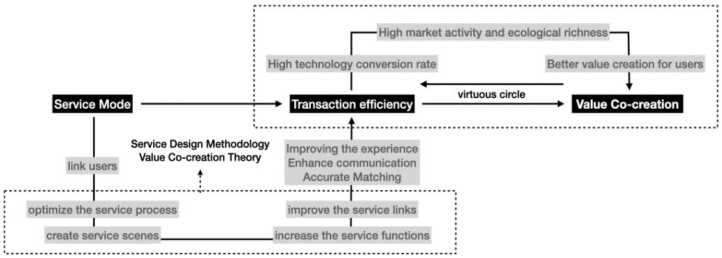
Design Forms The service scenes are not explicit, the service links are not full, and the service process in the current online technology market is ambiguous. Consequently, we should design a service mode that includes an entire process, an entire scene, and an entire link. With service as its central focus, it links users
The Value Co-Creation Service Mode Design of Online Technology Market 447
through services, optimises service processes, creates service scenes, improves service links and increases service functions. Monitor the entire procedure to give users the right advice and support before, during, and after the service. To satisfy the desire for a technological transaction experience, give the transaction scenes a sense of technology, presence, and intelligence.
Configure corresponding service contents and functions in each link to avoid the phenomenon known as a broken chain in the transaction process. We provide a comprehensive spectrum of services focused on the creation, use, exchange, and management of technology. In turn, this improves the user service experience, enhances user communication, and realizes accurate tech- nological transaction matching, improving transaction efficiency. The online technology market ecology then becomes more active, the greater the likeli- hood that users will engage in value creation and experience co-creation of value. In this way, a virtuous loop mechanism is produced (see Figure 4).
Design Results In conclusion, the online technology market is a part of a network platform that involves a variety of participants and emphasizes the co-creation of each. The service mode of the online technology market should be changed to a shared intelligent service mode, which can be service-centered, user-led, technology-driven, platform-based, with the path of design and co-creation as the goal. This should be done in conjunction with the theory of value co-creation. In order to construct the value co-creation service mode design model of the online technology market, the service is used to connect the resources of users, technology, platforms, and other parties (see Figure 5).
For online technology markets, the service mode design model offers four design results:
1. At the user level, it can satisfy users’ needs for transaction services, enh- ance communication effectiveness, optimize users’ advantages, and achieve co-win value.
2. At the platform level, it can improve the features and service offerings of the online technology market, standardize and institutionalize the platform, create a strong platform service ecosystem, and speed up the growth of the online technology market.
Figure 4: Online technology marketplace design forms (drawn from the author, 2023).
448 Xu and Wang
Figure 5: Online technology marketplace service mode design model (drawn from the author, 2023).
3. At the application level, it can increase the effectiveness of technological transactions and the rate at which technological advances are converted into actual productivity, encourage this conversion, and actualize the application on the ground.
4. At the social level, it can empower the industrial economy and foster social growth through the creation of the technology circulation industry and transaction method.
CONCLUSION
The service mode design of the online technology market is a crucial building block for boosting the efficiency of technology transactions, satisfying users’ transactional needs, and supporting the progress of technological innovation. Based on the theory of value co-creation and the service of technology tran- saction processes as the entry point, this study develops a service mode design model of value co-creation for the online technology market and establi- shes an efficient transaction service model for the invisible online technology market.
This is of vital importance in accelerating the rational flow of technology information, rapid value-addition of technology commodities, efficiency enh- ancement of technology transactions and innovation of technology service models. It also promotes the transformation of scientific and technological innovation achievements and technologies into real productivity, enhances the technological innovation capability of industry, university and research, realises the co-creation of technology transaction value and promotes social and economic development.
ACKNOWLEDGMENT
This research is supported by the Key Project of Soft Science of Zhejiang Province, China (2022C25055).
The Value Co-Creation Service Mode Design of Online Technology Market 449
REFERENCES
Bai Renfei, Cai Jun. (2022). Research on the innovation path of enterprise design value in the context of value network. Packaging Engineering 43(14), pp. 396–402. Bakos Yannis. (1998). The emerging role of electronic marketplaces on the internet.
Communications of the ACM, 41(8), pp. 35–42. Ettore Bolisani and Giorgio Gottardi. (2005). Online technology markets and suitable marketing strategies. Int. J. of Technology Marketing, 1(1), pp. 37–61. Ran Congjing, Ma Lina. (2023). Value co-creation of intellectual property informa-
tion service platform in higher education: process, mechanism and path. Library Forum 43(01), pp. 103–111. Su P, Yang X F, Wang X D. (2017). Research on the model of “Internet+” patent operation service platform [J]. Journal of Chongqing University of Technology (Social Science), 31(11), pp. 81–89. Vargo S L, Maglio P P, Akaka M A. (2008). On value and value co-creation: a
service systems and service logic perspective. European Management Journal, 26(3), pp. 145–152. Wang Z J, Xu X F. (2009). A service innovation model for bilateral resource integration. Computer Integrated Manufacturing Systems, 15(11), pp. 2216–2225. Xie Yangqun, Wang Chuanlei, Cheng Qinghong. (2004). Research on the constru-
ction mode of online technology market. Metallurgical Information Guide, (5), pp. 7–11. Zhang Hong, Lu Yaobin, Zhang Fengjiao. (2021). A review of value co-creation research: bibliometric analysis and knowledge system construction. Scientific Research Management, 42(12), pp. 88–99.
LISTED IN THE AHFE DIGITAL BOOKSTORE CATALOGUE
Explore the complete digital volume
Ergonomics In Design
Read this individual research paper free through the original publisher, or explore the full digital proceedings book.
ISBN 978-1-958651-53-7
Explore this ISBN in the AHFE Bookstore ↗Listed in the July 2026 bookstore catalogue; search by ISBN to confirm current availability · Digital book purchase optional