Lena Ahner, Benedikt Wohlmuth, Nicole Gladilov (2023). Innovation Labs as Value Co-Creation Platforms in Research Ecosystems. In: The Human Side of Service Engineering. AHFE Open Access, vol. 108, pp. 349–357. https://doi.org/10.54941/ahfe1003137
Digititalisation has significantly altered economic structures and has increased the speed of innovation. One result of this development is that competition does no longer exclusively take place between individual organisations that offer similar products and services, but also between entire sectors and ecosystems that disrupt the usual value creation logic. Taking this ecosystem perspective into account, value creation is no longer limited to single organisations but increasingly requires interaction and cooperation between organistions. Focus shifts towards a value co-creation approach, in which companies create joint value propositions towards common target groups. Consequently, collaboration and coopetion are widely discussed themes within the business research agenda. However, in order to convince organisations to participate in a value co-creation ecosystem, there must be added value for the co-existing actors within the ecosystem. This is especially challenging when the added value cannot be directly measured in terms of revenue or monetary performance indicators. This often applies to research ecosystems or – more broadly – where the public sector is involved. In this context, academia is lacking insights on how inter-organisational interaction and value co-creation can be facilitated within the research ecosystem itself. At the same time, innovation labs have become increasingly popular for co-creating product and service innovations within the business context. The aim of this paper is to examine, whether and how the approach of innovation labs can act as platform for value co-creation in research ecosystems.Our research is based on a literature review in which we analyse and compare exisiting research on value creation in ecosystems and innovation labs. Focus will be laid on detecting reccuring themes and major concepts. In a subsequent step, casaul mapping will be applied in order to outline and examine the network and links between different key concepts. In addition, established concepts such as the Value Proposition Design as well as the Jobs-to-be-done theory will be examined for applicability to value co-creation ecosystems.This paper helps to establish deeper knowledge, facilitate theory development, and uncover blind spots in value co-creation in research ecosystems. Based on a literature review, a conceptual model will be derived, outlining networks and links between actors of the research ecosystem and how innovation labs can act as platform or nucleus within this research ecosystems in order to facilitate value co-creation. The identification of key concepts and connections between concepts will open up future research potential. By collecting empirical data in subsequent research endaveours, the model can be further developed and refined. Furthermore, exisiting literature gaps and blind spots in academia on research ecosystems are highlighted.
Digitalisation has significantly altered economic structures and has increased the speed of innovation. One result of this development is that competition no longer exclusively occurs between individual organisations that offer simi- lar products and services but also between entire sectors and ecosystems that disrupt the usual value creation logic (Bullinger et al., 2017; Tombeil and Nägele, 2022). Considering this ecosystem perspective value creation is no longer limited to single organisations but increasingly requires interaction and cooperation between organisations (Robles et al., 2015; Roth, 2020). Focus shifts towards a value co-creation approach, in which companies create joint value propositions towards common target groups. Consequently, col- laboration and coopetition are widely discussed themes within the business research agenda, and the involvement of users in the innovation process has been progressively integrated into research and innovation policies (Robles et al., 2015; Roth, 2020).
Due to these developments, innovation labs have become increasingly popular for co-creating product and service innovations within the business context. In the private as well as in the public sector, innovation labs have been a well-known phenomenon for quite some time and are known by a wide variety of terms – e.g., living labs, service labs, open labs, or policy labs (Fritzsche, 2020; Kairies-Lamp, 2018). In general, innovation labs are
user-centred, open innovation ecosystems that integrate research and innova- tion processes in realistic environments (Robles et al., 2015) using a range of innovation methods and approaches, including co-production, co-creation, co-design and systems thinking (Jonas, 2020; Whicher and Crick, 2019). Innovation labs actively, creatively, and collaboratively engage the public and a variety of stakeholders in jointly developing solutions by utilizing co-design to engage with users for value co-creation (Roth, 2020; Whicher and Crick, 2019), addressing the topic of what applications currently are feasible as well as what potential future scenarios of human-technology interactions entail (Rossmeissl et al., 2019).
Innovation labs support practice-driven, open, and collaborative inno- vation processes within real-world settings, becoming orchestrators and matchmakers of different stakeholders while enabling the research of open and user innovation concepts and procedures (Ollila and Yström, 2020; Robles et al., 2015). There are many case studies providing insights into dif- ferent contexts and application fields and outlining the positive impact on facilitating the interaction and, with that, the innovation process (Budeanu and Rosner, 2021; Haug and Mergel, 2021; Jonas, 2020; Roth, 2020; Whi- cher and Crick, 2019) Yet, while research often consists and is dependent on interactions with its respective research ecosystem to outline new insi- ghts (Roth, 2020), the concept of innovation labs within research ecosystems has been little considered in the existing academic discourse (De Silva et al., 2021). A closer look at which and how internal as well as external stakeh- olders and actors should be included in the co-creation process, which value propositions are offered or created, and how innovation labs should deve- lop permanent structures is consequently needed to examine the potential of innovation labs as value co-creation facilitators in research ecosystems (Roth, 2020).
METHODOLOGY
For the analysis, we have oriented our approach towards the procedure of the systematic literature analysis (SLR) according to Tranfield et al. (2003) to highlight existing literature gaps and blind spots of the current research related to value co-creation in innovation labs within the context of research ecosystems and academia.
First, the publications for review have been searched for in the data- base SCOPUS, using the search query ((“innovation lab*” OR “living lab*” OR “open lab*” OR “service lab*”) AND (“value creation” OR “value co-creation”) AND (“innovation ecosystem” OR “platform” OR “research ecosystem”)) in the title, abstract and keywords for publications in English or German. We did not apply limitations on methodology (i.e., including, for example, empirical and conceptual publications) or quality criteria (e.g., journal rankings) to provide a detailed summary of the scientific debate. This allowed us to consider recent publications that have not been ranked yet. From this initial research, 434 publications were identified. Second, these identified publications were screened using the filter options in SCO- PUS by limiting relevant subject areas (Business and Social Sciences) and
Innovation Labs as Value Co-Creation Platforms in Research Ecosystems 351
keywords. As a result of this first screening, 262 publications were identified. Third, publications from the search were included in the integrative review when they met all the following inclusion criteria: publications on innovation labs as specific approaches for value co-creation or collaborative innovation; publications concerned with value co-creation in innovation ecosystems and publications analysing co-creation in the ecosystem context and the role of higher educational and research institutions. Studies on policy and/or public labs that were based on citizen or public servant participation, studies focu- sing on innovation labs or hubs in developing countries as well as studies on open innovation and innovation ecosystems in general were excluded. The review process revealed that innovation labs as value co-creation platforms are mostly applied in public governance and participation contexts (e.g., e- governance, health care) and the concept of innovation labs within research ecosystems has been less prominent in the identified publications. After scre- ening the abstracts of the initially searched publications, 39 were identified as relevant for this study, based on the described criteria. Most of these publica- tions were published between 2014 and 2022. Forth, to include all academic publications and current discussions on innovation labs, value co-creation, and innovation ecosystems across contexts and sectors, eight publications and one anthology from our initial search and previously known literature were added. Finally, after detecting recurring themes and major concepts, we derived a conceptual model, outlining networks and links between actors of the research ecosystem and how innovation labs can act as a platform or nucleus within this research ecosystem to facilitate value co-creation.
INNOVATION LABS AS PLATFORMS IN RESEARCH INNOVATION ECOSYSTEMS Focus of innovation processes has shifted from the individual perspective towards a dyadic or even more open co-creation network. With that, the ecosystem and its affiliated actors play an increasingly important role (De Silva and Wright, 2019; Schütz et al., 2019). These ecosystems can include several different actors from businesses, universities, government bodies, intermediaries, and citizens, which come together in joint co-creation initiatives to generate innovations (Schütz et al., 2019).
Schütz et al. (2019) describe this dynamic by outlining a quadruple helix model including four core components of an innovation system, consisting of academia, industry, government, and society. Individual actors are thereby not involved in unidirectional relationships but rather in multi-layered, dyna- mic interactions. Moreover, the authors particularly highlighted the need for an active integration of societal actors such as the public along the innovation process (Schütz et al., 2019). Yet, while a conceptual approach is outlined, more detailed insights on how to develop and manage the multi-layered inte- ractions, such as motives or common value proposition mechanism among the actors, are not provided.
An approach to foster the network interaction and support the implemen- tation of co-created solutions can be found in the research on innovation labs. Innovation labs have thereby been described to create a room and
environment which allows diverse actors to work together and to co-create innovation. Labs can act as an intermediary or orchestrator in rather com- plex ecosystem network structures and thus, be seen as a platform to bridge structural holes (Jonas, 2020; Roth, 2020). Following this logic, the objective of an innovation lab as a platform is to provide – in a structured manner – relevant infrastructure, resources, and services that support the innovation ecosystem in the value co-creation process (Fehrer et al., 2020; De Silva et al., 2021). This does not exclusively comprise a physical platform, but also the digital and virtual infrastructures and structuring mechanisms that support communication, sharing, and integration and are vital for value co-creation (De Silva et al., 2021).
According to Jonas (2020), labs can serve as a platform and intermedi- ary for several stakeholder groups including industries, academia, start-ups, administration, interest groups and NGOs. While Roth (2020) outlines labs from a business-centric perspective, other scholars such as Budeanu and Ros- ner (2021) highlight University anchored labs as an approach to accelerate start-ups. Examples like this show, that the focus of innovation processes is still rather firm-centric and can be problematic according to Fehrer et al. (2020), as innovation in open communities leads to creation of redundant knowledge and ideas. Taking this into consideration, a closer look on innova- tion labs in the research ecosystems is to be taken. By suggesting innovation labs as platform for the value co-creation process, a conceptual model for future research endeavours will be outlined. Before presenting the model however, a closer look on dimensions of value co-creation in innovation labs will be taken to gain a deeper understanding on this end.
DIMENSIONS OF VALUE CO-CREATION IN INNOVATION LABS With innovation describing the intentional (as opposed to coincidental) crea- tion of something new, we must take a closer look on the element of intention. This opens the question as to why and to what extend actors engage in inno- vation processes. De Silva and Wright (2019) define the motivation for actors to participate in co-creation processes as a crucial factor in innovation, and further observe the dimension of generated value for actors in the ecosystem. As opposed to unilateral innovation processes within a single organisation, co-creation is based on the concept of dual value, which unites both, the generated value by the co-creation process for each actor itself, as well as the value that is being generated as a result of the co-created innovation (De Silva et al., 2021; Tombeil and Nägele, 2022). From a business model perspe- ctive, generated value is the result of mapping customer jobs, pains and gains with selected services and products that address these customer needs (Bullin- ger et al., 2017). While this exchange of benefits for the most part describes classic customer – vendor relationships, the general logic can also be applied when motives for exchanging benefits are not primarily or exclusively profit oriented, which is often the case in co-creation processes with multiple actors involved (De Silva et al., 2021).
The first aspect that needs to be addressed is the dimension of initial value of the innovation lab which is provided to the actor and which – in
Innovation Labs as Value Co-Creation Platforms in Research Ecosystems 353
return – serves as an incentive to engage in the co-creation process. Accor- ding to Fehrer et al. (2020), “Engagement platforms by nature co-create value through connecting various stakeholders effectively and efficiently and by allowing these stakeholders to collaborate”. Benefits of co-creation platforms therefore comprise, very broadly, positive network effects by reduced transaction costs, the combination of complementary resources and the use of underutilized resources (Fehrer et al., 2020; Jonas et al., 2020). Researchers often distinguish between tangible and intangible elements of value (De Silva et al., 2021; Haug and Mergel, 2021; Rossmeissl et al., 2019). Tangible initial values to participate in value co-creation consist of the sha- ring of resources – both human and financial, the access to and sharing of data, as well as the access to crucial infrastructure, such as tools, premises, and IT infrastructure (De Silva et al., 2021; Haug and Mergel, 2021; Robles et al., 2015; Rossmeissl et al., 2019). According to Schiller et al. (2021), these tangible elements of value co-creation primarily take place in the platform perspective, with platforms defining the architecture and technological basis of value creation, while the innovation ecosystem supports the collaborative creation of value.
However, intangible values are more prevalent when it comes to parti- cipation in value co-creation platforms (Haug and Mergel, 2021; Robles et al., 2015). First, with different actors participating and collaborating in co-creation-processes, they can benefit from different knowledge and skills within the ecosystem (Fehrer et al., 2021; De Silva et al., 2021). For the specific case of academia in innovation ecosystems, Schütz et al. (2019) highlight transdisciplinary as a crucial element to address new requi- rements towards knowledge production and dissemination. Additionally, each actor involved in an innovation ecosystem might include its extended network, which gives other partners indirect access to further potential par- tners, collaborators, or customers (Nyström et al., 2014; Ollila and Yström, 2020). Also, actors might benefit from reputational spill-over effects when engaging in innovation ecosystems with specific partners with a desired public image or specialist role within a certain community (De Silva et al., 2021). Finally, we will look at co-created values as a result of the collabora- tive innovation process. These values can manifest in tangible innovation outputs like new or improved services, products, or prototypes as well as intangible innovation outputs that include the generation of valuable new knowledge and know-how resulting from co-creation processes between sta- keholders (De Silva et al., 2021; Haug and Mergel, 2021). Through the collaboration of otherwise disconnected actors, heterogeneous knowledge is combined and therefore value in form of knowledge is created. Addi- tionally, otherwise undetected user demands are uncovered through this collaborative process, which results in the creation of new and improved products and services (Fuglsang et al., 2021; Haug and Mergel, 2021). Therefore, innovation labs can produce dual value (Haug and Mergel, 2021).
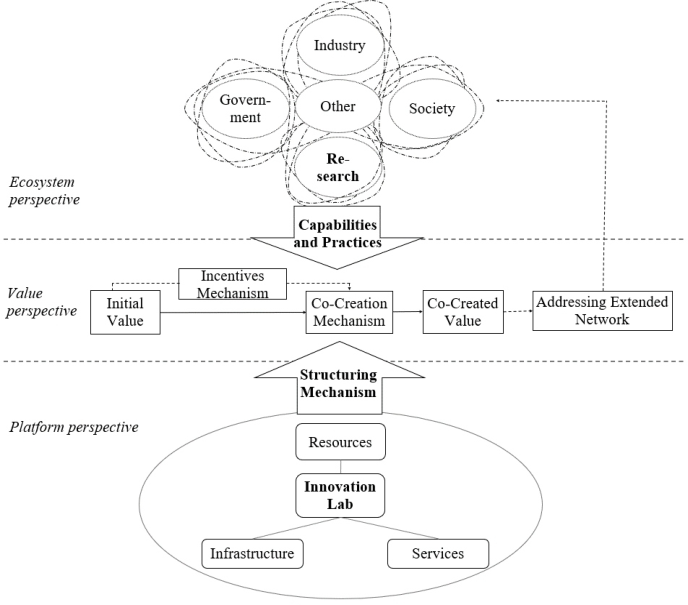
A SUGGESTED MODEL FOR INNOVATION LABS AS VALUE CO-CREATION PLATFORMS Having outlined different aspects of innovation labs, ecosystems and value co-creation, the following model is introduced to approach innovation labs as value co-creation platforms within research ecosystems.
The model consists of three layers representing key elements of the value co-creation process with focus on research-driven ecosystems including the Ecosystem perspective, the Value perspective, and the Platform perspective.
The Ecosystem perspective outlines actors within the research ecosy- stem, which interact in varying and changing constellations with each other. Individual actors are not involved in unidirectional relationships, but in multi-layered and dynamic interactions. Each actor within the ecosystem provide – as described above – their specific set of skills, knowledge, and capabilities. The ecosystem, in which value co-creation takes place, thereby cannot be perceived as a static and unchanging entity, as additional partici- pants that are being addressed by the co-created value and/or being attracted by the initial value might be included in the innovation ecosystem.
The Value perspective outlines a potential value creation process within the research ecosystem. It is based on the interaction of actors within the
Figure 1: Conceptual model of innovation labs as value co-creation platforms in rese- arch ecosystems based on De Silva et al. (2021), Fehrer et al. (2020) and Schütz et al. (2019).
Innovation Labs as Value Co-Creation Platforms in Research Ecosystems 355
research ecosystems to jointly co-create value. The co-creation of value is thereby based on several co-creation mechanism – such as tools, methods, and skills – and enabled by incentives for the ecosystem to participate in the co-creation process. Main objective of co-created value is to address the target group of each actor involved, which can be described as the extended network of the innovation ecosystem, with a value proposition.
The Platform perspective demonstrates one form of bringing together the research ecosystem and the value co-creation process by means of innovation labs. Innovation labs thereby act as an intermediary between the multi- layered and dynamic actor constellations of the research ecosystem in order to initiate and foster interaction and enable value co-creation. By providing necessary infrastructure, services and resources in technical and social form, innovation labs can initiate and strengthen the co-creation process within the research ecosystem.
DISCUSSION AND FUTURE RESEARCH In recent years, innovation labs have become a popular approach for facili- tating collaboration across company and industry boundaries. Yet, while the need for close interaction in academia has been outlined, little is known on how to foster the interaction between different research institutions and affi- liated actors and what role innovation labs can play in this network. While there is a large amount of research on innovation labs (including similar lab concepts), value co-creation and platforms individually, little research is pro- vided on the intersection areas, specifically with focus on academia as a main driver of co-creation processes. Hence, it is important to highlight, that this paper is research in progress with the aim to provide an overview on this rela- tively narrow research field trying to provide links and connections between all the relevant aspects and perspectives.
The conceptual model presented in chapter five outlines a new starting point on how to approach the value co-creation process in research ecosy- stems and highlights, based on existing research insights, the links between the concepts of value co-creation and research ecosystem by suggesting inno- vation labs as intermediating platforms. By providing technical and social infrastructure, services and resources, the platform forms the foundation for the joint value co-creation process. It allows actors within the research ecosystem to come together, initiate and facilitate interaction.
In the future, more research is needed to collect and gather further insights to complement and extend the model. As the model is currently a theoretical construct, empirical data needs to be collected. As co-creation processes can be highly individual, this research will be applied to specific use cases and data can be collected, among other, from stakeholder workshops that are conducted in the context of building up an innovation lab around a research ecosystem.
From the ecosystem perspective, relevant open research questions com- prise a more refined view on which actors are included in the research-driven innovation ecosystem, how they interact, and if effects like clustering or sub-networks within ecosystems can be observed.
Additionally, from the value perspective, incentives and motivations to par- ticipate in and interact with the research ecosystem can be examined more deeply. Furthermore, value co-creation mechanisms and their use could be more specifically described. From a business model perspective, it could be examined how the concept of dual value can be embedded in a revenue or financing model and which prerequisites would be required.
Finally, from the Platform perspective, different roles, such as platform owners, as well as respective characteristics and functions can be investigated. In addition, future research should look at concrete forms of provided social and technical infrastructure, resources, and services to foster the value co- creation process, as well as investigate governance mechanism to facilitate value co-creation within the research ecosystem.
ACKNOWLEDGMENT
The project “Urban Innovation Hub”, on which this article is based, is funded by the Ministry of Economic Affairs, Labour and Tourism of the German federal state of Baden-Wuerttemberg.
REFERENCES
Budeanu, Andrea-Mariana and Rosner, Daniel (2021). “Big Data as Capital. A Case Study on the Innovation Labs Tech Accelerator”, in 2021 23rd International Conference on Control Systems and Computer Science (CSCS) (pp. 469–475). IEEE. Bullinger, Hans-Jorg. Neuhüttler, Jens. Nägele, Rainer and Woyke, Inka (2017).
“Collaborative Development of Business Models in Smart Service Ecosystems”, in 2017 Portland International Conference on Management of Engineering and Technology (PICMET) (pp. 1–9). IEEE. De Silva, Muthu. Gokhberg, Leonid. Meissner, Dirk and Russo, Margherita (2021).
“Addressing societal challenges through the simultaneous generation of social and business values: A conceptual framework for science-based co-creation”, Technovation, Volume 104. pp. 102268. De Silva, Muthu and Wright, Mike (2019). “Entrepreneurial co-creation: societal impact through open innovation”, R&D Management, Volume 49 No. 3. pp. 318–342. Fehrer, Julia A. Brodie, Roderick J. Kaartemo, Valtteri and Reiter, Maximilian.
(2020). “12 The Role of Engagement Platforms in Innovation Ecosystems”, in Fritzsche, A. Roth, A. Jonas, J. M. and Möslein, K. M. (Eds.), De Gruyter Studies in Innovation and Entrepreneurship. Innovating in the Open Lab: The new poten- tial for interactive value creation across organizational boundaries (pp. 129–140). De Gruyter Oldenbourg. Fritzsche, Albrecht. (2020). “6 The Many Facets of Open Laboratories and Their Implications for Innovation Management”, in Fritzsche, A. Roth, A. Jonas, J. M. and Möslein, K. M. (Eds.), De Gruyter Studies in Innovation and Entrepreneur- ship. Innovating in the Open Lab: The new potential for interactive value creation across organizational boundaries (pp. 73–80). De Gruyter Oldenbourg. Fuglsang, Lars. Hansen, Anne V. Mergel, Ines and Røhnebæk, Maria T. (2021).
“Living Labs for Public Sector Innovation: An Integrative Literature Review”, Administrative Sciences, Volume 11 No. 2. pp. 58.
Innovation Labs as Value Co-Creation Platforms in Research Ecosystems 357
Haug, Nathalie and Mergel, Ines (2021). “Public Value Co-Creation in Living Labs— Results from Three Case Studies”, Administrative Sciences, Volume 11 No. 3. pp. 74. Jonas, Julia M. (2020). “11 Co-creating Value with Open Labs”, in Fritzsche, A.
Roth, A. Jonas, J. M. and Möslein, K. M. (Eds.), De Gruyter Studies in Innovation and Entrepreneurship. Innovating in the Open Lab: The new potential for intera- ctive value creation across organizational boundaries (pp. 125–128). De Gruyter Oldenbourg. Kairies-Lamp, Nina (2018). “Innovation Labs: Katalysator für die Digitalisierung”, Public Governance Des Instituts Für Den Öffentlichen Sektor. pp. 12–16. Nyström, Anna G. Leminen, Seppo. Westerlund, Mika and Kortelainen, Mika (2014).
“Actor roles and role patterns influencing innovation in living labs”, Industrial Marketing Management, Volume 43 No. 3. pp. 483–495. Ollila, Susanne and Yström, Anna. (2020). “18 Open Laboratories as “In-between Spaces”“, in Fritzsche, A. Roth, A. Jonas, J. M. and Möslein, K. M. (Eds.), De Gruyter Studies in Innovation and Entrepreneurship. Innovating in the Open Lab: The new potential for interactive value creation across organizational boundaries (pp. 203–212). De Gruyter Oldenbourg. Robles, Ana G. Hirvikoski, Tuija. Schuurman, Dimitri and Stokes, Lorna. (2015).
Introducing ENoLL and its Living Lab community. https://issuu.com/enoll/docs/e noll-print. Rossmeissl, Thomas. Groß, Erwin. Tzempetonidou, Maria and Siegert, Jörg (2019). “Living Learning Environments”, Procedia Manufacturing, Volume 31. pp. 20–25. Roth, Angela. (2020). “1 Piloting in Open Innovation Labs – A Challenge for Local Ecosystems”, in Fritzsche, A. Roth, A. Jonas, J. M. and Möslein, K. M. (Eds.), De Gruyter Studies in Innovation and Entrepreneurship. Innovating in the Open Lab: The new potential for interactive value creation across organizational boundaries (pp. 3–10). De Gruyter Oldenbourg. Schiller, Christian. Müller-Wieland, Roda. Blank, David. Leyh, Jens. Jütting, Malte
and Neuhüttler, Jens. (2021). Wertschöpfung vernetzt gestalten. Whitepaper. Stutt- gart. Fraunhofer-Gesellschaft zur Förderung der angewandten Forschung e. V. https://publica.fraunhofer.de/handle/publica/300845. Schütz, Florian. Heidingsfelder, Marie L. and Schraudner, Martina (2019). “Coshaping the Future in Quadruple Helix Innovation Systems: Uncovering Public Preferences toward Participatory Research and Innovation”, She Ji: The Journal of Design, Economics, and Innovation, Volume 5 No. 2. pp. 128–146. Tombeil, Anne-Sophie and Nägele, Rainer (2022). “Towards a Concept of “Gover-
nance as a Smart- Service”in Service-Oriented Value-Creation-Systems”, in AHFE International, The Human Side of Service Engineering. AHFE International. Tranfield, David. Denyer, David and Smart, Palminder (2003). “Towards a Methodology for Developing Evidence-Informed Management Knowledge by Means of Systematic Review”, British Journal of Management, Volume 14 No. 3. pp. 207–222. Whicher, Anna and Crick, Tom (2019). “Co-design, evaluation and the North-
ern Ireland Innovation Lab”, Public Money & Management, Volume 39 No. 4. pp. 290–299.
LISTED IN THE AHFE DIGITAL BOOKSTORE CATALOGUE
Explore the complete digital volume
The Human Side of Service Engineering
Read this individual research paper free through the original publisher, or explore the full digital proceedings book.
ISBN 978-1-958651-84-1
Explore this ISBN in the AHFE Bookstore ↗Listed in the July 2026 bookstore catalogue; search by ISBN to confirm current availability · Digital book purchase optional