Takashi Onoda, Yasunobu Ito (2025). Managing Large-Scale Research Facilities for Innovation: Stakeholder Approaches to Institutional Collaboration in Academia. In: The Human Side of Service Engineering. AHFE Open Access, vol. 182, pp. 178–186. https://doi.org/10.54941/ahfe1006417
The role of academia has become increasingly central to the development and management of Innovation Ecosystems (IE). By spearheading industry-academia collaboration projects with regional enterprises and facilitating the shared utilization of large-scale research facilities, academia functions as a critical hub for open innovation, enhancing its engagement with industry and society. However, a major challenge lies in fostering effective collaboration across academic departments and institutions to drive such initiatives and ensure seamless facility operations. While prior research on academic collaboration predominantly focuses on individual researchers or laboratory-level efforts, recent studies have begun to explore interdepartmental and inter-institutional collaborations within academia to advance the IE framework. Nevertheless, the issue of providing adequate incentives to encourage academic scientists to participate autonomously and meaningfully in these activities remains unresolved. This study examines these challenges through interviews with academic scientists involved in managing neutron facilities and detailed analyses of relevant case studies. The research identifies key barriers to effective collaboration and proposes actionable strategies for promoting efficient and sustainable IE management. The findings contribute to the advancement of value creation within IE and provide a solid foundation for its long-term sustainability.
Innovation ecosystems (IEs) play a crucial role in driving technological advancements and economic growth. These ecosystems resemble natural ecosystems, where diverse participants such as corporations, universities, research institutions, and government agencies interact dynamically to generate new knowledge and innovation (Oh et al., 2016). As international competition intensifies, the sustainability and efficiency of IEs are critical for fostering innovation and addressing complex societal challenges. Academia
Managing Large-Scale Research Facilities for Innovation 179
serves as a central entity in these ecosystems, bridging scientific exploration with practical applications, making its role indispensable (Chen, 2023; Granstrand and Holgersson, 2020; Kapoor et al., 2022; Tomás et al., 2020).
In Japan, academia’s role in IEs has expanded through initiatives such as industry-academia collaboration projects and the shared use of large-scale research infrastructure. Additionally, government policies promoting the integration of universities and research institutions have further facilitated these efforts, enabling effective resource utilization and cooperative management. In particular, the field of neutron science requires strong inter-institutional collaboration to support both fundamental research and industrial applications.
Despite these advancements, significant challenges remain, particularly concerning the promotion of inter-institutional collaboration within academia. Previous discussions on academic collaboration have primarily focused on “research collaboration” at the level of individual researchers or research laboratories (Corley et al., 2006). While such efforts have contributed to scientific progress, they have not sufficiently addressed the need for sustainable interdepartmental and inter-institutional collaboration essential for the long-term development of IEs. Consequently, recent discussions have increasingly examined inter-institutional collaboration in academia. These discussions have often emphasized standardized rules and top-down management strategies (Vasconcelos et al., 2012; Boardman and Ponomariov, 2014). However, such approaches frequently overlook researchers’ intrinsic motivation and autonomy, which can pose barriers to establishing meaningful and sustainable cooperative relationships.
This study aims to address these challenges by exploring the issues and opportunities related to inter-institutional collaboration in academia. Focusing on the field of neutron science, the study employs ethnographic observations and interviews with researchers and facility managers to identify practical methods for fostering efficient and sustainable IE management. Specifically, this study proposes actionable strategies based on stakeholder theory (Freeman, 1984), aiming to construct a comprehensive framework that advances inter-institutional collaboration in academia while overcoming existing barriers.
LITERATURE REVIEW
Academic research collaboration has long been recognized as a crucial mechanism for advancing research and fostering innovation. Much of the existing literature has focused on the efficiency and effectiveness of collaboration at the level of individual researchers or research groups, aiming to enhance the outcomes of individual scholars (Corley et al., 2006). These studies provide valuable insights into the dynamics of academic collaboration within specific research groups and disciplines. More recently, however, attention has also turned to broader considerations of the relationship between academia and society, with these social practices being increasingly discussed under the concept of academic engagement.
Regarding this discourse, Perkmann (2021) highlights the transformative potential of academic engagement in contributing to social progress through
180 Onoda and Ito
partnerships with industry. Specifically, academic engagement encompasses a wide range of activities related to the transfer of knowledge from universities to industries, including joint research, contract research, consulting, and informal collaborations. Consequently, academic engagement is recognized as a critical component of innovation ecosystems (IEs), enabling academia to contribute more broadly to societal advancement.
One key function of innovation ecosystems is leveraging the large-scale research infrastructures available in academia to serve as starting points for open innovation (Rådberg and Löfsten, 2023). In Japan, these activities are increasingly prominent. A distinctive feature in the Japanese context is that large-scale research infrastructures are often managed collaboratively by multiple academic institutions, embodying the principles of open innovation. Thus, academic engagement focused on inter-institutional collaboration is indispensable for ensuring the sustainability of innovation ecosystems. However, promoting inter-institutional collaboration presents significant challenges, including differences in research ethics, operational rules, and cultural contexts. Vasconcelos et al. (2012) highlight these barriers in the context of international research partnerships, noting that the lack of standardized ethical frameworks and operational rules often complicates collaborative efforts. To address these challenges, they advocate for the development of standardized frameworks and the promotion of research ethics education.
Similarly, Boardman and Ponomariov (2014) emphasize the importance of management capabilities within university research centers. Their research suggests that leaders with strong management skills are better equipped to address challenges such as conflicts among researchers’ goals and balancing intellectual property protection with knowledge dissemination. They also argue that top-down management approaches can improve resource utilization and provide incentives for collaboration. While these studies offer valuable insights, they often rely on standardized rules and top-down management approaches, which tend to overlook the intrinsic motivations and autonomy of researchers. This limitation represents a significant obstacle to fostering sustainable and meaningful collaboration within academia.
This study seeks to address these limitations by leveraging stakeholder theory (Freeman et al., 1984) to explore strategies for promoting value recognition and cooperation among diverse stakeholders. By designing incentive structures that encourage academic scientists to engage proactively and meaningfully in inter-institutional collaboration, this research aims to bridge the gap between institutional frameworks and practical on-the-ground practices. Ultimately, it seeks to provide a comprehensive framework for managing sustainable innovation ecosystems.
METHOD AND MATERIAL This study aims to elucidate the challenges of inter-institutional collaboration in neutron science through a two-year ethnographic study and a series of interviews with researchers in the field. While neutron science is
Managing Large-Scale Research Facilities for Innovation 181
fundamentally a field of basic research, its outcomes have a unique dual nature, as they directly impact materials science and industrial applications. This duality—both “scientific significance” and “practical applicability”— underscores the crucial role of inter-institutional collaboration in advancing scientific progress and supporting industrial applications. In particular, research utilizing neutron beams is highly dependent on large-scale facilities, making effective collaboration frameworks and efficient management essential for research advancement.
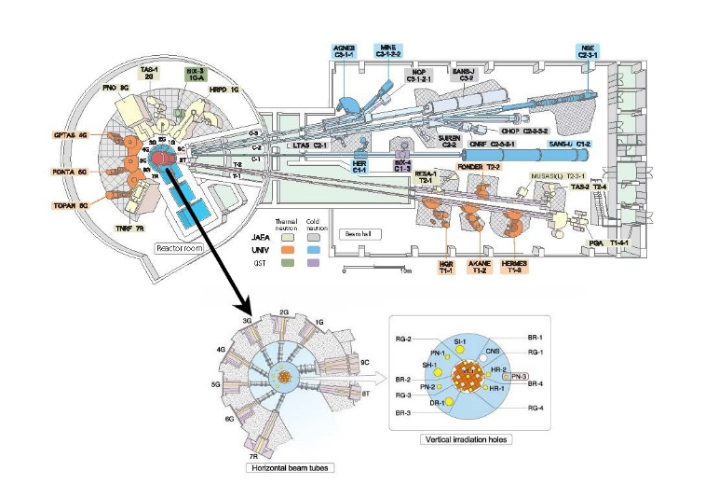
In Japan, there are three primary means of utilizing neutron beams: (1) the spallation neutron source at the Japan Proton Accelerator Research Complex (J-PARC) in Tokai, Ibaraki Prefecture; (2) the steady-state neutron source at the Japan Research Reactor No. 3 (JRR-3); and (3) small-scale accelerator-based neutron sources. J-PARC is a large-scale facility jointly managed by the High Energy Accelerator Research Organization (KEK) and the Japan Atomic Energy Agency (JAEA). In contrast, JRR-3 is operated by the Japan Atomic Energy Agency (JAEA), with collaborative involvement from multiple organizations, including Tohoku University, Kyoto University, the University of Tokyo, the National Institutes for Quantum Science and Technology (QST), and JAEA. Figure 1 illustrates which organization is responsible for managing the beamlines, which are experimental instruments inside JRR-3. Additionally, small-scale accelerator-based neutron sources, such as those at Hokkaido University, RIKEN, and the National Institute of Advanced Industrial Science and Technology (AIST), play a significant role in supporting diverse research activities, including applications in regional industries.
One of the authors has been actively participating, from a management studies perspective, in a committee under the Japanese Society for Neutron Science since 2023. This committee examines strategies for promoting neutron science, and the present study is conducted as part of its activities. Through this engagement, the author has established relationships with academic researchers affiliated with institutions that serve as key stakeholders in neutron science promotion. This presentation specifically focuses on JRR-3.
The methodological approach of this study combines ethnographic observation and semi-structured interviews. Ethnographic research involved direct observations of researchers’ activities at neutron facilities, gaining insights into their daily operations, decision-making processes, and approaches to addressing challenges in inter-institutional collaboration. The interviews targeted neutron science researchers, facility administrators, and managers involved in institutional collaborations. These interviews aimed to identify challenges and benefits associated with facility utilization, cultural and perceptual gaps in collaboration, and factors that either facilitate or hinder effective cooperation.
For this study, semi-structured interviews were conducted with 18 key personnel involved in the operation and utilization of JRR-3, including the facility director, site managers, and research staff. These interviews were conducted both on-site and via webinars. The collected interview data were transcribed and analyzed using the Grounded Theory Approach. This method
182 Onoda and Ito
enabled the extraction of conceptual themes and the development of a theoretical framework that captures the core challenges of inter-institutional collaboration in neutron science. The findings presented in this study are derived from this analytical process.
Figure 1: JRR-3 and its beam line map (https://jrr3uo.jaea.go.jp/jrr3uoe/instruments/ index.htm).
RESULTS AND DISCUSSIONS Fostering Innovation Ecosystems Through Inter-Institutional Collaboration
Inter-institutional collaboration is essential for fostering innovation ecosystems (IE), particularly in the management of large-scale research infrastructure. In Japan, neutron science has a long history of cooperation, with multiple institutions sharing responsibilities for the operation of neutron facilities. However, significant challenges remain in facilitating effective collaboration among academic institutions.
One major barrier is the fragmented operational structure, where each institution maintains its own management system, leading to limited coordination. Figure 1 illustrates which organization is responsible for the beamlines, which are measurement instruments inside JRR-3. As shown in the figure, the beamlines that make up JRR-3 are operated separately by different organizations. Specifically, the Japan Atomic Energy Agency (JAEA) is responsible for the operation of the JRR-3 research reactor, managing its beamlines and measurement instruments. Meanwhile, major user institutions such as Tohoku University, Kyoto University, and the University of Tokyo
Managing Large-Scale Research Facilities for Innovation 183
independently operate their respective beamlines within JRR-3, handling their operations and user access procedures separately. This fragmented management structure hinders the efficient sharing of resources and the integrated administration of facilities.
For external users, this fragmentation presents significant hurdles, requiring them to contact multiple institutions separately and navigate distinct administrative procedures for each. Moreover, independent proposal review committees at each institution create a disjointed evaluation process, adding complexity for researchers seeking access. The technical and operational staff supporting facility management are also independently allocated by each institution, making it difficult to establish a unified operational framework. While the specifications of JRR-3 have traditionally been coordinated among institutions, future planning must be led by JAEA as the facility owner while strengthening coordination with other institutions (Interview conducted on August 29, 2024).
A fundamental issue underlying these challenges is the lack of recognition of other institutions involved in facility operations as key stakeholders. From the perspective of stakeholder theory, it is problematic for a single institution to formulate strategies without considering the interests of other involved entities. Instead, external stakeholders should be integrated as vital components of institutional governance. This study highlights two key strategies to enhance inter-institutional collaboration: Establishing a unified management system for physical and operational infrastructure.
Developing a shared vision that encompasses all participating institutions. Regarding the first strategy, efforts are already underway to integrate the previously independent operational processes within JRR-3. A significant initiative in this regard is the development of a “one-stop service system”, which aims to streamline facility access for users while enhancing operational efficiency. Additionally, the maintenance of fundamental technologies such as cold neutron sources and detectors requires inter-institutional cooperation, and efforts to facilitate this technological sharing are progressing.
For the second strategy, future facility planning must not be determined solely by the facility owner but should involve all participating institutions and the broader user community in the decision-making process. A collaborative vision-building approach can help align the diverse interests of stakeholders, leading to more comprehensive and sustainable facility development (Interview conducted on September 3, 2024).
Despite these efforts, challenges remain in incentivizing academic researchers to actively promote institutional collaboration. Stakeholder theory suggests that management and governance structures are traditionally confined within individual organizations, making it difficult to integrate external stakeholders effectively. The persistence of independent management systems at each institution further complicates the establishment of a common collaborative framework. Additionally, the progress of the one-stop service system has been hindered by conflicting institutional interests, with a single leading institution primarily driving its implementation (Interview conducted on August 29, 2024).
184 Onoda and Ito
Moreover, differences in organizational culture pose a significant barrier to collaboration. The University of Tokyo, Tohoku University, and Kyoto University follow bottom-up governance models, whereas JAEA operates as a top-down governmental agency. These fundamental differences in decision- making structures make inter-organizational cooperation challenging.
Overcoming Barriers to Institutional Collaboration How can academic institutions recognize the importance of external stakeholders and foster sustainable collaboration? Addressing this challenge requires proactive support from academic societies and relevant governmental agencies. Traditionally, facility management has been the responsibility of individual institutions, with limited involvement from academic societies or government bodies. However, if the government were to subsidize the operational costs of a one-stop service system, institutional collaboration could be significantly strengthened (Neutron Science Society, Science Diversity Report, 2024). Furthermore, in planning future facility development, the Neutron Science Society could play a leading role in formulating a comprehensive roadmap, thereby providing researchers with a framework for common vision-building (Interview conducted on April 28, 2024). By implementing these initiatives, stakeholder collaboration can be reinforced, ultimately contributing to the development of a sustainable innovation ecosystem. This study examines the challenges and prospects of inter-institutional collaboration in fostering innovation ecosystems and presents the following key findings:
The persistence of institution-specific management systems is a primary obstacle to effective inter-institutional collaboration.
This fragmented governance structure impedes resource sharing and integrated facility management, creating access barriers for researchers and external users.
To enhance institutional collaboration, the following measures should be prioritized: The implementation of a cross-institutional unified management system (e.g., a shared one-stop service system).The establishment of a collaborative framework for facility usage coordination and future planning (e.g., joint management committees or society-led roadmap initiatives). From a stakeholder theory perspective, the sustainable development of inter- institutional collaboration requires recognizing other institutions and external organizations as critical stakeholders and establishing an integrated governance framework. Strengthening coordination through academic societies and collaborative governance mechanisms will be essential in overcoming these structural barriers and fostering an innovation ecosystem.
CONCLUSION
In the management of neutron facilities, it is essential to move beyond institution-specific initiatives and establish a collaborative decision-making framework that includes academic societies and governmental agencies. Such
Managing Large-Scale Research Facilities for Innovation 185
an approach would facilitate resource sharing among institutions, enhance operational efficiency, and improve accessibility and convenience for external users.
A critical challenge moving forward is the design of incentive mechanisms that encourage researchers within academic institutions to actively promote inter-institutional collaboration. This requires demonstrating the concrete benefits of institutional cooperation, such as expanding opportunities for joint research and allocating preferential funding to collaborative projects. Additionally, evaluating the effectiveness of inter-institutional collaboration models and developing long-term operational guidelines will be crucial in ensuring their sustainability.
Ultimately, these initiatives contribute to the development of a sustainable innovation ecosystem grounded in institutional cooperation. Key anticipated outcomes include enhanced sharing of facilities and data across institutions, increased accessibility for external researchers, and the generation of new research outcomes. By establishing a framework in which academic societies and governmental agencies take the lead, while researchers drive collaboration through practical engagement, a more open and inclusive academic research environment can be realized.
ACKNOWLEDGMENT
This work was supported by JSPS KAKENHI Grant Number 23K12517. We would like to express our gratitude to the President and members of the Japan Society for Neutron Science for their warm hospitality and invaluable support during our research.
REFERENCES
Boardman, Craig, and Branco Ponomariov. (2014). “Management Knowledge and the Organization of Team Science in University Research Centers.” The Journal of Technology Transfer 39 (1): 75–92. Chen, Jin. (2023). Enterprise Innovation Ecosystem: Theory and Practice. Springer
Nature. Corley, Elizabeth A., P. Craig Boardman, and Barry Bozeman. 2006. “Design and the Management of Multi-Institutional Research Collaborations: Theoretical Implications from Two Case Studies.” Research Policy 35 (7): 975–93. Freeman, R. Edward, Jeffrey S. Harrison, and Stelios Zyglidopoulos. (2018).
Elements in Organization Theory: Stakeholder Theory : Concepts and Strategies: Concepts and Strategies. Cambridge, England: Cambridge University Press. Granstrand, Ove, and Marcus Holgersson. (2020). “Innovation Ecosystems: A Conceptual Review and a New Definition.” Technovation 90–91 (February): 102098. Kapoor, Kawaljeet, Ali Ziaee Bigdeli, Andreas Schroeder, and Tim Baines. (2022). “A
Platform Ecosystem View of Servitization in Manufacturing.” Technovation 118 (December): 102248. Oh, Deog-Seong, Fred Phillips, Sehee Park, and Eunghyun Lee. (2016). “Innovation Ecosystems: A Critical Examination.” Technovation 54 (August): 1–6.
186 Onoda and Ito
Perkmann, Markus, Rossella Salandra, Valentina Tartari, Maureen McKelvey, and Alan Hughes. (2021). “Academic Engagement: A Review of the Literature 2011–2019.” Research Policy 50 (1): 104114. Perkmann, Markus, Valentina Tartari, Maureen McKelvey, Erkko Autio, Anders
Broström, Pablo D’Este, Riccardo Fini, et al. (2013). “Academic Engagement and Commercialisation: A Review of the Literature on University–Industry Relations.” Research Policy 42 (2): 423–42. Rådberg, Kamilla Kohn, and Hans Löfsten. (2024). “The Entrepreneurial University and Development of Large-Scale Research Infrastructure: Exploring the Emerging University Function of Collaboration and Leadership.” The Journal of Technology Transfer 49 (1): 334–66. Vasconcelos, Sonia M. R., Nicholas H. Steneck, Melissa Anderson, Hatisaburo
Masuda, Marisa Palacios, José C. S. Pinto, and Martha M. Sorenson. (2012). “The New Geography of Scientific Collaborations. Changing Patterns in the Geography of Science Pose Ethical Challenges for Collaborations between Established and Emerging Scientific Powers.” EMBO Reports 13 (5): 404–7.
LISTED IN THE AHFE DIGITAL BOOKSTORE CATALOGUE
Explore the complete digital volume
The Human Side of Service Engineering
Read this individual research paper free through the original publisher, or explore the full digital proceedings book.
ISBN 978-1-964867-58-8
Explore this ISBN in the AHFE Bookstore ↗Listed in the July 2026 bookstore catalogue; search by ISBN to confirm current availability · Digital book purchase optional