Inoue Kazuoki, Shin-ichi Taniguchi, Yasunobu Ito (2025). Using Fieldnotes to Enhance General Practitioner Training. In: The Human Side of Service Engineering. AHFE Open Access, vol. 182, pp. 187–194. https://doi.org/10.54941/ahfe1006418
The purpose of this paper is to report on an educational practice that utilise cultural anthropological findings conducted for health professionals (general practitioners) who engage with patients, families and communities from a comprehensive perspective. We conducted an educational practice focused on sharing fieldnotes with others for general practitioners. This educational practice aimed to help learners become more cognizant of the perspectives they tend to use while having exposure to the perspectives of others. The main contents of the educational practice were (1) lectures and exercises on the concept of cultural anthropology and how to write fieldnotes, (2) fieldwork on ward rounds, and (3) reflection while sharing fieldnotes. In the process of sharing fieldnotes with others, observers talked about the differences in the points they observed between themselves and others, and made comparisons with their own clinical practice. This educational practice indicates that fieldnote taking and sharing can be used as a method for medical practitioners to reexamine events and phenomena from multiple perspectives.
The purpose of this paper is to report on an educational practice that utilise cultural anthropological findings conducted for health professionals (general practitioners) who engage with patients, families and communities from a comprehensive perspective.
In Japan’s super-aged society, people living with chronic diseases are increasing. Not to mention, people’s values are becoming increasingly diverse. As a result, medical practitioners in Japan are progressively required to think together with patients and to observe patients, families and communities from a comprehensive perspective. Furthermore, doctors are required to understand the background of their patients and to collaborate with other healthcare professionals and stakeholders in healthcare.
However, the main content of education in the training of doctors in Japan is to memorise medical knowledge. Most doctor training programmes focus on treatment, examination and procedures. There is minimal focus on training in social factors that have negative impact on health. Therefore, the challenge is that doctors are not provided with the opportunities to
implement the comprehensive view of healthcare as demanded by society. To solve this problem, (i) the social sciences curriculum has become compulsory in all medical schools in Japan, and (ii) the training for general practitioners has begun to be implemented.
In Japan, the application of social science, which scientifically explores various aspects of human society, in medical education only began full-fledged implementation in 2017. The introduction of social science knowledge into medical education has not necessarily been successful, even in leading countries ahead of Japan (Litva 2008). The reasons include a lack of collaboration between clinical supervisors and cultural anthropologists (Satterfied 2010) and lack of learners’ capability to relate to medicine with an acute relevance (Hemmings 2005). One of the advantages of cultural anthropology over other social sciences when it comes to being introduced in medical education is that it is said to be a discipline that can build bridges between various disciplines (Wiedman and Martinez 2021). Collaboration between cultural anthropologists and medical educators is essential for the application of social sciences in medical education.
To first become a doctor in Japan, one must go through six years of training at a medical school. Followed by two years of training as junior resident doctors. In the third year after graduation doctors train in one of 19 major specialty training programmes. In 2018, the Department of General Medicine became one of 19 major specialities. The inclusion of the Department of General Practice as one of the major specialties was driven by the society’s demand to train medical practitioners who are capable of medical practice by understanding events with a comprehensive perspective.
Training programmes in general medicine specialities are accredited by the Japanese Medical Specialty Board. A variety of Japanese-Medical-Specialty- Board-accredited general medicine speciality training programmes have been established throughout Japan. The difference between the training of general practitioners and that of other specialists is in acquiring a perspective to decipher the social system context surrounding the patient which is positioned at the core of the training. While specialist training in general began 2018, there are issues to be addressed. A study by Ohta and Sano found that trainees in specialised training in general medicine were hesitant about dealing with chronic diseases in a clinical setting and anxious about working with various stakeholders and health professionals in the community (Ohta and Sano 2023). Residents’ anxiety in specialty training in general medicine can be attributed to a lack of training in deciphering the context of the patients.
In this paper, the educational practice incorporates cultural anthropological findings into training in deciphering the context of the patient. Cultural anthropology is a discipline that attempts to grasp the events occurring in front of our eyes, encompassing cultural backgrounds, politics and life experiences. By incorporating cultural anthropological findings into the training, medical practitioners will be able to view events from multiple perspectives.
Ethnography is the main research method in cultural anthropology. Ethnography is based on participatory observation, examining the activities
Using Fieldnotes to Enhance General Practitioner Training 189
and lives of people. Cultural anthropologists carry out ethnography by writing fieldnotes. The process of writing fieldnotes improves their understanding of the events they are observing and changes the way they participate. They are then able to listen much more attentively to what others are saying and observe from a new perspective than before (Emerson et al. 2011). Cultural anthropologists write fieldnotes with the mindset of cultural anthropology. On the other hand, some cultural anthropologists have pointed to the Rashomon effect (Heider 1988), where different observers claim different views of the same event. Even if cultural anthropologists enter the same field, the ethnography described will be different for each cultural anthropologist because of the different lenses through which they observe. Performing ethnography as a team allows you to encounter the lenses that others use to observe. This allows them to become aware of their own lens that they use to observe.
The author, in collaboration with a co-author, a cultural anthropologist, is conducting an ethnography in one of the general practice specialty training programmes in Japan. The target subject is participants in general practice specialty training programmes in Tottori Prefecture, Japan which is accredited by the Japanese Medical Specialty Board. In AHFE-HSSE 2024, we reported that resident doctors learn together with patients in the medical field and that resident doctors can perceive events from multiple perspectives by learning cultural anthropology (Inoue and Ito 2024). In the process of conducting this ethnography, a resident doctor said ’After learning the “Techniques of Patient-Centred Medicine”, I found myself trying to interpret events in the medical field in terms of the “Techniques of Patient-Centred Medicine” without realising it. I felt some perils in thinking like this.’ The takeaway for him is that if you learn a perspective, you will see events from that perspective without knowing it. In order to become aware of the perspective for viewing events, we developed an educational practice focused on sharing fieldnotes with others. The paper is on developing this educational practice.
METHODS
One of the authors (KI) is in a position to coordinate resident doctor education in this programme. KI has been working as a specialist in general practice before the establishment of the general practice specialty training programme in 2018. Since 2022, KI is enrolled in a PhD programme in cultural anthropology. KI collaborated with co-author YI, a cultural anthropologist, to plan, implement and evaluate this educational practice. They held monthly meetings to plan this educational practice. The planned objectives and content are as follows.
Purpose of the educational practice Through writing the fieldnotes, the learners recognize the points that are the same or different between their own and others’ perspectives. Recognising these points can make learners become aware of the tendencies in their own perspective.
Contents of the educational practice The contents and aims of the educational practices are shown in Table 1. The learners were asked to read an article in advance explaining the philosophy of cultural anthropology making the strange familiar and making the familiar strange (Ito 2021). Making the strange familiar refers to grasping the seemingly strange logic of different cultures into our own perspective and translating it into a form that is comprehensible to us. Furthermore, making the familiar strange is about reassessing such cross-cultural experiences with fresh eyes, from a cross-cultural perspective, and reassessing our own normative norms.
Table 1: Contents of the educational practice.
Table available in the original PDF paper.
Activities Aims of the activity Time (mins)
10 Explanation of aim To communicate the purpose of this
To inform participants about the
educational practice to the participants to give them an idea of what they will be doing. 30 Commentary on fieldnotes from a meaning, perspectives and methods of writing fieldnotes. Participants are then able to imagine actually writing fieldnotes during fieldwork in the hospital wards.
cultural anthropologist Lectures and observation exercises on the main themes of ’what is cultural anthropology’, ’making the strange familiar and making the familiar strange’ and ’what is fieldnotes’.
Continuing to write fieldnotes during
60 Fieldwork on the hospital wards In two
the fieldwork allows participants to reflect on what it is like to observe the medical field with fresh eyes.
groups, participants follow the doctors rounds on the hospital wards and conduct observation and write fieldnotes.
Recognizing the differences between
50 Reflection Sit in a circle and verbally
communicate, show each other what they have written in their fieldnotes and share their feelings about the process.
their own and others fieldnotes can help participants become more aware of the perspectives they tend to use for themselves. 10 Closing Participants verbalize what they felt during this time.
The educational practice we organised took place on 30 November, 2024 at a medical institution in Tottori Prefecture, where the general practice specialty training took place. Participants included four resident doctors, six supervisors; KI and YI were not included in this group. KI facilitated the discussion on Explanation of aim, Reflection and Closing. YI provided Commentary on fieldnotes from a cultural anthropologist perspective.
Cultural anthropologists write detailed fieldnotes in their research. Although there is a general view that there is no need to bother with handwritten fieldnotes if photographs or videos are taken, it was emphasized that writing, editing and interacting with the fieldnotes enables lessons learned and triggers awareness (Ito 2021: 24-5). Furthermore, in this case, the fieldnotes created by other participants were shared after the exercise. These could be rephrased as follows.
Using Fieldnotes to Enhance General Practitioner Training 191
-Writing fieldnotes: a dialogue with oneself (to gain insights, to enable reflection).
-Sharing fieldnotes: comparing perspectives with others (to see how others observe and differ in their perspectives).
RESULTS
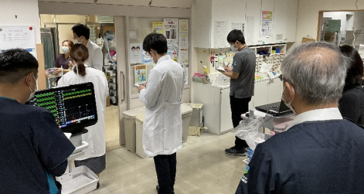
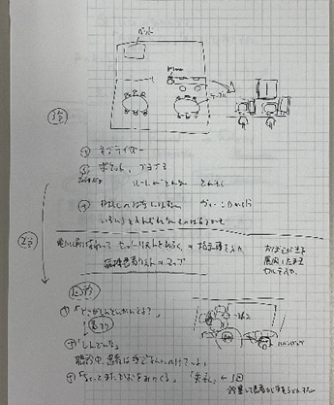
Ten participants were divided into two groups and carried out a fieldwork (observation) exercise on the hospital wards. Figure 1 shows the fieldwork in the hospital wards. This picture shows participants observing the doctor discussing patients with the nurse. In both groups, doctors checked the patients records in the electronic medical record before going to see the patients in the hospital ward. During the fieldwork on the wards, nurses and patients on the wards had observed the participants writing the fieldnotes. Participants described fieldnotes incessantly during the fieldwork.Figure 2 shows the actual fieldnotes described by the resident doctor. This fieldnote describes the layout of the nurses’ station and the items placed at the nurses’ station.
Figure 1: Fieldwork in the hospital wards.Figure 2: Resident doctor fieldnotes.
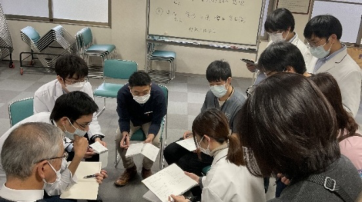
In reflection, they were reserved at first when sharing their own fieldnotes. As the sharing time passed, participants themselves began to share the fieldnotes and verbalize what they felt. First, one participant shared fieldnotes focusing on the content of conversations between doctors and nurses and patients. Then, other participants had shared fieldnotes focusing on the tone and speed of the doctor’s voice, the doctor’s posture in the hospital rooms, the lights and sounds in the hospital rooms, the arrangement of objects in the hospital rooms (household items, books, TV, etc.) and the corridor.
In the process of sharing the fieldnotes, resident doctors and supervisors talked about the differences between what they and others were observing. As they reflected, participants recognized that their own perspectives had changed during the fieldwork. One resident, in reflection, said the following.
Figure 3: Reflection after the fieldwork.
At first, I was writing fieldnotes about verbal exchanges between patients and the doctor. While describing the fieldnotes, he recalled a lecture by the cultural anthropologist. Later, my attention had focused on the brightness of the hospital room and the sounds in the room. (20241130 Fieldnotes) In addition, residents and supervisors had become conscious of making comparison with their usual clinical practice in the fieldwork. In particular, participants had made comparisons between doctor-patient communication (verbal and non-verbal) and physical examination practices.
In closing, several participants stated that ’it was very interesting to write fieldnotes with a cultural anthropological perspective. And I could feel the difference from my own perspective. On the other hand, I have not yet been able to imagine how I can make use of it in my own field.’
DISCUSSION
Participants’ perspectives are able to carry out fieldwork in hospital wards from the perspective of writing fieldnotes like a cultural anthropologist. Since the cultural anthropologist provided input in advance through lectures, the participants did not just focus on the interaction between the patient and the doctor, but also observed the environment, such as the objects in the rooms and corridors, the sounds they heard, and the temperature.1 1In the lecture by the cultural anthropologist, the AEIOU framework was introduced as a cue for observation; AEIOU is an acronym for Activities, Environments, Interactions, Objects and Users.
Using Fieldnotes to Enhance General Practitioner Training 193
Although they are observing the same events, what they actually wrote in their fieldnotes was different for each participant. Sharing the fieldnotes described by the participants themselves allowed the participants to recognise the differences between other participants perspectives, and their own perspectives. Normally, doctors input patient information before carrying out a patient examination. In this fieldwork, the participants were committed to observation, which meant that they observed the medical scene without inputting patient information. Therefore, we think that they were able to observe and reflect and focus on the medical situation while the patient’s medical care was left aside for the moment.
An area of improvement in this educational practice was that the participants were not able to think through on how to make use of this educational experience in the field. This point has not been verbalised in the purpose of the educational practice, which was set out in advance.2 When the fieldwork reflection was conducted, the focus was on the dialogue among the participants. Therefore, KI did not ask the participants how they would apply the learning from this experience in their field. In the future at the appropriate timing and method, we may ask them: How would you apply the experience and lessons learned in your own field? Participants may be able to imagine how they can make use of it in their field.
Even if the same field is observed simultaneously, what was described in the fieldnotes varied from person to person. Sharing fieldnotes allowed participants to be exposed to the different contents which in turn raised them to become aware of their own perspectives. By participating in this educational practice, participants can realise the Rashomon effect and think about how they perceive the differences in perspectives. In the future, we will consider educational practices that enable participants to envision clinical practice while consciously perceiving events with the Rashomon effect in their mind.
Limitations of This Study and Implications for Future Research This study had several limitations. First, this study was limited to a specific general practice in the specialty training programme. Further work is needed to determine whether the findings of this study are equally applicable to other general practice specialty training programmes.
Second, the effectiveness of the educational practices in this study was assessed mainly from the participants reflections and fieldnotes descriptions. In the future, it will thus be necessary to evaluate the impact of educational practice in actual clinical practice using more multidimensional indicators.
In light of the above, further research will be carried out to apply the findings of this study for a wider range of educational practices and clinical medical services.
2In the cultural anthropologist’s lecture, it was explained that developing an ethnographic perspective is useful in dealing with examining and treating patients, as well as in collaborating with other professions in a hospital organisation. Furthermore, observing the differences between different departments (cultural differences between departments) is also useful for medical students in choosing their future career path. (Ito 2021: 17) The fact that such comments were made despite prior lectures from the cultural anthropologist would suggest that there is room for further improvement.
ACKNOWLEDGMENT
This work was supported in part by JSPS KAKENHI Grant Numbers JP 22K10467 and 23K22042.
REFERENCES
Emerson R. M, Fretz R. I., and Shaw L. L., 2011, Writing Ethnographic Fieldnotes (Second Edition), Chicago, The University of Chicago Press. Heider K. G., 1988, The Rashomon Effect: When Ethnographers Disagree, American
Anthropologist, 90 (1): 73–81. Hemmings C. P., 2005, “Rethinking medical anthropology: How anthropology is failing medicine,” Anthropology & Medicine, 12 (2): 91–103. Inoue K., and Ito Y., 2024, Introducing cultural anthropological perspectives into
practice: A case study of a general practice specialty training programme in Tottori, Japan, 15th International Conference on Applied Human Factors and Ergonomics and the Affiliated Conferences. Ito Y. 2021, Ethnography and Cultural Anthropology Perspectives, in Iida J. and Nishigori H eds., 2021, Anthropology and Sociology for Doctors and Medical Students, Kyoto, Nakanishiya Shuppan, 17–26. (In Japanese). Litva A, Sarah P., 2008, “Exploring barriers to teaching behavioural and social
sciences in medical education,” Medical Education, 42 (3): 309–314. Ohta R., and Sano C., 2023, “Enhancing the Comprehensive Integration of General Medicine Education in Rural Japan: A Thematic Analysis,” Cureus, doi: 10.7759/ cureus.50874. eCollection 2023 Dec. Satterfield J. M, Shelley R. A, Carrie H. C, Karen E. H, George W. S, Rene S.,
2010, “Creating an ideal social and behavioural sciences curriculum for medical students,” Medical Education 44 (12): 1194–1202. Wiedman D, and Martinez I. L., 2021, “Anthropologists in Medical Education in the United States: 1890s to the Present,” Martinez I. L. and Wiedman D, eds., Anthropology in Medical Education, Switzerland: Springer Nature Switzerland AG, 13–51.
LISTED IN THE AHFE DIGITAL BOOKSTORE CATALOGUE
Explore the complete digital volume
The Human Side of Service Engineering
Read this individual research paper free through the original publisher, or explore the full digital proceedings book.
ISBN 978-1-964867-58-8
Explore this ISBN in the AHFE Bookstore ↗Listed in the July 2026 bookstore catalogue; search by ISBN to confirm current availability · Digital book purchase optional