Kazuo Sakai, Yasunobu Ito (2026). Bridging the Gap Between Stratification and Personalization in Precision Medicine: "Invisible Labor" and Value Transformation in Japanese Cancer Genomic Medicine. In: The Human Side of Service Engineering. AHFE Open Access, vol. 221, pp. 189–195. https://doi.org/10.54941/ahfe1007723
Publisher statistics will load when you open Metrics.
AHFE OPEN ACCESS OPEN ACCESS CONFERENCE PROCEEDINGS PAPER
Bridging the Gap Between Stratification and Personalization in Precision Medicine: "Invisible Labor" and Value Transformation in Japanese Cancer Genomic Medicine
This study aims to clarify how frontline healthcare professionals transform the imbalance between clinical outcomes and patient needs—arising from the transitional implementation phase of cancer genomic medicine, a core domain of Precision Medicine (PM)—into meaningful value. Since its introduction in the United States in 2015, PM has been promoted across advanced nations as a "forward-looking promise" to create the next generation of standard care (Ackerman 2022: 197). Meanwhile, Japan entered a unique implementation phase in 2019, integrating cancer genomic medicine into its universal healthcare system. Currently, a large-scale national survey (Sunami et al. 2022) reveals a structural imbalance: the success rate of identifying therapeutic drugs (the primary objective) remains at 7.7%, whereas the detection rate of genetic risks (secondary findings, or SF), a by-product, is higher at 10.3%. Based on qualitative research at two facilities in Japan, this study utilizes Bogicevic et al.'s (2021) mode classification and Ackerman's (2022) concept of "invisible labor" for analysis. The findings indicate that the "labor of connection" performed by healthcare professionals serves to humanize and personalize the otherwise undesirable outcomes of finding no targeted treatments or disclosing SFs affecting patients' families. From a service engineering perspective, this study visualizes the value transformation process and proposes a framework for human-centered medical service design.
In 2015, U.S. President Barack Obama announced the Precision Medicine Initiative during his State of the Union address (Ackerman 2022: 197). This positioned PM as a “forward-looking promise” to pursue genomics- informed treatments across advanced nations (Ackerman 2022: 197), triggering a global paradigm shift in medicine. Concurrently, the critical role of “invisible labor” performed by specialized professionals—such as the “curation” required to translate vast genomic data into clinical practice—has increasingly been recognized in clinical settings across these nations (Kerr et al., 2021).
190 Sakai and Ito Japan also introduced cancer gene panel testing into its public health insurance system in 2019, but it is currently in a “transitional stage of social implementation,” where access to therapeutic drugs and the establishment of counseling infrastructures lag behind the rapid spread of next-generation sequencing (NGS) technologies. According to Sunami et al. (2022: 3997), the rate of identifying actionable therapeutic targets (7.7%) is outpaced by the incidental detection rate of secondary findings (SF) (10.3%). Ackerman (2022: 199) refers to the activities aimed at bridging this gap between ideal and reality as “invisible labor,” emphasizing its importance.
To understand this structural imbalance, the “two modes” conceptual framework in cancer genomic medicine proposed by Bogicevic et al. (2021) is highly useful. Bogicevic et al. defined the “Somatic Mode” as treating genetic information as “detached” from the individual, focusing purely on the tumor to concentrate resources on current treatment decisions. Conversely, the “Germline Mode” treats genetic information as “attached” to the person and their blood relatives, thereby expanding the scope of care to encompass not only the patient but also family members who might be affected in the future (Bogicevic et al. 2021: 180–181).
In short, despite being provided under a universal healthcare system, current medical services struggle to fulfill their primary function in the Somatic Mode (treating the individual’s present illness) and, more frequently, inadvertently place a heavier burden on the Germline Mode (caring for the family’s future). This study clarifies how frontline healthcare professionals use “invisible labor” to bridge this insurmountable gap between technical stratification and human personalization, ultimately achieving a transformation of value.
METHODS
Qualitative ethnographic research was conducted at two domestic facilities: O University Hospital (a core hospital for cancer genomic medicine) and P Cancer Center (a specialized affiliate hospital). Data was gathered through semi-structured interviews with five professionals—a medical oncologist (Dr. C), a clinical geneticist (Dr. B), two certified genetic counselors (CGCs D and E), and a hereditary tumor specialist (Dr. G)—as well as through participant observation of case review conferences, and the collected data was subsequently analyzed (Sakai and Ito 2025: 195–202).
RESULTS
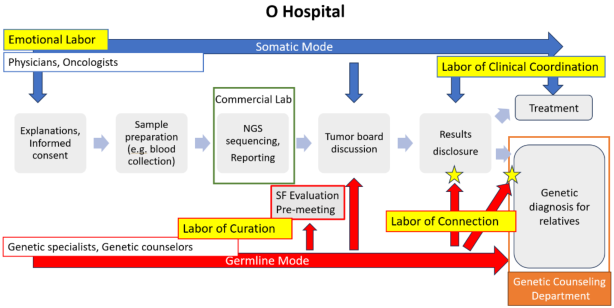
The investigation revealed that “invisible labor” in Japanese cancer genomic medicine, much like Ackerman’s findings in the U.S., is clearly divided into two distinct practice flows: the Somatic Mode (aimed at treatment) and the Germline Mode (dealing with genetic risk). Figure 1 visualizes the standard workflow observed at O Hospital.
Figure 1: The standard workflow in Japanese cancer genomic medicine and the divergence between the “Somatic Mode” and “Germline Mode” focused on in this study (Created by the authors).
Somatic Mode: Bridging Expectations and Reality Through Jin Through long-term participant observation in U.S. cancer genomic clinics, medical anthropologist Sara L. Ackerman (2022) revealed the grueling labor forced upon clinical settings by the expectations touted by PM. Ackerman points out that in the aforementioned Somatic Mode, an immense amount of backstage “clinical coordination”—such as negotiating with insurance companies and securing access to unapproved drugs—is indispensable. This labor is invisible from the front stage of the system and is supported by highly individualized devotion to keep a glimmer of hope alive for the patient (Ackerman 2022: 208).
This structure, which bridges the “gap between promise and reality,” is also evident in Japan’s public health insurance framework. Dr. C, an oncologist at O University Hospital, expressed the conflict during this transitional phase: “Actually, I don’t think the cost-benefit balance is being achieved. … But as doctors, when we talk about Jin medicine, we shouldn’t think about those things, right? (omitted) I am always struggling with how to integrate [medical economic efficiency] into the concept that ‘Medicine is a
benevolent art’ (I wa Jin nari).” (Interview with Oncologist Dr. C, November 17, 2023) The term Jin mentioned here originates from Confucian philosophy and forms the core of traditional East Asian medical ethics. Often translated into English as “Medicine is a benevolent art,” this norm dictates that the moral foundation of a healthcare provider is to offer unconditional compassion and holistic care to the patient before them, transcending economic rationalities such as cost-effectiveness. As cancer genomic medicine remains in a systemic transitional phase (characterized by limited access to treatment and high costs), Dr. C is seeking ways to harmonize the “rationality of Western medical economics” with the “ethics of East Asian Jin” in the clinical setting. This narrative suggests that the gaps currently unable to be institutionalized within the cancer genomic system are being flexibly compensated for and supported at the frontline by the profound moral responsibility and professionalism of individual physicians.
In situations where no therapeutic drugs are found (a lack of functional benefit), frontline healthcare workers engaged in the following types of labor to breathe new meaning into the SF data generated as a system by-product.
1. Labor of Curation In genomic medicine, “curation” to ensure data quality has emerged as an indispensable form of labor (Kerr et al., 2021). In this study, CGC D diligently cross-checked vast amounts of mutation data visually, noting that “entering variants manually is too high-risk”. This constitutes meticulous “preparatory labor” required to transform sterile data into clinically Actionable information (Sakai and Ito 2025: 199).
2. Labor of Connection CGC E defines her role as a “translator” bridging a “Point” to a “Line,” stating: “We are merely a point. Not a line that is continuously involved in treatment like a doctor, but a point that only appears at that moment.
... With that single interaction, how can we reach the patient’s heart and connect it to the ‘line’ of their family’s future? I feel an immense responsibility and burden there.” (Interview with Genetic Counselor E, November 17, 2023)
Comparative Case: Systematization from a “Point” to a “Line” At O University Hospital, limited patient contact due to institutional constraints left counselors feeling vulnerable, heavily relying on individual performance for this “connection”. CGC E expressed a sense of crisis, noting,
“Depending on the situation, a single word or action from us might make the patient say, ‘I don’t want to hear about it,’ and then we can’t protect their blood relatives either.” (Interview with Genetic Counselor E, November 17, 2023)
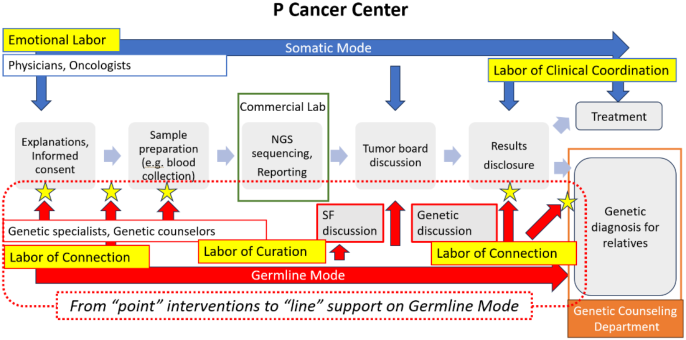
In contrast, P Cancer Center had systematized this “connection”. The patient support system, established by Dr. G utilizing a nurse-based hereditary tumor coordinator, ensures that “the same person is always by their side” from the initial visit through results disclosure and follow-up. This integrates the narratives of “treatment (Somatic)” and “genetics (Germline)” that are often fragmented within the patient’s experience (Figure 2). Dr. G stated in an interview: “It’s good for the patients, too, to always have the same person with them. It’s better than having a completely different person suddenly show
up one day and say, ‘Actually, about your genetics...’ I think that way is better.” (Interview with Hereditary Tumor Specialist G, December 5, 2023)
Bridging the Gap Between Stratification and Personalization in Precision Medicine 193 This can be seen as a successful case of elevating a model overly dependent on individual “invisible labor” into an organizational “service system”.
Figure 2: Systematized germline mode response observed at P cancer center (created by the authors).
Theoretical Synthesis: Structural Contrast Between Somatic and Germline Modes Based on the interview data and analysis, this study integrated and expanded Bogicevic et al.’s (2021) mode classification and Ackerman’s (2022: 208) concept to apply to SF management (Germline Mode), organizing the nature of labor in each mode (Table 1). This analysis clarifies how frontline “invisible labor” recovers the structural imbalances within a transitional system.
Table 1: Contrast between somatic mode and germline mode (expansion based on Bogicevic et al. 2021 and Ackerman 2022).
Table available in the original PDF paper.
Category Somatic Mode Germline Mode (Expansion by This Study) Primary Target Tumor detached from the patient (Bogicevic et al., 2021) Genes attached to the patient and family (Bogicevic et al., 2021)
Ackerman’s Insight
Clinical coordination (Ackerman 2022: 208)
(Expanded by this study) Value transformation into a resource for the family
Functional benefit (Discovery of drugs)
Perspective benefit (Maintaining/ inheriting family health)
Expected Benefit (Fujimura, 2018) Invisible Labor
Labor of connection, meaning-making, curation
Insurance negotiation, acquiring unapproved drugs, etc.
DISCUSSION
From “Stratification” to “Personalization” via Boundary Spanning The differences between O University Hospital and P Cancer Center revealed in this study provide crucial implications for the nature of “Boundary Spanning” in the social implementation of PM.
At O University Hospital, the functions provided by the Somatic Mode promoted the “Stratification” of patients based on genetic mutations, despite the promise of Precision Medicine. In contrast, what frontline healthcare workers faced and managed in the Germline Mode was the true process of “Personalization”—transforming data into tailored value that considers the patient’s family background and personal narrative.
The gap between this “technical stratification” and “human personalization” was skillfully bridged at the frontline level through the high expertise and ethical devotion (Jin) of physicians and CGCs. However, a model reliant on such “advanced tacit knowledge” leaves the quality of service up to individual skills, posing challenges from the perspective of organizational “Sustainability” and “Scalability”.
Conversely, the deployment of a coordinator observed at P Cancer Center exemplifies the formalization and institutionalization of this bridging function as an “Organizational Function,” rather than leaving it solely to individual effort. From a service management perspective, it is suggested that redefining these highly complex coordination tasks as a “formal service that generates added value” and systematically allocating resources to them is of great importance, especially in PM where advanced technical stratification is accelerating.
Designing for “Value Co-Creation” The greatest challenge in the Germline Mode is the functional deficiency, where the output information often does not lead to a cure. Here, the process of “Value Transformation” observed in the case of CGC D becomes critical.
D likes the process of conveying complex genetic information to patients, not simply as “information transmission,” but rather as a “personalized tutoring school” where solutions are derived together according to the recipient’s level of understanding.
“(Explaining SF) personally feels like a personalized tutoring school. You find what each individual doesn’t understand, their worries or concerns, the parts the students can’t solve or are weak at, and you understand it together with them.” (Genetic Counselor D, Patient Explanation Role Play, December 13, 2023)
D’s narrative suggests that “Co-creation of Meaning” through dialogue is indispensable to transform the “stratified data (questions without absolute answers)” provided by PM into “personalized meaning (a unique answer)” that the patient can accept. Future service design for PM must intentionally incorporate engagement platforms—spaces for dialogue that support this
Bridging the Gap Between Stratification and Personalization in Precision Medicine 195 generation of meaning—rather than focusing solely on the efficiency of information transmission.
CONCLUSION
This study demonstrated that in the transitional phase of implementing advanced medical technologies, waiting for perfect systems or guidelines is insufficient. Structurally evaluating and supporting the “labor of connection” responsible for value transformation is essential for realizing a truly human- centered medical system.
REFERENCES
Ackerman, Sara L. 2022. “Promising Precision Medicine: How Patients, Clinicians and Caregivers Work to Realize the Potential of Genomics-Informed Cancer Care.” New Genetics and Society 41 (3): 196–215. Bogicevic, Ivana, Kristoffer Staal Rohrberg, Estrid Høgdall, and Mette N. Svendsen.
2021. “The Somatic Mode: Doing Good in Targeted Cancer Therapy.” New Genetics and Society 40 (2): 178-198. DOI: 10.1080/14636778.2020.1799345. Fujimura, Kazuhiro. 2018. “The Negative Effect That Benefit Delay in Service Consumption Causes to a Customer and the Countermeasure against It.” In Advances in Intelligent Systems and Computing, 203–14. Galasso, Ilaria, Sone Erikainen, Martyn Pickersgill, and Giuseppe Testa. 2024.
“‘Different Names for the Same Thing’? Novelty, Expectations, and Performative Nominalism in Personalized and Precision Medicine.” Social Theory & Health 22 (2): 139–55. Kerr, Anne, et al. 2021. Personalised Cancer Medicine: Future Crafting in the Genomic Era. Manchester University Press. Sakai, Kazuo, and Yasunobu Ito. 2025. “The Process of Explaining Secondary Findings
in Cancer Genome Panel Testing with Consideration for the Patient’s Benefit.” AHFE International. The Human Side of Service Engineering 182: 195–202. Sunami, Kuniko, et al. 2022. “Chronological Improvement in Precision Oncology Implementation in Japan.” Cancer Science 113 (12): 3995-4000.
LISTED IN THE AHFE DIGITAL BOOKSTORE CATALOGUE
Explore the complete digital volume
The Human Side of Service Engineering
Read this individual research paper free through the original publisher, or explore the full digital proceedings book.
ISBN 978-1-964867-97-7
Explore this ISBN in the AHFE Bookstore ↗Listed in the July 2026 bookstore catalogue; search by ISBN to confirm current availability · Digital book purchase optional