Miho Matsuzono, Yasunobu Ito (2025). New Service Development Process through UX Research: Case Study of "mercard”. In: Usability and User Experience. AHFE Open Access, vol. 194, pp. 93–100. https://doi.org/10.54941/ahfe1006671
The purpose of this paper is to identify the role and contribution of UX research in the development process of a new service. Comparing the start-up phase and growth phase of “mercard”, the credit card service offered by a Japanese Fintech startup, we analyzed how UX research led to the design and improvement of the new service using the Decagon model.The following points were revealed through our research. In the start-up phase, UX researcher facilitated ideation from the project members and contributed to the smooth progress of the design process by providing rationale which was based on past actual usage surveys. In the growth phase, UX researchers themselves became active in proposing improvements based on actual usage surveys, and this transformation from ideation facilitator to a position where they themselves execute ideation is a characteristic of the growth phase.
UX research is the clarification of User Experience (UX) for service development by using research methods such as interviews, observations, and utilizing deep knowledge of users which lead to new insights and good decision making and can further enhance organizational creativity (Matsuzono and Kusano, 2021).
The case study discussed in this paper is the development project of the “mercard” credit card offered by the Japanese Fintech startup Merpay Inc. According to a survey by the Japan Credit Association, there are 308.6 million credit cards issued in Japan as of the end of March 2023, with 3.0 cards per capita held by the population aged 20 and over (Japan Credit Association, 2023). In this mature Japanese credit card market, “mercard” has issued over 2 million cards in less than a year since its launch in November 2022. This issuance speed is one of the fastest among credit cards in Japan. Furthermore, the design of “mercard” is highly acclaimed, winning the 2023 GOOD DESIGN AWARD1 in the Insurance, Financial Services, and Systems category in Japan (Japan Institute of Design Promotion, 2023).
1The GOOD DESIGN AWARD is Japan’s only comprehensive design award system that has been in existence since 1957. https://www.g-mark.org/en/learn/what-is-gda
This paper clarifies the role UX research played in the development process of “mercard” and examines the potential contribution of UX research in the future service development. Specifically, we compare UX research activities during the start-up phase and the growth phase, and analyze how UX research leads to service design and improvement through the Decagon model.
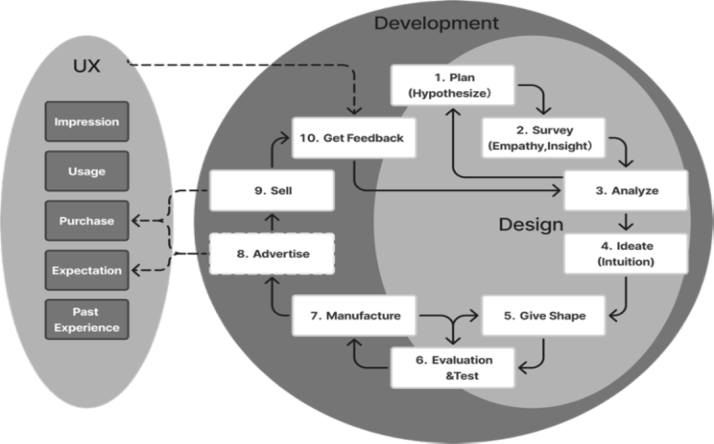
DECAGON MODEL Kurosu and Hashizume (2023) defined the Decagon model to clarify the relationship between product and service development and UX (see Figure 2). The name Decagon derives from the fact that there are 10 phases included in this model. 1–6 phases are design steps, which also overlap with the ISO model (ISO 9241-210:2019) and design thinking (Institute of Design at Stanford, 2012).
Figure 2: Decagon model (Kurosu and Hashizume, 2023).
New Service Development Process Through UX Research: Case Study of “Mercard” 95
1. Plan (Hypothesize) 2. Survey (Empathy, Insight) 3. Analyze 4. Ideate (Intuition) 5. Give Shape 6. Evaluation & Test 7. Manufacture 8. Advertise 9. Sell 10. Get Feedback The development process on the right side of Figure 2 begins with the “Plan” phase from a business perspective. The next phase in the design process “Survey”conducts user research to obtain information about the user and context of use followed by “Analyze” where survey data is analyzed. In case more data is needed to identify the issue, the process goes back to the “Plan” phase. Then, “Ideate” phase calls for the intuition which the designer excels in followed by “Give Shapes” to create a design solution. The “Evaluation and Test” phase evaluates the design solution by applying the usability testing or inspection methods. If problems are found in “Evaluate and Test”, the process should go back to “Give Shapes” to conduct a redesign. Afterwards, the product or service enters the “Manufacture” activity followed by “Advertise” and “Sell” activities. Occasionally, the original design may need to be improved. In such a case, the process may return to the “Evaluate and Test” or even “Give Shapes” phase. The final phase, “Get Feedback,” is obtaining UX information from users. The left part of the process represents the activities of users which are acquired from “Get Feedback”, with their impressions that accumulate through the experience of using actual products and services, that is fed back to the “Analyze” and to the “Ideate” phase. It goes through each of the “Give Shapes,” and “Evaluate and Test”phases to improve the quality of the product or service and the UX.
In the Decagon model, “Survey”, “Evaluate and Test”, and “Get Feedback” are considered as UX research. The methods used in “Get Feedback” in particular are almost identical to those used in the “Survey,” which is a qualitative approach involving interviews and observations. The difference between them is that in “Survey”, the target product or service can be anything related to the user goals determined in the “Plan”activities in the early design phase of the start-up. On the other hand, the qualitative methods in the “Get Feedback” phase are used to learn about the user experience of a product or service that has just been developed.
In this paper, we find the characteristics of the UX research process in light of the Decagon model.
METHODS
This paper focuses on the activities of UX researchers in the “mercard” project, and interviews were conducted on 4 employees who were members of the “mercard” development project.
96 Matsuzono and Ito
The “mercard” development project can be divided into two phases: the start-up phase, which lasts for about two years from December 2020 to its service launch in November 2022; and the growth phase, in which large-scale campaigns and functional improvements are undertaken after the launch. The growth phase is essentially ongoing, but for the purposes of this paper, the period from November 2022 to November 2023, is the study period considered as the growth phase.
For the start-up phase, we mainly investigated documents such as meeting minutes and UX research deliverables, and conducted interviews for Project leader A and Designer B between October and December 2022. For the growth phase, we conducted the same research focusing on documents and interviewed Designer C, and UX researcher D between November and December 2023.
Table 1: Interview list.
Table available in the original PDF paper.
Occupation Interview Date A Project leader Oct 24, 2022, Nov 29, 2023 B Designer Nov 1, 2022 C Designer Nov 27, 2023 D UX researcher Dec 6, 2023
RESULT
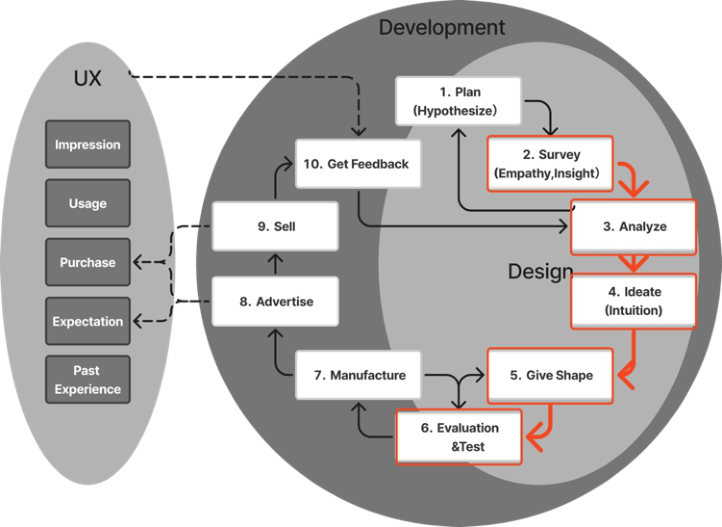
Start-up Phase At the time, Merpay Inc. already offered a post-payment service on smartphones called “Merpay Smart Pay”. Since postpaid services and credit cards are similar in terms of mechanism, there was a great concern that the release of the new “mercard” would cause confusion. Therefore, UX researchers first extracted data on the usage of other companies’ credit cards and their own services from past survey databases to determine the value and credit card issues users face and analyzed how users of “Merpay Smart Pay” perceive the differences compared with credit cards. Then, together with the project team, they identified hypotheses on the potential customer experience, and the designers proceeded to create prototypes followed by UX researcher evaluation via conducting qualitative research. This process follows the Decagon model, with the UX researcher in charge of the “Survey” to “Analyze”phase, the project team to start participate in the “Ideate”phase, the product designer taking charge in the “Give Shapes” phase, and finally, the UX researcher performing the “Evaluation and Test” (see Figure 3).
The following is an interview with a Designer B who was leading the design process at the time.
—How did you proceed with the design process when some things were still undecided?
“If something is still undecided, I just make assumptions for the time being. I would create the design, let them look at it, and then fix it based on the feedback. The customer experience data compiled by the UX researcher will give you a perspective, and when you give it shape, you will find yourself
New Service Development Process Through UX Research: Case Study of “Mercard” 97
saying, “Oh, here, let’s do this.” First of all, you have to give it shape, even if it is in your imagination. Going back and forth, with trial and error, the design’s accuracy is gradually improved.”
Figure 3: Decagon model in start-up phase.
—Then, even if the concept is not clear, you make assumptions anyway. “Yes, there must have been other detailed patterns besides the ones the UX researcher put together in the document, and I discarded some of them in my mind when I created the drawing. Based on my past experience, I would discard them and say, “I don’t need this pattern. Then I choose three that seem to make good sense.”
(From an interview with Designer B, November 1, 2022). Designer B said that he “makes assumptions” at the beginning of the design process, and the results of the customer experience hypotheses were used to make assumptions. He also said that he would materialize on the multiple patterns that he imagined from his past experiences into the design.
In this way, during the start-up phase, the UX researcher offered material that led to the “Ideate” phase through analysis of the past “Survey,” enabling designers to formulate hypotheses about the unknown using acquired knowledge and data as rationale to accelerate to the “Ideate” phase.
Growth Phase After the launch of “mercard,” there was a discrepancy between the initial campaign results and its expectations. Initially, the appealing points of the campaign were the “mercard” benefits compared with other credit cards,
98 Matsuzono and Ito
namely – the redemption rate and free of charge fee–, was subsequently changed to “communication” which focused on the benefits of using related services when “mercard”was being used. This one produced a huge sensation and “we had a sense of a product-market fit,” said Project Leader A.
UX researcher D in charge of these improvements, recalls, “We began to communicate, aligning with the context of the customer’s interest in the card, namely coupons and special offers on related services, rather than on the card.” Designer C, who was in charge of the design and production direction of the campaign, says, “As we researched, we learned that customers were rejecting things that we didn’t think they would, so we gradually amplified the issue and worked on it to make further improvements that would encourage customers to use the card.”
UX researcher D also actively participated in the detailed discussions among the project members, “Based on the previous research, we pretty much joined the discussion and said what we could say without conducting new research”. In response, Designer C said the following: “UX researchers are accumulating knowledge. Of course, they understand the customer’s sentiment better than we do. In that sense, we can receive accurate feedback from UX researchers without having to do research, which makes it easier for us to proceed with the project.”
(From an interview with Designer C, November 27, 2023) Against the backdrop of the UX researcher becoming actively involved in the discussion, Designer C mentioned, “Since UX researcher is seeing the entire process of the “mercard,” from the beginning where the “mercard” is known to the customer to the usage of the card”. During the growth phase, there were two separate teams: one for promoting the issuance of “mercard” and the other for promoting its use. A discrepancy or gaps in communication emerged between the customer experience at the time of application and after use. Acknowledging this, UX researcher D said “We realized that UX researchers are the ones who could comprehensively see the entire customer experience”. During the growth phase after the release of the service, Merpay Inc. allocated every wednesday as weekly UX Research Day, and recruited survey targets in advance to conduct four 90-minute UX research sessions per day, which allowed the company to flexibly respond to a variety of projects. Whereas before, when the researcher has decided to conduct UX research to start recruiting, normally, there would be a time lag of several days to several weeks; however by preparing the weekly UX Research system in advance, it was possible to conduct repeated verification without losing speed (Matsuzono & Kusano, 2021). Thus by using the knowledge accumulated from the weekly UX research, the UX researcher was able to provide accurate feedback without having to conduct research every time, making it easier to move the project forward.
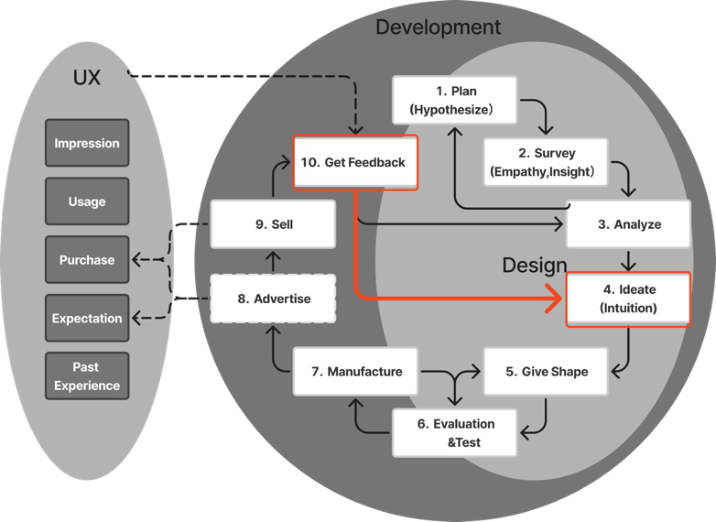
Comparing this improvement process with the Decagon Model, it can be said that UX researchers hypothesize like this: “If this were the case, this is what would happen” and taking into account usage surveys accumulated through weekly UX Research via “Get Feedback” and intuit “what we could say without conducting new research,” then led to “Ideate” (see Figure 4).
New Service Development Process Through UX Research: Case Study of “Mercard” 99
This improvement process is different from the start-up phase, and uniquely special in that it has not been pointed out in the decagon model before. Furthermore, this is expected to speed up the improvement process.
Figure 4: Decagon model in growth phase, “Get Feedback” to “Ideate”.
Comparing the start-up phase with the growth phase, it can be said that during the start-up phase, the analysis of user “Survey” was used to facilitate “Ideate” in the project team, whereas during the growth phase, UX researchers themselves came up with ideas and made specific improvement proposals, thus changing their position from facilitators of “Ideate” to proactive executors of “Ideate”. On the background of this role shift is the time constraint to perform analysis in sync with the fast paced improvement of the growth phase and the frequent availability of “Get Feedback”on actual “mercard” via weekly UX research which enabled UX researchers to come up with “what we could say without conducting new research” and the ease of identifying issues for improvement.
CONCLUSION
During the start-up phase of “mercard,” the project progressed according to the Decagon model, with the UX researcher using the past “Survey” data for analysis and facilitating the “Ideate” phase of the project team.
During the growth phase, through weekly UX research, UX researchers began to proactively propose improvements without having to conduct a new survey. Repeated access to “Get Feedback”from actual usage surveys enabled
100 Matsuzono and Ito
the establishment of a direct process to the “Ideate” phase. This was a new trend not expressed in the decagon model.
Compared with the start-up phase, in the growth phase, UX researchers themselves came up with ideas and made concrete improvement proposals via “Get Feedback” actual user survey, thus their position shifted from facilitators of “Ideate” in the project team to becoming a proactive executor of “Ideate” which contributed to the improvement of service.
REFERENCES
Institute of Design at Stanford (2012), “An Introduction to Design Thinking Process Guide”, Stanford University, Available at: https://web.stanford.edu/∼mshanks/ MichaelShanks/files/509554.pdf (accessed 28 January 2024). ISO 9241-210:2019. (2019). Ergonomics of human-system interaction Part 210:
Human-centred design for interactive systems. Japan Credit Association (2023), Statistics Based on Survey Results of Japan Credit Association, Japan Credit Association Website (in Japanese), Available at: https://www.j-credit.or.jp/information/statistics/download/toukei_inumber_a.pdf (accessed 20 January 2025). Japan Institute of Design Promotion (2023), “2023 GOOD DESIGN AWARD Credit
Card Mercard”, GOOD DESIGN AWARD Website, available at: https://www.g- mark.org/en/gallery/winners/15883?years=2023 (accessed 26 January 2024). Konno, N. (2009). “The Age of Knowledge Design: A View from Japan”, Design management review, Vol. 20, pp. 6–14. Kurosu, M., Hashizume, A. (2023). Usability and User Experience (UX) of Human-
Automation Interaction: Concept and Measurement Method. In: Duffy, V. G., Lehto, M., Yih, Y., Proctor, R. W. (eds), Human-Automation Interaction. Automation, Collaboration, & E-Services, Vol. 10, Springer International Publishing, pp. 311–25. Matsuzono, M. Kusano, K. (2021). “UX Research Start Guide” (in Japanese).
Shoei-sha, Tokyo, Japan. Stanford Encyclopedia of Philosophy (2001), “Charles Sanders Peirce”, available at: https://plato.stanford.edu/entries/peirce/#dia (accessed 20 January 2025).
LISTED IN THE AHFE DIGITAL BOOKSTORE CATALOGUE
Explore the complete digital volume
Usability and User Experience
Read this individual research paper free through the original publisher, or explore the full digital proceedings book.
ISBN 978-1-964867-70-0
Explore this ISBN in the AHFE Bookstore ↗Listed in the July 2026 bookstore catalogue; search by ISBN to confirm current availability · Digital book purchase optional