Kazuo Sakai, Yasunobu Ito (2025). The process of explaining secondary findings in cancer genome panel testing, putting into consideration patient benefit. In: The Human Side of Service Engineering. AHFE Open Access, vol. 182, pp. 195–202. https://doi.org/10.54941/ahfe1006419
This study aims to explore ways to improve the burden on medical professionals {oncologists, physicians, genetic specialists, hereditary tumour specialists, genetic counsellors} and the benefits for patients in the process of precision oncology genetic test and its secondary findings with a service management perspective. Since former US President Obama announced the Precision Medicine Initiative in his 2015 State of the Union address, the terms and concepts of precision medicine have rapidly gained ground in Japan. Cancer genome medicine is the field in which the implementation of precision medicine is most advanced. By comprehensive sequencing of the genetic mutations of cancer, it becomes possible to select specific treatments. However, hereditary pathological gene mutations may be found incidentally at a certain rate. This is called “secondary finding”. In June 2019, CGP (Comprehensive Cancer Genome Profiling) panel tests for terminal cancer patients were reimbursed by Japan's national health insurance system. 64,047 people have been examined by 31 October 2023 (National Cancer Center, 2024). According to a research by an oncologist: while the probability of reaching treatment was 3.6%, secondary findings were detected in 14.3% of cases. This high rate of secondary findings, even surpassing the rate of achieving the treatment goal, underscores the substantial burden of managing secondary findings (Inagaki et al., 2021). This highlights the urgent need for further research and potential interventions to address this issue. This article focuses on exploring the possibilities for supporting improvements in the process of explaining secondary findings. Ethnographic research: Interview and participant observation was conducted at a general medical institution, O University Hospital, and a cancer-specialized hospital, P Cancer Center, in 2023. An oncologist, a genetic specialist, two genetic counsellors at O University Hospital and a hereditary tumour specialist at P Cancer Center cooperated with the study. The interviews and field notes were coded and analyzed with MAXQDA software using the code matrix technique. Then, we analyzed the data using the “Benefit Delay model”. A marketing professor, Dr Kazuhiro Fujimura formulated it. This concept expresses the time gap between the start of the service delivery process and the point at which the customer perceives the benefit. Dr Fujimura defines three types of customer benefits. Functional Benefit is related to the outcome of the service. He added two more concepts related to the processes: Emotional Benefit and Perspective Benefit. Those make it possible to consider the benefit to the customer (i.e. the patient) even when the primary objective is uncertain (Fujimura, 2018).Through the study, we revealed that both Perspective Benefit and Emotional Benefit positively changed patients. In conclusion, this study advocates for the early involvement of genetic counsellors in the explanation process. By initiating face-to-face meetings with genetic counsellors and maintaining regular contact, patients can use the time until the disclosure of the results to reflect and actively participate. This approach can significantly reduce the overall burden on cancer genome medical professionals and improve patients’ benefits.
This study explores ways to improve on the issues in cancer genome medicine, gene panel testing explanation process for SF and alleviate the burden on healthcare professionals from the perspective of service management by focusing on patient benefit. The field research was conducted via semi- structured interviews and participant observation on five cancer genome
medicine professionals selected from two hospitals. The research was conducted with the cooperation of an oncologist, a genetic specialist, two genetic counselors and a hereditary tumor specialist.
The evolution of the next-generation sequencing (NGS) technology, which can comprehensively detect gene mutations that cause cancer, and the emergence of cancer drugs that target gene mutations have accelerated the adoption of precision medicine in cancer treatment in Japan. NGS-based panel testing meets the need to find as many gene mutations as possible that may lead to treatment. Still, the comprehensiveness of the testing also increases the likelihood of finding SF. According to a previous study by an oncologist, SF was detected in 14.3% of cases, compared to a treatment success rate of 3.6% (Inagaki et al., 2021). In Japan, since June 2019, panel testing for patients without standard treatment or who have completed standard treatment can be reimbursed by Japan’s National Health Insurance system. For the majority of patients, the original purpose of finding a prospective treatment was not found, while partly informed of the possibility of SF. In the limited time remaining for the patient, one can easily imagine the burden of sharing this result with relatives. Some patients refuse to undergo confirmatory testing even after being informed of the possibility of SF. According to the medical professionals in one research, the most common reason given for refusing to check is that it is “not useful for my treatment” (Shimada et al., 2022). Shimada et al. (2025), certified genetic counselors and researchers in medical ethics and medical genetics, suggest this is due to “patients’ lack of understanding of SF”. First of all, it presents the difficulty of explaining SF to patients and gaining their understanding of SF. Secondly, it indicates the headstrong belief on the part of medical professionals that it is good to make use of SF in genetic medicine. There is a possibility of discrepancy from the perspective of patient benefit. European guidelines state that patients’ “autonomy and desire to know or ignore” should be respected (Cozzi, 2021:95).
In this study, the data obtained from the field research was analyzed using a service management researcher’s “Benefit Delay” model (Fujimura, 2018). The model proposed by Kazuhiro Fujimura, a researcher in service management made it possible to visualize the benefit for patients even when the achievement of the main objective was uncertain such as in this case study subjects. Furthermore, we derived measures to improve the explanation process of SF from this perspective.
METHOD
The two facilities that were the subject of the field research for this study were O University Hospital, a general hospital that advocates 35 medical specialties, and P Cancer Center, which specializes in cancer treatment. An overview of the two facilities is given in Table 1.
The Process of Explaining Secondary Findings in Cancer Genome Panel Testing 197
Table 1: Overview of the facilities surveyed.
Table available in the original PDF paper.
Name of Facility O University Hospital P Cancer Center Number of Beds 930 410 Number of Departments 35 26 Number of outpatients per day 2,400 550 Number of inpatients per day 800 350
The interviewees were five people in total: specialist in genetic medicine B, oncologist C, genetic counselor D, genetic counselor E, all of whom belong to O University Hospital, and specialist in hereditary tumors G, who belongs to P Cancer Center. We conducted semi-structured interviews with all of them. The average length of the interviews was about 60 minutes. We asked Genetic Counselor D to role-play a patient explanation, which took about 30 minutes. At O University Hospital, we conducted participant observation (30 minutes) of the SF discussion that was held every week.
Table 2: Informants.
Table available in the original PDF paper.
Age/Gender Organization Position – Pseudonym Duration 50s / Male O Univ. Hosp. Genetic Medicine Specialist B 17 yrs 30s / Female O Univ. Hosp. Oncologist C 3 yrs 20s / Female O Univ. Hosp. Genetic Counselor D 2 yrs 60s / Female O Univ. Hosp. Genetic Counselor E 13 yrs 50s / Male P Cancer Ctr. Hereditary Tumors Specialist G 23 yrs
A verbatim transcript was created from the audio data of all interviews and participant observations. Codes were added to the resulting text data, and a cross-sectional and comprehensive examination was conducted to derive common themes. MAXQDA 24 (ver. 24.1.0, VERBI Software, Berlin, Germany) was used for data coding, comparison, and examination. The following five codes, which were frequently used, were considered important themes and were re-contextualized.
RESULTS AND DISCUSSION
The following is a description of the five themes derived from the field research results analysis.
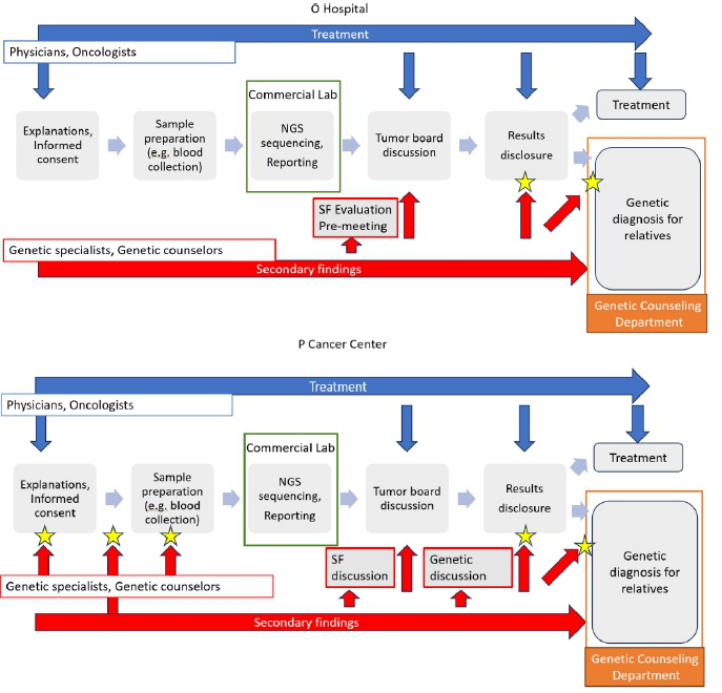
SF Explanation and Disclosure Process The star mark indicates the point of contact between the genetic counselor and the patient. At O University Hospital, the oncologist explains SF to the patient at the initial examination. Unless there are special circumstances or reasons, a genetic physician or counselor is not required to attend. The topic of conversation is to find the treatment which is the main goal. On the other hand, at the P Cancer Center, the hereditary tumor coordinator is present at the initial examination explanation, and the coordinator takes over from the doctor in charge to explain SF. This increases the point of contact with the patient, and as a result, the probability of visiting the genetic outpatient
198 Sakai and Ito
clinic is high. The differences in the starting point and the contents of the SF explanation potentially have an impact on the rate of access to genetic medicine afterwards.
Figure 1: The differences in the workflow at the two facilities.
The Advantages and Disadvantages of SF In order to delve deeper into this argument, I would like to take this opportunity to summarize how the medical professionals interviewed here think about the advantages and disadvantages of SF. All of the interviewees expressed the view that the advantage of SF is that they can lead to the prevention of the next onset of the disease in the patient’s relatives. This suggests that there is a firm common understanding among medical professionals that SF should be used in genetic medicine, and that this understanding may take precedence over the wishes and desires of the patient.
“What I think about genetic medicine and hereditary tumor treatment is that when something of this importance is found, we can manage everyone’s risk so there’s no need to feel sorry for the parents or the children. Even so, there are still patients who worry about it.”
(Interview with Hereditary Tumors s-Specialist G, December 5, 2023)
The Process of Explaining Secondary Findings in Cancer Genome Panel Testing 199
Regarding the disadvantages, Genetic Medicine Specialist B, Oncologist C, and Hereditary Tumors Specialist G mentioned that those patients who hold negative views of SF and heredity have social and psychological burden, fear, and are vigilant against social inequality.
Sharing With Family and Blood Relatives For the patient themselves, communicating the risk of a hereditary disease to their blood relatives is often painful. The patient’s feelings will vary depending on the family structure and relationship with blood relatives. For patients who do not want to tell their family about their SF, Genetic counselor D sometimes questions whether informing the family will lead to family surveillance (taking measures such as regular check-ups for undiagnosed cancer) is actually beneficial. In such cases, she first asks about the patient’s own situation and feelings.
“Please also think about who you want to tell. Do you want to keep it to yourself and not tell anyone, or do you feel like you have to tell your family?”
(Genetic Counselor D, Patient Explanation Role Play, December 13, 2023) Only then, measures are taken to encourage the sharing of information with family members who may become guardians of children, such as the spouse, and to arrange for the family to have ongoing communication with the Department of Genetic Medicine, with the aim of balancing the patient emotions and the family benefits.
Negative Reactions and Positive Changes In multiple interviews at both facilities, it was mentioned that the older the patient, the more likely they were to negatively react to the idea of genetic testing.
Genetic counselor D indicated that if a patient shows a negative reaction to SF, multiple counseling sessions can help the patient feel emotionally stable, encourage their participation, and deepen their understanding. It is also useful to pay attention to what the patient says and explain things that might be of interest to them based on their situation.
Even if you can’t think about it at the time, you might think about it later, or what you think about it then might be different from what you think about it later on. It could go either way. It could change for the better, or it could change for the worse. It also depends on whether the illness is curable or not. Even if it’s cancer, it could be something that can be cured or treated, or it could be something that can’t (and it would be different).
(Interview with a genetic medicine specialist B, December 13, 2023) As the number of counseling sessions increases, the relationship and trust improve. It also becomes possible to divide complex explanations into
200 Sakai and Ito
multiple sessions and check communication progress between the patient and family.
Point of Contact With the Patient In the previous section, we mentioned the frequency and number of interviews as factors that bring about positive change in patients, but it is speculated that the number of interviews that can actually be held is limited. It is considered that increasing the frequency will increase the time burden on medical staff, but we have seen comments from genetic counselors themselves that indicate otherwise, they would like to meet up more with patients. It is expected of counselors to convey the doctors’ message “get a medical checkup” in a way that takes into consideration patient’s emotion and patient’s family relationships and convey it in a way that the patient can understand.
“I always say that genetic counseling is like a dot. It’s a point of contact with the patient. For doctors and nurses, when a patient is admitted to hospital, the dots connect to form a line, and then a plane is created, but for us (genetic counselors), we are just dots. In some cases, after just one session and it’s over, it’s really scary. If the patient stops listening to us because of something we say or do, then we won’t be able to protect the relatives either.”
(Interview with Genetic Counselor E, November 17, 2023) It became clear that fulfilling this role poses difficulty as contacts with patients are limited. On the other hand, it was suggested that increasing the number of contacts would actually reduce the stress on medical staff when working with patients who experiencel anxiety during the consultation.
Based on the results of the above research, we describe the results of our analysis of how SF in cancer genomic medicine benefit patients using the Benefit Delay model. We will then describe the findings obtained regarding measures to improve the process of explaining SF by healthcare professionals. Finally, we will describe the theoretical and practical implications of the results of this study and the implications for future research.
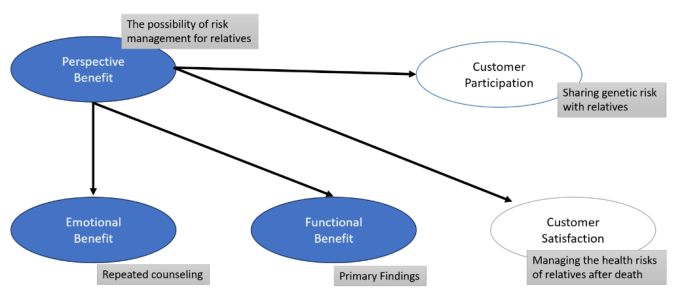
The field research results were plotted on Fujimura’s model “The effects of three types of benefits on customer satisfaction and customer participation” (Fujimura 2018: 213) as a frame for analyzing the field research data (Figure 2). As a result, it was concluded that even if the results do not lead to treatment for the cancer patient themselves, SF brings Perspective Benefit and Emotional Benefit for the patient. The equivalent of Perspective Benefits in SF is the possibility of managing the risk of hereditary tumors in blood relatives. The aim is not just to manage one’s own health and treatment but also to manage the risk of hereditary diseases in one’s relatives, such as children, siblings, and parents, through genetic medicine and avoid the onset of disease or lead to early detection and treatment. Perspective Benefits encourage customer participation and also affect the cultivation of goals and happiness even after service delivery has ended.
The Process of Explaining Secondary Findings in Cancer Genome Panel Testing 201
Figure 2: The author created this based on “The effects of three types of benefits on customer satisfaction and customer participation” (Fujimura 2018: 213).
Emotional Benefits are the benefits gained from good relationships between medical staff and patients, repeated communication, and active listening. Genetic counselors are assigned to specific patients, and whenever possible, the same person provides genetic counseling and related explanations. This person also participates in the medical examination of the patient’s SF (including doubts), and while maintaining a high level of expertise, they communicate in a way that is empathetic to the patient’s psychology and work to build a relationship of trust. Emotional Benefits foster patient trust. Genetic medical care for the patient’s relatives may not begin while the patient is still alive. In order to realize genetic medical care and its benefits, it is essential to gain the trust of patients and their relatives in the Department of Genetic Medicine and the Genetic Outpatient Clinic for the future.
CONCLUSION
In this study, we clarified the actual situation in cancer genomic medicine regarding the benefits to patients and the handling of SF through field research of healthcare professionals and attempted to analyze them using the “Benefit Delay” concept in service management. “Benefit Delay” concept defines “Functional Benefit”, “Perspective Benefit”and “Emotional Benefit”, which were used in the explanation of medical services are expected to be applicable not only in cancer genome medicine, but also in other areas such as genetic medicine, including hereditary diseases and reproductive medicine, and pre-symptomatic screening services that go beyond the genome. In these growing fields, where it is difficult to perceive “Functional Benefit”, the Benefit Delay framework used in the design and verification of service delivery processes, is expected to bring the perspective of patient behavior to the service providers (healthcare professionals) and contribute to the efficient improvement of service quality.
In terms of practical implications, several genetic healthcare professionals indicated that the participation of genetic counselors from the beginning
202 Sakai and Ito
of the SF disclosure process and the increase of contact with patients will facilitate the execution of work related to SF. It is expected that the initiation of communication with patients regarding SF by specialized genetic healthcare staff during the initial examination explanation will encourage patient participation in actual clinical practice and lead to improvements in patient benefits.
Limitations of This Study and Implications for Future Research In this study, the field research subject was limited to healthcare professionals, hence we could indirectly know how patient benefits were actually perceived. In addition, further research is needed to demonstrate whether the results of the field research at the two facilities can be used as a general model.
REFERENCES
Cozzi, Alessia-Ottavia, 2021, “Incidental findings and the right not to know in clinical setting: Constitutional perspectives:” BioLaw Journal, Rivista di BioDiritto, Special Issue 1/2021: 79–109. Fujimura, Kazuhiro, 2018, “The Negative Effect that Benefit Delay in Service
Consumption Causes to a Customer and the Countermeasure Against it” Advances in The Human Side of Service Engineering, Advances in Intelligent Systems and Computing 601, doi: 10.1007/978-3-319-60486-2_19. Inagaki, Chiaki. Maeda, Daichi. Hatake, Kazue. Sato, Yuki. Hashimoto, Kae. Sakai, Daisuke. Yachida, Shinichi. Nonomura, Norio. Satoh, Taroh. 2021, Clinical Utility of Next-Generation Sequencing-Based Panel Testing under the Universal Health-Care System in Japan: A Retrospective Analysis at a Single University Hospital: Cancers 13, 1121. Shimada, Saki. Yamada, Takahiro. Iwakuma, Miho. Kosugi, Shinji. 2021 Physicians’
perceptions of the factors influencing disclosure of secondary findings in tumour genomic profiling in Japan: A qualitative study, European Journal of Human Genetics: 30:88–94. Shimada, Saki. Yamada, Takahiro. Minamoto, Akari. Matsukawa, Manami. Yabe Ichiro. Tada Hiroshi. Oda, Katsutoshi. Ueki, Arisa. Higashigawa, Satomi. Morikawa, Maki. Sato, Yuki. Hirasawa, Akira. Ogawa, Masanobu. Kondo, Tomohiro. Yoshioka, Masahiro. Kanai, Masashi. Muto, Manabu. Kosugi, Shinji. 2025 Nationwide survey of the secondary findings in cancer genomic profiling: survey including liquid biopsy, Journal of Human Genetics 70:33–40.
LISTED IN THE AHFE DIGITAL BOOKSTORE CATALOGUE
Explore the complete digital volume
The Human Side of Service Engineering
Read this individual research paper free through the original publisher, or explore the full digital proceedings book.
ISBN 978-1-964867-58-8
Explore this ISBN in the AHFE Bookstore ↗Listed in the July 2026 bookstore catalogue; search by ISBN to confirm current availability · Digital book purchase optional