Lena Ahner, Jens Neuhüttler, Nicole Gladilov (2022). An approach for developing and assessing sustainable business models. In: The Human Side of Service Engineering. AHFE Open Access, vol. 62, pp. 335–341. https://doi.org/10.54941/ahfe1002575
With sustainability becoming an increasingly important factor in a globalized world, there is an increasing demand for ways to systematically incorporate sustainable activities into companies. Representing the value creation logic of a company, business models play an important role in this development. In this paper we suggest an approach to support organizations in developing and evaluating sustainability aspects in their business model by helping select appropriate measures as well as considering assessment indicators that help evaluate their successful implementation.
The traditional understanding of successful business models often focuses on creating the highest possible profits, using available resources in the shortest possible time. In times of fully globalized economy and competition, growth from traditional business models is often achieved at the expense of social and environmental factors, such as hazardous working conditions or the exploita- tion of natural resources (Ahrend, 2016). Sustainable business models (SBM), however, aim to achieve long-term economic growth while at the same time meeting ecological and social requirements, such as consciously using water, energy and finite raw materials as well as humane and dignified working conditions.
Often, the genuine pursuit of sustainable activities in companies is asso- ciated with social responsibility or philanthropic considerations. However, current research shows strong links between ESG (Environmental, Social, Governance) Issues performance and long-term resilience, which shows that sustainability is not only a social responsibility, but also a value creation factor (Ahrend, 2016), hence affecting an organization’s business model.
A business model represents the core logic of a company that describes which values are created for whom (‘value proposition’), how these values are being delivered (‘value creation’) and how customer relationships can be converted into profit (‘value capture’) (Neuhüttler et al. 2020). In this paper we suggest an approach to support organisations in developing and evaluating sustainability aspects in their business model by providing a tool to help select appropriate activities.
Based on literature research, we have identified a comprehensive number of measures and assessment indicators that have been structured and assigned to the respective dimensions of a business model, as well as indicating their affiliation to ecological, economical, or social characteristics. In this paper we will also discuss the definition of sustainable business models and suggest requirements that have to be met in order to be considered sustainable.
WHAT MAKES BUSINESS MODELS SUSTAINABLE?
Business models represent the main and relevant activities of the value crea- tion of companies (Paiva & Carvalho, 2020; Wirtz et al., 2016). The division of the business model concept into three core dimensions - value proposition, value creation and value capture - can be used to characterize sustainable business models: For a business model to be considered sustainable, at least two of the three dimensions should be designed in a sustainable way (Bocken et al., 2014; Boons et al., 2013; Cosenz et al., 2020).
In management literature, the concept of sustainability is closely linked to business models and innovation (Boons & Lüdeke-Freund, 2013). Designing sustainable business models are a subtopic of business models literature that aims to contribute to the natural environment and social cohesion in addition to long-term economic value (Ahrend, 2016). For implementation, they fol- low a triple bottom line approach with economic, social and environmental objectives and take into account a wide range of stakeholder interests (Belz & Binder, 2017; Boons & Lüdeke-Freund, 2013; Dyllick & Muff, 2016). In this respect, they should fulfil economic, environmental and social objecti- ves better than other business models and be a key driver in shaping lasting competitive advantages (Bocken et al., 2014; Boons et al., 2013). Sustainable business models include not only customer benefits, resource transformation and exchange relationships with customers and partners, but also concrete approaches to achieving ecological and social benefits. They aim at econo- mic value contributions as well as ecological and social added values (Cosenz et al., 2020).
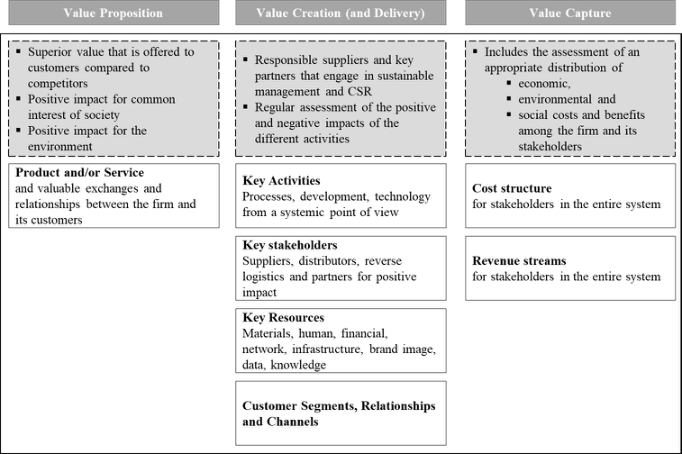
This means that sustainability becomes an integral part of the core business as opposed to being implemented in the form of isolated activities (D’heur, 2014). Moreover, the further integration of sustainability aspects into the overall business model takes a broad perspective on strategy design and the related organisational dynamics that determine the success (or failure) of organisations (Cosenz et al., 2020). Figure 1 shows the link between the three business model dimensions, the sustainability goals and the elements to be considered.
The value proposition does not only consist of the specific product or service, but it also includes all valuable exchanges and relationships between the company and its customers. According to Boons et al. (2013) a special strength of sustainable business models lies in the balance between economic, social and ecological dimensions of a value proposition. This entails the exa- mination of consumers wants and needs, which could be fulfilled i.e. by the specific function of the product or service offered.
An Approach for Developing and Assessing Sustainable Business Models 337
Figure 1: Sustainable business model dimensions (Bocken et al., 2018; Osterwalder & Pigneur, 2010).
The value creation (and delivery) comprises all essential activities of the company (Boons et al., 2013). This includes the management of resources, partners, the network, the customer interface, and the supply chain. In order to achieve sustainable business models, it is especially important to regularly access the positive and negative impacts on society and the environment of the different activities and of the whole supply chain as well as the activities of key partners (D’heur, 2014). The supply chain is according to Boons et al. (2013) one of the essential part of this larger activity system. Especially in sustainable business models it needs to consist of suppliers and key partners that take responsibility towards their stakeholders and engage in sustaina- ble management, which includes recycling or reuse of materials and paying fair wages. A key principle can be seen in not shifting own socio-ecological burdens to suppliers (Boons & Lüdeke-Freund, 2013, p. 13).
Value capture reflects the distribution of revenues and costs and what reciprocal values a company can achieve from its activities. In sustainable business models this also includes the appropriate distribution of economic, environmental and social costs and benefits among the firm and its stake- holders as well as non-monetary revenues (Bocken et al., 2018; Boons & Lüdeke-Freund, 2013).
APPROACH TO SUPPORT DEVELOPMENT AND EVALUATION OF SBM In order to not only characterize sustainable business models, but also to be able to systematically develop, evaluate and control them, suitable activities
as well as indicators to measure and evaluate the current state and develop future goals are required to assess sustainability and performance.
In literature there already exists a wide range of sustainability criteria and KPI lists (c.f. Ahrend, 2016). A good starting point for the development of a catalogue of measures for the development and evaluation of sustainable business models are the EFFAS criteria and ESG dimensions collected by Nie- möller et al. (2015). Our catalogue of measures builds on these, extends them and structures them for application in the context of business models.
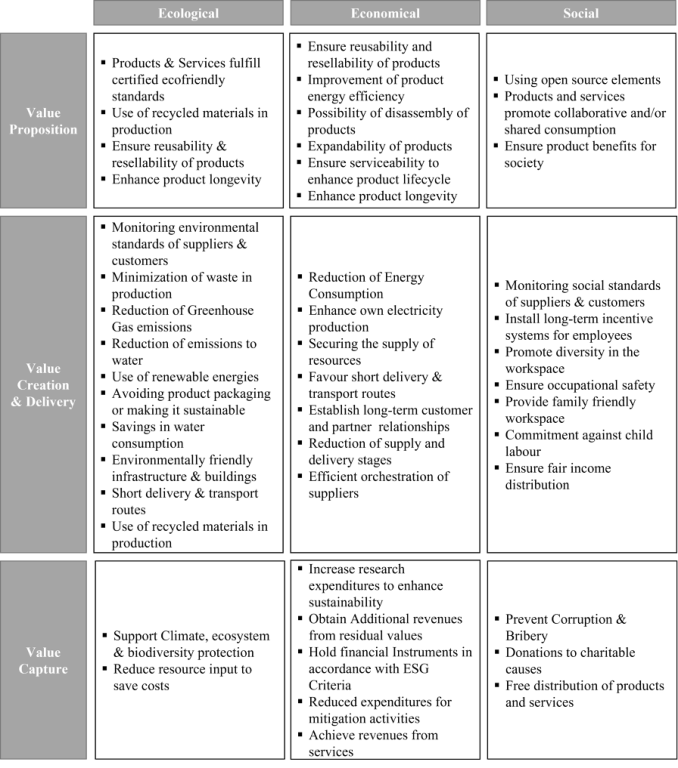
Furthermore, the measures were selected based on two main requirements: they had to explicitly contribute to sustainable dimensions on an ecological, economical, and/or social level and be able to be assigned to either one of the three main dimensions of a business model (Value Proposition, Value Capture, Value Creation and Delivery). In addition, the measures should be precise enough to enable fast definition of steps for implementation, but at the same time broad enough to be used across sectors and industries. Figure 2 shows the resulting catalogue of measures.
The following key questions can help organizations with the selection of appropriate measures for each individual business model development or evaluation process (Deutsches Institut für Normung e.V, 2015):
Which measures will affect the process of providing the service or product?
Will internal and external stakeholders (e.g. employees, shareholders, general public) be affected by the measure and relate it to the service or product?
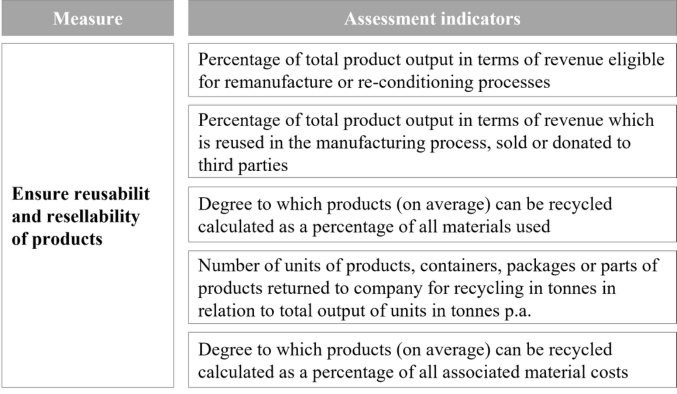
To help track and evaluate the selected measures, assessability must be ensured. Therefore, within the extensive list of categories in which sustai- nable activities can take place, possible (yet not exhaustive) parameters to help assess the success of the measures have been assigned. Figure 3 shows an exemplary list of indicators for the measure “Ensure reusability and resellability of products”.
This approach can support companies both in assessing their own business model with regard to sustainability aspects and in introducing meaningful measures that inevitably affect the core business. Also, when thinking about developing new business models, it helps to systematically incorporate sustai- nability into the core logic of a business. Additionally, this approach can help to assess the total scope of sustainability within an organization. While there do exist gradual distinctions on business sustainability (Dyllick & Muff, 2016), it remains unclear as to when a business model is truly sustainable. With our definition, a sustainable business model must address as a mini- mum requirement all three sustainability dimensions while at the same time addressing at least two of the three business model dimensions. Following this logic, a business model is most sustainable, when activities from each field of the matrix have been successfully incorporated by an organization.
CONCLUSION AND OUTLOOK Sustainability is often implemented by companies in the form of isolated activities that do not necessarily affect the core business. With this paper
An Approach for Developing and Assessing Sustainable Business Models 339
Figure 2: Catalogue of measures to develop and evaluate sustainable business models based on Niemöller et al. (2015), EFFAS (2010) and Geissdoerfer et al. (2020).
we intent to provide companies with a systematic approach to think about sustainability as part of the value creation logic. The approach and thoughts presented in this paper are the result of extensive research and integration of various sources. It does not represent a completed state of research and will be subject to further refinement and testing.
In the long term, the work performed in this paper aims to help building a methodology that supports companies in assessing their sustainability at the level of their value creation logic. We suggest that different methodological approaches will have to be applied when developing a new business model from scratch as opposed to refining a business model surrounding existing products or services.
For the development of new sustainable business models, existing patterns and archetypes (Bocken et al., 2014) could help to provide inspiration and
Figure 3: Possible parameters to help measure sustainability based on EFFAS (2010), Deutsches Institut für Normung e.V. (2015) and global sustainability standards board (2021).
drive the process of developing ideas, while balanced scorecards (e. g. Figge et al., 2002) could help keeping record of the current state and the desired outcome of sustainability activities within a company. However, the selection of suitable and goal-oriented activities to support sustainability are vital steps for both objectives and the key outcome of this work.
REFERENCES
Ahrend, K.-M. (2016). Geschäftsmodell Nachhaltigkeit. Springer Berlin Heidelberg.
https://doi.org/10.1007/978-3-662-52880-8 Belz, F. M., & Binder, J. K. (2017). Sustainable Entrepreneurship: A Convergent Process Model. Business Strategy and the Environment, 26(1), 1–17. https://doi.org/ 10.1002/bse.1887 Bocken, N., Schuit, C., & Kraaijenhagen, C. (2018). Experimenting with a circular
business model: Lessons from eight cases. Environmental Innovation and Societal Transitions, 28, 79–95. https://doi.org/10.1016/j.eist.2018.02.001 Bocken, N., Short, S. W., Rana, P., & Evans, S. (2014). A literature and practice review to develop sustainable business model archetypes. Journal of Cleaner Production, 65, 42–56. https://doi.org/10.1016/j.jclepro.2013.11.039 Boons, F., & Lüdeke-Freund, F. (2013). Business models for sustainable innova-
tion: state-of-the-art and steps towards a research agenda. Journal of Cleaner Production, 45, 9–19. https://doi.org/10.1016/j.jclepro.2012.07.007 Boons, F., Montalvo, C., Quist, J., & Wagner, M. (2013). Sustainable innovation, business models and economic performance: an overview. Journal of Cleaner Production, 45, 1–8. https://doi.org/10.1016/j.jclepro.2012.08.013 Cosenz, F., Rodrigues, V. P., & Rosati, F. (2020). Dynamic business modeling for
sustainability: Exploring a system dynamics perspective to develop sustainable business models. Business Strategy and the Environment, 29(2), 651–664. https: //doi.org/10.1002/bse.2395
An Approach for Developing and Assessing Sustainable Business Models 341
D’heur, M. (2014). shared.value.chain: Profitables Wachstum durch nachhaltig gemeinsame Wertschöpfung. In M. D’heur (Ed.), CSR und Value Chain Mana- gement (pp. 1–122). Springer Berlin Heidelberg. https://doi.org/10.1007/978-3- 642-39889-6_1 Deutsches Institut für Normung e.V. (2015). Referenzmodell für die Entwi- cklung nachhaltiger Dienstleistungen, Gesellschaft und Wirtschaft (DIN SPEC 35201:2015-04). Berlin. Beuth Verlag GmbH. Dyllick, T., & Muff, K. (2016). Clarifying the Meaning of Sustainable Busi-
ness. Organization & Environment, 29(2), 156–174. https://doi.org/10.1177/ 1086026615575176 EFFAS. (2010). KPI for ESG - Key Performance Indicators for Environmental, Social & Governance Issues: A Guideline for the Integration of ESG into Financial Analysis and Corporate Valuation. Figge, F., Hahn, T., Schaltegger, S., & Wagner, M. (2002). The Sustainability Bala-
nced Scorecard - linking sustainability management to business strategy. Business Strategy and the Environment, 11(5), 269–284. https://doi.org/10.1002/bse.339 Geissdoerfer, M., Pieroni, M. P., Pigosso, D. C., & Soufani, K. (2020). Circular business models: A review. Journal of Cleaner Production, 277, 123741. https: //doi.org/10.1016/j.jclepro.2020.123741 Global Sustainability Standards Board (2021). GRI Standards Glossary 2021. Neuhüttler, J., Kett, H., Frings, S., Falkner, J., Ganz, W. & Urmetzer, F. (2020).
Artificial Intelligence as Driver for Business Model Innovation in Smart Service Systems. In J. Spohrer and C. Leitner (Eds.), Proceedings of AHFE 2020, AISC 1208, pp. 212–219. https://doi.org/10.1007/978-3-030-51057-2_30 Niemöller, C., Bärtling, N., & Thomas, O. (2015). Nachhaltigkeit durch Hybride Wertschöpfung - Entwicklung eines Reifegradmodells. In D. W. Cunningham, P. Hofstedt, K. Meer, & I. Schmitt (Eds.), GI-Edition Lecture Notes in Informatics Proceedings: Vol. 246. Informatik 2015: Tagung vom 28. September – 02. Okto- ber 2015 in Cottbus (pp. 427–442). Ges. für Informatik. https://dl.gi.de/handle/ 20.500.12116/2207 Osterwalder, A., & Pigneur, Y. (2010). Business model generation: A handbook for
visionaries, game changers, and challengers. Wiley&Sons. Paiva, T., & Carvalho, L. (2020). Sustainable Business Model. In S. Idowu, R. Schmidpeter, N. Capaldi, L. Zu, M. Del Baldo, & R. Abreu (Eds.), Encyclo- pedia of Sustainable Management (pp. 1–6). Springer International Publishing. https://doi.org/10.1007/978-3-030-02006-4_543-1 Wirtz, B. W., Pistoia, A., Ullrich, S., & Göttel, V. (2016). Business Models: Ori-
gin, Development and Future Research Perspectives. Long Range Planning, 49(1), 36–54. https://doi.org/10.1016/j.lrp.2015.04.001
LISTED IN THE AHFE DIGITAL BOOKSTORE CATALOGUE
Explore the complete digital volume
The Human Side of Service Engineering
Read this individual research paper free through the original publisher, or explore the full digital proceedings book.
ISBN 978-1-958651-38-4
Explore this ISBN in the AHFE Bookstore ↗Listed in the July 2026 bookstore catalogue; search by ISBN to confirm current availability · Digital book purchase optional