Intelligent products are experiencing the development from industrial intelligence to service-oriented, chat-oriented,and virtual life intelligence. Today's Intelligent products can help humans complete complex and dangerous work and gradually become our friends in daily life. Especially in the COVID-19 pandemic, when the whole society faces the challenge of loneliness together, people urgently need to use AI to solve the problem of emotional companionship. It is a problem that needs to be solved by interdisciplinary thinking to make the machines that interact with people able to observe, understand and generate emotional characteristics similar to those of people. This paper introduces companion-type intelligent products and the status quo of multi-modal interaction between such products and users. On this basis, combined with design, psychology, and ergonomics, a design scheme for further research on companion-type intelligent products using multi-modal emotion recognition technology is proposed. This scheme focuses on using the "instinct and emotion" module in the product to adjust the interactive behavior and realize different responses even when the same stimulus is presented.
The emergence of Companion Intelligent Products, on the one hand, is caused by artificial intelligence technology. On the other hand, it is closely related to the depth of social cognition of the human-machine relationship. Intel- ligent products have not only entered the daily life of human beings and are accompanied by people but also constantly meet the emotional needs of human beings thoroughly. Its role is gradually expanding to social support and emotional companionship (Wang and Krumhuber, 2018).
In this context, the elderly population is a globally recognized group becoming increasingly susceptible to loneliness (Wu et al., 2010). Intelligent products that serve elderly users are roughly divided into smart home produ- cts for elderly care services, apps for elderly users, and wearable products for the elderly. These products focus on eliminating the digital divide while faci- litating the lives of the elderly and paying attention to their emotional needs. From an emotional perspective, most products play the role of personal assi- stants, addressing the social loneliness issues of the elderly. However, the problem of emotional loneliness remains a difficult issue for current research (Gaby Odekerken-Schröder et al., 2020).
Studies have revealed that companion robots, like pets, often generate posi- tive psychological effects by establishing social relationships and improving brain functions (Robinson et al., 2014). Although robots are highly respe- cted for providing life services, health monitoring, and loneliness relieving (Lee et al., 2006), their roles in emotional support in the innovative home sector are largely scanty.
Given this, the research attempts to solve the following question, that is, how can intelligent homes alleviate or stimulate users’ happiness by establishing different types of supporting relationships (personal assistants, relationship partners, and close partners) (Odekerken et al., 2020) while hel- ping the elderly or the disabled to achieve basic activities in an independent life?
USER STUDY As the old have experienced more “physical-psychological-social”difficulties and others, they suffer from behavioral and psychiatric disorders, severely affecting their quality of life. The current world is facing the problems of a large elderly population base and a fast-aging rate, which has laid a vast market foundation for intelligent products that can provide emotional com- panionship service functions. The tendency has shown that the emergence of smart homes and digital services has turned the research hotspots of pension to “how to introduce technical service products into the lives of the elderly” (Lin Lu, 2022).
In order to evaluate the satisfaction and demand of the elderly for intel- ligent products, a survey was conducted in December 2022 on individuals aged 65 to 85. Receiving 300 valid questionnaires (the effective recovery rate was 95%). We conducted outlier and normality checks on the data. Among the total sample size, questionnaires indicating “no smart home products in the household” were excluded from the analysis as they did not provide satisfaction and demand data (see Table 1).
Subsequently, outlier checks were conducted using SPSS, and no extreme outliers were detected. Therefore, attitude cross-analysis was performed (see Table 2). The results showed that the elderly feel satisfied with the physiolo- gical services provided by their intelligent products. At the same time, there remains a large room for improvement in the products to meet the spiritual life needs of the elderly. It is available for the future, accompanying intelligent products for the elderly to compensate for physiological deficiency through
Table 1. The elderly sample characteristics description.
Table available in the original PDF paper.
Age distribution
Educational level Physical status Use of home smart products Age % Education % Physical status % Use %
65∼70 67% Primary school 31% Healthy 35% None 0% 70∼75 21% Junior high school 43% Genera 52% 1–3 pieces 36% 75∼80 7% Senior high school 15% Minor illnesses 13% 4–7 pieces 60% 80∼85 5% Junior college 10% Above 7 pieces 4% College and university 1%
Design Proposal to the Future Companion Intelligent Products 557
Table 2. Crosstabs of elderly people’s attitudes toward intelligent products.
Table available in the original PDF paper.
Service attitude toward intelligent products Variable name Satisfied At large Dissatisfied
2 4 4
Intellectual life Stimulate positive emotions 0 4 6 Emotional comfort 0 5 5 Promote the development of their own potential
2 1 7
Conducive to social intercourse Feel social identity 4 4 2 Realize self-value 4 5 1
In general 12 23 25 Physiological services Regular routine 8 2 0 Cooking auxiliary 1 2 7 Sanitary cleaning 5 4 1 Emergency help 2 2 6 Rehabilitation training 4 6 0 Control of life 6 1 3
In general 26 17 17
technical means and to provide technical service products according to users’ life experiences and emotional needs. Concerning interaction, it is necessary to endow products with two-way triggers, multi-modal recognition, and inte- raction. That is, they can identify users’ invisible needs, provide different services for people with different habits and personalities, and finally realize the social value and sense of participation of the elderly.
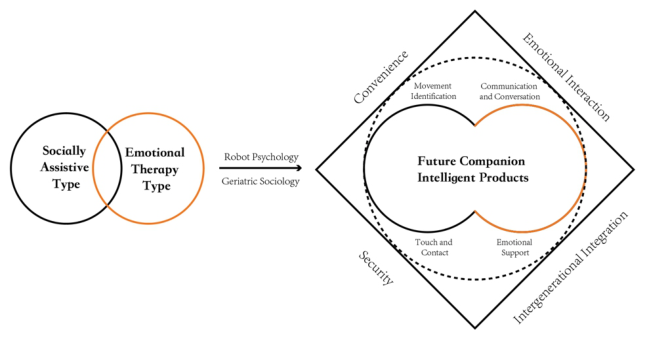
CASE STUDY The intelligent products that provide companionship are currently divided into two categories: Socially Assistive Types and Emotional Therapy Types, which have functions such as action recognition, communication, dialogue, emotional support, touch, contact, etc. They can bring convenience to users, solve their loneliness, and help them escape the blue mood, low happiness, and other psychological problems (see Figure 1).
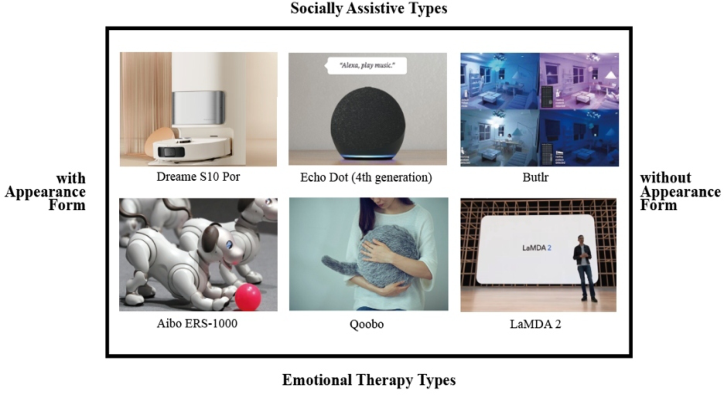
In the field of smart homes, service functions are dominant in social- assisted intelligent products, making them play the role attribute of an “assistant.” It helps the old to perform basic activities or tasks in their living in an independent manner. Such technical aid enables the old and the disabled to live independently in their homes and receive support for extended peri- ods (Li et al., 2017). For instance, DREAME S10 Por, an automatic tracking, dust collecting, and dragging robot, can intelligently avoid obstacles, select the recovery route, and prompt the user through intelligent voice.
Such products are divided into tangible (entity) and invisible (system) in appearance. As visible interaction objects, entities have more empathetic and responsive features in human-computer interaction. For example, a robot, BOCCO emo, of a Japanese company, Yukai Engineering Inc., that promotes
558 Wang and Wang
Figure 1: The role of future companion intelligent products.
family communication allows users to interact more actively with the robot and present it in a resonating way. Besides, invisible products often have the perception ability of equifinality, multimodality, and modal-modal. For instance, Butlr, a product of MIT Media Lab, has a sensor system that analy- zes low-resolution thermal data to generate the behavior in building space. On the premise of ensuring user privacy, it can accurately generate people’s trajectory and location in the space. Such products enable high-dimensional complex interaction systems and machine learning capabilities to monitor mobility and awareness barriers in real-time (see Figure 2).
Following the development of the Times, the two forms of intelligent products have shown a trend of integration.
Figure 2: Domains of human systems integration.
Design Proposal to the Future Companion Intelligent Products 559
DESIGN PROPOSAL Our product provides intelligent solutions for the elderly in their home life from the perspective of emotion, containing multi-modal recognition systems and small morphological robots. It reckons the living space of the elderly as an intuitive path to record their living habits and behavior trajectory and out- puts intelligent management schemes. Small robots can convey information to users and express their emotions through multi-modal interaction.
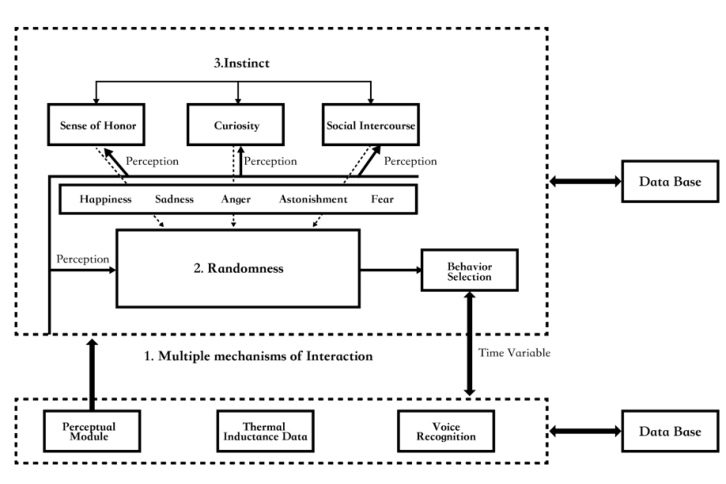
Based on studies, robots significantly affect the psychological aspects of depression, independent living, social isolation, and happiness (Li et al., 2017). Our design focuses on creating a good relationship between people and the product machine through the design of artificial hearts, generating an illusion in the human brain so that it feels that the machine has a mind. To better evaluate the design objectives, the problem is represented as maximi- zing the familiarity of the machine with the user habits and having empathy and response functions to inspire the user to interact more actively with the machine in this thesis(see Figure 3). It is suggested to introduce the following factors to evaluate solutions to this problem: a) Cultivation mechanism with the ability of independent iteration. b) Multiple motivations for the interaction. c) Unique behaviors of the robot.
Cultivation Mechanism With the Ability of Independent Iteration The investigation has revealed that lighting is the most suitable intelligent scene at this stage. In the past era taking smart speakers as the entrance, 80% of users’ instructions were used to control light (Zhao et al., 2022). Besides, because the hearing function of the elderly is weakened, lighting can make up
Figure 3: Behavior control architecture diagram.
560 Wang and Wang
for the hearing impairment with the visual sensory function and reduce the life problems caused by hearing loss to a certain extent. In addition, the com- bination of different lighting degrees, Angles, and color temperatures can also impact people’s moods. Hence it is decided in this research, at different times and occasions, to create suitable lighting schemes according to the applica- tion scenarios, define different “moments,” and create an intelligent home with temperature through home lighting systems for the users.
To turn such a design into reality, the product captures the dynamics of the human body through sensory monitoring and artificial intelligence techno- logy, detects user behavior and indoor location, accurately generates people’s movement trajectory in the space, learns user behavior data, and makes a timely response.
This mechanism has the ability of autonomous learning and iteration. The longer they stay with the users, the more they know about their living habits. Suppose the user has the habit of sitting on the sofa to read the newspaper after dinner. In that case, the system will judge the user’s needs according to the time, moving position, and other information, automatically turn on the floor lamp next to the sofa and start the evening reading mode. If the judgment is accurate, when the user reads the newspaper or a book, the tiny robot will raise its head, along with the ear movement, showing a happy emotion.
Multiple Motivations for the Interaction Two motivations are mainly used in this study, which can be interpreted as being distributed in two different domains. The first area is time. A robot must respond quickly to some stimuli but slowly respond to some behaviors through thoughtful consideration.
The second domain is instinct and emotion. In this scheme, robots have three instincts: feeling of honor, curiosity, and social communication. The machine’s emotional value (representing the desire to acquire the emotion) will increase with less interaction. When there is more interaction between people, the emotional value will decrease (the external influence is internal). To increase internal motivation (internal influence and external influence), we implement five artificial emotions selected from Ekman’s basic emotions: happiness, sadness, anger, surprise, and fear (P. Ekman and R. J. Davidson, 1994). As the artificial instinct we described above, these artificial emotions will also increase and decrease according to the ascending and declining of artificial instinct. If the value of the emotion becomes more extensive, the corresponding emotional expression behavior will be displayed.
Unique Behaviors of the Robot As for designing the product’s form, we aim to make a friendly but not realistic small robot with unique movements of the machine rather than simulating human or animal behavior. It is a family member.
The swing way of the driver on the head of the small robot can associate people with the pet’s moving ears, which is used to increase the emotional expression of the small robot. Meanwhile, its eyes’ changing shape and size can also make users understand its emotional state more easily. When the
Design Proposal to the Future Companion Intelligent Products 561
robot feels a nearby user, it can actively make greetings. Moreover, elderly users can start calls with family and friends through simple voice commands. It can voice cute to emotional words and when being called a nickname. It connects the family as a family member and can also use sound to deter- mine the user’s dangerous behavior and make emergency calls in case of an emergency.
CONCLUSION AND VISION The research focuses on enhancing the response and empathy function of companion intelligent products by multi-modal identification and intera- ction to stimulate the emotional interaction between users and machines and improve the emotional response and positive experience of the elderly in the innovative family scene. One limitation of the study is that the user’s emotional state may influence the evaluation of their satisfaction with the product. In the future, this emotional enhancement design will gradually spread with the continuous upgrading of the emotional data of intelligent products, fulfilling the machine’s mission of “promoting interpersonal rela- tionships.” Therefore, our next task is to study how to enable the computer to perceive the user’s behaviour and expression while also knowing what the system is doing at that time.
Artificial creations are constantly criticized for being very cold. Perhaps, through this research, it is possible to make the machine an existence that enables human emotion and drives the academic circle to have a deeper understanding of the humanistic care of the design for the elderly.
REFERENCES
Arkin R C, Fujita M, Takagi T, et al. An ethological and emotional basis for human–robot interaction [J]. Robotics and Autonomous Systems, 2003, 42(3-4): 191–201. Kanamori M, Suzuki M, Tanaka M. Maintenance and improvement of quality of
life among elderly patients using a pet-type robot[J]. Nihon Ronen Igakkai zasshi. Japanese journal of geriatrics, 2002, 39(2): 214–218. Lee, K. M., Jung, Y., Kim, J. and Kim, S. R. (2006), “Are physically embodied social agents better than disembodied social agents?, the effects of physical embo- diment, tactile interaction, and people’s loneliness in human–robot interaction”, International Journal of Human-Computer Studies, Vol. 64 No. 10, pp. 962–973, doi: 10.1016/j.ijhcs.2006.05.002. Li Sijia, Ni Shiguang, Wang Xueqian, Peng Kaiping, Socially Assistive Robot: Explore
a New Method of Psychological Healthcare for the Elderly [J]. Chinese Jounrla of Clinical Psychology, 2017, 25(6):6. Lin Lu. (2022), Intelligence Enhancement Design: A New Form of Design for the Aged from the Perspective of Advantage [J]. ZhuangShi, 2022, dio:10.16272/j.cnki.cn11-1392/j.2022.05.012. Odekerken-Schröder G, Mele C, Russo-Spena T, et al. Mitigating loneliness with companion robots in the COVID-19 pandemic and beyond: an integrative fra- mework and research agenda [J]. Journal of Service Management, 2020, 31(6): 1149–1162.
562 Wang and Wang
P. Ekman and R. J. Davidson, The Nature of Emotion. Oxford, U. K.: Oxford Univ.
Press, 1994. Robinson, H., MacDonald, B. and Broadbent, E. (2014), “The role of healthcare robots for older people at home: a review”, International Journal of Social Robotics, Vol. 6 No. 4, pp. 575–591, doi: 10. 1007/s12369-014-0242-2. Wang, X. and Krumhuber, E. G. (2018), “Mind perception of robots varies with
their economic versus social function”, Frontiers in Psychology, Vol. 9, p. 1230, doi: 10.3389/fpsyg.2018.01230. Zhao Yiping, Zhao Hua. Explore the Frontier, and Empower the Industry: Smart Home Solutions of KNOW[J]. ZhuangShi, 2022, DOI:10.16272/j.cnki.cn11- 1392/j.2022.01.010.
LISTED IN THE AHFE DIGITAL BOOKSTORE CATALOGUE
Explore the complete digital volume
Ergonomics In Design
Read this individual research paper free through the original publisher, or explore the full digital proceedings book.
ISBN 978-1-958651-53-7
Explore this ISBN in the AHFE Bookstore ↗Listed in the July 2026 bookstore catalogue; search by ISBN to confirm current availability · Digital book purchase optional