Huang Baimin, Li Chu Yang, Byungjun Jeon, Jung-ho Jung (2024). Service Design for Waste Separation and Disposal in University Housing Complexes - Around the Gwangju Campus of Chonnam National University. In: Ergonomics In Design. AHFE Open Access, vol. 129, pp. 107–119. https://doi.org/10.54941/ahfe1004816
In Korea, recycling of garbage has been emphasized by the government and various sectors for a long time, and various systems have been established to ensure the implementation of sorting. In addition, people are becoming more aware of environmental protection and are making beautiful handicrafts out of garbage. However, little research and attention has been paid to waste segregation in areas with multicultural backgrounds. Some scholars believe that there is a positive relationship between values and lifestyles and ecological behavior. DeYoung says that simple and moderate lifestyles are positively associated with glass and paper recycling. Livers proved that people with religious values and conservative lifestyles like to contribute positively to the improvement of society. This article focuses on the residential neighborhood of University Street in Chonnam University. The residential area is characterized by single apartments, international students, and art studios, and the problem of garbage sorting has not been improved in the neighborhood, and illegal dumping is often found. As people with different habits and diverse backgrounds live in the same area, it is difficult to separate garbage, and it would be more beneficial to develop an area-specific garbage separation program. Therefore, this thesis utilizes the service design methodology to solve the problem.in the discovery stage, field visits are made to investigate the publicity of sorting and recycling, overseas and AI examples are grasped, and user surveys are conducted. In the definition stage, we organize the results of user surveys and in-depth interviews and analyze the problem of garbage sorting through Personas. In the development stage, design insights were drawn from the existing problems and needs. In the final Delivery stage, design value suggestions are made. It is hoped that the program of this thesis can improve the local garbage sorting problem.
Waste recycling is gaining increasing importance in governments worldwide, not only for conserving resources but also for preserving the natural environ- ment. To ensure the execution of waste classification, various regulations and systems have been introduced. Furthermore, people’s awareness of environ- mental protection is rising as they comply with waste separation rules and create diverse and beautiful crafts through waste processing.
However, research and attention toward waste classification often neglect areas where people with different lifestyle habits and values coexist. Some scholars suggest a positive correlation between values, lifestyle, and ecolog- ical behavior. For instance, De Young argued that simple, modest lifestyles correlate positively with glass and paper recycling (De Young, 1986). Liv- ers demonstrated that individuals with conservative, religious values and lifestyles actively contribute to societal improvements. Consequently, achiev- ing consistent waste classification behaviors among people with diverse values and lifestyles in a specific area has become challenging (Livers, 1986). Therefore, devising suitable waste classification methods for multicultural stakeholders is highly advantageous for implementing waste separation and disposal practices.
This paper focuses on the housing area of Chonnam National Univer- sity, where not only international students but also single-person households, multi-person families, and individuals with diverse lifestyle habits and val- ues reside. Reports indicate that this residential area is characterized by a high number of single-person households, foreigners, and numerous work- shops. Waste separation and disposal have long been problematic here, with frequent instances of recyclable and non-recyclable waste not being sorted properly. In efforts to address waste separation issues, welfare institutions in Yongbong-dong have established environmental protection organizations and dedicated efforts to improve the situation. While some progress has been made, certain areas still struggle to fully adopt these practices.
Moreover, complex social issues typically involve engagement with multiple stakeholders. Service design methodologies offer a comprehensive approach that integrates the interests and resources of various departments, organizations, and individuals to address problems. This reduces repeti- tive efforts, enhances efficiency, and fosters collaboration. Therefore, this paper investigates waste separation and disposal issues through service design methodologies, aiming to identify solutions within this framework. It is hoped that the proposals in this paper serve as a reference for improving waste separation and disposal issues in multicultural stakeholder areas.
Theoretical Background of Service Design The concept of service design was initially coined by Shostack in 1982 in the paper ‘How to Design a Service’ (Shostack, 1982). The Harvard Busi- ness Review in 1984 presented a blueprint for service design that integrated services with design and outlined the process of concretizing this concept (Shostack, 1984). Kim Hyo-Il mentioned that service design occurs through an experience-centered approach, where methodologies like service vision, journey mapping, and personas enable designers to derive elements of prob- lems through their firsthand experiences (Kim Hyo-Il, 2013). Among these elements, experiential aspects are distilled into knowledge, and direct or indi- rect experiences are utilized through result analysis to find specific solutions. In essence, service design is a user-centered approach for intangible services and tangible objects, analyzing stakeholders’ experiences, perceptions, and demands, and employing divergent and convergent thinking to visualize and solve problems.
Service Design for Waste Separation and Disposal 109
Moritz proposed a six-step service design process consisting of under- standing, thinking, creating, choosing, describing, and implementing (Moritz, 2005). Service design company IDEO develops effective services through rapid iterative revisions, comprising observation, brainstorming, RAPD (Rapid Prototyping and Development), refinement, and implementation in its five-stage process. The Design Council’s ‘Double Diamond Design Pro- cess’ widely used across various fields including service and product design, was developed by analyzing processes of world-renowned design compa- nies in 2005. It consists of Discover, Define, Develop, and Deliver stages. The Discover stage involves collecting extensive information and exploring possibilities from multiple perspectives. In the Define stage, problems are derived and defined based on the results of the Discovery phase. The Develop stage expands ideas from the defined problems to create prototypes and advance them into outcomes. The Deliver stage structures the entire concept, measuring the creativity, efficiency, and reliability of the solution.
Service design employs various tools, commonly utilizing visualization tools to visualize problems and solutions. These tools include drawing User Journey Maps, Touch-point Mapping, Clustering, creating Personas, Mind Mapping, Service Experience Prototyping, Co-Creation, Concept Sketch- ing, Service Blueprints, Concept Sketching, Storyboarding, Role Play, and Guideline creation. The service design process does not adhere to a fixed methodology; rather, it varies depending on the purpose of the service design, as outlined by Jung Yong-Jin (2018).
Assessment of Waste Separation and Disposal Status in Chonnam National University Housing Complex Assessment of Waste Separation and Disposal Guidance and Promotion in Gwangju’s Buk-gu To understand the management status, waste classification regulations, and promotional activities, data was collected and analyzed through online research and offline leaflet collection. Firstly, in terms of management, a team of 16 members, split into five groups, conducts daily patrols and special night- time patrols to enforce waste littering regulations, using methods like direct visits, mail, and fax to submit evidence and documentation to the Cleaning Administration Department. While there are established management mea- sures, there’s a lack of understanding regarding manpower deployment and inadequate incentives for reporting.
Secondly, as per waste classification rules, waste in Gwangju’s Buk-gu is categorized into household waste, recyclables, food waste, large waste, and large appliances. Waste should be disposed of from the previous day’s 8 PM until collection at 5 AM the next day. Disposal locations include in front of houses, in front of stores, and in shared residences (within the complex). Household waste should be separated and disposed of in designated volume- based bags. Recyclables, such as PET, cans, bottles, and plastics, should be cleared of impurities, placed in transparent bags, and placed in front of resi- dences. Food waste should be disposed of in designated containers with paid stickers attached. Large waste items like pots, furniture, electric mats, and
blankets, which can’t fit into volume-based bags, must be reported to the contracted company (Green Environment) via phone or orally for disposal. Large appliances (TVs, refrigerators, air conditioners, etc.) can be collected free of charge after reporting to the contracted company.
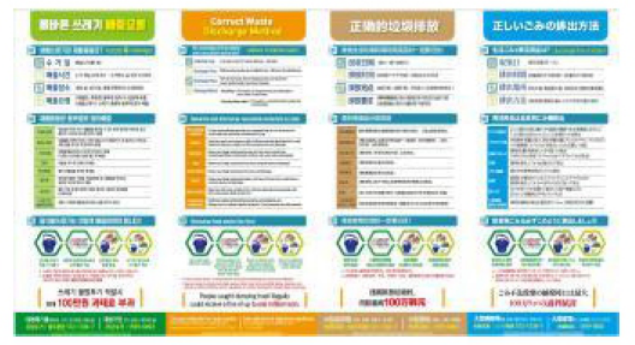
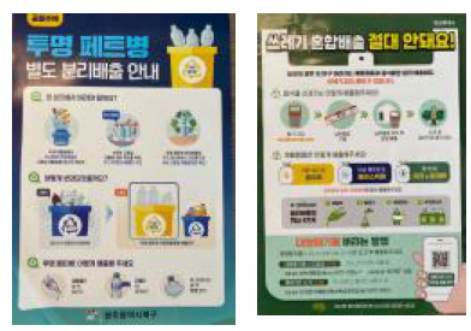
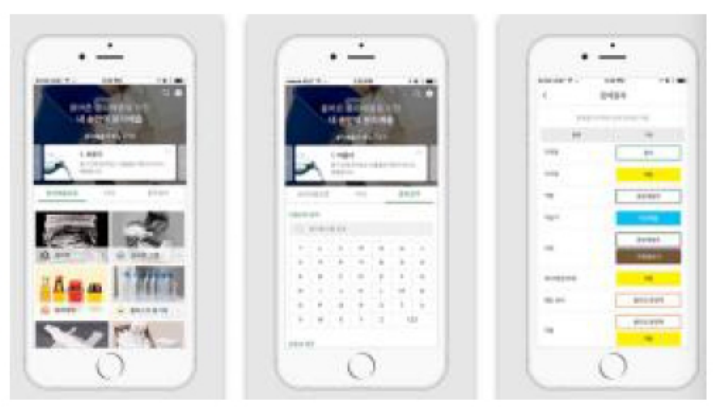
Thirdly, promotional methods include online and traditional leaflet pro- motions, with an app-based promotion strategy available as well. As depicted in Figure 1, online promotion provides foreign language classification expla- nations but accessing them is inconvenient as they are only available online. Other promotional methods lack foreign language services. Figure 2, depicted in leaflets, explains classification methods with designs and text, but different leaflets for various classifications create inconvenience in collection and viewing. Moreover, traditional promotional methods tend to have less audience engagement. Figure 3, the app, offers easy download and viewing functionalities but lacks diversity in features.
Figure 1: Online promotion.Figure 2: Brochure.
Service Design for Waste Separation and Disposal 111
Figure 3: Waste separation app on my hand.
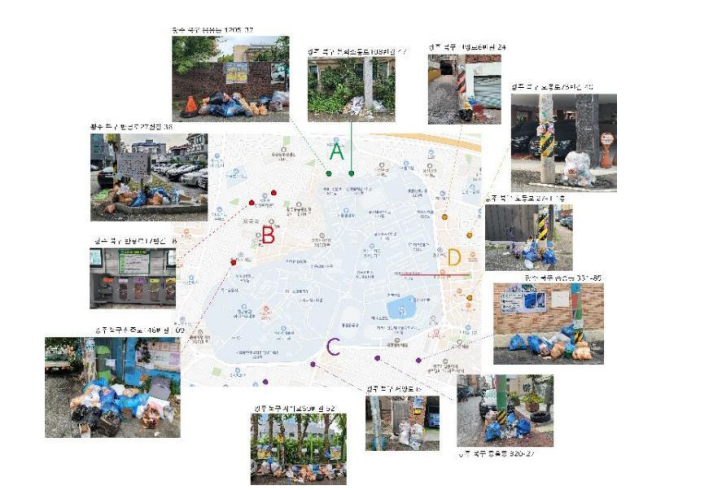
On-Site Field Research Field research is a social science research method where researchers directly visit the site of interest to observe, record, exchange, and collect infor- mation and data. The purpose is to gain insights into specific phe- nomena, behaviors, communities, groups, or environments and generate detailed qualitative data. The field research period for this paper was on July 30, 2023. As depicted, Area A displays slogans and signage regarding waste classification, maintaining a relatively orderly appearance. How- ever, closer inspection revealed household waste not being disposed of in volume-based bags, rather using recycling waste bags for collection. Simi- lar to Area A, in Area B, despite well-placed guidance signage, household waste and designated disposal waste weren’t being segregated according to the specified bags. Additionally, illegal disposal using black plastic bags was observed. Unlike other areas, Area B had a designated waste separation site with bins facilitating a more organized segregation pro- cess. Both Area A and B are inhabited by single-person households and foreigners.
Area C, near Chonnam University’s main gate, showcased a well-organized classification of household waste and recycling plastics. However, a notice- able issue was the lack of waste segregation in the boarding house area, with irregular disposal using non-designated bags being common. Area D, a bustling commercial area near Chonnam University, primarily dealt well with food waste disposal and had waste bins, but several transparent plastic cups left after consuming coffee were found.
Overall, the waste segregation situation appeared less than optimistic and requires substantial improvements, especially in areas concerning boarding houses and single-person household residences.
Figure 4: Waste separation and disposal status around Chonnam National University housing complex.
Multicultural Stakeholders Survey Survey methodology is commonly used in user research, involving the design of questions and the distribution of structured answer sheets to a targeted user group. It allows for the rapid collection of quantitative feed- back data on users’ perceptions or evaluations regarding specific issues or their basic information. The purpose of the user survey in this paper is to objectively understand the current status of waste separation services through quantitative analysis and provide objective evidence to define the issues.
In 1988, Parasuraman, Zeithaml, and Berry proposed the ‘SERVQUAL Service Quality Model,’ reintroducing the five elements of service, namely, reliability, tangibility, responsiveness, assurance, and empathy, naming it the ‘SERVQUAL Service Quality Scale.’ The SERVQUAL scale is a service qual- ity measurement tool based on the gap theory, suitable for various service situations, highly reliable, easy to manipulate, and convenient in analysis procedures and result determination, widely used in measuring the quality of various service industries. Considering the advantages and flexibility of the SERVQUAL scale in evaluating service quality, it’s chosen as the quality evaluation tool for the service system. The SERVQUAL scale includes five basic service quality elements: Tangibles, Reliability, Responsiveness, Assur- ance, and Empathy. Tangibles cover all tangible and intangible aspects of customer contact with service providers, such as equipment, appearance, and behavior of staff. Reliability refers to the trustworthiness of the services provided by the service provider. Responsiveness means the service provider
Service Design for Waste Separation and Disposal 113
promptly responding to customer demands. Assurance indicates the profes- sional knowledge that customers can trust in the staff. Empathy involves the service provider’s interest in and understanding of customers. Additionally, to evaluate current digital interfaces, an analysis of interface availability across these five dimensions is included. The specific survey items are presented in Table 1.
Table 1. Composition of the questionnaire.
Table available in the original PDF paper.
Elements Coding Service Quality Segmentation Factors Typicality Q1 The instructions regarding waste disposal timing, locations, and classification rules in the promotional materials are clear and easy to understand. Q2 The waste disposal areas are well-organized.. Q3 Information about waste separation is easily accessible through leaflets or promotional materials. Q4 Waste separation education is conducted smoothly. Q5 The waste collection staff and volunteers maintain a uniformed appearance, projecting a professional image. Reliability Q6 The waste sorting according to the waste collection rules is being executed effectively. Q7 Ongoing waste sorting education and promotion can assist users in effectively categorizing various types of waste. Q8 The current waste sorting management system in progress is reliable and effectively monitors illegal dumping. Q9 The ongoing waste separation education enables users to develop an awareness of waste sorting. Responsiveness Q10 The ongoing waste sorting system can increase satisfaction based on sorting criteria. Q11 The current waste sorting system is highly efficient and convenient, reducing sorting time. Q12 The ongoing waste sorting system can systematically guide users through the utilization process. Q13 Feedback is obtainable when seeking assistance from waste sorting volunteers. Q14 Feedback on waste separation can be obtained during waste separation education and management. Assurance Q15 The waste separation and disposal process is easy, convenient, and free of burden. Q16 Providing relevant education to waste sorting volunteers can solve many issues related to waste separation and disposal. Q17 The service attitude of waste sorting volunteers is commendable. Q18 Regarding waste separation and collection, residents can provide feedback to the neighborhood council or service providers at any time. Empathy Q19 The decisions regarding waste disposal sites are rational. Q20 The waste separation collection times are suitable. Q21 The sorting service can accommodate users’ requests and preferences. Q22 The waste separation collection system is inclusive and accommodating to individuals of varying ages, genders, and cultural backgrounds. Accessibility Q23 The waste separation app is conveniently downloadable. Q24 The waste separation app can meet user classification needs. Q25 The waste separation app has a clear interface, making necessary information easily accessible. Q26 The waste separation app provides immediate feedback to users, ensuring smooth usability. Q27 The interface of the waste separation app is user-friendly.
“The survey period was from September 16th, 2023, to September 30th, targeting residents living around the school. The survey was conducted through questionnaires to collect data. The survey sample consisted of a total of 72 individuals, and the characteristics of the respondents are outlined in Table 2.
Table 2. Characteristics of survey participants.
Table available in the original PDF paper.
Category Number of Cases Ratio Nationality Korean 41 43.1% Foreigner 31 56.9% Gender Male 30 39.7% Female 42 58.3% Age 20s 27 37.5% 30s 15 20.8% 40s and above 30 41.7% Occupation Student 10 13.9% International student 25 34.7% Working professional 29 40.3% Retiree 8 11.1% Residential Type Single-person household 36 50% Shared rental 8 11.1% Multi-member family 28 38.9% Total 72 100%
The survey results indicate that the element with the highest average satis- faction rating is Empathy (3.50), followed by Assurance (3.435), Reliability (3.392), Responsiveness (3.390), and Tangibles (3.082). The lowest-rated ele- ment is Accessibility (3.02). The overall average satisfaction score was 3.289. All coding average values for Empathy are higher than the total average. Meanwhile, all coding average values for Interface Accessibility are lower than the total average. Apart from Q5 (3.54), the coding average values for Tangibles, excluding Q5, are lower than the total average. Other elements, specifically Q6 (3.18), Q8 (3.24), Q18 (3.24), Q13 (3.22), and Q14 (3.28), were all lower than the overall average (3.289), demanding focused attention and improvement. Notably, among the service quality factors, the lowest five codings—Q1 (3.19), Q2 (2.96), Q3 (2.83), Q4 (2.89), Q6 (3.18)—require significant enhancements, particularly beyond the newly added interface’s utility. The survey revealed a prevalent lack of awareness regarding the exis- tence of the classification app, leading to an overall low satisfaction level. Hence, improvements are necessary in both app design and promotional strategies.
In-Depth Interviews To extract actual grievances and demands, this study collected common opinions from stakeholders involved in waste sorting and disposal to gain insights. In-depth interviews were conducted to address these grievances and demands, aiming to find solutions and provide design plans and proposals
Service Design for Waste Separation and Disposal 115
regarding waste sorting and disposal issues. The interview period was from October 16th to October 30th, 2023. The interviews were structured with open-ended questions and conducted offline. To fulfill the needs of service providers (environmental protection organizations) and beneficiaries (local residents living near schools and foreign residents residing around schools) and to serve the public interest, surveys were conducted on both sides. Char- acteristics of the participants in the in-depth interviews are detailed in Table 3 below.
Table 3. Participants of in-depth interviews survey.
Table available in the original PDF paper.
Occupation Category Name Nationality Address Duration of Residency
10 years Employee
Local Residents Bak00 Korean 81 Yongsu-ro 40beon-gil 1 year Shopping complex employee Lee00 Korean Wunheung-dong, Bukgu
3 years Employee
Lee00 Korean Villa in Ochi-dong, Bukgu
3 years Student
Kim00 Korean 126 Yonbong-ro, Bukgu
1 year International student
Foreign Residents (including international students)
Dong00 China Back gate of Jeonnam National University 9th Dormitory
Employee 2and a half years
LU00 China Back gate of Jeonnam National University Language Institute venkatesan00 India Wunheung-dong, Bukgu Half a year International student MURUGAN00 Vietnam Yongbong-ro, Bukgu
1year International student Environmental Protection Organization
Zang00 Korean Community Development Center
7years Head of Development Center Hu00 Korean Environmental Advocacy Group
10years Head of Environmental Protection Organization
The interview method employed both close-ended and open-ended sub- jective in-depth interviews. The structure of the in-depth interviews was designed to derive practical issues through the experiences of the intervie- wees. Utilizing a pre-established questionnaire, the interview format allowed for free-form questions tailored to the interviewee, enabling insight into the cognitive, attitudinal, grievances, needs, behaviors, motivations, perspectives, and specialized knowledge of the research subjects. Therefore, the questions for both groups focused on: 1. Cognitive assessment of the current waste sorting situation, 2. Investigating behaviors contributing to the observed situation, 3. Collecting proposals from stakeholders.
As per the results of the in-depth interviews: Awareness of the surrounding waste sorting environment differs among respondents. Four local residents mentioned discrepancies in waste sorting,
with some locations having efficient sorting and others lacking. Among four international students, three noted instances where proper sorting around the school area was neglected. Experts also cited poor waste sorting near schools, mentioning piles of disposable waste near one-room apartments and boarding houses.
The cause of the perception disparity in waste sorting awareness stems from insufficient precision sorting education, leading to improper waste sort- ing tendencies among local residents. Factors include unclear labeling on neighborhood waste bins and a lack of knowledge about large waste collec- tion methods. Some residents mentioned a lack of motivation for meticulous sorting and insufficient education on food waste separation, resulting in random disposal.
Improvement suggestions include strengthening promotional education for both locals and foreigners, experts suggesting multiple education ses- sions through app designs. Promotion is crucial for those not accustomed to smartphone usage, and traditional education methods are deemed impor- tant. Suggestions also included installing waste bins for frequent disposal, improving labeling for foreigners, and offering incentives for accurate sort- ing by residents. Experts highlighted the necessity of corporate participation for a sustainable recycling system.”
Persona Analysis and Problem Definition Persona Analysis Foreign exchange student Venkatesan00, who has been in Korea for six months, resides in a studio apartment and is learning Korean. His issues include a lack of education and promotion on waste separation, unaware- ness of waste classification rules, and a casual approach to sorting. He faces confusion due to multilingual and unclear labels on bins and struggles with inadequate space for waste storage. Solutions required are guidelines, edu- cation, habits fostering waste separation mechanisms, clear labeling, and designated spaces for waste disposal during outings. Local resident Kim00 works nearby and shares a residence with friends. Her problem lies in not understanding precise waste sorting methods, lack of motivation due to inconvenience in food waste separation, leading to forgetfulness and lack of local sorting facilities. Solutions required are easy-access sorting knowledge, habit formation, and encouragement for strict sorting, and proactive poli- cies for food waste disposal. Clear labeling on waste bins is also necessary. Zang00 is an environmentalist who discovered a heap of disposable items near one-room apartments and boarding houses while working. Education and strengthening sorting awareness among locals and financial limitations hinder environmental organizations from providing diverse promotion ser- vices. Solutions required are increased waste sorting facilities, educational campaigns transcending time and space, expanded government participation, and corporate collaboration to foster a circular economy.
Problem Definition Based on field surveys and analysis of promotion for sorting methods, the following problem definitions have been derived quantitatively and qualita- tively: Firstly, there’s a lack of education and promotion. User satisfaction
Service Design for Waste Separation and Disposal 117
regarding sorting education (Q4: 2.89) and promotion (Q1: 3.19, Q3: 2.83) was lower than the overall average. Analysis of promotional materials high- lights areas requiring improvement. Most international students lack sorting education and knowledge of sorting rules, even unaware of disposal timings. Local residents are also unfamiliar with larger furniture and precise sorting rules. Environmental groups report inability to provide adequate education due to lack of manpower and financial resources.
Secondly, there’s a shortage of waste sorting facilities and unclear labeling. User satisfaction with the order of dumping places (Q2: 2.96) was lower than the average. Nearly all in-depth interviewees reported a lack of waste sorting facilities. Both locals and foreigners find it challenging to locate bins, resulting in untidy areas and lack of facility utilization. Environmentalists state that even after sorting, without fixed facilities, it damages the city landscape. Both locals and foreigners find unclear bin labels as an issue.
Thirdly, excessive use of disposable items leads to pile-ups. Environmental groups highlight excessive disposable waste near one-person households and boarding houses. Accumulation makes disposal difficult, with some residents like LU wishing for frequent disposal spaces due to limited living space.
Lastly, there’s a lack of punishment and incentives. User satisfaction with waste classification management systems (Q8: 3.24, Q13: 3.22, Q14: 3.24) was lower than the average. In-depth interviews show a lack of motivation among locals due to inadequate punishment and incentives, making it chal- lenging for them to foster sorting habits. Environmental groups advocate for incentives for detailed sorting and highlight the lack of government support and corporate cooperation in securing punishment and incentives.”
Proposal for Waste Separation and Disposal Services in University Housing Complexes Design Implications Due to the issue of inadequate education, some may struggle with how to sort waste and may not be able to do so accurately. To address this educational gap, the installation of an app could be initiated. However, app adoption requires encouragement and promotion. Education needs to encompass not only pictorial instructions but also video interpretation services. Moreover, traditional promotional methods are necessary to care for the elderly. To boost usage, a usable waste separation calendar could be designed. Addi- tionally, foreigners should receive waste separation education during their language courses and must download a waste separation app.
To address situations where foreigners can’t adapt to sorting due to a lack of waste treatment facilities, it’s essential to install bins with clear separa- tion labels. Especially in areas with many one-person households and limited space in studio apartments, more proactive installation of waste bins is nec- essary. Utilization of colors and pattern identification in waste separation, provision of foreign language services, and strategic placement of bins to deter the habit of discarding disposable cups randomly are essential. Besides bin design, overflow monitoring and classification management through the Internet of Things (IoT) are necessary.
The issue of excessive use of disposable items can be tackled by implement- ing policies such as purchasing garbage bags based on the volume of waste and charging for cleaning services. Cleaning companies can collect a cleaning fee as a deposit each month, deducting fees if excess garbage is disposed of by the residents in the area or refunding if not. Effective management systems need to be built to execute this function.
In a situation lacking punishment and incentives, adopting the habit of waste separation and detailed sorting is challenging. Offering rewards for uploading images or videos of meticulous waste sorting processes or accurate disposals five times or more via the app could be implemented. Inadequacy in the number of penalizing personnel might necessitate the involvement of elderly and student groups. Supervision shouldn’t rely solely on special- ized personnel but should also involve mutual oversight among neighbors. Incorporating social features within the app and informing each other when illegally disposed waste is detected, followed by expert tracking and penalties for illegal dumping in the same location, could help curb this issue.
Service Blueprint The paper is a result of on-site assessments, promotional material reviews, surveys, and in-depth interviews aimed at defining issues. Through sur- vey findings, persona analysis, and issue definition, design proposals were derived. First, it proposes trash bins with overflow alert and segregation detection features. Second, the waste segregation app needs improvement, integrating IoT for bin status and adding features like segregation educa- tion, query, social interactive monitoring, rewards, and penalties. Third, it advocates for consistent offline education, distributing functional segregation calendars to promote app downloads. Furthermore, it presents the following service blueprint based on waste segregation process timings. Firstly, indi- viduals unaware of segregation methods receive segregation calendars before disposing of trash, complete offline segregation education, and download the waste segregation app. Service providers offer offline waste segregation education services based on user demand, designing segregation calendars and apps. Secondly, when waste is generated, depositors pay a deposit for segregation and illegal dumping surveillance. Service providers refund or deduct deposits based on user segregation habits and waste records. Addi- tionally, users watch educational videos related to waste disposal in Gwangju North District before disposal, with service providers offering monitoring and reward services based on user learning and situations. Thirdly, waste depositors engage in knowledge retrieval or consultations for waste seg- regation. They can upload 14-day records of their segregation habits by capturing the segregation process. Service providers offer education and query services regarding Gwangju North District’s segregation knowledge, providing 14-day waste segregation habit-building systems with rewards and supervision. Fourthly, waste depositors check disposal conditions and locate input points based on bag capacities to upload waste amounts and use bins equipped with detection, classification, and identification features. Moreover, IoT sends overflow and segregation status to the app, supervising input loca- tions for recording input amounts. Lastly, after waste disposal, users can
Service Design for Waste Separation and Disposal 119
upload photos of illegal dumping or inspection results for joint sharing and supervision through social interactive features. Service providers offer a social platform for photo uploads, contact with nearby friends, and reward services for informants and sharers.
CONCLUSION
Waste separation and disposal have long received attention from govern- ments and various sectors, elevating awareness and promoting sorting behavior through a series of policies. However, current research and inter- est in waste separation and disposal are rare in areas where people reside with different lifestyles and values. This paper focused on residential areas around universities with diverse cultural backgrounds, conducting field vis- its, literature reviews, user surveys, and in-depth interviews, identifying the following issues: firstly, lack of clarity in educational and promotional materials on waste sorting, secondly, insufficient waste separation facilities, thirdly, excessive use of disposable items, and fourthly, a lack of incentives and penalties. To address these problems, brainstorming sessions generated potential solutions: firstly, the design of waste bins with overflow notification and separation detection features, secondly, improvements in waste separa- tion app functionalities including integration with the Internet of Things for real-time bin status updates, educational modules, separation status checks, interactive social monitoring, and a reward/punishment system. Thirdly, a recommendation for ongoing offline educational campaigns promoting the app’s universality and distributing functional sorting knowledge calendars to encourage app downloads and usage. Lastly, the development of a service blueprint based on waste disposal timings. We hope the suggestions in this paper serve as a reference for improving waste separation and disposal issues.
REFERENCES
De Young, R. (1985–1986), “Encouraging environmentally appropriate behaviour: The role of intrinsic motivation”, Journal of Environmental Systems, Vol. 15, No. 4, pp. 281–92. Jung, Y., A Study on Youth Shared Villages Using Service Design Methods, Journal
of the Korea Contents Association, Vol. 18, No. 4, 2018, p. 316. Kim, H. (2013). A Study on the Evolution of Service Design and Its Relation to Knowledge. Digital Design Studies, 13(2), 421–430. Lievers, S., Serra, P. and Watson, J. (1986), “Religion and visiting hospitalized old
people: Sex differences”, Psychological Reports, Vol. 58, No. 3, pp. 705–96. Moritz, S. (2005). Service design: Practical access to an evolving field. Cologne, Germany: Köln International School of Design. Shostack, G. L. (1982). How to design a service. European Journal of Marketing.
16(1), 49. Shostack, G. L. (1984). Designing services that deliver. Harvard Business Review, 62(1). 133–139.
LISTED IN THE AHFE DIGITAL BOOKSTORE CATALOGUE
Explore the complete digital volume
Ergonomics In Design
Read this individual research paper free through the original publisher, or explore the full digital proceedings book.
ISBN 978-1-964867-05-2
Explore this ISBN in the AHFE Bookstore ↗Listed in the July 2026 bookstore catalogue; search by ISBN to confirm current availability · Digital book purchase optional