Katherine Mollenhauer, Javiera Rodríguez, Gaspar Jarry, Karen Silva, Kay Bergamini (2026). Systemic Design for Social License: Modelling Information and Communication Challenges in Mining Environmental Management through a Systemic CJM. In: Human Systems Engineering and Design (IHSED2026): Future Trends and Applications. AHFE Open Access, vol. 237, pp. 44–54. https://doi.org/10.54941/ahfe1008144
Environmental management in mining projects is a complex socio-technical process in which legitimacy and operational viability depend not only on regulatory compliance, but also on the capacity to articulate actors, institutions, procedures, and environmental information throughout the project lifecycle. In this context, social licence is strained when environmental information is highly technical, dispersed, and fragmented, limiting traceability, shared understanding, and the capacity for informed action among public-sector, private-sector, and civil-society actors.This article discusses the contribution of Systemic Design, articulated with Service Design, to model the environmental management of mining projects through the construction of a systemic Customer Journey Map. Based on the case study of the Environmental Observatory for Mining Projects (EO), the article analyses how the “mining project journey” was constructed as a methodological device to represent interactions among actors, procedures, and environmental information platforms.The study shows that the Systemic Customer Journey Map enabled the identification of breakdown points in access, comprehension, traceability, coordination, and participation. It also supported the translation of these findings into design criteria for the Observatory and its Support Service. In doing so, the article contributes a replicable model for making visible the information and communication challenges that affect environmental governance and social licence in mining contexts.
Climate change represents one of the main contemporary challenges, threatening ecosystems, natural resources, and social well-being (United Nations [UN], n.d.). The transition toward clean energy and decarbonization has intensified the demand for critical minerals such as copper, nickel, and lithium (Bruckmann et al., 2022). Due to its copper and lithium reserves,
Systemic Design for Social Licence 45 Chile plays a strategic role in this global transition. However, the expansion of mining activity also increases socio-environmental pressures and conflicts (Schorr, 2018).
In this context, mining sustainability cannot be understood through clean energy adoption, or regulatory compliance alone. Effective governance of extractive industries requires legal and institutional frameworks that ensure environmental sustainability and social participation throughout the project lifecycle (Cameron & Stanley, 2017). Consequently, the legitimacy of mining projects is defined by the capacity to articulate actors, institutions, procedures, and information around shared decisions and actions.
These challenges are particularly evident in the Chilean context. Bergamini et al. (2025) argue that access to environmental information is affected by institutional dispersion and asymmetrical access among civil-society and the public and private sectors. Improving environmental management would require not only producing information, but also integrating, communicating, and translating it into formats that different actors can use throughout the project lifecycle.
This article discusses the contribution of Systemic Service Design to model the information and communication challenges involved in mining environmental management through the construction of a Systemic Customer Journey Map. Based on the case study of the Environmental Observatory for Mining Projects (EO), the article analyses how the “mining project journey” was constructed to model the complexity of interactions involved in a mining project lifecycle.
The article addresses three research questions: How can the articulation between Systemic Design and Service Design methodologically operationalize the complexity of mining environmental management? How can this articulation help identify and characterize breakdown points in the journey? To what extent can the “mining project journey” operate as a replicable model for articulating actors, procedures, and environmental information platforms?
THEORETICAL FRAMEWORK Environmental Information and Communication Challenges
Social licence has become a central concept for understanding the legitimacy of mining projects. Unlike a formal authorization or permit, social licence is not tangible (Arntz, 2017), but a condition of trust and acceptance granted by communities and stakeholders over time (Medina, 2020). It depends on the capacity of project developers, institutions, and communities to sustain transparent communication, meaningful participation, and shared understanding throughout the project lifecycle (Deonandan et al., 2024; Spiller et al., 2025).
Environmental information plays a critical role in this process. Its access can contribute to improving industrial performance, reducing environmental conflicts (Vera, 2015; Calveras & Ganuza, 2015; Silva, 2021), and strengthening informed citizenship (Banas, 2010; Creighton, 2005;
Richardson & Razzaque, 2006; Silva, 2021). However, availability does not guarantee informed participation or better decision-making. Information is often highly technical, dispersed across multiple platforms and institutions, fragmented across documents and difficult to trace over time. This generates asymmetries between mining companies, public institutions, and communities (Sabatini, 2000; Botero, 2012; Fuenmayor, 2004).
Previous work developed within the EO proposed the Multilevel Information Delivery Strategy (MIDS) as a strategic design-based model for equitable access to environmental information. Mollenhauer et al. (2024) show that information delivery cannot be homogeneous, since actors differ in their motivations, capacities, levels of action, and expectations. This reinforces the need to understand environmental information as part of an information ecology shaped by users, platforms, interpretation capacities, and communication channels.
These limitations are also communicational. Information must be translated, contextualized, explained, and exchanged according to different actors. When this does not occur, the availability of data may coexist with low comprehension, weak traceability, fragmented coordination, and limited participation. In this sense, the comprehension of environmental information becomes essential for sustaining bidirectional communication, strengthening trust, and supporting the conditions for social licence to operate (Rodríguez et al., 2023).
Systemic Service Design and the Modelling of Complexity Service Design offers methods to understand people’s experiences, visualizing processes, identifying pain points, and translating insights into actionable design criteria. It makes visible both the frontstage and backstage dimensions of services (Suoheimo et al., 2025a). However, when the object of study is a complex socio-technical system, traditional service design tools may be insufficient.
Service Design has recently expanded from problem-solving toward systemic approaches in order to address complex problems in social systems, characterized by interdependencies, conflict, uncertainty, and multiple stakeholders (Koskela-Huotari & Vink, 2022; Sevaldson, 2022). The articulation between Service Design and Systemic Design has therefore contributed to the emergence of Systemic Service Design, combining the user- centred strengths of Service Design with the capacity of systemic approaches to represent relationships and multi-level conditions (Horn, 2025; Suoheimo et al., 2025b).
Systemic Service Design is relevant for mining environmental management because the challenges involved are located in the relationships between actors, procedures, platforms, institutions, and communication channels, contextualized within territorial, technical, and social boundaries (Mollenhauer et al., 2023b).
Systemic Design for Social Licence 47 Towards a Systemic Customer Journey Map
Design mapping is central to engaging with complexity. Systemic Design methods such as Gigamapping support collaborative sense-making by representing actors, flows, relations, boundaries, and scales within complex situations (Sevaldson, 2022; Suoheimo et al., 2025b). At the same time, Service Design tools such as Customer Journey Maps help organize experiences across time, but may produce overly linear representations when applied to complex socio-technical systems (Besplemennova & Tassi, 2018; Suoheimo et al., 2025a).
The Customer Journey Map is traditionally used to visualize the experience of a user within a specific service or interaction, identifying activities, touchpoints, emotions, and pain points. Yet, when the experience being studied involves multiple actors, long temporalities, institutional procedures, legal requirements, and dispersed information systems, the CJM requires a systemic transformation.
From this perspective, a Systemic Customer Journey Map enables the connection of user-centred depth with systemic breadth, modelling multi- actor and information-intensive processes and breakdown points within the system.
CASE STUDY The Environmental Observatory for Mining Projects (EO) is an applied research initiative aimed at addressing gaps in public environmental information management in the Chilean mining industry. It was funded by the Promotion of Scientific and Technological Development Fund (FONDEF ID20I10084) and the Technological Research Fund (IT23I0066). Its development began with a pilot which integrated dispersed environmental information into a public platform that would be useful for the public sector, private sector, and civil society actors. Subsequently, the project aimed at scaling, incorporating challenges related to the management of large volumes of data, the generation of performance indices, the integration of nationally representative indicators, and the effective adoption of the platform by different types of users.
The EO includes a Support Service (EOSS), conceived as a layer of assistance to facilitate the interaction of different actors with environmental information. Its existence responds to the need to ensure the platform is not limited to mere availability of data, but also incorporates resources that help users interpret, contextualize, and use information according to their capacities and roles.
METHODOLOGY
The project followed a co-creative and multi-method research strategy with actors from the environmental management ecosystem, including public- sector, private-sector, and civil-society participants. Research was structured according to the triple diamond model for public service design developed
by the UC Public Innovation Laboratory (LIP UC, 2017), and complemented by methods from design thinking applied to organizational vision, strategy, and systemic transformation (Buchanan, 2015), social sciences, information visualization, user experience, and multi-method design research (Muratovski, 2022). The Systemic Customer Journey Map (SCJM) was constructed as a methodological device to model the broader socio-technical process in which environmental information is produced, circulated, interpreted, and used by different actors throughout a project’s lifecycle. It followed four iterative steps: First, the environmental management process of a mining project was defined as a unit of analysis. Second, the main phases of a mining project were mapped, from prospection to closure, establishing the temporal structure of the SCJM. Third, the actors involved in the ecosystem were identified and characterized through co-creative sessions, interviews, and validation with public, private, and civil-society. For each actor, roles, activities, expectations, needs, difficulties, and situated knowledge were analyzed. Fourth, the SCJM was used to identify breakdown points, understood as gaps emerging from systemic interactions. These were systematized into a Logical Design Matrix (Mollenhauer et al., 2023a), which translated the systemic diagnosis into design-oriented categories and requirements for the Support Service.
RESULTS
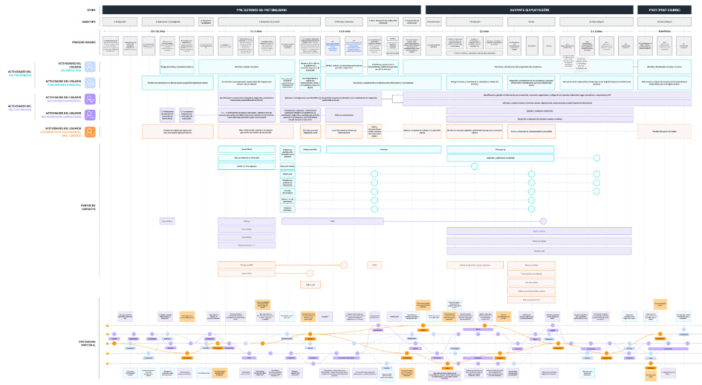
Systemic Customer Journey Map (SCJM) Tool The first result was the completion of the SCJM as a tool (Figure 1), which organized the journey through phases, sub-phases, process stages, actors, activities, touchpoints, information flows, evidence, and emotional responses. This structure made it possible to visualize how the different actors interact with environmental information at different moments of the project lifecycle.
Systemic Design for Social Licence 49 Identification of Breakdown Points and Gap Patterns
The second result was the identification of breakdown points. Five gap patterns emerge: access, comprehension, traceability, coordination, and participation. Access gaps refer to difficulties in finding, obtaining, or navigating environmental information. Although information may be formally public, it is often dispersed across platforms and institutions, making it difficult for actors to locate what they need in a timely and meaningful way. Comprehension gaps refer to the technical and specialized nature of information. This particularly affects civil-society actors, who often encounter information that is not translated into usable formats, language, or frameworks. Traceability gaps refer to the difficulty of following information across the project lifecycle. Actors often lack a clear view of how data, reports, observations and project decisions are connected over time. Coordination gaps refer to weak articulation among public institutions, private actors and communities. These gaps become visible when responsibilities, timelines, communication channels, and requirements are unaligned. Participation gaps refer to the limited capacity of actors, particularly local communities, to engage in participatory processes in an informed and timely manner.
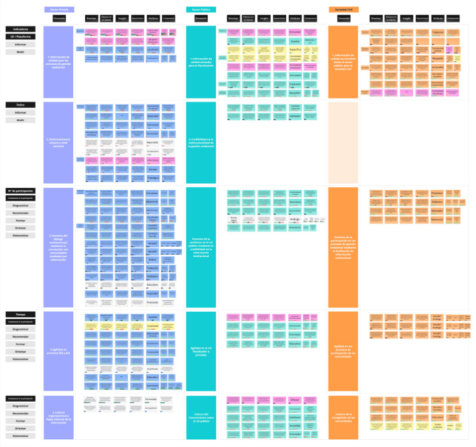
Translation of Gaps Into the Logical Design Matrix (LDM) The third result was the translation of the breakdown points into a Logical Design Matrix. The LDM organized the gaps identified through the SCJM into design-oriented categories and actionable requirements for the Support Service. It translates the findings into criteria related to information accessibility, interpretability, navigation, communication, institutional legibility, and support for informed action.
Figure 2: EOSS logical design matrix.
DISCUSSION Methodological and Epistemological Contribution of the SCJM Methodologically, the SCJM offers a structured process for transforming a CJM into a systemic mapping device, capable of representing multiple actors, long temporalities, legal and technical procedures and communication breakdowns. The translation of the SCJM into a Logical Design Matrix reinforces the role of Systemic Service Design as a bridge between diagnosis and situated interventions, making possible to convert systemic breakdowns into design-oriented requirements. Its contribution is also epistemological, since it produces a situated and relational form of knowledge about mining environmental management. The collaborative construction of the tool made it operate as a sense-making and sense-sharing device, helping actors recognize their own position within the environmental management ecosystem and understand how their actions, needs, and communication practices relate to those of others.
The Mining Project Journey as an Applied and Transferable Model The case also suggests that the “mining project journey” can operate as an applied and transferable model for environmental governance. Its value lies in offering a methodological structure that can be adapted to different territories, project stages, institutional settings, or information systems. The SCJM enables comparison between cases, identification of key breakdown patterns, and formulation of design criteria for improving access and communication of information in complex socio-technical systems.
Systemic Transformation of the Customer Journey Map From a Service Design perspective, this article contributes to the discussion on how tools can be systemically transformed. The SCJM expands the scope of analysis of a traditional CJM by incorporating multiple enhanced components. Table 1 synthesizes the main components used to construct the SCJM, and Table 2 describes specific systemic enhancements from the CJM to the SCJM.
Table 1: Components of SCJM, compared with CJM, and their use in the case study.
Table available in the original PDF paper.
Component Description Use in CJM Use in Case Study (SCJM) Phase Broad framing of the journey, structuring major stages.
Broad phases, but usually within a delimited service.
The mining project was structured through feasibility evaluation (pre), operation (during), and closure (post).
Sub-phase Linear process phases within the broader phase.
Utilized, but generally with a narrower temporal scope.
Sub-phases included prospection, environmental assessment, construction, operation, and closure.
(Continued)
Table 1: Continued.
Table available in the original PDF paper.
Component Description Use in CJM Use in Case Study (SCJM) Time frame Explicit indication of the duration of each sub-phase.
Usually not central. Focus on shorter interactions.
The map incorporated long- term temporalities associated with multiple management processes.
Process phase
Specific process stages and activities, including description.
Usually absent or simplified in traditional CJMs.
The broad phases (3 phases) were expanded into specific stages of the mining process (32 activities).
Stakeholder activities
Focus mainly on one user’s actions.
Activities performed by each actor during each process stage.
Activities were differentiated for public-sector, private-sector, and civil-society actors.
Stakeholder effects
Expectations, emotions and reactions on each stage.
Usually represented as emotions or pain points.
Effects included expectations regarding information quality, institutional response, and actor responsibilities.
Stakeholder evidence
Empirical input from participants, validating their experience.
Often focused on an individual’s experience.
Evidence included quotes and insights from interviews, co-creative sessions, and validation instances.
Common in CJMs. Emotional responses included
Emotion mapping
Emotions emerging from activities, evidence and effects.
caution, uncertainty, trust, frustration, vigilance, and confidence.
Stakeholder touchpoints
Sector-specific interfaces, or elements of interaction.
Common in CJMs, but within one service ecosystem.
Touchpoints included databases, reports, focus groups, fieldwork sessions, and sector-specific tools.
Common touchpoints
Shared interfaces and elements of interaction used by multiple actors.
Depends on whether the CJM considers multiple users.
Common touchpoints included public platforms, institutional databases, reports, and participatory instances.
Table 2: Systemic transformation of the customer journey map.
Table available in the original PDF paper.
Variable Customer Journey Map Systemic Customer Journey Map Enabling Component Unit of analysis Maps the linear set of interactions of a single user within a delimited experience.
Maps the interactions of multiple actors within a broader socio-technical journey structured by overlapping processes.
Phase Sub-phase Process phase Common touchpoints
Goals Maps a user’s specific goal during a service.
Maps multiple goals distributed over time, both within each actor’s journey and between actors.
Variable Customer Journey Map Systemic Customer Journey Map Enabling Component Temporality Enclosed within a Phase Time frame
limited time frame (hours or days).
Weeks, months, or years, according to the large-scale process temporality.
Incorporates linear, cyclical, and overlapping interactions.
Sequence Thrives on linear sequences of interactions.
Process phase Stakeholder activities
Relation with process
Relates a stakeholder experience to a specific service process
Phase Sub-phase Process phase Touchpoints
Overlays multiple legal, technical, institutional, and communicational processes that shape stakeholder interactions over time.
Type of breakdown
Identifies pain points in the user experience.
Stakeholder effects Evidence Touchpoints
Identifies systemic gaps that emerge from relationships between actors, processes and touchpoints.
Design translation
Supports service improvement opportunities.
Supports the translation of systemic breakdowns into design criteria for services, strategies and tools.
Breakdown patterns; Logical Design Matrix (LDM)
CONCLUSION
This article shows how the Customer Journey Map can be transformed into a systemic device for representing and analysing complexity in socio- technical contexts. It also contributes to discussions on the role of design in environmental governance, particularly in contexts where extractive industries, institutional fragmentation, territorial conflicts, and information asymmetries intersect. Through tools such as the SCJM, Systemic Service Design can contribute to the construction of shared understanding, informed participation, and communicational conditions required to sustain social licence.
REFERENCES
Arntz, M. E. (2017). A Path to Achieving a Social License. *Nueva Minería y Energía* Magazine. https://www.nuevamineria.com/revista/una-ruta-para-acc eder-a-la-licencia-social/ Banas, P.A. (2010) International ideal and local practice—Access to environmental
information and local government in Poland. Environ. Policy Gov. 2010, 20, 44–56. https://doi.org/10.1002/eet.528 Bergamini, K., Angel, P., Mollenhauer, K., Medina, J.I., Rugiero, V. and Rodríguez, J. (2025) ‘The Environmental Observatory for Mining Projects: A system for the analysis of public environmental management information’, in Intersections. Springer, pp. 99–115. doi: 10.1007/978-3-031-76402-8_7.
Systemic Design for Social Licence 53 Besplemennova, Y., & Tassi, R. (2018). Systems thinking for service design: More-
than-human-centered tools. In Proceedings of RSD7, Relating Systems Thinking and Design 7 (pp. 332–346). http://openresearch.ocadu.ca/id/eprint/2736/ Botero, C. A. (2012). Access to Environmental Information in Latin America: Challenges and Perspectives. CEPAL. Bruckmann, M., Barrios, M.A. and Lajtman, T. (2022) ‘Latin America in 21st-Century
Geopolitics: The Decline of the United States and the Rise of China’, in The Environmental Geopolitics of the United States and Its Global North Allies: Implications for Latin America. CLACSO and UNIJUÍ, pp. 121–180. Buchanan, R. (2015). Worlds in the making: Design, management, and the reform of organizational culture. She Ji: The Journal of Design, Economics, and Innovation, 1(1), 5–21. https://doi.org/10.1016/j.sheji.2015.09.003 Calveras, A. and Ganuza, J.-J. (2016) ‘The role of public information in corporate
social responsibility’, Journal of Economics & Management Strategy, 25(4), pp. 990–1017. doi: 10.1111/jems.12156. Cameron, P. D., and Stanley, M. C. (2017). Oil, gas, and mining: A sourcebook for understanding the extractive industries. World Bank. https://doi.org/10.1596/978- 0-8213-9658-2 Creighton, J.L. (2005). The Public Participation Handbook: Making Better
Decisions Through Citizen Involvement. Jossey-Bass A Wiley and Sons Imprint, San Francisco, CA, United States of America. ISBN 0-7879-7307-6. Deonandan, K., Schoenfeld, J., Salim, A., & Bourassa, M. (2024). Social license to operate (SLO): Private governance and barriers to community engagement. The Extractive Industries and Society, 17, 101404. https://doi.org/10.1016/j. exis.2024.101404 Fuenmayor, L. (2004). Environmental Information and Public Participation:
Challenges for Democratic Governance. Editorial Universidad del Zulia. Horn, R.E. (2025) ‘Case study of Mess Mapping process: Improving long-term care services’, in Suoheimo, M., Jones, P., Lee, S.-H. and Sevaldson, B. (eds.) Systemic Service Design. Routledge. doi: 10.4324/9781003501039-10. Koskela-Huotari, K., and Vink, J. (2022). Tracing the systems turn in service design
and innovation: Convergence toward service system transformation. In B. Edvardsson & B. Tronvoll (Eds.), The Palgrave handbook of service management (pp. 537–558). Palgrave Macmillan. https://doi.org/10.1007/978-3-030-91828- 6_27 Laboratorio de Innovación Pública UC [LIP UC] (2017). User Co-production in Public Services. Public Innovation Laboratory (Vol. 1). Santiago, Chile. https:// www.lipuc.cl/publicaciones/coproduccion Medina, J. (2020). Social License to Operate: Trust, Legitimacy, and Sustainability in
Latin American Mining. Revista de Estudios Sociales, 72, 45–60. Mollenhauer, K., Del Río, C., Rodriguez, J., Bianchi, D., and Riveros, S. (2023a).
Logical design matrix (LDM): How to operationalize systemic projectual design thinking in complex contexts. Human Systems Engineering and Design (IHSED2023), 112, 245–257. https://doi.org/10.54941/ahfe1004135 Mollenhauer, K., del Río, C., Rodríguez, J., Silva, K., & Rugiero, V. (2023b). How to build resilient communities? The Chilean Environmental Observatory as an interdisciplinary research case driven by systemic design to empower through information. Proceedings of Relating Systems Thinking and Design (RSD12), Article 173.
Mollenhauer, K., del Río, C., Rodríguez, J., Bergamini, K., Rugiero, V., & Medina, J. I. (2024). Multilevel Information Delivery Strategy (MIDS): A strategic design based model and method for equitable access to environmental information. Human Systems Engineering and Design (IHSED 2024), 158, 325–343. https:// doi.org/10.54941/ahfe1005556 Muratovski, G. (2022). Research for designers: A guide to methods and practice. 2nd
edition. SAGE. Richardson, B.J. and Razzaque, J. (2006) ‘Public participation in environmental decision-making’, in Richardson, B.J. and Wood, S. (eds.) Environmental Law for Sustainability. Oxford: Hart Publishing, pp. 165–194. Rodríguez, J., Mollenhauer, K., & Del Río, C. (2023). Thesis Report: Support Service
of the Environmental Observatory for Mining Projects. Pontifical Catholic University of Chile. Sabatini, F. (2000). State Reform and Environmental Management in Chile: The Case of the SEIA. Revista de Ciencia Política, 20(2), 79–108. Schorr, B. (2018) ‘Unequal Opportunities: Companies and the State in Conflicts over
Mining in Chile’, Estudios Atacameños, 57, pp. 239–255. doi: 10.4067/S0718- 10432018005000601. Sevaldson, B. (2022). Designing complexity: The methodology and practice of systems oriented design. Common Ground Research Networks. https://doi. org/10.18848/978-1-86335-262-8/CGP Silva, A. (2021) Analysis of Exceptions to the Right of Access to Environmental
Information in the Escazú Agreement and Differences with Chile. Environmental and Climate Justice. 2021, 13, 47–90. Spiller, E., Htun, N., & Shah, S. (2025). Community engagement and participatory inclusion in mining: Challenges, barriers, and opportunities (RFF Working Paper 25-08). Resources for the Future. https://media.rff.org/documents/WP_25-08_ PHBFNYf.pdf Suoheimo, M., Jones, P., Lee, S.-H. and Sevaldson, B. (2025a) ‘Innovations in
theory and practice of systemic service design’, in Suoheimo, M., Jones, P., Lee, S.-H. and Sevaldson, B. (eds.) Systemic Service Design. Routledge. doi: 10.4324/9781003501039-1. Suoheimo, M., Kist, F., Horn, R.E. and Sevaldson, B. (2025b) ‘Mess Mapping and Gigamapping tools to understand systems in services’, in Suoheimo, M., Jones, P., Lee, S.-H. and Sevaldson, B. (eds.) Systemic Service Design. Routledge, pp. 17–40. doi: 10.4324/9781003501039. United Nations (n.d.) Causes and effects of climate change. Available at: https://
www.un.org/en/climatechange/science/causes-effects-climate-change Vera, A. (2015). Nine Answers to Ten Questions on Access to Environmental Public Information. In M. Juliá (Ed.), Legal Research on Environmental Public Policy (1st ed., pp. 1–162). Narvaja.
FIND THE COMPLETE VOLUME IN THE AHFE DIGITAL BOOKSTORE
Explore the complete digital volume
Human Systems Engineering and Design (IHSED2026): Future Trends and Applications
Read this individual research paper free through the original publisher, or explore the full digital proceedings book.