Katherine Mollenhauer, Cala Del Rio, Javiera Rodriguez, Daniela Bianchi, Sara Riveros (2023). Logical Design Matrix (LDM): How to operationalize systemic projectual design thinking in complex contexts. In: Human Systems Engineering and Design (IHSED 2023): Future Trends and Applications. AHFE Open Access, vol. 112, pp. 245–257. https://doi.org/10.54941/ahfe1004135
In recent years, the design discipline has achieved a leading role in fields of knowledge where complex projects requiring a systemic scope are addressed and implemented. This has created the challenge for designers to communicate to others the way in which this discipline generates knowledge in applied research projects. For most design practitioners, this is implicit in the way projects are carried out, however, professionals from other disciplines that make up teams do not always have the same understanding of the process, making it difficult to move forward together within a project framework. Simultaneously, nowadays the complexity of situations being addressed has escalated exponentially. Problems are no longer bounded, where there is a one-way solution, instead they exist within complex ecosystems and are in constant movement, where responses must be systemic and have the same mutation potential to evolve as the context and its issues do. In this context, designers as part of interdisciplinary teams have a double challenge. On the one hand, to contribute from and for the design discipline itself, by displaying and communicating the design process methods within the design spectrum. And, on the other hand, to implement and demonstrate to others the methodological contribution of the design projective thinking in the general process of the multidisciplinary team. This article proposes and discusses a model and a systemic instrument that addresses the complexity present in the materialization and operationalization of the contribution of the projectual design thinking process. The synthesis of the model and subsequent instrument is presented through the review, systematization and discussion of cases where this tool has been applied. Both methodological and systemic elements are relevant for the internal organization of the applied research project as well as for the interdisciplinary team that develops it and the stakeholders involved.
THE CONTRIBUTION OF PROJECTUAL DESIGN THINKING TO APPLIED INTERDISCIPLINARY RESEARCH: A WORK IN PROGRESS According to Lopez-Leon and Macias (2020) and referring to Bentz and Franzato (2017), there are four levels in which it is possible to identify the production of knowledge in the methodological practice of design. Level zero is the design practice, where the knowledge contribution is given by the language of the designed object itself. Level 1 is the production of a metalan- guage, achieved through the construction of a critical discourse of the results of design practice. Redundantly, this level describes what the practice pro- duces but, in a language, different from the one of the designed object itself. Level 2 is the production of a meta-metalanguage and reflects the description, critique and adequacy of the selected methods used in practice according to the nature of the problems addressed, i.e., the project methodology. Level 3 is the production of a meta-meta-metalanguage or knowledge to an episte- mological level, providing “the perspective and beacons for methodological work” (Bentz and Franzato, 2017, p. 135) that enriches the discipline. There- fore, having models and methodologies that support the projective thinking of the design processes is fundamental to progress in multi-, inter- and trans- disciplinary teams that address complex contexts where the design discipline has taken a new position.
For Findeli et al. (2008), applied research in design always occurs in the framework of the project. The knowledge generated in this context can come from research for, through or by design (Frayling, 1993; 2015). This last type of research allows the creation of models that methodologically support the design thinking process.
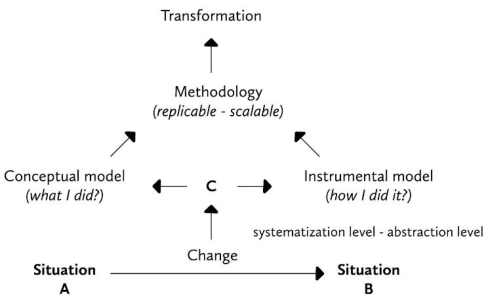
Mollenhauer et al. (2020), states that applied research and specifically research through design gives the discipline its transformative character, allowing a situation to change from state A to state B through a vector of change (Figure 1). This action of change is possible thanks to the projective thinking of the design process that the designer applies in a given situation. While this change occurs, the professional reflects on the process and the results of this change (C), raising the levels of synthesis and abstraction of the design process with which the change was achieved. A conceptual and an instrumental model of the design thinking process is generated. The first model conceptualizes the new paradigm proposed by the intervention and what was done, and the second model instrumentalizes the operation with which the intervention was carried out and defines how it was done. By combining both models in a systemic way, we can create a methodology that can be replicated and scaled in similar situations, leading to a widespread environmental transformation.
Logical Design Matrix (LDM): How to Operationalize Systemic Projectual Design Thinking 247
Figure 1: Applied knowledge creation for design led transformation (Mollenhauer et al., 2020).
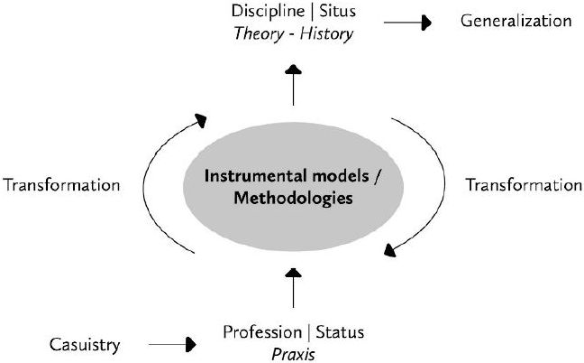
The systematization and methodological abstraction of the projectual design thinking process connects the casuistry of professional praxis with the necessary generalization that allows the construction of a theory that strengthens the discipline (Figure 2). The methodological knowledge gen- erated by research through design strengthens the discipline’s situs and contributes to a better delimitation of its status based on a consistent praxis and permanent development.
Figure 2: Strengthening of the design discipline through the creation of instrumental models or methodologies (Mollenhauer et al., 2020).
For the design discipline, communicating the contribution of projectual design thinking has always been a challenge (Mollenhauer et al., 2020). The objective of this article is to make visible the way in which applied research is approached and the relevance of the methodological knowledge generation process to interdisciplinary research. With this, it is intended to contribute to the enhancement of the design value for the discipline itself and for applied interdisciplinary research in complex contexts.
COMPLEX CONTEXTS: AN OPPORTUNITY TO APPLY SYSTEMIC PROJECTUAL DESIGN THINKING The complexity of the situations that are addressed with projective logic has escalated exponentially. We no longer find ourselves with limited problems, where there is only one solution. The design practice and research, addresses diverse problems, in different scenarios and involving a multiplicity of people and organizations. These situations are inherently indeterminate (Rittel, 1967 cited in Buchanan, 1992, p. 15), however they can be categorized according to the clarity of the direction towards a preferable scenario (Simon, 1969) to be reached with a proposal. Scott Page (2009) uses the metaphor of landscapes to exemplify this; single-peaked landscapes are those of a clear summit, where the preferable situation to aim at with a solution is evident. Rugged landscapes are those of several peaks, where the highest one amongst them is not self-evident and it is essential to get as close as possible and explore some of them in order to decide which is the best one. Finally, and referring to those landscapes of greater indeterminacy, are those in constant movement, like the waves of the sea. In these, the preferable situation changes permanently, therefore time becomes one of the most important factors when dealing with them, since what is preferable is constantly mutating.
Understanding their complexity, the way to approach these contexts should be from a systemic perspective, analysing the multiple variables that affect them where interdisciplinary collaboration proposes results that achieve preferable (Simon, 1969), sustainable and equitable outcomes. As early as 1992, Richard Buchanan argued that design tends to be integra- tive, and that “no single definition of design, or branches of professionalized practice such as industrial or graphic design, adequately covers the diver- sity of ideas and methods gathered together under the label. Indeed, the variety of research reported in conference papers, journal articles, and books suggests that design continues to expand in its meanings and connections, revealing unexpected dimensions in practice as well as understanding” (p. 5). This requires constant discussion and development of knowledge about the inherent workings of design in complex and constantly moving ecosystems, where solutions must be systemic and have the same potential for mutation and evolution as the context itself.
In this regard, design has been acquiring a new role in recent years, and there has been extensive discussion on design methodologies and how they can be adopted by other disciplines, as well as the new position of design- ers in an increasingly collaborative work ecosystem “When design thinking emerged more than a decade ago, it offered a response to the ebbs and flows of a global, mediatized economy of signs and artifacts; in this context, pro- fessional designers play increasingly important roles, less as makers of forms and more as cultural intermediaries (Julier, 2008) or as the “glue” in mul- tidisciplinary teams (Kelley and VanPatter, 2005)” (Kimbell, 2011, p. 287) Among these new discussions around design as a discipline evolving from the world of crafts to a segmented professionalization (Buchanan, 1992), new approaches emerge, especially oriented to address complex problems and work cooperatively with other disciplines. Muratovksi (2016) approaches transdiscipline as an enhanced vision, where design transcends its own norms and adapts to new ways of working:
Logical Design Matrix (LDM): How to Operationalize Systemic Projectual Design Thinking 249 “This is a case when designers have achieved a sufficient level of knowledge to enable them to work across disciplines in new and innovative ways. This approach is most suitable for working on complex problems for which no single discipline possesses the necessary methods on its own to form or resolve them. Working in this way requires an extensive amount of knowledge of research methods and methodologies and many years of experience. Designers capable of working in a transdisciplinary mode will be able not only to work in cross-transdisciplinary teams, but also to lead them” (Muratovski, 2016, p. 20).
Systemic design, as one of those nascent approaches within the evolution of the discipline, unveils three clear guidelines; i) systemic thinking as a problem- solving approach capable of taking on more complex problems, ii) as a space where designers can assume a holistic vision, and iii) as a way to incorpo- rate different visions (da Costa, Diehl & Snelders, 2019). Thus, systemic design stands as a suitable approach to address moving landscapes, where the designer assumes a role of orchestra conductor within a multidisciplinary group, playing a strategic role in precipitating innovations that can transform these landscapes (Hunt, 2012). This paradigm also contemplates the inclu- sion of perspectives of both the team and the stakeholders, transforming the intervention into something co-created and leaving aside the more tradition- ally passive role of users and stakeholders (De Smedt & Borch, 2022). This is especially relevant under the view of systems design, which considers design as a social process that happens in the interaction between different contexts, variables and stakeholders, and therefore collaboration is required “among those who design systems, those affected by the designed systems, and those invested in the outcome of the system but who are not directly served by the outcome” (da Costa, Diehl & Snelders, 2019, p. 12).
Birger Sevaldson, exponent of systemic design, in his most recent book, states that one of the major challenges of contemporary design is to work with problem of problems, making it necessary “to develop efficient design tech- niques, skills and competencies that enable the designers to bypass his or her inherent object orientation and cope with multiple interlinked issues simul- taneously” (2022, p. 84). Therefore, on the one hand, the systemic design approach establishes methodological frames (Kees Dorst, 2011) that are rel- evant to determine the conceptual paths of action to be taken to reach one of the possible solution peaks. Identifying the critical elements of the problem and reducing uncertainty about the adoption of the solution by users. On the other hand, complex contexts provide the opportunity for design, to generate models and methods that allow it to lead the internal and external articu- lation of the project. Articulating members of a multidisciplinary team to the definition of an interdisciplinary solution, and in the case of stakeholder participation towards a transdisciplinary solution.
Now the opportunity lies in having methods to build a “general work- ing principle - for a team, that defines the value to be transmitted to users” (Culagovski and Del Rio, 2022). In this respect, the difference between multi or interdisciplinary and transdisciplinary lies not only in the fact that teams are made up of people from different disciplines, or that there is a trans- fer of knowledge between them. The difference resides in the creation of “a unity of intellectual frameworks beyond disciplinary perspectives” (Jense- nius, 2016 cited in Groth et al., 2020, p. 329), challenging the boundaries of knowledge between researchers and research subjects, integrating them
not only as objects of analysis, but also as active subjects of the research process itself. Therefore, having a methodological framework that structures projectual design thinking when we refer to transdisciplinary development processes is even more relevant. The model to be presented below acts as a backbone, which “opens up the possibility and the freedom for practices from different fields/backgrounds to be mixed and cross-linked in an open ‘practice dialogue”’ (Dorst, 2018, p. 64).
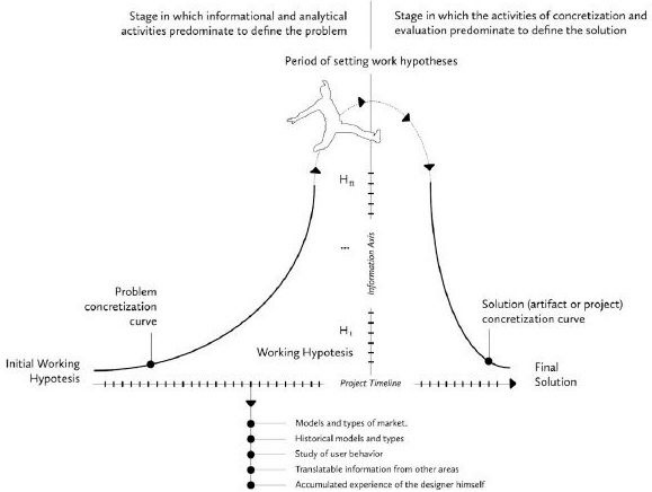
THE DESIGNER’S “SOMERSAULT WITHOUT A NET”: AN ILLUSION OF ONE FOR THE OTHERS There have been several authors who have studied the design process and methods that make it possible to generate knowledge for research-informed design decision-making. Cross (1993) indicates that it was at the Conference on Design Methods, held in London in 1962, where the foundational mile- stone of design as a field of research was marked. But it was in 1999, when Josep Maria Martí published his book Introduction to Design Methodology where he exposes a model that explains the projective thinking of the design and how it addresses the complexities from a systemic perspective (see Figure 3). In this model, Martí refers to the moment of maximum uncer- tainty where the designer must take a “somersault without a net in the circus of the project” (1999, p. 124). Martí explains how a designer moves from the informative and analytical stage of the variables that make up the work- ing hypothesis to the stage of concretization and evaluation of the solution options. In the first stage, as time goes by, the information is increasing and the number of working hypotheses in this period can become infinite. In the second stage, the designer must specify the proposed solution within a time horizon that is finite, since it is determined by the constraints of the brief.
Figure 3: Marti’s “somersault without a net” interpretation (based in Martí, 1999).
Logical Design Matrix (LDM): How to Operationalize Systemic Projectual Design Thinking 251
When the design process takes place among designers, this “leap without a net” is clear and understandable, since they make use of their technical knowledge, conditioning factors and intuition in the choice of the working hypothesis and design path to follow (Martí, 1999). However, in the eyes of a multidisciplinary team, this creative leap true to design is “a moment hidden from the gaze and evaluation of others” (Martí, 1999). Therefore, the practice of design in the creation of knowledge has long been questioned, undervalued and sometimes discredited. Yet, the truth is that this somersault is “a process that occurs within another process” (Martí, 1999, p. 124) hence, understandable if seen. Complementing Martí’s theory, perhaps the “net”has always been there, but invisible. In recent years, it has been the paradigm shifts in interdisciplinary and transdisciplinary work that have triggered the need to systematize and visibilize this net, which we will call the Logical Design Matrix (LDM).
APPLICATION OF THE LDM IN TWO INTERDISCIPLINARY APPLIED RESEARCH PROJECTS Gjoko Muratovsky, says that “applied research is a methodology that enables practitioners to reflect on and evaluate their own work in order to find prac- tical solutions for the problems that they are working on” (2022, p. 242). “This type of research may be solely described in text (...) but artifacts may be included in order to better exemplify the practice in question if that is deemed necessary or appropriate” (Muratovsky, 2022, p. 244). Therefore, to understand how LDM works, two cases are presented:
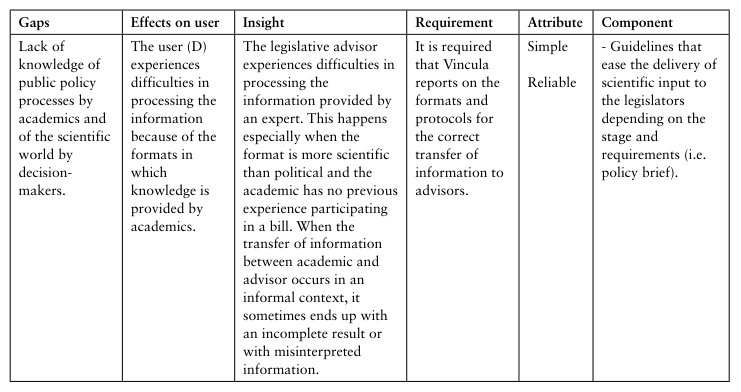
Case 1: The Vincula System is a meeting and linkage space between knowl- edge producers and legislative decision makers (vincula.cl). Its objective is to promote the participation of researchers and academics in the process of law formation, contributing to more and better evidence informing the legislative process, proposing a secure and efficient contact mechanism between both types of users. It also contemplates a training system for users of the platform and a public registry of the contributions made by those who participate in law making commissions. In addition to design researchers, researchers from the fields of political science, commercial and industrial engineering, com- puter science and biological sciences participated in the development of this project (Tables 1 and 2).
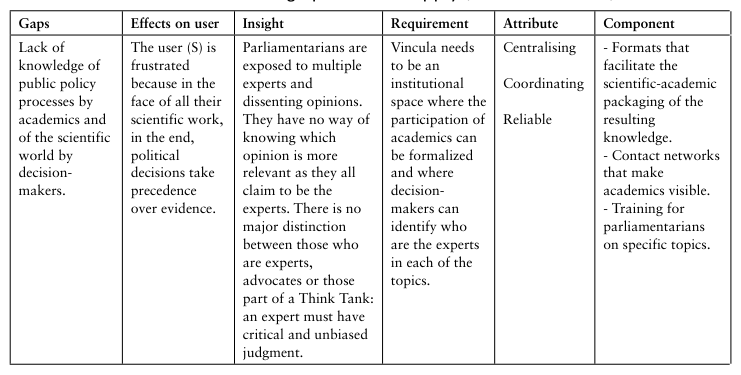
From a systemic perspective, the problem definition stage included the con- struction of an actor’s map and their characterization, composed mainly of knowledge producers - the “supply” of the System- and decision makers - the “demand” of the System-. The LDM articulated the diagnosis with the proposed solution, enabling reasoned and traceable design decisions. As an example, a row showing one gap and subsequent variables of the LDM is detailed below for each type of stakeholder.
Table 1. LDM extract for knowledge producers/supply (own elaboration).Table 2. LDM extract for decision makers/demand (own elaboration).
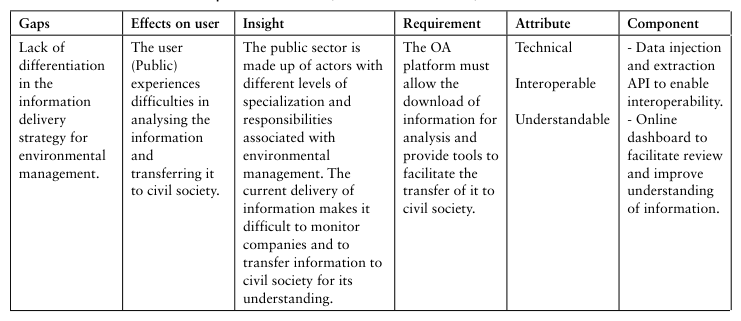
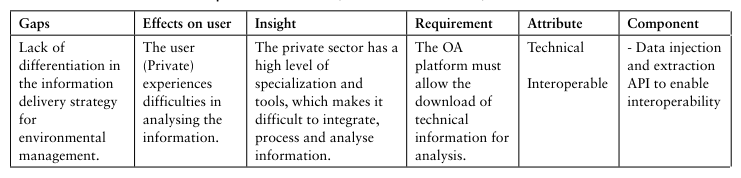
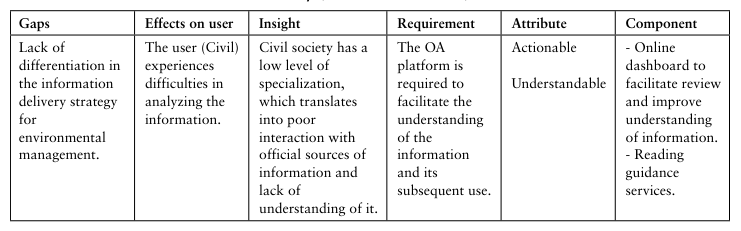
Case 2: The Mining Projects Environmental Observatory is a public access platform that integrates accurate, reliable and quality environmental management information on the mining industry in Chile (observatorioambientaluc.cl). Its objective is to improve access to information for resilient community action that responds to environmental crisis contexts and avoids the generation of conflicts. In addition to the design research team, researchers from geography, urban studies, engineering and computer science participated in the development of this project (Tables 3, 4 and 5).
The platform is built with and for an information ecology (Nardi & O’Day, 1999) composed by different actors from the public sector, the mining indus- try and civil society. In the initial stage of the project, a needfinding process was carried out to define the problem, which made it possible to identify: i) the motivations for the use of environmental management information, ii) the levels of specialization and capabilities, iii) the levels of action in the environmental management process, iv) the opportunities for using the OA
Logical Design Matrix (LDM): How to Operationalize Systemic Projectual Design Thinking 253
platform and iv) the requirements for understanding and using environmental management information of each type of actor according to the role they play within their territories. From a systemic perspective, for each of the dimen- sions of the problem (public sector, private sector and civil society), the data collected was analyzed. Using the LDM, the following were determined: i) the gaps, ii) the effects on the user and iii) the insights. Then, iv) the require- ments, v) the attributes and vi) the components that allowed articulating the system-solution were defined.
Table 3. LDM extract for public sector (own elaboration).Table 4. LDM extract for private sector (own elaboration).Table 5. LDM extract for civil society (own elaboration).
CONTRIBUTIONS OF THE LDM TO INTERDISCIPLINARY APPLIED RESEARCH PROJECTS The LDM made it possible to address the complexities associated with the projects Sistema Vincula (SV) and the Environmental Observatory for Mining Projects (OA), both in terms of the internal organization of the multidisci- plinary team and the design of the response. The Matrix allowed, in the case of Vincula, to identify the gaps associated with the functioning of the legislative world and access to academic information, mediated by the inter- action of knowledge producers and decision makers, and in the case of the Observatory, to identify gaps associated with access to environmental impact information and interaction between actors in relation to mining environ- mental management. These gaps are directly related, in the first case, to participation in the process of law formation, and in the second, to environ- mental management, which, from a systemic perspective, should be addressed from a projective design thinking perspective. Likewise, the LDM made it possible to understand how these gaps translate into levels of participation of each type of actor within their ecosystems and in the potential use of the solution or platform. Understanding and systematizing the effects of these gaps made it possible to establish attributes of the VS and the OA that guided the materialization of the system or platform guaranteeing the coherence and relevance of the development of the project and the proposed solution. Fur- thermore, the Matrix allowed proposing components and functionalities of the system or platform that took care of the attributes established by the research team to generate fit with each type of stakeholder and respond to their specific needs. Finally, in addition to materializing the design thinking and guiding the creation of the solution, the Matrix laid the foundations for the research team’s work plan and established a methodological route that could be consulted at any time during the development of the project, in order to ensure the relevance and coherence of the process in the context in which it is inserted.
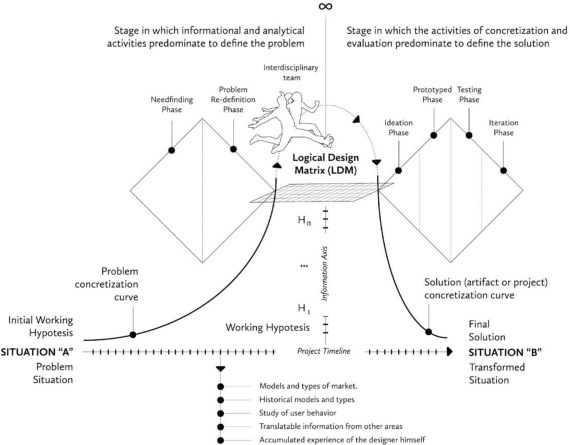
The Logical Design Matrix (LDM): The Somersault Is Always Netted The LDM is a resistant weft that supports any doubt, questioning or scrutiny towards design decision making that occurs in a research process. This “net” is a weave that - in complex contexts and from a systemic design perspective - allows for the definition of the problem and coherently the definition of the components of the solution that respond to it, giving con- sistency and order to the working hypothesis. These phases of the design process have been modeled by the Double Diamond of the Design Council (2007). The LDM, as an instrumental model, connects the phases of informa- tion gathering and analysis of the context or environment where the design project is located with the phases of concretion and materialization of the solution. In this way, the definition of the design problem is coherently con- nected with the proposed solution. The LDM is constituted in the mesh that supports the somersault of the design but also of the whole multidis- ciplinary team (Figure 4). While the LDM is not a guarantee of a successful
Logical Design Matrix (LDM): How to Operationalize Systemic Projectual Design Thinking 255 solution at least it decreases the uncertainty about the adoption of the solu- tion since for the users and stakeholders involved, the solution is logical (LIP, 2017).
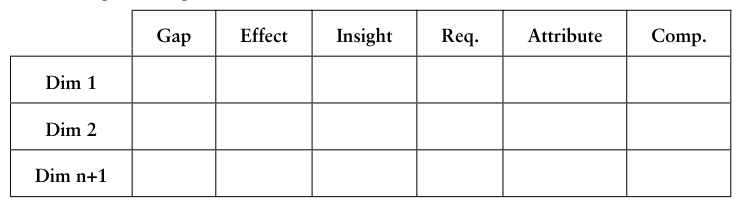
To this purpose, the MLD is composed of the following variables. First, on the system complexity axis, each dimension (D) that composes the “prob- lem of problems” is determined (Sevaldson, 2022). Second, on the projectual design thinking variables axis, we determine: i) one or more Gaps that are identified during the needfinding for each dimension, ii) one or more Effects on the user of these identified gaps, and iii) the findings or Insights that pro- vide evidence of the effects of the identified gaps. From these, the following are determined: iv) the Requirements that the solution must satisfy, accord- ing to the identified gap, v) the Attributes as characteristics of the solution according to the needs, wishes and expectations of the users, and vi) the Components consistent with the system-solution for the identified problem (Table 6).
Table 6. Logical design matrix (LDM) model (own elaboration).
Overall, from the study of these two case studies of applied research projects, it is possible to observe that the use of MLD enabled:
The “somersault with net” for multidisciplinary teams, providing conti- nuity to the research process from projective design thinking.
Synthesizing the results of the information gathering in such a way that it would be understandable to all team members regardless of their discipline of origin.
Coherently connecting the problem definition phase with the decision- making phase regarding the possible solutions to the problem at hand.
Closing the first diamond of the design process by identifying each problem, determining each effect on the user, and recording each insight.
Opening the second diamond by defining each requirement, attribute and component that the system-solution should consider.
The coherence validation of the proposed solution with the users’ needs.
The methodological contribution of the LDM can be summarized in: i) the traceability of design-oriented decision making within the project itself, ii) the organization of the multidisciplinary team when delivering an integral solu- tion within complex contexts and iii) the communication of the process and validation of the result to the multidisciplinary team, the users, the client and stakeholders.
Figure 4: Projectual design thinking model and the logical design matrix, provider of support for the interdisciplinary team’s somersault. (Own elaboration based in Martí (1999), Design Council (2007) and Mollenhauer et al. (2020).)
Finally, it is possible to provide an instrumental model that materializes and makes projective design thinking visible, allowing: i) the recognition of the practice by designers, ii) the valuation of the design practice by interdis- ciplinary teams operating in complex contexts, and ii) the strengthening of the discipline’s learning contexts in design schools.
REFERENCES
Bentz, I. M. and Franzato, C. (2017) “The relationship between strategic design and Metadesign as defined by the levels of knowledge of Design,” Strategic Design Research Journal, 10(2). Available at: https://doi.org/10.4013/sdrj.2017.102.06. Buchanan, R. (1992). Wicked Problems in Design Thinking. Design Issues, 8(2),
5–21. https://doi.org/10.2307/1511637 Cross, N. (1993). “A history of design methodology”. En: M. J. de Vries, N. Cross y D. P. Grant (eds.), Design methodology and relationships with science. Dordrecht: Springer, pp. 15–27. https://www.springer.com/la/book/9780792321910 Culagovski R., & Del Rio, C. (2022). Design as a Driver for Multidisciplinary Teams:
An Applied Research Case in El Quisco, Chile. https://www.diid.it/diid/index.php /diid/article/view/diid76-culagovski-rubio-del-rio-alemparte Da Costa Junior, J., Diehl, J. C. and Snelders, D. (2019) “A framework for a systems design approach to complex societal problems,” Design Science. Cambridge University Press, 5, p. e2. doi: 10.1017/dsj.2018.16. De Smedt, P., & Borch, K. (2022). Participatory policy design in system innovation.
Policy Design and Practice, 5(1), 51–65. https://doi.org/10.1080/25741292.2021. 1887592 Design Council. (2012). Design Council, “Eleven lessons: Managing design in eleven global companies-desk research report”, Design Council, 2007. Dorst, K. (2011). The core of ‘design thinking’ and its application. Design Studies,
Logical Design Matrix (LDM): How to Operationalize Systemic Projectual Design Thinking 257
Dorst, K. (2018) “Mixing practices to create transdisciplinary innovation: A designbased approach,” Technology Innovation Management Review, 8(8), pp. 60–65. Available at: https://doi.org/10.22215/timreview/1179. Findeli, A., Brouillet, D., Martin, S., Moineau, C. (2008) ’Research through design
and transdisciplinarity: a tentative contribution to the methodology of design research’. In Swiss Design Network, FOCUSED: current design research projects and methods. Berna: Swiss Design Network, pp. 67–91. Findeli, A. and Coste, A. (2007). “De la recherche-création à la recherche-project: un cadre théorique et méthodologique pour la recherche architecturale”. Lieux communs, 10: 139–161. Frayling, C. (1993). “Research in art and design”. Royal College of Art Research
Papers, 1 (1): 1–5. Frayling, C. (2015). RTD 2015. Provocation by Sir Christopher Frayling. Part 1: research through design evolution. Consultado en: https://vimeo.com/129775325 Groth, C. et al. (2020) “Conditions for experiential knowledge exchange in col-
laborative research across the sciences and creative practice,” CoDesign, 16(4), pp. 328–344. Available at: https://doi.org/10.1080/15710882.2020.1821713. Hunt, J. (2012). Letter from the Editor. The Journal of Design Strategies: Transdisciplinary Design. Vol. 5 (1) 5–10 Kimbell, L. (2011). Rethinking Design Thinking: Part I. Design and Culture, 3(3),
285–306. https://doi.org/10.2752/175470811X13071166525216 Laboratorio de Innovación Pública. (2017). La Co-producción del usuario usuario en los servicios públicos. Documento de Trabajo N
1. Pontificia Universidad Católica de Chile. https://www.lipuc.cl/publicaciones/coproduccion López-León, R., Macias, E. (2020) Enhancing design strategy through visual map-
ping: the strategy map. J. Design Research, Vol.18, Nos. 1/2, 2020. Martí Font, J. M. (1999) Introduccio’ a la Metodologia del Disseny. Barcelona: Edicions de la Universitat de Barcelona. Mollenhauer, K., Moraga, E. y Bernasconi, R. (2020). “Modelo instrumental para
proyectos complejos. Poliedro Propuesta de Valor Académico”. Bitácora Urbano Territorial, 30 (II): 127–140. 10.15446/bitacora.v30n2.81661 Muratovski, G. (2016) Research for designers. A guide to methods and Practice.
London: SAGE Publications. Nardi, B. A., & O’Day, V. L. (1999). Information ecologies: using technology with heart. Cambridge, MA: MIT Press. Observatorio Ambiental de Proyectos Mineros (2023). Sitio Web del Observatorio
Ambiental UC. Recuperado el 8 de abril de 2023, de observatorioambientaluc.cl Page, S. E. (2009) Understanding complexity: Course Guidebook. Chantilly, Virginia: Teaching Company. Sevaldson, B. (2022) Designing complexity the methodology and practice of Systems
Oriented Design. Champaign, IL: Common Ground Research Networks. Simon, H. A. (1969). The sciences of the artificial. The MIT Press. Van De Weijer, M.; Van Cleempoel, K.; Heynen, H. (2014). “Positioning research and design in academia and practice: a contribution to a continuing debate”. Design Issues, 30 (2): 17–29. https://doi.org/10.1162/DESI_a_00259 Vincula. (2022). Sitio Web de Vincula. Recuperado el 8 de abril de 2023, de
vincula.cl.
LISTED IN THE AHFE DIGITAL BOOKSTORE CATALOGUE
Explore the complete digital volume
Human Systems Engineering and Design (IHSED 2023): Future Trends and Applications
Read this individual research paper free through the original publisher, or explore the full digital proceedings book.
ISBN 978-1-958651-88-9
Explore this ISBN in the AHFE Bookstore ↗Listed in the July 2026 bookstore catalogue; search by ISBN to confirm current availability · Digital book purchase optional