Satu Jumisko Pyykko, Jukka Pulkkinen (2025). Opportunities of Systems Intelligence in Systemic Design. In: Human Factors, Business Management and Society. AHFE Open Access, vol. 176, pp. 34–45. https://doi.org/10.54941/ahfe1006301
To tackle complex and wicked problems, systemic approaches are needed. Systems Intelligence (SI) takes behavioral, interactional and bottom-up perspectives on systems. Systemic design aims to design desired futures to solve complex and interconnected problems. As a process, it consists of framing the system, sensemaking and analysis, reframing, codesigning, and roadmapping (Jones & Van Ael, 2022). The goal of this paper is to demonstrate how SI can be applied in systemic design. As an outcome, we propose a three-part model that combines these systemic approaches in design principles, methodology, and evaluation. This paper contributes a new theoretical model to the field of systemic design.
Nowadays, the world is increasingly facing complex and wicked problems in our continuously changing environment. As a means of responding to the needs of solving complex problems, systemic design has been introduced during the last decades to combine design thinking, systems thinking, and practices. In systemic design, systems and change are co-constructed. This requires effective and goal-oriented collaboration and cooperation between the heterogeneous groups of stakeholders. There is a need to establish a shared understanding of systemic design, enhance professionals’ expertise in its practical implementation, and foster effective cooperation and collaboration in complex engagement situations (Jones, 2018).
Systemic design is about practice that integrates dialogue in co-creation for sensemaking and decision-making (Jones, 2018). Among its many approaches, it might be called systems (oriented) design, systems-led design, systems-aware codesign, design for complexity, or system(s/ic) innovation (Blomkamp, 2021). Considering the emerging and pluralistic practice of systemic design, various design principles and methodologies have been proposed to support designers’ work (Ryan, 2014).
Systems Intelligence (SI) is a human-centered approach to human systems, emphazising active, behavioral, and interactional perspectives (Saarinen & Hämäläinen, 2004). Most of the previous SI research has focused on theory and evaluation, with few exceptions in human-centered design. For example, promising correlations have been reported between SI as a capability and
Opportunities of Systems Intelligence in Systemic Design 35
emotional intelligence, organizational learning, and well-being (see, e.g., Kautiala & Jumisko-Pyykkö, 2024). Furthermore, the existence of SI in human-technology interaction design and outcomes has been demonstrated (Toivonen & Jumisko-Pyykkö, 2024). However, previous research has not explored the possibility of combining SI and systemic design to be able to support practitioners’ work.
This paper aims to explore opportunities for combining SI and systemic design. We approach this from the viewpoints of design principles, methodology, and evaluation in this theoretical paper.
SYSTEMIC DESIGN Design Principles
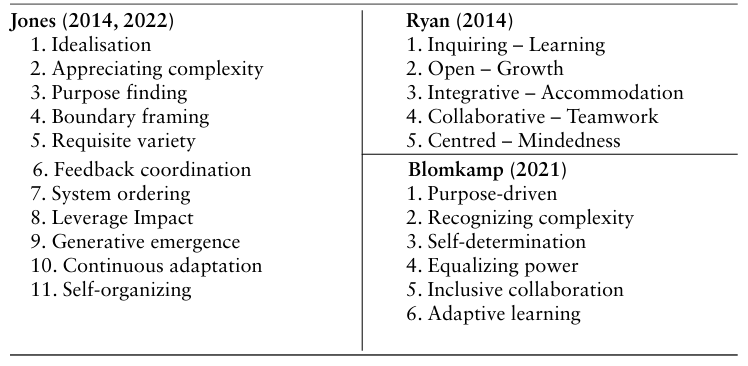
A design principle is a rule derived from experience that provides guidance for the design process to increase the likelihood of reaching a successful solution (Fu et al., 2016). Principles are generally applicable, effective, and specific to the context or problem, but they can be utilized across similar design contexts (Van der Bijl-Brouwer & Malcom, 2020). They can also be seen as a mindset that describes a set of values and habits to guide the systemic design process (Ryan, 2014). Principles serve as the foundation for understanding, selecting, and applying methodologies and methods (Fu et al., 2016; Ryan et al., 2014). Table 1 summarizes the design principles reported in previous research across various systemic design fields, including social, innovation, and policymaking.
Table 1: Systemic design principles.
Design Principles Van der Bijl-Brouwer and Malcom (2020)
1. Opening up and acknowledging the interrelatedness of problems 2. Developing empathy with the system 3. Strengthening human relationships to enable creativity and learning 4. Influencing mental models to enable change 5. Adopting an evolutionary design approach to desired systemic change Jones (2014, 2022)
36 Jumisko-Pyykkö and Pulkkinen
Six design principles were synthesized based on previous research (Table 1) using content analysis: 1) Awareness of the system. Appreciating the complexity of systems (interdependence, connections, feedback, and emergence) enables us to open the system, understand it, and frame it to identify/determine the scope of interest within the system. 2) Toward purpose. Finding the aim and drivers to facilitate the action toward the desired future. 3) Empathy and dialogue with the system. Inclusive collaboration among different actors to encompass a diversity of perspectives and experiences, act creatively in the face of tensions, and foster shared ownership. 4) Human relationships. A relationship-centered approach, targeting and strengthening relationships to achieve systemic change. 5) Systemic change. Constructing change through multiple small trials, influencing mental models to facilitate change, and targeting impactful leverage points. 6) Continuous adaptation. Reflective actions, adaptive learning, continuous feedback, and actions that accelerate self-organizing behaviors.
Design Methodologies In systemic design, a methodology refers to a logic for selecting and combining a set of methods used to understand a complex and wicked problem and create a roadmap to change (Ryan, 2014). The systemic design methodologies combine both systems thinking methods to understand complex problem situations independently of solutions and design approaches to create solutions without understanding all related factors (Jones, 2014). The systemic design aims to understand a phenomenon within the context of the larger whole, and the methods need to be selected in the way that the thing to be explained is treated as part of a containing whole (VanPatter & Pastor, 2016).
Jones & Van Ael (2022) have presented systemic design methodology as a Systemic Design Toolkit, which consists of Framing, sensemaking and Analysis, Reframing, Codesign, and Roadmapping. Framing aims to reach a common understanding of an issue, its scope, and the systems involved through collaboration with a wide range of team members. The outcome of the phase is the defined system with boundaries based on the shared insight of an issue. Sensemaking and Analysis aim to understand the meaningful patterns of the defined existing system by reviewing the results of workshops, canvases, collected data, and other data sources. Understanding the multiple perspectives of the issue, the stakeholders’ roles and their relationships through a collaborative approach is the primary outcome of this phase. Reframing aims to define the purpose of the new system by understanding the opportunities and challenges that arise from the earlier phases. The outcome is the value proposition to which stakeholders are committed, which is created by complementing the team with external experts as needed. Codesign aims to build a shared narrative for the change programs to achieve an impact by exploring possible future contexts. The outcome is a strategy and organizational approach that is achieved through productive teamwork, resulting in tangible decisions and validation of the models within the context of stakeholders. Roadmapping aims to build the future vision and directions by listening to stakeholders’ future outcome priorities. The outcome is organizational change, governance, actions, and the phasing of the change
Opportunities of Systems Intelligence in Systemic Design 37
process over time, which are created through time-framed scenarios to reach the vision.
SYSTEMS INTELLIGENCE Systems Intelligence (SI) was originally introduced and defined by Saarinen and Hämäläinen (2004): “[…] intelligent behavior in the context of complex systems involving interaction and feedback. A subject acting with Systems Intelligence engages successfully and productively with the holistic feedback mechanisms of her environment. She perceives herself as a part of a whole, the influence of the whole upon herself, as well as her own influence upon the whole. By observing her own interdependence in the feedback intensive environment, she is able to act intelligently.” SI has multidisciplinary roots and has been applied in various arenas, including psychotherapy, communication, leadership, education, and design (overview, Jumisko-Pyykkö et al., 2021).
There are five main principles associated with SI. 1) SI is a rich capacity in human beings or competence. Parallel to cognitive, emotional, or social human capabilities, it involves instinctual, intuitive, tacit, subconscious, and unconscious aspects (Saarinen & Hämäläinen, 2004). 2) SI is contextual intelligence (Hämäläinen & Saarinen, 2004; Kautiala & Jumisko-Pyykkö, 2024; Toivonen & Jumisko-Pyykkö, 2024). It takes place in real-time and within complex, interconnected, and changing structures, situations, and environments where human agents tune into, react to, and influence one another, also beyond the visible (Hämäläinen & Saarinen, 2007). 3) SI is about pragmatic and outcome-oriented intelligence in action (Saarinen & Hämäläinen, 2004). In addition to measurable and easily visible outcomes, it can create less perceivable outcomes such as hope, excitement, trust, and openness. These can contribute to systemic change that intelligence in action is a part of. 4) SI is part of systems which are seen and lived from within (Saarinen & Hämäläinen, 2004). It is about seeing oneself within a system. The insider view makes a difference to externalist and objectifying systems thinking approaches (Hämäläinen & Saarinen, 2007). 5) SI has an optimistic approach to change (Hämäläinen & Saarinen, 2007). Small changes in a system can lead to positive upward spirals toward flourishment (Saarinen & Hämäläinen, 2004). Optimism is the ability to connect with the human environment and other people in modes that generate growth.
SI is composed of several factors of intelligent capability, and it is measurable. Table 1 summarizes definitions of SI factors and gives examples of related Organizational Systems Intelligence (OSI) survey statements (Törmänen et al., 2022). Perceptual aspects of SI are covered by the factors called systemic perception and attunement (Törmänen, 2021). Systemic perception as a form of broadened vision involves observing and recognizing systems as a whole along with their behavioral patterns (Hämäläinen et al., 2018, 2019). It is about connections within and between systems, awareness of surrounding situations, and keeping both the whole and the details in mind. Attunement concentrates on tuning into the social situation of the system. High attunement reflects openness, presence,
38 Jumisko-Pyykkö and Pulkkinen
mindfulness, and situational sensitivity in both nonverbal and verbal communication.
The attitudinal aspect of SI is composed of a positive attitude and spirited discovery (Törmänen, 2021). A positive attitude is about maintaining a positive outlook toward the future and the environment. It is one’s openness when approaching other people, situations, and systems, and it has resilience to balance with negativity. Spirited discovery is about openness toward new ideas and change. Creativity, trying new things, finding new solutions, and playing with ideas are key elements in spirited discovery.
Table 2: SI factors, their definitions and examples of statements from the OSI survey (Hämäläinen et al., 2014; Hämäläinen et al., 2019; Törmänen et al., 2022).
Table available in the original PDF paper.
SI Factor Definition and Example Systemic perception (P) Seeing, identifying, and recognizing systems,
patterns, and interconnections having situational awareness. -- people form a rich overall picture of situations Attunement (P) Engaging intersubjectivity, being present, mindful, situationally sensitive, and open. --people take into account what others think of the situation
Positive attitude (At) Keeping a positive outlook and not getting stuck on negative impressions and effects. -- people have a positive outlook on the future
Spirited discovery (At) Engaging with new ideas, embracing change.
-- people like to play with new ideas Reflection (T) Reflecting upon one’s thinking and actions, challenging one’s own behavior. -- people view things from many different perspectives
Wise action (T) Exercising long-term thinking and realizing its implications, understanding that consequences may take time to develop. -- people take into account that achieving good results can take time
Positive engagement (Ac) Taking systemic leverage points and means successfully into action with people. --people actively contribute to the shared atmosphere
Effective responsiveness (Ac) Taking systemic leverage points and means successfully into action with the environment, being able to dance with the system. -- people prepare themselves for situations to make things work
Equation reproduced from the original PDF.
Opportunities of Systems Intelligence in Systemic Design 39
Thinking as an aspect of SI is summarized as reflection and wise action (Törmänen, 2021). Reflection focuses on the awareness of one’s thinking and actions, encompassing many different perspectives, drivers, and consequences. These can lead to striving for change and growth. Wise action is about long-term comprehensive development. Changes require time, effort, and deep reflection and can be nurtured and constructed in collaboration with others to summarize wise action.
The action aspect of SI is composed of positive engagement and effective responsiveness (Törmänen, 2021). They both take systemic leverage points and means and successfully put those into action. Positive engagement is about constructing social situations that support the common goal, emotional intelligence, and positive social interaction. It is about contributing to a shared atmosphere, seeing other’s achievements, and bringing out the best in others. Effective responsiveness focuses on action within the environment and complies with the purpose and understanding of the goal. It is reflected in achieving results, prioritizing, tackling difficult challenges, and overcoming them.
Surveys to evaluate SI and its factors on both individual and organizational levels have been developed (Törmänen et al., 2016; Törmänen et al., 2022). The surveys have also been adapted to team and peer evaluation (Jumisko- Pyykkö et al., 2025; Törmänen, 2021). Previous research has reported a positive correlation between SI and emotional intelligence, teamwork efficiency, organizational learning, well-being, and perceived performance (Törmänen et al., 2016; Törmänen et al., 2022; Jumisko-Pyykkö et al., 2022; Juvonen & Jumisko-Pyykkö, 2025). For example, in top-performing organizations, the level of SI is significantly higher than in lower-performing organizations (Törmänen et al., 2022).
Few recent studies have examined SI in a design context. Based on a systematic literature review, a framework for SI design solutions supporting the teamwork of interdependent teams was constructed (Toivonen & Jumisko-Pyykkö, 2024). The framework extends the current eight SI factors with context-specific aspects. The review also showed that SI factors have been utilized in all main phases of the design process. Jumisko-Pyykkö et al. (2021) presented and partly validated 32 SI tactics for empathic design. Tactics refer to a planned approach, action, method, or technique for achieving a particular result covering actionable and design-relevant aspects from principles to methodologies and methods. Although both studies are promising in showing the relevance of SI in a design context, they do not directly address systemic design.
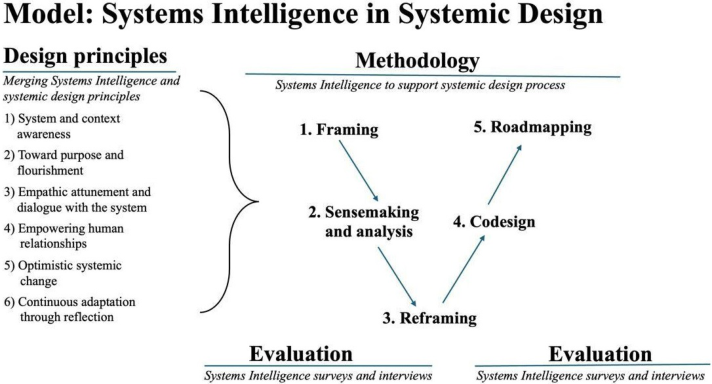
MODEL: SYSTEMS INTELLIGENCE IN SYSTEMIC DESIGN Systems Intelligence in systemic design is a model that merges design principles, evaluation methods, and methodologies into a unified framework. In this theoretical synthesis, systemic design principles and methodology serve as a foundation, and aspects of SI complement them.
40 Jumisko-Pyykkö and Pulkkinen
Figure 1: Model: systems intelligence in systemic design with three parts - design principles, methodology, and evaluation.
Design Principles The model consists of six systemic design principles combining both aspects of SI and systemic design principles. Their role is to guide the design process and methodologies in achieving desired futures with the system.
1) System and context awareness. Appreciating the complexity of systems (interdependence, connections, feedback, and emergence) and opening the system to understand it, being aware of its contextual, situational, or dynamic nature, including the phenomenon that surrounds the system and its changing structures, situations, and environments (Systemic perception). It includes framing the system to find the scope of the system of interest and being able to form a rich overall picture of the system within its context, keeping its details in mind.
2) Toward purpose and flourishment. Finding the aim and drivers to facilitate the action toward the desired future. Supporting a positive attitude, an optimistic outlook on the future, and aiming for human flourishing in action (Positive attitude) while reflecting and paying attention to the drivers of behavior to support fulfilment in life (Reflection).
3) Empathic attunement and dialogue with the system. Inclusive collaboration of different actors to cover the diversity of perspectives and experiences. The system is lived and seen from inside the system compared to an objectifying approach to it. The human aspect is approached from a holistic, personal, and existential perspective (e.g., cognitive, emotional, social human capabilities, instinctual, intuitive, subconscious, unconscious, and tacit aspects). Human-to-human situations are constructed with attunement and positive engagement. Situations engage intersubjectivity and support being present, mindful, situationally sensitive, warm, accepting, and open between people (Attunement). In dialogue with the system, there is a need to act creatively in the face of tensions and to foster shared ownership (Positive engagement).
Opportunities of Systems Intelligence in Systemic Design 41
4) Empowering human relationships. A relationship-centered approach, targeting and strengthening relationships when aiming for systemic change. Consciously empowering relationships through positive engagement, such as taking systemic leverage points and means successfully into action with people (Positive engagement). It builds relationships, e.g., through active contribution to a shared atmosphere, bringing out the best in others, and alleviating tensions under challenging situations.
5) Optimistic systemic change. An optimistic approach to change, in which small changes in a system can lead to positive, upward spirals toward flourishment. Change is constructed through multiple small trials. This requires an active engagement in new ideas, approaches, and experimentation culture (Spirited discovery). Systemic change is about influencing mental models to enable change and aiming at impactful leverage points. It requires effective responsiveness, such as taking systemic leverage points and means successfully into action with the environment and being able to dance with the system (Effective Responsiveness). It is about making things work. Systemic change also requires exercising long-term thinking, realizing its implications, and understanding that consequences may take time to develop (Wise action). Parallel to visible systemic change contributions, it can also create less perceivable outcomes such as hope, respect, and trust, which can further influence systemic change.
6) Continuous adaptation through reflection. Reflection is about thinking and actions and challenging the system’s behavior (Reflection). It requires viewing things from multiple perspectives, thinking about the consequences of actions, and understanding the behavioral drivers. Adaptive learning and continuous feedback call for growth possibilities of the system and actions that accelerate self-organizing behaviors.
Evaluation of Systems Intelligence Systems Intelligence evaluations can be conducted either prior to, during or after the early phase of the systemic design process. Understanding the starting level of SI helps to identify the central development points as capabilities in the system. After the systemic design process, the evaluation indicates the achieved impact and reached capabilities of the system. In order to measure SI, surveys targeted to different systems can be used (e.g., the Systems Intelligence Inventory for individuals, Organizational Systems Intelligence (OSI) for teams or organizations) (Törmänen et al., 2016; Törmänen et al., 2022; Jumisko-Pyykkö et al., 2025). In order to gather the contextual aspects of SI, mixed methods combining surveys and interviews can be used (Kautiala & Jumisko-Pyykkö, 2024).
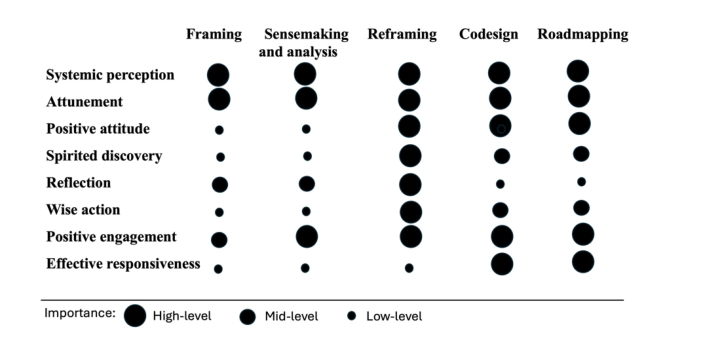
Design Methodology In this paper, design methodology is approached as an iterative process with five main phases: Framing, Sensemaking and Analysis, Reframing, Codesign, and Roadmapping (Jones & Van Ael, 2022). All SI factors are present in all phases of methodology, but their relative emphasis varies depending on the
42 Jumisko-Pyykkö and Pulkkinen
phase (Figure 2). In this section, we open the most important factors per the phase.
Framing aims to reach a common understanding of an issue, scope, and systems, which requires capabilities like seeing, identifying, and recognizing systems and interconnections (System perception). The goal is reached through collaboration with a wide range of team members, which requires capabilities such as being present, mindful, situationally sensitive, and open (Attunement). Additionally, the following competences support our aim: challenging one’s own behavior (Reflection) and taking the system successfully into action with people’s support to reach a common understanding (Positive engagement). Sensemaking and Analysis aim to understand the meaningful patterns of the system based on the multiple perspectives of the issue and stakeholders’ role through a collaborative approach. It requires capabilities like recognizing the systems, patterns, and interconnections (System perception), being present, mindful, situationally sensitive, and open (Attunement), seeing leverage points into action with people (Positive engagement), and the capability to challenge one’s own behavior and reflecting on one’s own thinking (Reflection) supports activities. Reframing aims to define the purpose of the new system, and the outcome is the value proposition to which stakeholders are committed. To reach this requires capabilities like seeing interconnections with situational awareness (System perception), being present, mindful, and situationally sensitive (Attunement), not getting stuck on negative impressions and effects (Positive attitude), engaging with new ideas (Spirited discovery), challenging one’s own behavior (Reflection), exercising long-term thinking, and realizing its implications (Wise action), and taking system leverage points and means successfully into action with people (Positive engagement). Codesign aims to build a shared narrative for the change programs to achieve an impact which is reached through productive teamwork leading to tangible decisions. It requires capabilities like seeing systems patterns and interconnections with situational awareness (System perception), being present, mindful, and situationally sensitive (Attunement), not getting stuck on negative impressions and effects (Positive attitude), taking system leverage points and means successfully into action with people (Positive engagement) and the environment, being able to dance with the system (Effective responsiveness), engaging with new ideas (Spirited discovery), and the capability to understand that consequences may take time to develop (Wise action) support to reach the target. Roadmapping aims to enable organizational change, governance, actions and the phasing of the change process, which requires capabilities like seeing systems patterns and interconnections with situational awareness (System perception), being present, mindful, and situationally sensitive (Attunement), not getting stuck on negative impressions and effects (Positive attitude), taking system leverage points and means successfully into action with people (Positive engagement) and the environment, being able to dance with the system (Effective responsiveness), engaging with new ideas (Spirited discovery) and the capability to understand that consequences may take time to develop (Wise action) support to reach the target.
Opportunities of Systems Intelligence in Systemic Design 43
Figure 2: Importance of systems intelligence factors in systemic design phases.
DISCUSSION AND CONCLUSION The goal of this paper is to demonstrate how SI can be applied in systemic design. We presented a three-part model which combines these systemic approaches in design principles, methodology, and evaluation. Systemic design principles combined both approaches. The methodology highlighted the importance of SI factors in all phases, with varying importance. In evaluation, SI evaluation tools provide new ways to assess the capabilities of the system as a part of its development. Taken together, SI not only extended the existing systemic design approach but also provided qualitative depth to it, offering a tangible framework for systemic designers.
There are three main suggestions for further development of the model proposed. Firstly, the presented model combining SI and systemic design is theoretical. Additional work is needed to validate it in empirical research. Secondly, the model is composed of a continuum from principles and methodology to evaluation. The pragmatic level of systemic design is based on methods which follow methodology. Future research needs to focus on extending the methods to reflect the new combined methodology. Jumisko- Pyykkö et al. (2021) have proposed and validated SI-based design tactics for empathic design, which can be partially useful for adapting the model to the level of methods. Thirdly, the presented model and future methods can renew the systemic designers’ theory and practices. Future work should support these integrations through actionable practices.
To conclude, this paper presents a model combining systemic design with Systems Intelligence. This work responds to the growing need to solve complex and wicked problems in a changing environment. This paper supports professionals’ systemic design expertise with Systems Intelligence when constructing better systems and toward systemic change.
REFERENCES
Blomkamp, E. (2022). Systemic design practice for participatory policymaking.
Policy Design and Practice, 5(1), 12–31.
44 Jumisko-Pyykkö and Pulkkinen
Fu, K. K., Yang, M. C., & Wood, K. L. (2016). Design principles: Literature review, analysis, and future directions. Journal of Mechanical Design, 138(10), 101103. Hämäläinen, R. Jones, R. Saarinen, E. (2014). Being Better Better: Living with
Systems Intelligence. Helsinki: Aalto University Publications. Hämäläinen, R. P, and Saarinen, E. (2007). Systems Intelligence: A Key Competence in Human Action and Organizational Life. In R. P. Hämäläinen and E. Saarinen, eds. Systems Intelligence in Leadership and Everyday Life. Systems Analysis Laboratory, Helsinki University of Technology, Espoo. Hämäläinen, R. P. Saarinen, E. Törmänen, J. (2018) Systems Intelligence: A
Core Competence for Next-Generation Engineers?, Proceedings of 2018 IEEE International Conference on Teaching, Assessment, and Learning for Engineering, Australia. Hämäläinen, R. P., Saarinen, E. and Törmänen, J. (2019). Systems intelligence: A core competence for next-generation engineers? IEEE International Conference on Teaching, Assessment, and Learning for Engineering (TALE), pp. 641–644, doi: 10.1109/TALE.2018.8615247. Jones, P. H. (2014). Systemic design principles for complex social systems. Social
systems and design, 91–128. Jones, P. H. Jones, Peter. (2018). “Contexts of Co-Creation: Designing with System Stakeholders.” In Systemic Design, edited by Peter Jones and Kyoichi Kijima, 8: 3–52. Translational Systems Sciences. Tokyo: Springer Japan. doi: 10.1007/978- 4-431-55639-8_1. Jones, P. H., & Van Ael, K. (2022). Design journeys through complex systems:
Practice tools for systemic design. Amsterdam: Bis Publishers, 2022. Jumisko-Pyykkö, S., Halme, A., Hattingh., G., Kerkola H., Scotcher B., Rapp., A. Rönkä, W., Saarinen, J., Salonen, T., Siipola, V., Toivonen, E., Vanhala, J., Hämäläinen, R. P., Saarinen, E. (2025) Systems Intelligence and Mediated Team Touch via Smart Sleeves in E-sports, The proceedings of International Human Computer Interaction, 2025. Jumisko-Pyykkö, S., Törmänen, J., Vänni, K., Hämäläinen, R. P., & Saarinen,
E. (2022). Systems intelligence, perceived performance and well-being. Human Factors, Business Management and Society, 56, 55. Jumisko-Pyykkö, S., Viita-aho, T., Tiilikainen, E., & Saarinen, E. (2021) Towards Systems Intelligent Approach in Empathic Design. Academic Mindtrek 2021, Finland. https://doi.org/10.1145/3464327.3464370. Juvonen, A. and Jumisko-Pyykkö, S. (2025). Systems Intelligence and Perceived
Teamwork Effectiveness in an Organizational Context. AHFE 2025. Kautiala, J., Jumisko-Pyykkö, S., Hämäläinen, R. P., & Saarinen, E. (2024).
Systems Intelligence in an Expert Organization: A Mixed Methods Approach. Human Factors, Business Management and Society. https://doi.org/10.54941/ ahfe1004934 Ryan, A. (2014). A framework for systemic design. FORMakademisk, 7(4). Saarinen, E., & Hämäläinen, R. P. (2004). Systems Intelligence: Connecting engineering thinking with human sensitivity. In Systems Intelligence - Discovering a Hidden Competence in Human Action and Organizational Life (pp. 1–29). Helsinki University of Technology. Toivonen, E., & Jumisko-Pyykkö, S. (2024). A Systematic Literature Review on
Design for Supporting Systems Intelligence of Interdependent Teams. OZCHI 2024. Törmänen, J. Hämäläinen, R. P. Saarinen, E. (2016). Systems intelligence inventory, The Learning Organization, Volume 23, No. 4.
Opportunities of Systems Intelligence in Systemic Design 45
Törmänen, J., Hämäläinen, R. P., & Saarinen, E. (2022). On the systems intelligence of a learning organization: Introducing a new measure. Human Resource Development Quarterly. Advanced online publication. https://doi.org/10.1002/hr dq.21455. Van der Bijl-Brouwer, M., & Malcolm, B. (2020). Systemic design principles in social
innovation: A study of expert practices and design rationales. She Ji: The Journal of Design, Economics, and Innovation, 6(3), 386–407. VanPatter, G., & Pastor, E. (2016). Innovation methods mapping: De-mystifying 80+ Years of Innovation Process Design.
LISTED IN THE AHFE DIGITAL BOOKSTORE CATALOGUE
Explore the complete digital volume
Human Factors, Business Management and Society
Read this individual research paper free through the original publisher, or explore the full digital proceedings book.
ISBN 978-1-964867-52-6
Explore this ISBN in the AHFE Bookstore ↗Listed in the July 2026 bookstore catalogue; search by ISBN to confirm current availability · Digital book purchase optional