Satu Jumisko Pyykko, Juha Törmänen, Kimmo Vanni, Raimo P Hämäläinen, Esa Saarinen (2022). Systems Intelligence, Perceived Performance and Wellbeing. In: Human Factors, Business Management and Society. AHFE Open Access, vol. 56, pp. 55–63. https://doi.org/10.54941/ahfe1002252
Systems intelligence (SI) takes systemic, an employee-level, pragmatic, bot-tom-up, behavioral and interactional approach to organization. A goal of this research is to explore relation between SI and both perceived performance of organization and wellbeing. We conducted a survey with health care and ed-ucation organizations. Organizational Systems Intelligence (OSI) correlated positively with perceived performance of organization, work engagement, mental work ability, and negatively with perceived stress. In addition, per-ceived performance had stronger correlation with OSI than wellbeing measures. This research underlines importance of addressing SI as a part of human resource development in organizations.
The Organizational Systems Intelligence (OSI) scale (Törmänen et al. 2021a) is a quantitative instrument for evaluating how well systems skills, such as those discussed by Peter Senge in his classic The Fifth Discipline (Senge, 1990) are present in an organization. The OSI scale distinguishes itself from other organizational measurement tools by focusing strictly on the every- day, individual-level behavior of people in the organization. As the authors note, the OSI “depicts the learning organization as emerging from behaviors and aspirations of people in the everyday of their work, in a way that can be perceived by people themselves” (Törmänen et al. 2021a).
The OSI scale has originally been introduced in the context of human resource development and to support the development of learning organiza- tions (Örtenblad, 2018). We believe, however, that its promise of “improve- ment possibilities in and among people in contrast to structural manager-level constructs” (Törmänen et al. 2021a) is also applicable in many other con- texts, such as for improving workspace wellbeing. Many of the OSI scale items, such as “In my organization, people approach each other with warmth and acceptance”, are surely desirable behaviors also from the perspective of wellbeing.
In this article, we connect the OSI scale with organizational wellbeing measurements to explore whether the OSI framework could be used to also improve the wellbeing of employees and other members of an organiza- tion. We believe that this approach brings significant novelty to the field, as the systems intelligence perspective can provide new approaches to deve- loping employee wellbeing, and the OSI scale can provide an easy-to-use, improvement-focused tool that is easy to apply on all levels of the organiza- tion. Furthermore, we tackle one of the recognized limitations of the original study, which was conducted with an online sampling strategy, by focusing on two specifically selected health care and education organizations. As such, this article also serves to improve understanding of the OSI construct.
SYSTEMS INTELLIGENCE Systems Intelligence (SI) is originally defined as (Saarinen and Hämäläinen, 2004): “[…] intelligent behavior in the context of complex systems involving inte- raction and feedback. A subject acting with Systems Intelligence engages successfully and productively with the holistic feedback mechanisms of her environment. She perceives herself as a part of a whole, the influence of the whole upon herself as well as her own influence upon the whole. By obse- rving her own interdependence in the feedback intensive environment, she is able to act intelligently.”
Depending on the perspective, we can consider SI either as “intelligent beh- avior” or as a skill that can be learned. Individuals can use the SI framework to reflect on their own skills and possibilities for growth, while teams and organizations can use its terminology to discuss how behavior within their group could be improved.
As a framework, SI relates to many fields. It draws especially from the systems sciences (Hämäläinen and Saarinen, 2006) and the “five disciplines” of Peter Senge (1990). The SI framework has been applied in several domains, including knowledge management (Sasaki, 2014), personal growth (Saarinen and Lehti, 2014), design thinking (Harviainen et al. 2021; Jumisko-Pyykkö et al. 2021), and engineering disciplines (Hämäläinen at al. 2018). For a historical summary of SI, see (Törmänen, 2021).
From the perspective of further research and applications, an especi- ally interesting area of SI research is provided by the quantitative Systems Intelligence Inventory (Törmänen et al. 2016) which allows self-report asses- sment of one’s own SI-related strengths and weaknesses. The inventory presents eight dimensions of systems intelligent behavior: Systemic Perce- ption, Attunement, Attitude, Spirited Discovery, Reflection, Wise Action, Positive Engagement, and Effective Responsiveness. The same inventory con- tents and dimensions can be used for peer evaluation (Törmänen et al. 2021b) and for organizational evaluations (Törmänen et al. 2021a), of which the latter is also the focus of this article.
These three measures allow the evaluation of an individual’s or an orga- nization’s systems intelligence capabilities from different perspectives and for different contexts; in the context of one’s own work, one’s life at
Systems Intelligence, Perceived Performance and Wellbeing 57
home, or how a team or an entire organization manages to succeed in their environment.
The OSI scale has been observed to be strongly correlated with perceived organizational performance (Törmänen et al. 2021a). When compared with existing measurement tools, the scale distinguishes itself by focusing purely on the individual. OSI discusses behaviors and changes that can be taken into action by an individual member of the organization, rather than describing top-down processes or suggesting structural changes. In this, the approach joins the recent “Copernican turn”described by Rigby & Ryan (2018), where the focus on developing human resources is shifting from institutions to indi- viduals. From the perspective of wellbeing, this focus on individuals can be highly desirable. If improving in systems intelligence means that wellbeing is also improved, then the OSI scale can be used as a tool for both micro-level interventions within individual teams, as well as for supporting wide-ranging organizational development programs.
The eight dimensions of SI and OSI can be divided into four different aspects: systemic perception, attitude, thinking, and acting. While some dimensions such as Reflection are highly cognitive and intrapersonal, other factors such as Attunement and Positive Engagement strongly relate to com- munication and forming connections with other people. The interpersonal dimensions relate SI to Emotional Intelligence (Goleman, 1995; Salovey and Mayer, 1989). The correlation between self-report assessments of the SI factors and Emotional Intelligence have been observed to be strong (Törmänen et al. 2016).
The dimensions of SI also link to various aspects of work wellbeing. SI considers how individuals in the organization handle positive and negative emotions (via the dimension of Attitude) and changes in their environment (via the dimension of Spirited discovery). Relating the factors of the OSI scale to measures of wellbeing such as work ability, work engagement, and stress should show how strongly individual perceptions of systems intelli- gent behavior in the organization are connected to the direct measures of wellbeing.
A goal of this study is to explore the relation between OSI and both percei- ved performance of organization and wellbeing. We include the OSI scale and perceived organizational performance using a similar phrasing as the origi- nal OSI paper. We relate OSI with the well-known wellbeing instruments of Utrecht Work Engagement Scale–9 (UWES-9) (Schaufeli et al. 2006), Work Ability Score (WAS) (Gould et al. 2008) and Perceived Stress Scale (PSS) (Cohen, 1994).
RESEARCH METHOD A survey was used as a method to gather data about OSI, perceived per- formance and wellbeing. The OSI scale measures eight factors of systems intelligence with 32 items on a 6-point scale from “almost never” to “almost always” (Törmänen et al. 2021a). Compared to the original OSI, we instru- cted the participants to evaluate their organization and the items in Finnish in a “we” form without starting all items with “in my organization”. The
items were, e.g., “We approach each other with warmth and acceptance” and “We have a positive outlook on the future”. Internal consistency was found to be good for all factors (Systemic perception (α = .91), Attunement (α = .85), Positive attitude (α =.78), Spirited discovery (α =.89), Reflection (α = .84), Wise action (α = .84), Positive engagement (α = .87), Effective responsiveness (α = .78)).
Perceived performance was phrased as “On a scale from 0 to 10, how successful is your organization in its field?” (Törmänen et al. 2021a). It was assessed on a 11-point scale with the labels 0 as “Very bad,” 5 as “Average,” and 10 as “Excellent”.
Wellbeing was evaluated using five different measures. Work engagement was measured using the Utrecht Work Engagement Scale–9 (UWES-9) inclu- ding nine statements (e.g., “At my job, I feel strong and vigorous”) and rated on a 7-point scale from “never” to “everyday” (Schaufeli et al. 2006). Its internal consistency was excellent (α = .94). The current physical and men- tal work abilities were measured on a work ability score (WAS) from 0 to 10 (Gould et al. 2008). WAS is a part of the Work Ability Index (ibid), and methodological studies have shown that this single question is a valid indi- cator (Ilmarinen and Tuomi, 2004; Tuomi et al. 2001). WAS has a link to perceived productivity, and thus can be used as a latent variable for assessing an organization’s subjective productivity (Vänni et al. 2012). The perceived health status was measured on a 0-10 scale. Studies have shown that the contingency coefficient between perceived work ability and perceived health status is high (Vänni et al. 2018). The perceived stress level was assessed with the Cohen-4 measure which consists of four items on a five-point scale from 0 “never” to 4 “very often” (Cohen, 1994). Cohen-4 is the shorter version of the original 14-item perceived stress scale (Cohen et al. 1983) and it has showed adequate internal consistency and reliability (Vallejo et al. 2018). An acceptable level of internal consistency was reached (α = .76).
A total of 103 respondents filled the online survey between March and August 2021 (Table 1). The respondents were from two different organizati- ons. The mean age of the respondents was 45.6 years (sd 10.6), mean work experience 18 years (sd 11), and the majority were female (84.5%) and in a non-superior position (85.4%).
Systems Intelligence, Perceived Performance and Wellbeing 59
Table 2. Pearson’s correlations for OSI, perceived performance and wellbeing.
Table available in the original PDF paper.
Health
Perceived performance
Perceived stress
Work engage- ment
Mental work ability
Physical work ability .663*** -.423*** .405*** .373*** .229* .280**
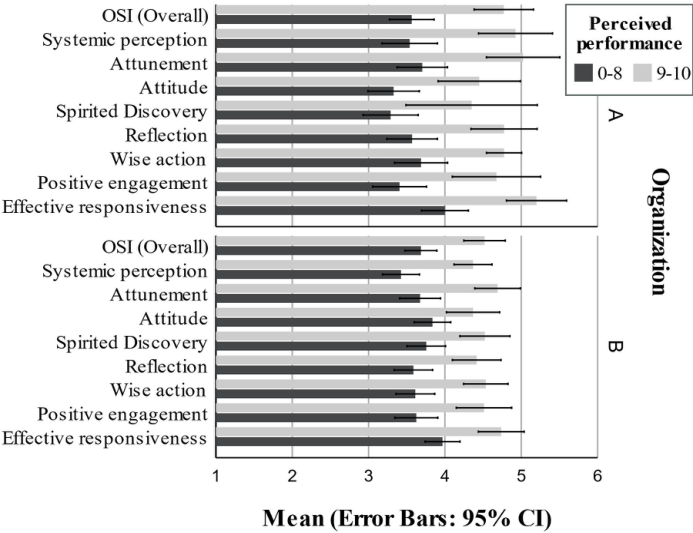
The results show correlations between OSI and both perceived performance and wellbeing measures (Table 2). There is a significant moderate positive correlation between overall OSI, its eight factors and perceived performance. A linear regression model between perceived performance and overall OSI (β=.663, p<.01) would explain 40.3% of variability (p<.01). We also cate- gorized evaluations of perceived performance in the top performing (ratings 9-10) and the lower performing groups (ratings 0-8) within organizations studied (Figure 1). 24% of participants of organization A and 34% of orga- nization B experienced their organization being a top performing. When comparing the top performing and the lower performing groups, Mann- Whitney U test was used for the organization A as the presumption of parametric methods was not met, and for the organization B parametric inde- pendent samples t-test was used (Coolican, 2004). The result showed that when participants experienced their organization as being top performing, their overall SI scores were significantly higher compared to other groups with lower levels of perceived performance (Organization A: U=−286.5, p<.001; Organization B: t(59)=4.90, p<.001). This differentiation between high- and lower perceived performance was visible in all factors of the OSI questionnaire (all comparisons A: p<.05; B: p<.05).
The results show correlation between OSI and wellbeing measures, but the direction varies depending on the measures used. There is a significant, linear, and moderate positive correlation between the overall OSI and work
Figure 1: Mean scores for overall Organizational Systems Intelligence and its eight factors within two organizations on two perceived performance levels.
engagement and mental workability. Similarly, all OSI factors and work enga- gement and mental workability show a positive linear correlation. There is also a weak positive correlation between overall OSI and physical workability and health. In contrast, there is a significant moderate negative correla- tion between overall OSI and perceived stress. This negative correlation is also visible between the OSI factors and perceived stress. Especially, Positive engagement, Attunement and Reflection show moderate negative correlation with perceived stress while all other factors show at least weak correlation. Finally, perceived performance correlates weakly and positively with mental and physical workability and health and negatively with perceived stress.
DISCUSSION AND CONCLUSIONS The aim of this study was to explore the relation between OSI and both perceived performance of organization and wellbeing. The results show strong positive correlations between overall OSI, its eight factors, and percei- ved performance confirming previous research (Törmänen et al. 2021a). Our results also show that perceived performance can vary within organization and a high performance is associated to a high level of systems intellige- nce. The results also show that OSI and its eight factors correlate positively with work engagement and mental workability, and negatively with perceived stress.
Systems Intelligence, Perceived Performance and Wellbeing 61
The two organizations included in this study are large public organizations, where people evaluated organizational systems intelligence and perceived performance from their own perspective. Therefore, variance in both OSI and perceived performance is expected; units have different objectives, and from different perspectives, the organization may seem to perform better or worse. Based on the strong correlation observed in this study, it appears that individuals who feel that their own environment exhibits systems intelligent behavior also feel that that the organization is performing well.
Wellbeing instruments were found to not correlate strongly with percei- ved performance. While wellbeing was measured on an individual level and can therefore be expected to have somewhat lower correlations with orga- nizational metrics, these results do suggest that improving organizational systems intelligence capabilities could be a promising solution to improving both individual employee wellbeing and organizational performance at the same time.
The OSI measure could also be used within organizations to help share best practices from high-performing teams and units with others, and to iden- tify units that could benefit from interventions. OSI results could be used to develop targeted improvement programs to units that are, e.g., experienced to have low Positive Engagement or Reflection scores.
This study is limited by its relatively small sample size and its focus on only two organizations. As participation to the study was voluntary, the sample may also not represent the entire organization. The results may also be affe- cted by the time of the questionnaire; the results were gathered during the COVID-19 pandemic, which caused exceptional work conditions and extra stress and pressure on the employees.
Based on the promising results shown here, we believe further research on the link between OSI, performance, and wellbeing would be highly intere- sting. Future research could focus on widening the scope of the research to multiple organizations; following the used instruments over time to observe changes in OSI, perceived performance, and wellbeing; and on modeling any possible causal relationships between the metrics.
ACKNOWLEDGMENT
We thank the project “Development of Digital Culture - Better Productivity and Work Ability by Mastering Digital Culture” and the participants of our study.
REFERENCES
Cohen, S. (1994) Perceived Stress Scale. Mind Garden. Available from https://www.
mindgarden.com/documents/PerceivedStressScale.pdf Cohen, S., Kamarck, T., Mermelstein, R. (1983) A Global Measure of Perceived Stress. Journal of Health and Social Behavior, 24(4), 385–396 Coolican, H. (2004) Research Methods and Statistics in Psychology, J. W. Arrow-
smith, London, UK, 4th edition. Goleman, D. (1995) Emotional Intelligence, Bantam Books, New York, NY.
Gould R, Ilmarinen J, Järvisalo J, Koskinen S. (2008) Dimensions of Work Ability, Results of the Health 2000 Survey. [Available at http://www.etk.fi/] Harviainen, J. T., Hämäläinen, R., & Saarinen, E. (2021) System intelligence as
an organization-al approach for service designers. Touchpoint: The J. of Service Design, 12(2), 16–29. Hämäläinen, R. P., & Saarinen, E. (2006) Systems intelligence: A key competence in human action and organizational life. Reflections: The SoL Journal, 7(4), 191– 201. Hämäläinen, R. P., Saarinen, E., & Törmänen, J. (2018) Systems Intelligence: A Core
Competence for Next-Generation Engineers? 2018 IEEE International Conference on Teaching, Assessment, and Learning for Engineering (TALE), 641–644. https: //doi.org/10.1109/TALE.2018.8615247 Ilmarinen J, Tuomi K. (2001) Past, present and future of work ability. Proc. of the 1st Int. Symposium on Work Ability. People and Work Research Reports 65, Finnish Institute of Occupational Health, Helsinki 1-25. Jumisko-Pyykkö, S., Viita-aho, T., Tiilikainen, E., & Saarinen, E. (2021) Towards
Systems Intelligent Approach in Empathic Design. Academic Mindtrek 2021, Finland. https://doi.org/10.1145/3464327.3464370 Rigby, C. S., & Ryan, R. M. (2018) Self-determination theory in human resource development: New directions and practical considerations. Adva- nces in Developing Human Resources, 20(2), 133–147. https://doi.org/10.1177/ 1523422318756954 Saarinen, E., & Hämäläinen, R.P. (2004) Systems Intelligence: Connecting engineering thinking with human sensitivity. In Systems Intelligence - Discovering a Hidden Competence in Human Action and Organizational Life (pp. 1–29). Helsinki University of Technology. Saarinen, E., & Lehti, T. (2014) Inducing mindfulness through life-philosophical
lecturing. In A. Ie, C. T. Ngnoumen, & E. J. Langer (Eds.), The Wiley Blackwell Handbook of Mindfulness (pp. 1105–1131). John Wiley & Sons. Salovey, P. and Mayer, J.D. (1989) Emotional intelligence, Imagination, Cognition and Personality, Vol. 9 No. 3, pp. 185–211. Sasaki, Y. (2014) Systems Intelligence in Knowledge Management Implementation: A
Momentum of the SECI Model. Proceedings of the 15th International Symposium on Knowledge and Systems Science, 69–74. Schaufeli, W. B., Bakker, A. B., & Salanova. (2006) M. The measurement of work engagement with a short questionnaire: A cross-national study. Educational and psychological measurement, 66(4), 701–716. Senge, P. M. (1990) The fifth discipline: The art and science of the learning
organization. Doubleday/Currency. Tuomi K, Huuhtanen P, Nykyri E, Ilmarinen J. (2001) Promotion of work ability, the quality of work and retirement. Occup Med (Lond). 51(5):318–324. Törmänen, J. (2021) Systems intelligence - measurement and modeling. Doctoral
dissertation, Aalto University. http://urn.fi/URN:ISBN:978-952-64-0468-4 Törmänen, J., Hämäläinen, R. P., & Saarinen, E. (2021a) On the systems intelligence of a learning organization: Introducing a new measure. Human Resource Development Quarterly. Advanced online publication. https://doi.org/10.1002/hr dq.21455 Törmänen, J., Hämäläinen, R. P., & Saarinen, E. (2016) Systems Intelligence Inven-
tory. The Learning Organization, 23(4), 218–231. https://doi.org/10.1108/TLO- 01-2016-0006
Systems Intelligence, Perceived Performance and Wellbeing 63
Törmänen, J., Saarinen, E., & Hämäläinen, R. P. (2021b) Perceived Systems Intelligence and Performance in Organizations. The Learning Organization. Advanced online publication. https://doi.org/10.1108/TLO-04-2021-0045 Vallejo MA, Vallejo-Slocker L, Fernández-Abascal EG and Mañanes G. (2018) Deter-
mining Factors for Stress Perception Assessed with the Perceived Stress Scale (PSS-4) in Spanish and Other European Samples. Front. Psychol. 9:37. Vänni K, Neupane S, Siukola A, Karinen H, Pursio H, Uitti J, Nygård C-H. (2018) The Presenteeism Scale as a measure of productivity loss. Occup. Med. 68(8):512–518. https://doi.org/10.1093/occmed/kqy124 Vänni K, Virtanen P, Luukkaala T, Nygård CH. (2012) Relationship between percei-
ved work ability and productivity loss. Int J Occup Saf Ergon. 18(3):299-309. doi: 10.1080/10803548.2012.11076946. PMID: 22995129. Örtenblad, A. (2018) What does "learning organization" mean? The Learning Organization, 25(3), 150–158. https://doi.org/10.1108/TLO-02-2018-0016
LISTED IN THE AHFE DIGITAL BOOKSTORE CATALOGUE
Explore the complete digital volume
Human Factors, Business Management and Society
Read this individual research paper free through the original publisher, or explore the full digital proceedings book.
ISBN 978-1-958651-32-2
Explore this ISBN in the AHFE Bookstore ↗Listed in the July 2026 bookstore catalogue; search by ISBN to confirm current availability · Digital book purchase optional