Jari Kautiala, Satu Jumisko Pyykko, Raimo P Hämäläinen, Esa Saarinen (2024). Systems Intelligence in an Expert Organization: A Mixed Methods Approach. In: Human Factors, Business Management and Society. AHFE Open Access, vol. 135, pp. 93–103. https://doi.org/10.54941/ahfe1004934
Systems Intelligence (SI) has a systemic, pragmatic, bottom-up, behavioral, and interactional approach to organization. It correlates positively with organizational learning, performance, and wellbeing. However, previous research has focused on quantitative measurements while context-specific patterns behind the evaluations are understudied. A goal of this case study is to explore SI using a mixed method approach in an expert organization. To study SI, an Organizational Systems Intelligence (OSI) inventory was used and received 46 responses. The results of the OSI showed an overall good level of SI in the organization studied. Four, the most and least positively evaluated, SI factors (attunement, spirited discovery, reflection and effective responsiveness) were further studied to understand the organization-specific underlying themes and practices using semi-structured interview with five participants. The results of thematic analysis are in line with previous research on SI and complements it with context-specific characteristics. This research contributes a new approach to experience-focused and context-dependent SI and supports the bottom-up development of organization.
Systems Intelligence (SI) is defined by Saarinen & Hämäläinen (2004): “[…] intelligent behavior in the context of complex systems involving interaction and feedback. A subject acting with Systems Intelligence engages successfully and productively with the holistic feedback mechanisms of her environment. She perceives herself as a part of a whole, the influence of the whole upon herself as well as her own influence upon the whole. By observing her own interdependence in the feedback intensive environment, she is able to act intelligently.”
SI has a human-centred approach to organizations. SI is built on Peter Senge’s seminal book The Fifth Discipline (Senge, 1990). Senge describes learning organization with five disciplines called as systems thinking, per- sonal mastery, mental models, building shared vision and team learning.
SI aims at operationalizing and conceptually integrating Senge’s vision on learning organization (Törmänen et al., 2021).
SI focus on capturing the employee level human experience as opposed to placing the center of interest to structures accessible primarily or only to man- agers (Törmänen et al., 2021; Törmänen et al., 2022). Organizational systems intelligence aims to bring aliveness to systems thinking with its bottom-up action-orientation (ibid.). In past, systems thinking has been slowly adopted to organizations, in spite of its benefits (Ackhoff, 2006). With its emphasis of the “more subjective side of the human experience and intentionality”, grass roots agency and behavior is taken seriously as giving rise to systems (Törmänen et al., 2022). SI is in line with Rigby & Ryan’s (2018) vision of “Copernican turn” in which the focus on developing human resources is shifting from institutions to empowering individuals. Employees’ experiences of values and meaningfulness, engagement, and affective and intrinsic moti- vation plays important role in contrast to control and command systems, or externally motivated intervention strategies (ibid.). Richness of experi- ence is approached using employees’ own language and in the context of their work (e.g. Nousiainen, 2018) using mixed methodological approaches. Mixed methods can combine understanding not only on measurable excel- lence, but also underlying context-specific characteristics and requirements (e.g. Jumisko-Pyykkö, 2011). In practise, mixed method approach can give answers such as how good employee experiences of SI is and what its orga- nization, situation or practice specific characteristics behind SI are. This versatile but concrete picture of SI gives a starting point for organizational development activities.
Our abilities and skills to succeed and flourish in complex situations in organizational settings and everyday life are at the core of SI (Tormänen et al., 2021; Hämäläinen et al., 2014). SI points to aspects of human behav- ior and thinking that can be improved. Conceptually, the perspective offers a framework with terminology for individuals, teams, and organizations for reflecting SI skills and illuminates possibilities to continuous develop- ment. Table 1 presents eight factors of SI and their definitions (Hämäläinen et al., 2014; Hämäläinen et al., 2018). These represents four different aspects of system intelligent behavior: perception, attitude, thinking and acting (Törmänen, 2021).
Table 1. SI factors and definitions (Hämäläinen et al., 2014; Hämäläinen et al., 2018).
Table available in the original PDF paper.
SI factor Definition Systemic perception Seeing, identifying, and recognizing systems, patterns, and interconnections having situational awareness. Attunement Engaging intersubjectivity, being present, mindful, situationally sensitive, and open. Positive attitude Keeping a positive outlook, not getting stuck on negative impressions and effects. Spirited discovery Engaging with new ideas, embracing change.
(Continued)
Systems Intelligence in an Expert Organization: A Mixed Methods Approach 95
Table 1. Continued SI factor Definition
Table available in the original PDF paper.
Reflection Reflecting upon one’s thinking and actions, challenging one’s own behavior Wise action Exercising long-term thinking and realizing its implications, understanding that consequences may take time to develop. Positive engagement Taking systemic leverage point and means successfully into action with people. Effective responsiveness Taking systemic leverage points and means successfully into action with environment, being able to dance with system.
Systemic perception and attunement cover the perceptual aspect of intel- ligent behavior. Systemic perception points to the ability to observe and recognize a system as a whole along with its key behavioral patterns, to see connections within and between systems, in a situation, and between the whole and the details (Hämäläinen et al., 2014; Hämäläinen et al., 2018 & Törmänen et al., 2016). Attunement focuses on tuning into the social situa- tion of a system. It means openness, presence, mindfulness, and situational sensitivity in nonverbal and verbal communication.
Positive attitude and Spirited discovery describe the attitudinal aspect of intelligent behavior. Positive attitude concentrates on keeping a positive out- look towards environment and future. It is about openness to approach other people, situations and systems, and constructive resilience with negativity. Spirited discovery focuses on an open attitude towards new ideas and change. It is visible in creativity, inspiration to try out new things and to explore new approaches and solutions.
Reflection and Wise action summarize the thinking aspect of intelligent behavior. Reflection is about awareness of one’s thinking and actions, and underlining motives and consequences which offer a possibility to change or grow. Wise action has a strong emphasis on long-term comprehensive development. It is about understanding that changes require time, effort, reflection, and can be nurtured and constructed with others.
Positive engagement and Effective responsiveness illustrate action of intel- ligent behavior. Positive engagement means considering and encouraging other people to pursue common goals. It highlights emotional intelligence and positive interaction towards other people. Effective responsiveness con- denses the purpose and understanding of the goals, achieving the results, prioritization, tackling of difficult challenges and overcoming them.
SI as framework has been applied in several different research fields, such as knowledge management, organizational research, personal growth, psy- chotherapy, engineering education, design (overview Jumisko-Pyykkö et al., 2021). This wide applicability indicates SI’s explicit capability to frame, capture, and construct fundamental understanding on systems intelligent behaviors in different systems and contexts. However, the research beyond the theoretical and descriptive aspects of SI is relatively limited Surveys are the main methods to measure SI. Systems Intelligence Inven- tory is a self-report assessment tool to evaluate eight SI factors as systems
skills on an individual level (Törmänen et al., 2016). Its results have shown to correlate positively with Emotional Intelligence (ibid) and it can also be used for peer evaluation (Törmänen et al., 2021). The Organizational Sys- tems Intelligence (OSI) scale (Törmänen et al., 2022) is a survey for systems skills on an organizational level, based also on eight factors of SI. It focuses on the everyday, individual-level behaviors and aspirations perceived by peo- ple themselves in their organizations. Previous research has reported positive correlations between OSI and essential aspects of organizational functioning such as perceived performance, organizational learning, and wellbeing (Tör- mänen et al., 2022; Jumisko-Pyykkö et al., 2022). For example, the SI’s of all factors top-performing organizations get higher scores compared to lower performing organizations (Törmänen et al., 2022).
Although previous research has constructed versatile theoretical under- standing on SI in different disciplines, developed surveys to quantify it and correlate with key aspects of organizational behaviour, it is limited in understanding qualitative context-specific organizational practices behind the quantitative evaluation. In practise, it is expected that comprehension of these context-specific patterns (e.g. strength, challenges, behaviours) can offer ground for continuous organizational learning and development.
RESEARCH METHODS A goal of this case study is to explore SI using a mixed method approach in an expert organization. Our mixed method study is composed on a quantita- tive survey and qualitative interviews. Mixed methods combine quantitative and qualitative research into one single study to provide complementary viewpoints, to provide a complete picture of the phenomena, to expand understanding to phenomena, and to compensate for the weaknesses of one method (Creswell et al., 2006). Rooted in pragmatic philosophy, mixed meth- ods represent the third wave of research methods, and is suitable for applied research (Tashakkori & Teddlie, 2008) such as systems intelligence in orga- nizations. In our study, we use an explanatory mixed method design in which a quantitative study sets out the base and its results are further explored by qualitative data (Creswell et al., 2006).
OSI Survey Systems intelligence was measured using the Organizational Systems Intel- ligence survey (OSI, Törmänen et al., 2021). The OSI scale measures eight factors of systems intelligence, with 32 items on a 7-point scale from “almost never” to “almost always”. The items were, e.g., In my organization, we approach each other with warmth and acceptance (Attunement); In my organization, we look for new approaches (Spirited Discovery); In my orga- nization, we view things from many different perspectives (Reflection); In my organization, we put first things first (Effective Responsiveness). Inter- nal consistency was found to be good for all factors (Systemic perception (α = 0.87), Attunement (α = 0.80), Positive attitude (α = 0.83), Spirited dis- covery (α = 0.92), Reflection (α = 0.83), Wise action (α = 0.81), Positive engagement (α = 0.91) except Effective responsiveness (α = 0.57)).
The online survey was distributed in the expert organization focused on advanced data-driven applications, artificial intelligence solutions and
Systems Intelligence in an Expert Organization: A Mixed Methods Approach 97
a cloud-based data platform for healthcare and welfare customers in April 2022. The survey gathered altogether 46 responses from ten different teams in the organization. Demographics were not collected to maintain anonymity. The mean age of the population was 40.4 years (sd 8.1), the mean work experience 15.4 years (sd 8.2), and the majority were male (92.2%) and in a non-superior position (84.4%). The answering duration of the survey was approximately five minutes.
Interview The goal of the interview was to understand the underlying themes of the selected SI factors from the perspective of daily practices in a selected organi- zation. Four factors, attunement, spirited discovery, reflection, and effective responsiveness, were chosen for the interview. They covered perceptual, atti- tudinal, thinking and action aspects of SI and two factors were among the most and two among the least positively rated in the survey. A semi-structured interview was used as a method being suitable for exploring novel themes raised by the participants parallel to the predefined themes. The factor and related items of OSI were presented one by one for the participants and with three interview questions: How do you experience this in daily prac- tices (of the organization)? How is this visible in daily practices? How could this be improved? Individual remote interviews were conducted, and they were audio-video recorded (mean duration: 45min). The interviews were conducted in June 2022.
Five participants took part into the interviews. They were from different roles in the organization and from heterogeneous backgrounds (Table 2). The data was analyzed factor by factor using bottom-up thematic analysis (Braun & Clarke, 2006). It aims at identifying patterns as themes within data through systematic steps of analysis and is applicable to research areas with limited prior knowledge such as practices behind SI. To become familiar with the data, the interviews were transcribed and read through. Initial codes were created for all pieces of meaningful text. This phase was done by one researcher and reviewed by another researcher. The size of one unit of analy- sis (a piece of text containing one coherent thought) varied from one word to four sentences. A total of 156 codes were categorized based on the similarity to find the initial themes and they were iterated to find the final themes. The definitions and names were given for the themes. These phases were done in parallel by two researchers.
Table 2. The participants of the interviews.
Table available in the original PDF paper.
Role Gender Age Working Experience In the Organization Product Manager Female 40–49 > 15 years 4 years Project Manager Male 40–49 > 15 years 3 years Engineer Male 30–39 < 5 years 3 years Architect Male 40–49 > 15 years 2 years Executive Male 40–49 > 15 years 7 years
RESULTS
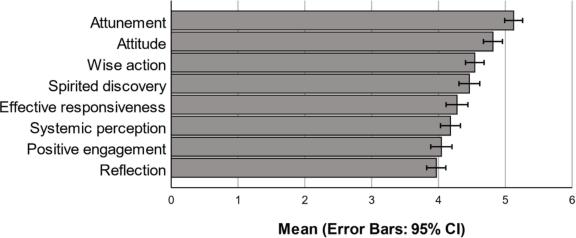
OSI Survey Overall, all SI factors were evaluated between 4.0-5.1 on average, referring to the “very often” and “often” occurrence of the factors in the organization (Figure 1). Four factors, Attunement, Attitude, Wise action, and Spirited dis- covery were among the strengths of the organization being assessed above 4.5 (mean). Reflection, Positive engagement, Systemic perception, and Effec- tive responsiveness were among the lowest-rated factors and received mean evaluations between 4.0-4.3.
Figure 1: Organizational systems intelligence in an expert organization.
Interview Four SI factors and related themes are presented in Table 2. ATTUNEMENT is composed of a humane and respective approach to people, a positive and empowering atmosphere, a feeling of openness, and embracing failures. It can be supported by respecting social situations, by co-learning and transparency. Respect for humanity and diversity highlights the importance of valuing and respecting diversity in discussions. The interviews underlined the existence and need for creating an environment where diverse perspectives are heard, differences are valued, and constructive dialogue is encouraged for the better- ment of the collective. They also raise the question of whether everybody is really equal and heard despite their personality or seniority as a self-analyzing recursion. Respect was underlined with a strength-based lens on people. “Everybody contributes with their own strengths (interviewee 4)”. Positive and empowering atmosphere is seen as a cornerstone to the desired orga- nizational culture. Promotion of appreciation, freedom and good conflict resolution were seen as ways to create a better and more positive work envi- ronment. One interviewee suggests that organizational growth, measured by e.g. increase of head count, net sales or number of customers, correlates with a sense of freedom, and encouragement of autonomy in decision-making and taking action. Positive and empowering atmosphere enhances employee sat- isfaction, collaboration, and organizational success. “Experiencing growth with a sense of freedom without pressure to any conflict fosters a shared feeling of a group of friends who do smart things and appreciate each
Systems Intelligence in an Expert Organization: A Mixed Methods Approach 99
other (interviewee, 2)”. Face-to-face formal and informal meetings were seen important for building a positive and empowering atmosphere.
Openness is a requirement for an atmosphere where employees feel com- fortable to freely express their thoughts, concerns, and ideas. Constructive dialogues build openness. According to the interview openness “creates the foundation for continuous improvement (interviewee 1)”. Embracing failures is about acknowledgement or acceptance of the unintentional occurrences. It analyzes the origin of failure to support continuous improvement and fram- ing failure as a positive experience and even making it visible. Co-learning is about actively reflecting shared experiences. It highlights the significance of evaluating past actions to enhance both personal and collective growth. Ret- rospectives was mentioned as an effective method for creating open ground for discussions about the past. They contribute to the growth, and evolution of the culture and positive atmosphere within the organization. Realizing the whole emphasizes being aware of the entire scope, big picture, or having a general understanding of the subject matter. Lacking enough shared informa- tion about the whole have impact to action. “-- you can take into account if you understand what to take into account (interviewee 5)”.
Table 3. Four SI factors and related themes.
Table available in the original PDF paper.
Attunement Effective Responsiveness Respect for humanity and diversity Time and task relationship Positive and empowering atmosphere Goals Openness Prioritization and decision-making Embracing failure Continuous improvement Co-learning Challenges from work and external factors Realizing the whole
Reflection Spirited Discovery Humanity Culture of experimentation and technologies Personal development Ways of working Long-term goals and choices Obstructive elements Consequences of poor reflection
SPIRITED DISCOVERY describes experimentation culture and experi- mentation with technologies, ways to support it, and its obstacles. Culture of experimentation and technologies emphasizes the importance of creating an atmosphere and circumstances which value experimentation, encourage the exploration of new technologies, foster technical innovations, and pro- mote creative thinking. “Creative work is the key driver for many of us in a team, to implement things in a new way, rather than just repeating what has already been done. (interviewee, 3)”. It underscores the need to chal- lenge existing methods and approaches, embrace change, and continuously develop new solutions to drive progress and stay competitive. Ways of work- ing covers approaches to development and continuous improvement. It values reflection as a method for growth and development. It gives a possibility to influence and commit to a joint working environment with a positive impact
on the outcome. Obstructive elements are practically the obstacles of spir- ited discovery. The lack of business need or time for experimentation or creativeness, or technology development are typical obstacles. They can also be isolated team work instead of collaboration, focusing on problems over solving them, resistance to change and overemphasis on hard skills over soft skills. Overcoming these obstacles requires fostering collaboration, allocat- ing more time for experimentation and innovation, balancing importance of a heterogeneous skillset, and a mindset of continually challenging existing habits.
EFFECTIVE RESPONSIVENESS – describes the relationship between the time horizon of the activities and task, the setting of goals, the capabilities of effective prioritization and decision-making, and the approach to contin- uous improvement in an organization. Challenges from work and external factors summarizes the obstacles of effective responsiveness. Time and task relationship is about balancing between reactiveness and proactiveness of actions. Interviews revealed a need to prepare and align schedules accord- ing to tasks and emphasized the importance and commitment of adhering to planned timelines and schedules. It was observed that shorter planning hori- zons allow for more flexibility and responsiveness to unexpected changes. However, it is also necessary to adopt a long-term perspective, emphasiz- ing the significance of considering future tasks and objectives that extend beyond immediate needs. Visibility of long-term horizon was seen as moti- vating. Goals – illustrate the need for setting clear objectives, planning, and following them. Prioritization and decision-making reflect the importance of the prioritization of customers’ needs or different views and processes, and the capability of decision-making and taking action. Commitment to the customers was highly valued, even if it may require balancing between heterogeneous opinions and the complexity of decision making. It was also highlighted that clear priorities within the team, following the process, and implementing decisions were keys to success. Lack of a single truth and “there is always two sides of a coin (interviewee, 4)” was felt to also emphasize the importance of flexibility and adaptability in decision-making and prioriti- zation. Continuous improvement highlights the urge for personal and team development with building upon existing knowledge and expertise to drive improvement efforts. It also consists of unleashed capability and potential that “we have achieved a lot, it’s not about that, but we could gain even more (interviewee, 4 X).” This implies the organization’s acknowledgement of the dynamic nature of its operations and the importance of adapting and evolving over time to meet changing demands and challenges. Challenges from work and external factors encompasses different dimensions of the obstacles encountered by individuals and teams arising from their work or external influences. It encompasses areas such as tackling technical hurdles, evaluating the perceived volume of difficulties, the absence of stimulating problems, managing workload impact, recognizing the significance of per- severance, comprehending customer needs, and acknowledging reliance on external factors. “We didn’t give up (interviewee, 2)” describes perseverance towards problems faced.
Systems Intelligence in an Expert Organization: A Mixed Methods Approach 101
REFLECTION – describes the importance of paying attention to soft-skills and empathic approach in an organization, diversity of personal develop- ment, and the capability to align the work according to positive long-term goals as well as the outcomes of poor reflection. Humanity emphasizes soft values and an empathetic approach within the organization. Intervie- wees highlighted the importance of prioritizing soft values and cultivating an inclusive work culture driven by empathy. The importance of individual perspectives was recognized, including “the need for all persons to be heard, although we don’t have a formal mechanism in place to ensure this (inter- viewee, 4).” Personal development describes the willingness to change and learn about both hard and soft skills. It was experienced that the existence of a strong willingness for development featured with good opportunities and personal attitude, aided in adapting to change. It was observed in indi- vidual and team development that hard skills get more attention than soft skills “personal development is not only accomplished technical certificates (interviewee, 1).” Long-term goals and choices - focuses on prioritizing work content and making strategic choices aligned with long-term goals. The importance of customer-centricity was the widely perceived, high-quality of decisions and systematic future planning to create a “reusable solutions approach and avoiding band-aid solutions (interviewee, 3).” Consequences of poor, or lack of, reflection is visible behavior, as in inefficient work prac- tices, the pursuit of secondary goals driven by customers at the expense of primary goals, time pressure distorting priorities, reactive behavior, and loss of broader business perspectives.
DISCUSSION AND CONCLUSIONS The goal of this study is to explore SI using a mixed method approach in an expert organization. A case study was conducted combing both an OSI survey and interviews. The results of the OSI survey showed, overall, a good level of all factors in the organization with appearance frequency ranging from “very often” to “often” in all factors in daily life. Similar levels of SI have been reported in previous studies in different countries, domains, and organizations (Jumisko-Pyykkö et al., 2022; Törmänen et al., 2021).
The results of the thematic analysis of four of the SI factors are in line with previous research and complement it with context-specific understanding. Attunement reflected versatile aspects of a warm approach to other people, atmosphere, and outcomes of work as well as formal and informal ways to support them. These results support the intersubjectivity of attunement (Hämäläinen et al., 2014) and extend it with collective attunement to work outcomes and supportive practices to enhance the perception of the system. Attunement focused only on the positive aspects of the factor while other factors highlighted both positive and negative aspects (e.g. obstacles in daily practices). Spirited discovery is about the culture of experimentation, tech- nologies, and ways of working to support it. It requires collaboration and valuing versatile skills, resources, and an active mindset of continually chal- lenging itself. These reflect the characteristics of Spirited discovery, such as engaging with new ideas and embracing change (Hämäläinen et al., 2014).
They also provide context-specific practices and needs in the field of fast developing technology. Effective responsiveness focused on goals, the flexi- bility to navigate in time and task horizons, and effective actions, continuous improvement and their obstacles. It was well aligned with the definition and the actional intelligence of effective responsiveness (Hämäläinen et al., 2014). Reflection covered empathic approach to people in organization, seeing rich personal development possibilities, appreciation towards the long- term goals of organization, and the negative consequences of poor reflection. These support reflection as thinking of own thinking, actions and challenging behaviour (Hämäläinen et al., 2014). The results also expanded reflection to a wider horizon e.g. awareness of valuing individual people and their active relation being a part of successive system.
There are three suggestions for further work. Firstly, future work needs to explore all SI factors using mixed method to build an understanding between the excellence of SI factors and their underlying characteristics. This study demonstrated that using a mixed method approach can provide organization-specific depth and knowledge about the practices behind the SI factors. Secondly, future work is needed to study the approach presented in different organizational domains to construct a more generic practice-based patterns and characteristics behind the SI factors. Bridging theory-driven SI and practice-driven research can strengthen SI as a theory and its impact of applicability in organizations. Thirdly, further studies need to be conducted to explore the ways of integrating the proposed mixed method approach of SI to the flow of continuous development of organization. For example, pre- vious SI research has proposed promising dialogue-based interventions with early childhood education professionals (Hämäläinen et al., 2020). The con- tribution of this research is a new approach for evaluating experience-focused and context-dependent SI. It supports the path of the bottom-up development of an organization.
REFERENCES
Ackoff, Russel. L. (2006). Why few organizations adopt systems thinking, Systems Research and Behavioral Science, Volume 23, No. 5. Braun, Virginia and Clarke, Victoria. (2006). Using thematic analysis in psychology.
Qualitative Research in Psychology, Volume 3, No. 2. Creswell, J. W. Shope, R. Plano Clark, V. L. Green, D. O. (2006). How interpretive qualitative research extends mixed methods research. Research in the Schools, Volume 13, No. 1. Hämäläinen, R. Jones, R. Saarinen, E. (2014). Being Better Better: Living with
Systems Intelligence. Helsinki: Aalto University Publications. Hämäläinen, R. P. Kumpulainen, K. R. Harviainen, T. Saarinen, E (2022). Design gaming for learning systems intelligence in socio-emotional systems, Systems Research and Behavioral Science, Volume 39, No. 1 Hämäläinen, R. P. Saarinen, E. Törmänen, J. (2018) Systems Intelligence: A Core
Competence for Next-Generation Engineers?, Proceedings of 2018 IEEE Inter- national Conference on Teaching, Assessment, and Learning for Engineering, Australia.
Systems Intelligence in an Expert Organization: A Mixed Methods Approach 103
Jumisko-Pyykkö, S. (2011). User-centered quality of experience and its evaluation methods for mobile television. Tampere: Tampere University of Technology. Jumisko-Pyykkö, S. Törmänen, J. Vänni, K. Hämäläinen, R. P. Saarinen, E. (2022).
Systems intelligence, perceived performance and wellbeing, Human Factors, Business Management and Society, Volume 56, No. 1. Jumisko-Pyykkö, S. Viita-aho, T. Tiilikainen, E. Saarinen, E. (2021). Towards Systems Intelligent Approach in Empathic Design, Academic Mindtrek 2021Tampere/ Finland. Nousiainen, A. (2018). Humanizing Workplaces - HR executives’ role in fostering
systems intelligence in forerunning companies, Espoo: Aalto University. Rigby, C. S. & Ryan, R. M. (2018). Self-determination theory in human resource development: New directions and practical considerations, Advances in Develop- ing Human Resources Volume 20, No. 2. Saarinen, E. Hämäläinen, R. P. (2004) “Systems Intelligence: Connecting engineering
thinking with human sensitivity” in Systems Intelligence – Discovering a Hidden Competence in Human Action and Organizational Life, Saarinen, E. Hämäläinen, R. P. (Ed.). pp. 1–29. Senge, P. M. (1990). The fifth discipline: The art and science of the learning organization. New York: Doubleday/Currency. Tashakkori, A. Teddlie, C. (2008) “Quality of inferences in mixed methods research
Calling for an integrative framework.”, in: Advances in Mixed Methods Research, Bergman, M. (Ed.). pp. 101–119 Törmänen, J. (2021). Systems Intelligence – Measurement and Modelling. Espoo: Aalto University. Törmänen, J. Hämäläinen, R. P. Saarinen, E. (2022). On the systems intelligence of a
learning organization: introducing a new measure, Human Resource Development Quarterly, Volume 33, No. 3. Törmänen, J. Hämäläinen, R. P. Saarinen, E. (2016). Systems intelligence inventory, The Learning Organization Volume 23, No. 4.
LISTED IN THE AHFE DIGITAL BOOKSTORE CATALOGUE
Explore the complete digital volume
Human Factors, Business Management and Society
Read this individual research paper free through the original publisher, or explore the full digital proceedings book.
ISBN 978-1-964867-11-3
Explore this ISBN in the AHFE Bookstore ↗Listed in the July 2026 bookstore catalogue; search by ISBN to confirm current availability · Digital book purchase optional