Yuwen Zou, Wardatul Hayat Adnan, Nurul Hijja Mazlan, Chang Liu (2026). Methodological Validation of Environmental Embedding and Cognitive Absorption for AR Instructional Communication in Chinese Motif Design Learning. In: Training, Education, and Learning Sciences. AHFE Open Access, vol. 231. https://doi.org/10.54941/ahfe1007992
Augmented reality is used to disseminate cultural heritage. However, its application in teaching traditional Chinese motif remains underexplored within communication and media studies. There is limited evidence regarding augmented reality’s influence on learning through cognitive absorption in higher education art and design. Therefore, this study employs an explanatory sequential mixed methods design, integrating situated cognition theory, cognitive absorption theory, and student engagement theory for methodological validation. The quantitative phase included 34 art and design students from universities in Nanchang, Jiangxi Province, China, who had nearly six months of experience learning traditional motif with augmented reality assistance. An adapted Chinese version of the scale was used to measure the relationship between environmental embedding, the five dimensions of cognitive absorption (enjoyment, curiosity, control, temporal dissociation, and focused immersion), and learning experience, with reliability, validity, and correlation analyses conducted. In the qualitative phase, four experts assessed the interview outline’s validity, followed by pre-interviews with four samples to optimize questions. Results showed good internal consistency and supported subsequent formal research. Related results showed a significant positive correlation between environmental embedding and curiosity and learning experience, with focused immersion showing the highest correlation, while the correlation between sense of control and learning experience was weaker. Interviews suggested augmented reality’s “seeable but difficult to control” experience gap may lower control scores. These findings preliminarily support the study’s proposed communication path, indicating control may fail under low-interaction augmented reality. This study proposes revising formal research to eliminate low-interaction augmented reality stimuli, using manipulable interactive materials to examine the control dimensions mediating role.
Augmented reality (AR) courses have become an unavoidable trend in contemporary education, and recent research emphasises the crucial importance of immersive and interactive cultural heritage education (Jin et al., 2022; Li et al., 2023; Yu et al., 2021; Yuan et al., 2024). Whilst AR is widely used in cultural heritage education, existing applications in traditional Chinese motif design instruction tend to focus on surface- level visual presentations, neglecting its deeper psychological mechanisms as an instructional communication medium (Koumpouros, 2024; Sakr and Abdullah, 2024). Empirical research is lacking to elucidate how AR’s environmental embedding influences students’ design learning experience through cognitive absorption.
To address this gap, this study focuses on the traditional Chinese motif learning context of art and design students in Nanchang, Jiangxi Province, China, defining AR as an instructional communication medium rather than a mere technological tool. The instructional communication perspective emphasises how information is transmitted within an environment and how learners receive and process information in context. Therefore, this study selects environmental embedding as the core variable, viewing it as a communication cue within the teaching environment. An explanatory sequential mixed methods design is employed. The quantitative phase constructs and tests a communication mechanism model of how augmented reality teaching media influences the learning experience of traditional Chinese motif. The qualitative phase further analyses the specific impact of augmented reality’s environmental embedding on students’ learning experience and cultural understanding (Mazlan, 2020).
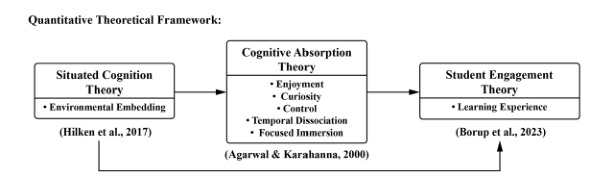
Therefore, this study aims to validate the methodology through an exploratory pilot study. The quantitative research verifies the feasibility of integrating situated cognition theory (explaining the relationship between environment and knowledge construction), cognitive absorption theory (explaining the psychological mechanisms of immersion), and student engagement theory (explaining the emotional pathways of learning experience) as an instructional communication model. The qualitative phase further explores the results of the quantitative research (as show in Figure 1). The purpose of the pilot study is to identify potential contradictions in the model and to refine the experimental stimulus materials and research process for subsequent large-sample empirical studies (Liu et al., 2025).
Figure 1: Domains of human systems integration. (Adapted from Hilken et al. (2017); Agarwal & Karahanna, (2000); Borup et al. (2023)).
This study aims to achieve three objectives. First, to validate the reliability and preliminary validity of the scale in a sample of art and design students in universities in Nanchang, Jiangxi Province, China, and to confirm the applicability of cross-contextual measurement tools. Second, to explore the initial pathways through which environmental embedding influences learning experience via five mediating dimensions: enjoyment, curiosity, control, temporal separation, and focused immersion, and to examine the interpretability of the theoretical model at the pre-experimental level. Third, to identify discrepancies between theoretical expectations and statistical results in the pre-experiment and to propose improvements for the formal research based on these discrepancies.
LITERATURE REVIEW
Augmented Reality in Instructional Communication The application of AR in cultural heritage dissemination has yielded rich practical cases, with common goals including enhancing learning interest, strengthening cultural presence, supporting contextualised understanding, and promoting cross-modal expression. However, there is a tendency in related research to view AR as a visual enhancement tool rather than a media structure in the teaching and communication process. A communication studies perspective emphasises that teaching is not a one-way transmission of information, but rather a negotiation of meaning among teachers, media, and learners in a specific context. If AR is used merely to display content, its dissemination function is compressed into an interface function. Only when AR integrates symbolic information, scene cues, and interactive feedback to form an environmental system that learners can actively interpret will teaching and communication enter a deeper stage (Li et al., 2025; Weidner et al., 2024).
Environmental Embedding The concept of contextual embedding emphasises that learning does not occur in an abstract vacuum, but rather in a context with space, objects, cues, and opportunities for action. Situated cognition theory posits that knowledge comprehension and contextual experience are inseparable, and learners construct meaning through interaction with their environment. In AR classrooms, the core of contextual embedding is not simply stacking three-dimensional models, but rather establishing semantic connections between virtual information and real space, enabling learners to form a continuous mapping between seeing and understanding (Bianchi et al., 2022; Lee et al., 2025; Rudenko, 2023). Lee et al. (2025) further propose that when environmental cues possess systematic consistency, learners are more likely to form stable exploration paths and interpretive frameworks, providing direct evidence for setting contextual embedding as an antecedent variable in this study.
Methodological Validation of Environmental Embedding and Cognitive Absorption 21 Cognitive Absorption
Cognitive absorption theory, proposed by Agarwal and Karahanna (2000), emphasises the deep engagement of individuals in technologically interactive situations, which can be characterised by five dimensions: enjoyment, curiosity, control, temporal dissociation, and focused immersion. This theory is widely used in information systems and educational technology research, but its application in research on the teaching and dissemination of traditional culture remains limited. In its five-dimensional structure, enjoyment and curiosity are often considered priming mechanisms that drive students to continue exploring. Focused immersion and temporal dissociation reflect sustained processing, determining whether students can transform surface stimuli into deep understanding. The control dimension is closely related to the manipulability of the interaction; if the system only provides passive browsing, learners, even with high interest, may give a low rating in terms of their sense of control (Ahmad Adeel et al., 2023; Cheng, 2023; Hii and Yang, 2025).
Learning Experience Learning experience is not merely a simple satisfaction evaluation, but rather the result of the combined effects of cognitive, emotional, and behavioural engagement. Student engagement theory posits that the key to learning effectiveness lies in whether learners are continuously engaged in understanding, reflection, practice, and transfer (Fredricks et al., 2004). Therefore, this study sets learning experience as an outcome variable to measure whether AR-based educational communication truly fosters deep engagement, rather than merely providing short-term excitement based on novelty (Xu et al., 2023).
METHODOLOGY
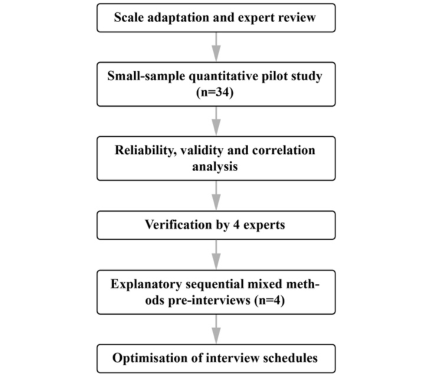
Research design This study employed an explanatory sequential mixed methods design within a pragmatic paradigm. As show in figure 2, in the quantitative research phase, 34 undergraduate art and design students from universities in Nanchang, Jiangxi Province, China, who had used AR-assisted learning of traditional Chinese motifs within the past six months with a learning purpose, were recruited as participants. An adapted scale was used to measure five dimensions of environmental embedding and cognitive absorption, as well as learning experience. Data were tested for reliability (Cronbach’s alpha) and Pearson correlation analysis using SPSS 27.0. In the qualitative research phase, to ensure the rigour of the qualitative data, the semi-structured interview outline was first validated by four experts from the fields of communication studies, traditional graphic design, and AR technology to ensure content validity. Based on the preliminary trends in the quantitative data, nested sampling was used to select four representative participants for a pre-interview test, and the wording and logic of the interview questions were optimised based on feedback.
Figure 2: Research design flow chart.
RESULT AND DISCUSSION
Quantitative Results Preliminary results showed good internal consistency among the latent variables, with Cronbach’s alpha all above 0.80 (as show in Table 1). The scale demonstrates stable measurement performance, supporting its continued use in subsequent main studies and confirmatory factor analysis (Tavakol and Dennick, 2011). The KMO reached 0.850, and Bartlett’s test of sphericity was significant, indicating that the correlation matrix is suitable for latent variable analysis, further supporting the feasibility of the research tool (Hair et al., 2021).
Table 1: Cronbach’s alpha coefficients of variables.
Table available in the original PDF paper.
Variable Cronbach Alpha Internal Consistency EE 0.901 Excellent
ENJ 0.864 Good CUR 0.869 Good
CON 0.897 Good TD 0.903 Excellent
FI 0.924 Excellent LE 0.827 Good
The correlation analysis generally aligns with theoretical expectations. As shown in Table 2, a significant positive correlation exists between environmental embedding and curiosity, with a correlation coefficient of 0.605, indicating that students are more likely to develop exploratory drive when spatial and informational cues are more abundant in the AR learning scenario. Environmental embedding also shows a significant positive correlation with learning experience, with a correlation coefficient of
Methodological Validation of Environmental Embedding and Cognitive Absorption 23 0.502, suggesting that environmental embedding not only affects immediate feelings but may also be related to overall learning evaluation. The strongest correlation exists between focused immersion and learning experience, reaching 0.621, suggesting that sustained attention and deep engagement are important pathways to improving the learning experience. Enjoyment and learning experience, as well as curiosity and learning experience, both show moderate positive correlations, consistent with cognitive absorption theory’s view on the synergy between emotion and cognition (Agarwal and Karahanna, 2000; Fredricks et al., 2004).
Note: *. Correlation is significant at the 0.05 level (2-tailed). **. Correlation is significant at the 0.01 level (2-tailed). < 0.20 (Very weak), 0.20–0.39 (Weak), 0.40–0.59 (Moderate), and 0.60–0.79 (Strong) (Papageorgiou, 2022).
Qualitative Results Pre-interviews revealed that all four participants acknowledged the role of the AR environment in stimulating interest and guiding exploration. The fusion of virtual and real environments enhanced their attention to the details and cultural meanings of traditional motif. This aligns with the positive correlation between environmental embedding and curiosity and enjoyment observed in the quantitative results, suggesting that environmental cues may improve the learning experience through emotional and cognitive priming mechanisms. More importantly, the pre- interviews provided an explanation for the weak correlation in the control dimension. Participants mentioned seeing more in AR applications but doing less. They expected more detailed adjustments and deconstructions of virtual elements, but the existing system primarily focused on browsing and switching, resulting in unmet control needs and low control perception scores. This suggests that the weak control pathway is more likely due to insufficient interaction levels with stimulus materials, rather than scale failure or theoretical inconsistency.
Discussion
From the perspective of instructional communication, this study preliminarily supports a three-stage mechanism. The first stage is the media context stage, where environmental embedding alters learners’ attentional entry point through spatial anchoring and information saliency. The second stage is the psychological processing stage, where curiosity, enjoyment, and immersion jointly drive learners to continuously process motif information. The third stage is the experience output stage, where students’ overall evaluation of the learning process improves with increasing engagement depth. This mechanism suggests that curriculum designers should view AR as a tool for constructing the communication environment, rather than simply a content display carrier (Lee et al., 2025). Existing reviews have indicated that the control dimension is less stable than enjoyment and focus across different tasks, suggesting that researchers must incorporate technological interaction conditions into the model explanation, rather than treating all psychological dimensions as having equal intensity (Balakrishnan and Dwivedi, 2021; Oz et al., 2023).
Impact on Formal Research Based on the findings of this study, subsequent formal research should substantially revise the selection of experimental stimuli. The study will exclude low-interaction, experiential AR applications and prioritise materials with manipulative interactions, such as those allowing learners to rotate and decompose motif structures and adjust mapping positions. Simultaneously, interviews will focus on the conditions for generating a sense of control, specifically asking learners at what interaction points they feel in control of the learning, to verify whether the control dimension recovers its significant role under high-interaction conditions. This revision not only improves the accuracy of model testing but also makes the research findings more valuable for curriculum design guidance (Liberman and Dubovi, 2023; Mayer, 2024).
CONCLUSION
Findings The results of this study demonstrate the feasibility of the instructional communication model integrating situated cognition theory, cognitive absorption theory, and student engagement theory in traditional motif AR learning scenarios. The scale showed good reliability and construct fit, supporting its continued use in formal research. Regarding variable relationships, environmental embedding was significantly positively correlated with curiosity and learning experience, with focused immersion showing the strongest association with learning experience, indicating that the path by which environmental cues influence learning experience through psychological engagement has an empirical basis. The control dimension did not exhibit the expected strength, suggesting that the interaction level of the current stimulus material is a key boundary condition affecting the model’s performance.
Methodological Validation of Environmental Embedding and Cognitive Absorption 25 Theoretical and Practical Significance
At the theoretical level, this paper advances AR research to explain the mechanisms of instructional communication, emphasising how media context influences learning experience through psychological processes. At the methodological level, the study demonstrates the value of pre- research in model validation, namely, identifying structural contradictions and making design revisions in advance through small-sample reliability and validity testing and relationship exploration. At the practical level, the study provides clear recommendations for traditional culture courses: AR design should prioritise enhancing the level of environmental embedding and task manoeuvrability, avoiding investing classroom resources in low- interaction solutions that only offer display functions (Koumpouros, 2024; Xu et al., 2023).
Limitations and Future Work This study still has limitations. The sample size is relatively small and geographically concentrated, and the current evidence is only suitable for preliminary judgements and is insufficient for robust causal inferences. The qualitative portion at this stage mainly completed the validation of the interview tools and process optimisation; the formal thematic results will be reported after further sample expansion. The next step will involve confirmatory factor analysis and structural equation modelling with a larger sample, combined with the analysis of the formal interview themes, to further confirm the mediating role of the control dimension under highly interactive AR conditions and compare the differences in the impact of different interaction intensities on the learning experience. Through this approach, the research is expected to provide a more universal and reproducible evidence system for AR-mediated dissemination of traditional cultural education.
ACKNOWLEDGMENT
We thank all participating students from universities in Nanchang, Jiangxi, for their valuable feedback, and the expert reviewers in communication, traditional motif design, and AR technology for their constructive guidance on the interview protocol and research design.
REFERENCES
Agarwal, R. and Karahanna, E. (2000), “Time Flies When You’re Having Fun: Cognitive Absorption and Beliefs about Information Technology Usage”, MIS Quarterly, Vol. 24, No. 4, pp. 665–694, doi: 10.2307/3250951. Ahmad Adeel, Samreen Batool, Daisy Mui Hung Kee, and Zain-ul-Abdeen Madni.
(2023), “Why cognitive absorption is not enough: The role of knowledge absorption capacity and technological opportunity for individual learning”, Asian Academy of Management Journal, Penerbit Universiti Sains Malaysia, Vol. 28, No. 2, pp. 239–274, doi: 10.21315/aamj2023.28.2.9.
Balakrishnan, J. and Dwivedi, Y.K. (2021), “Role of cognitive absorption in building user trust and experience”, Psychology & Marketing, Wiley, Vol. 38, No. 4, pp. 643–668, doi: 10.1002/mar.21462. Bianchi, G., Testa, F., Tessitore, S. and Iraldo, F. (2022), “How to embed environmental
sustainability: The role of dynamic capabilities and managerial approaches in a life cycle management perspective”, Business Strategy and the Environment, Vol. 31, No. 1, pp. 312–325, doi: 10.1002/bse.2889. Borup, J., Graham, C., West, R., Archambault, L. and Shin, J. (2023), “Academic Communities of Engagement (ACE) Framework”, EdTechnica, EdTech Books, doi: 10.59668/371.12259. Cheng, Y.-M. (2023), “What roles do quality and cognitive absorption play in
evaluating cloud-based e-learning system success? Evidence from medical professionals”, doi: 10.1108/ITSE-12-2021-0222. Fredricks, J.A., Blumenfeld, P.C. and Paris, A.H. (2004), “School Engagement: Potential of the Concept, State of the Evidence”, Review of Educational Research, Vol. 74, No. 1, pp. 59–109. Hair, J.F., Hult, G.T.M., Ringle, C.M., Sarstedt, M., Danks, N.P. and Ray, S. (2021),
Partial Least Squares Structural Equation Modeling (PLS-SEM) Using R: A Workbook, Springer International Publishing, Cham, doi: 10.1007/978-3-030- 80519-7. Hii, C.-H. and Yang, C.-C. (2025), “Comparing the Application Effects of Immersive and Non-Immersive Virtual Reality in Nursing Education: The Influence of Presence and Flow”, Nursing Reports, MDPI AG, Vol. 15, No. 5, p. 149, doi: 10.3390/nursrep15050149. Hilken, T., De Ruyter, K., Chylinski, M., Mahr, D. and Keeling, D.I. (2017),
“Augmenting the eye of the beholder: exploring the strategic potential of augmented reality to enhance online service experiences”, Journal of the Academy of Marketing Science, Vol. 45, No. 6, pp. 884–905, doi: 10.1007/s11747-017- 0541-x. Jin, S., Fan, M. and Kadir, A. (2022), “Immersive Spring Morning in the Han Palace: Learning Traditional Chinese Art Via Virtual Reality and Multi-Touch Tabletop”, International Journal of Human–Computer Interaction, Vol. 38, No. 3, pp. 213–226, doi: 10.1080/10447318.2021.1930389. Koumpouros, Y. (2024), “Revealing the true potential and prospects of augmented
reality in education”, Smart Learning Environments, Springer Science and Business Media LLC, Vol. 11, No. 1, doi: 10.1186/s40561-023-00288-0. Lee, M., Min, S., Kim, G. and Lee, S. (2025), “Understanding Practical Challenges and Enablers for Embedding Environmental Perspectives in Digital Product Design and Development”, Proceedings of the 2025 CHI Conference on Human Factors in Computing Systems, presented at the CHI 2025: CHI Conference on Human Factors in Computing Systems, ACM, Yokohama Japan, pp. 1–15, doi: 10.1145/3706598.3713144. Li, J., Zheng, Z., Chai, Y., Su, S., Wei, X., Shi, H. and Xin, X. (2023), “DianTea:Designing
and Evaluating an Immersive Virtual Reality Game to Enhance Youth Tea Culture Learning”, Proceedings of the 25th International Conference on Mobile Human- Computer Interaction, presented at the MobileHCI ’23: 25th International Conference on Mobile Human-Computer Interaction, ACM, Athens Greece, pp. 1–8, doi: 10.1145/3565066.3608707. Li, Q., Chen, Z., Wu, T., Shen, C., Yang, Y. and Zhao, X. (2025), “Exploring the Effects of Narrative Augmented Reality in Cultural Heritage: A Study on Emotional Arousal, Intrinsic Motivation, Cognitive Load, and Learning”, International Journal of Human–Computer Interaction, pp. 1–11, doi: 10.1080/10447318.2025.2504185.
Methodological Validation of Environmental Embedding and Cognitive Absorption 27 Liberman, L. and Dubovi, I. (2023), “The effect of the modality principle to support
learning with virtual reality: An eye-tracking and electrodermal activity study”, Journal of Computer Assisted Learning, Wiley, Vol. 39, No. 2, pp. 547–557, doi: 10.1111/jcal.12763. Liu, C., Redhuan Samsudin, M. and Zou, Y. (2025), “The Impact of Visual Design Elements in Tea Bag Packaging on Consumer Behaviour: A Prototype and Pilot Study”, AHFE International, Vol. 164, presented at the 16th International Conference on Applied Human Factors and Ergonomics (AHFE 2025), AHFE International, doi: 10.54941/ahfe1006076. Mayer, R.E. (2024), “The Past, Present, and Future of the Cognitive Theory of
Multimedia Learning”, Educational Psychology Review, Springer Science and Business Media LLC, Vol. 36, No. 1, doi: 10.1007/s10648-023-09842-1. Mazlan, N.H. (2020), “Development of collaborative flipped instruction for form one Malay language writing”, University of Malaya (Malaysia). Oz, B., Coursaris, C., Robert, J. and Lã, P.-M. (2023), “The Nature and Dimensionality
of Cognitive Absorption: A Critical Review and Meta-Analysis”. Papageorgiou, S.N. (2022), “On correlation coefficients and their interpretation”, Journal of Orthodontics, Vol. 49, No. 3, pp. 359–361, doi: 10.1177/14653125221076142. Rudenko, E. (2023), “Embedding sustainability into English environment: a holistic approach”, edited by Muratov, A. and Khasanov, S.E3S Web of Conferences, Vol. 371, p. 05017, doi: 10.1051/e3sconf/202337105017. Sakr, A. and Abdullah, T. (2024), “Virtual, augmented reality and learning analytics
impact on learners, and educators: A systematic review”, Education and Information Technologies, Springer Science and Business Media LLC, Vol. 29, No. 15, pp. 19913–19962, doi: 10.1007/s10639-024-12602-5. Tavakol, M. and Dennick, R. (2011), “Making sense of Cronbach’s alpha”, International Journal of Medical Education, Vol. 2, pp. 53–55, doi: 10.5116/ ijme.4dfb.8dfd. Weidner, F., Hartbrich, J., Arevalo Arboleda, S., Kunert, C., Schneiderwind, C.,
Diao, C., Gerhardt, C., et al. (2024), “Eyes on the Narrative: Exploring the Impact of Visual Realism and Audio Presentation on Gaze Behavior in AR Storytelling”, Proceedings of the 2024 Symposium on Eye Tracking Research and Applications, presented at the ETRA ’24: The 2024 Symposium on Eye Tracking Research and Applications, ACM, Glasgow United Kingdom, pp. 1–7, doi: 10.1145/3649902.3653344. Xu, X., Shi, Z., Bos, N.A. and Wu, H. (2023), “Student engagement and learning outcomes: an empirical study applying a four-dimensional framework”, Medical Education Online, Informa UK Limited, Vol. 28, No. 1, doi: 10.1080/10872981.2023.2268347. Yu, M., Zhang, M., Yu, C., Ma, X., Yang, X.-D. and Zhang, J. (2021), “We Can
Do More to Save Guqin: Design and Evaluate Interactive Systems to Make Guqin More Accessible to the General Public”, Proceedings of the 2021 CHI Conference on Human Factors in Computing Systems, presented at the CHI ’21: CHI Conference on Human Factors in Computing Systems, ACM, Yokohama Japan, pp. 1–12, doi: 10.1145/3411764.3445175. Yuan, Q., Chen, K., Yang, Q., Pan, Z., Xu, J. and Yao, Z. (2024), “Exploring Intuitive Visuo-Tactile Interaction Design for Culture Education: A Chinese-Chess-Based Case Study”, International Journal of Human–Computer Interaction, Vol. 40, No. 8, pp. 2099–2119, doi: 10.1080/10447318.2023.2223863.
LISTED IN THE AHFE DIGITAL BOOKSTORE CATALOGUE
Explore the complete digital volume
Training, Education, and Learning Sciences
Read this individual research paper free through the original publisher, or explore the full digital proceedings book.
ISBN 979-8-950676-07-9
Explore this ISBN in the AHFE Bookstore ↗Listed in the July 2026 bookstore catalogue; search by ISBN to confirm current availability · Digital book purchase optional