Hanshu Wang, Shizu Gotoh, Xiuzhu Gu (2026). Bridging Institutional Maturity and Public Attention: A Mixed-Methods Study of Telemedicine Institutionalization in Japan. In: The Human Side of Service Engineering. AHFE Open Access, vol. 221, pp. 355–365. https://doi.org/10.54941/ahfe1007739
Telemedicine in Japan is undergoing a critical transition from administrative guidance to a formal legal system, yet alignment between institutional maturity (supply side) and public attention (demand side) remains unclear. This study adopted a mixed-methods approach, combining the “Regulatory Framework for Telemedicine” (7 categories) with large language model (LLM)-enhanced topic modeling, to analyze policy documents and 68,481 X (formerly Twitter) posts related to telemedicine from 2019 to 2025. Then, the institutional maturity and public attention across categories were compared. Results revealed distinct interaction patterns between institutional maturity and public attention. First, a stabilization pattern was observed in the Governance and Actions of health institutions and teams categories: improvements in institutional maturity mitigated initial public attention, leading to a transient rise in attention that subsequently declined as practices became normalized. Conversely, a tension pattern persisted in Regulatory aspects, where limited growth institutional maturity failed to address sustained high public attention. Furthermore, a significant misalignment pattern was identified in Cross-cutting principles and human rights, where institutional maturity lagged rapidly rising public attention. We recommend that policymakers prioritize strengthening legal support for vulnerable groups and scenarios attracting high public attention, and transform temporary administrative guidance into formal legislation to bridge gaps between institutional design and public expectations. The developed methods provide a transferable approach for telemedicine institutionalization research in other regions.
Japan faces a critical demographic challenge: a “super-aging” society. The proportion of the population aged 65 and over reached 28.6% in 2020 and is projected to rise to 33.9% by 2038 (IPSS, 2023). This aging trend has intensified the tension between surging demand for chronic disease management and limited medical resources. In this context, telemedicine is increasingly viewed as a viable solution for supporting the sustainability of the healthcare system (Kadoya et al., 2020). The COVID-19 pandemic in 2020 acted as a catalyst for the diffusion of telemedicine. Against a backdrop of regulatory relaxation, the use of telemedicine increased significantly, Received February 5, 2026; Revised April 10, 2026; Accepted April 27, 2026; Available online July 20, 2026
transitioning from exceptional measures to widespread practice (Ishikawa et al., 2022). Today, as the Japanese government strives to transform these temporary measures into permanent arrangements, telemedicine is at a critical juncture, shifting from being governed largely by guidelines to being explicitly embedded in the regulatory/legal framework (The Council for Promotion of Regulatory Reform, 2025).
However, the successful societal embedding of new technologies depends not only on refining legal frameworks but also on their dynamic interaction with societal reception. Drawing on the Multi-Level Perspective (MLP), we posit that successful societal embedding requires the dynamic alignment between the ‘deep structure’ of institutional regimes and the fluidity of public attention. Misalignments manifest as societal tensions, while alignments promote stabilization (Geels, 2011). Yet existing research often addresses these two aspects in isolation. On the one hand, policy research primarily assesses the institutional maturity of telemedicine from the supply side, focusing on the legal framework and safety (Cresswell et al., 2025). On the other hand, social research relies on social media data to analyze public attention on the demand side, focusing on user expectations and discussions about telemedicine (Martín et al., 2025; Sazon et al., 2023). This fragmented perspective limits policymakers’ ability to assess whether existing institutional frameworks adequately reflect public concerns as manifested in online discussion and information-seeking behaviors (Eysenbach, 2009). If a structural mismatch exists between the focus of institutional design and public attention, even a refined legal system may fail to facilitate the true societal embedding of telemedicine.
To bridge this gap, this study adopts a mixed-methods approach to jointly compare the institutional maturity and public attention about telemedicine in Japan, and aims to answer the following three core questions: Q1: How is the institutional maturity of telemedicine in Japan? Q2: What are the focal points of Japanese public attention about telemedicine? Q3: What are the alignments or gaps between institutional maturity and public attention during different periods of the COVID-19 pandemic?
By exploring similarities and deviations between the institutional maturity and public attention, this study aims to provide recommendations to support the societal embedding of telemedicine in Japan. The proposed approach will also serve as a reference for other researchers seeking to integrate policy assessment with public opinion.
METHODOLOGY
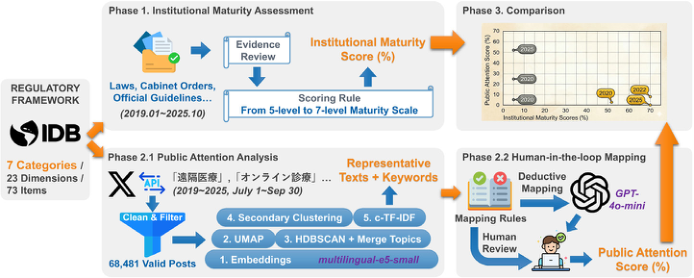
This study utilized a convergent mixed methods design to integrate a qualitative assessment of institutional maturity (supply side) with a quantitative analysis of public attention (demand side). As illustrated in Figure 1, the research comprises three distinct phases: (1) a systematic assessment of institutional maturity by adapting a regulatory framework for telemedicine; (2) the extraction of latent topics of public attention from large-scale social media data using BERTopic (Transformer-based embeddings) and large language models (LLMs), followed
Bridging Institutional Maturity and Public Attention 357 by mapping these topics onto the regulatory framework for telemedicine; (3) a comparison between institutional maturity and public attention.
Figure 1: Methodological flowchart of the mixed-methods approach.
Assessment of Institutional Maturity (Supply Side) To evaluate the institutional maturity of telemedicine in Japan, we adapted the “Regulatory Framework for Telemedicine” developed by IDB (Aizenberg, 2022) to the Japanese regulatory context. This framework comprises 7 core categories in telemedicine: Regulatory aspects, Governance, Personal data protection, Technological aspects, Actions of health institutions and teams, Role of patients, and Cross-cutting principles and human rights. These categories are further operationalized into 23 dimensions and 73 evaluation items.
Data collection involved a systematic review of Japan’s telemedicine related laws, cabinet orders, ministerial ordinances, administrative notices, and official guidelines issued between January 2019 and October 2025. We traced the revision history of each document to capture the institutional evolution triggered by the COVID-19 pandemic.
Considering Japan’s “soft law” governance, in which practical constraints are often shaped through administrative guidance rather than rigid statutes, we expanded the original five-level maturity scale into a seven-level maturity scale to enhance assessment granularity. Specifically, “Level 2 (Development phase)” was subdivided into three sublevels: 2-1 (Guideline stage), 2-2 (Administrative operation stage), and 2-3 (Strategy integration stage). Each item was first assigned a maturity level based on the evidence found in annual documents. Following the framework’s guidelines, these levels were then converted into specific scores by applying the assigned level of importance (low, medium, or high) to each dimension (Aizenberg, 2022). Finally, the total points were aggregated and converted into a normalized institutional maturity score (0–100%) for each category.
Extraction of Public Attention Topics (Demand Side) As a proxy for public attention, we collected Japanese posts related to telemedicine on X (formerly Twitter) via API service. We constructed
targeted search queries using core terms such as “オンライン診療” (online medical consultation) and “遠隔医療” (telemedicine), along with colloquial variants. The data collection window was set from July 1 to September 30 for each year between 2019 and 2025. This window was selected based on epidemiological data from the Ministry of Health, Labour and Welfare (MHLW, 2023) to capture a comparable epidemic phase across years, when COVID-19 infections and telemedicine use tended to surge, thereby facilitating longitudinal comparison.
During preprocessing, we implemented a rigorous data-cleaning workflow: (1). Text Normalization: Unifying full-width/half-width characters and removing URLs, extra spaces, and redundant punctuation. (2). De-noising: Excluding duplicate posts and very short texts (<5 characters). Manual screening was applied to identify and remove repetitive, machine-generated- like syntactic patterns. (3). Stop-word Removal: Using the fugashi engine for tokenization, we retained noun tokens only and applied a custom stop-word list to filter out common pronouns and formal nouns with low semantic value. The final dataset consisted of 68,481 valid posts.
To extract semantically coherent topics from unstructured text, we employed BERTopic, which combines a pre-trained language model for contextual embeddings with dimensionality reduction, density-based clustering, and class-based TF-IDF (c-TF-IDF) to generate well-structured and interpretable topics (Grootendorst, 2022). The specific parameters were configured as follows: Texts were mapped to 384-dimensional vector representations using the multilingual-e5-small pre-trained model. We applied mean pooling for sentence-level representations and L2 normalization to normalize vectors, ensuring stability in semantic distance calculations. Then we utilized UMAP (Uniform Manifold Approximation and Projection) to project high-dimensional vectors into a 5-dimensional space (n_neighbors = 30, min_dist = 0.0, random_state = 42), balancing the preservation of local structures with global structural consistency. We employed HDBSCAN (Hierarchical Density-Based Spatial Clustering of Applications with Noise) for density-based clustering (min_cluster_size = 30), with cluster_selection_method = “leaf” to capture fine-grained clusters. To prevent over-segmentation of highly similar semantics, clusters with a cosine similarity greater than 0.999 (based on topic representations) were merged during post-processing. For large clusters containing over 400 posts, which may exhibit high internal semantic heterogeneity, we applied a secondary clustering strategy. Vectors were first reduced to 50 dimensions via PCA (Principal Component Analysis) to remove redundancy, followed by subdivision using MiniBatchKMeans to generate sub-topics with higher interpretability and balanced sizes. Finally, we calculated the class-based TF-IDF (c-TF-IDF) scores to identify representative keywords for each cluster based on their relative importance.
We adopted a human-in-the-loop strategy to map the extracted topics of public attention onto the regulatory framework for telemedicine. Based on pre-defined mapping rules, the c-TF-IDF keywords and representative texts (up to 50 per cluster) were fed into the GPT-4o-mini model. The model
Bridging Institutional Maturity and Public Attention 359 performed deductive mapping under rule constraints to generate candidate allocations to institutional dimensions/items, along with the rationale for each decision. Subsequently, researchers manually reviewed and refined the model outputs using the same mapping rules to ensure the semantic consistency and boundary validity of the classification. Acknowledging the complexity of public discourse, we allowed for multi-label mapping (where a single topic corresponds to multiple institutional dimensions) and excluded noise topics (e.g., off-topic chatter) that could not be categorized within the current framework. Finally, for each category, the public attention score (0–100%) was computed as the proportion of posts assigned to that category (allowing multi-label assignments) relative to the total number of valid telemedicine- related posts in the corresponding year.
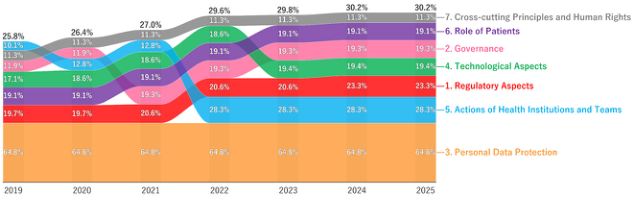
Figure 2: Trends in institutional maturity scores (%) by category from 2019 to 2025.
All analyses described above were conducted using Python 3.11.13.
The Comparison Between Institutional Maturity and Public Attention To facilitate the dialogue between qualitative institutional data and quantitative social data, we compared the temporal evolution and distributional differences between institutional maturity scores and public attention scores from 2019 to 2025, to identify the mismatches and alignments between them.
RESULTS
Characteristics of Institutional Maturity
Figure 2 illustrates the trends in institutional maturity scores across seven categories from 2019 to 2025, with the overall institutional maturity score (percentage of the maximum 2,220 points) annotated at the top of each year. The results indicate that the overall institutional maturity score increased gradually from 25.8% in 2019 to 30.2% in 2025. While the aggregate growth was modest, distinct variations were observed across categories. Actions of health institutions and teams (Institutional Maturity Score: MS2019 = 10.1%, MS2025 = 28.3%) and Governance (MS2019 = 11.9%, MS2025 = 19.3%) demonstrated the most significant growth, reflecting the government’s accelerated efforts to institutionalize telemedicine during the pandemic. In contrast, Regulatory aspects (MS2019 = 19.7%, MS2025 = 23.3%) and Technological aspects (MS2019 = 17.1%, MS2025 = 19.4%) showed small increases. Some categories showed no change in institutional maturity.
Notably, Personal data protection (MS2019-2025 = 64.8%) maintained a consistently high level of maturity throughout the period due to pre-existing rigid legal frameworks.
Temporally, the institutional development progressed unevenly. The period from 2019 to 2021 saw minor updates, while substantial growth occurred between 2021 and 2022. This shift primarily stemmed from special provisions regarding initial consultations during the pandemic. While minor revisions to detailed documents continued after 2022, no substantial structural changes were observed.
Table 1: Overview of item-level clusters by dimension with total clusters and post counts.
Table available in the original PDF paper.
Category Dimension Number of Posts (Sum of Clusters)
Example of Keywords in Japanese 1372 (10) 要件、指針、改定
1. Regulatory Aspects
1. General regulatory issues in telemedicine
2. Service delivery 11218 (65) 抗原、発熱、高熱 269 (2) 知事、スキーム、 大阪
3. Enforcement authority and responsibilities
3139 (18) 首相、会議、推進
2. Governance 4. National strategies and/ or specific government plans
388 (2) セミナー、企業、 参加
5. Telemedicine education and training
0 (0) (None)
6. Scopes of implementation in the health system
0 (0) (None)
3. Personal Data Protection
7. Legal protection of personal health data
0 (0) (None)
8. Ownership, use, and transfer of health data
9. Health data security 0 (0) (None) 968 (7) 往診、チャット、 夜間
4. Technological Aspects
10. Infrastructure and connectivity
510 (2) ナンバー、電子、 認証
11. Technical and/or technological aspects of telemedicine
6181 (37) 通話、郵送、送料
12. Digital tools and services in telemedicine
460 (3) 会長、政府、利権
5. Actions of Health Institutions and Teams
13. Authorization framework for telemedicine practice
3866 (24) 報酬、加算、療養
14. Issues related to the practice of telemedicine
347 (4) 通訳、外国、遠隔
15. Interjurisdictional service delivery
1958 (11) 心配、相談、受診
16. Humanization of telemedicine services
(Continued)
Table 1: Continued.
Table available in the original PDF paper.
Category Dimension Number of Posts (Sum of Clusters)
Example of Keywords in Japanese
0 (0) (None)
6. Role of Patients 17. Consent regarding personal rights
Characteristics of Public Attention In the primary clustering of posts for each year using HDBSCAN, the noise ratio ranged from 40.3% to 59.1%. Previous research indicates that when HDBSCAN is applied to short texts spanning diverse topics and contexts, up to 74% of content may be classified as noise (Groot et al., 2022). Considering the characteristics of posts on X, which often include diary-like or soliloquy- style content, this noise rate fell these results were considered acceptable within an acceptable range for thematic analysis. Following secondary clustering using MiniBatchKMeans, the final number of clusters for each year ranged from 9 to 52, with cluster sizes varying from 21 to 398. The Silhouette Scores ranged from 0.269 to 0.485. Given the inherent diversity and complexity of data on social networking services, these results were considered acceptable.
Table 1 presents an overview of for each dimension obtained by mapping topics of public attention onto the institutional framework. The results indicated that Regulatory aspects was the focal point of public attention, with the Service delivery dimension (Sum of Clusters: n = 65) generating a substantial volume of posts. This followed substantial post volume regarding Reducing barriers (n = 51) within Cross-cutting principles and human rights. Furthermore, Digital tools and services in telemedicine (n = 37) within Technological aspects represented another core area of public attention. In contrast, this study did not identify stable topics of public attention centered on Personal data protection. Although sporadic mentions existed in the raw corpus, their clustering scale in the embedding space was insufficient to form distinct topics.
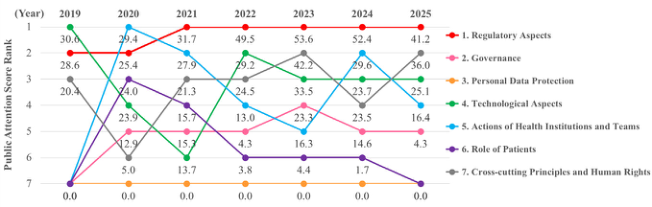
Figure 3 further illustrates public attention scores for each category and changes in their rankings across the seven categories. The results indicate that Regulatory aspects consistently ranked first from 2021 onwards, maintaining a high level of attention (Public Attention Score: AS2021-2025 = 31.7%-53.6%). Discussion regarding “positioning telemedicine as a substitute or supplement to face-to-face medical care” was particularly prominent. Actions of health institutions and teams exhibited two waves of heightened attention. From 2020 to 2021, the public attention (AS2020 = 29.4%; AS2021 = 27.9%) focused
on reimbursement for telemedicine consultations. Conversely, in 2024, there was a temporary increase in public attention (AS2024 = 29.6%) regarding ethics and professional standards of telemedicine. The ranking of Cross- cutting principles and human rights rose significantly after 2021, remaining in a higher position (AS2021-2025 = 21.3%-42.2%).
Figure 3: Temporal trends in public attention score (%) and rankings by category.
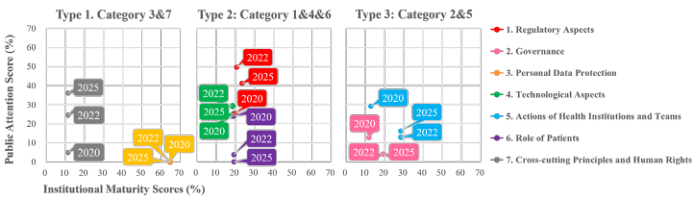
Comparison Between Institutional Maturity and Public Attention Based on the variations in scores, we classified the relationship patterns into three types: Misalignment, Tension, and Stabilization. To facilitate comparison and visualization, data from 2020, 2022, and 2025 were selected based on data volume and the pandemic timeline, as plotted in Figure 4.
Type 1 (Misalignment) represented a pattern of extreme divergence between institutional maturity and public attention. Specifically, while Cross-cutting principles and human rights remained at a low maturity level, it attracted surging public attention. Inspection of the topics reveals that public discourse actively sought solutions for specific barriers, such as remote care for individuals with disabilities and the over-the-counter availability of contraceptives. This stark contrast suggests that the current institutional framework has not adequately addressed the diverse needs of vulnerable groups. Conversely, Personal data protection showed high institutional maturity but negligible public attention, implying that existing legal protections may already satisfy public expectations. Type 2 (Tension) represented a pattern where public attention exhibited significant fluctuations or sustained high levels, while institutional maturity scores remained relatively constant. Specifically, public attention toward Role of patients surged during the early pandemic phase before declining (AS2019 = 0%; AS2020 = 24.0%), while attention toward Technological aspects showed volatility across the years. Meanwhile, Regulatory aspects consistently maintained a high volume of public discussion. Type 3 (Stabilization) represented a pattern characterized by a transient surge in public attention followed by a fallback, occurring in response to a rise in institutional maturity. Following the increase in the institutional maturity score for Governance in 2021, public attention rose from 2022 to 2023 and then gradually declined back to roughly its 2022 level by 2025. Similarly, Actions of health institutions and teams exhibited a phenomenon where attention first rose and then fell back following a significant increase in the institutional score in 2022.
Figure 4: Dynamic relationship patterns between institutional maturity and public attention.
DISCUSSION
The institutional maturity of Cross-cutting principles and human rights remained low throughout the period, despite rising public attention. This discrepancy was consistent with Miyawaki et al.’s work that identified significant disparities in telemedicine use by age and socioeconomic status in Japan during the pandemic (Miyawaki et al., 2021). From the MLP perspective, this represents a misalignment where the institutional regime has failed to absorb the normative pressures from the socio-technical landscape (Geels, 2011). While the pandemic shifted societal values towards health equity (landscape level), the deep structure of the regulatory regime remains locked in traditional efficiency-based models, creating a widening gap. These results indicated that bridging the digital divide and ensuring health equity were salient public concerns (Zhao et al., 2024), yet Japan’s institutional maturity has not effectively addressed this gap. The similar institutional immaturity pattern has been reported in studies of Latin American and Caribbean (LAC) countries (Aizenberg, 2022).
The rise in public attention toward Regulatory aspects was consistent with Ishikawa et al.’s work that identified regulatory relaxation as a primary driver of telemedicine adoption in Japan during the pandemic (Ishikawa et al., 2022). Notably, increases in institutional maturity for Governance and Actions of health institutions and teams preceded a surge in public attention, which subsequently returned to earlier levels. Ishikawa et al. reported that the 2020 policy relaxation led to a temporary surge in telemedicine utilization but did not fundamentally change the longer-term diffusion trend, which later stabilized (Ishikawa et al., 2022). This cyclical pattern suggested that telemedicine development in Japan may be largely “government-led” (Shibata et al., 2024).
Based on the comparative analysis of institutional maturity and public attention, this study proposes three policy recommendations. First, specific measures to bridge the “digital divide” for vulnerable groups should be developed. We recommend introducing digital support staff or hybrid care models to transform telemedicine from an emergency measure into infrastructure that supports healthcare equity (Wang and Sadahiro, 2024). Additionally, scenarios attracting high public attention should be considered, such as emergency contraception. Second, existing administrative guidelines should be transitioned into specific telemedicine legislation. Establishing a
clear statutory basis for telemedicine, rather than relying on interpretive notifications, will reduce regulatory uncertainty, thereby stabilizing public expectations and encouraging long-term investment by medical institutions. Finally, reflecting the high volume of public discussion regarding remuneration and the transient attention pattern observed in health institution actions, improving telemedicine reimbursement standards and establishing standardized practitioner training systems are essential. These measures are crucial for transitioning from a temporary crisis response to sustainable sociotechnical integration.
This study has limitations. First, while X provides real-time public discourse, its user demographics may not fully represent Japan’s super-aging population, potentially underrepresenting the voices of older adults who are primary targets of telemedicine. Second, the keyword-based data collection may have missed context-specific discussions (e.g., specific chronic diseases). Future research should integrate broader data sources, such as patient surveys or helpline records, to capture a more comprehensive spectrum of public needs.
CONCLUSION
This study demonstrated that integrating the telemedicine regulatory framework with social media topic modeling enabled a mixed-methods assessment of the structural misalignment between institutional maturity and public attention regarding telemedicine in Japan. Our results highlighted that although the pandemic catalyzed progress in institutional maturity, the alignment between institutional maturity and public attention exhibited distinct patterns across categories. Specifically, we identified three distinct interaction patterns between institutional maturity and public attention: (1) Stabilization: in Governance and Actions of health institutions and teams, where improvements in institutional maturity mitigated initial public attention; (2) Tension: in Regulatory aspects, where limited growth institutional maturity sustained high public attention; and (3) Misalignment: in Cross-cutting principles and human rights, where the institutional maturity lagged the landscape shift towards equity. These findings suggest that to transform telemedicine from an emergency measure into sustainable social infrastructure, we recommend that policymakers prioritize targeted support for vulnerable groups and scenarios attracting high public attention. Furthermore, integrating temporary administrative guidance into the formal legal system is essential to stabilize public expectations and better leverage healthcare system capacity in the long term. The mixed assessment framework proposed in this study provides a transferable methodological reference for analyzing alignment between institutional maturity and public attention in other regions.
ACKNOWLEDGMENT
This work was supported by the Japan Society for the Promotion of Science (Grant Number 24K07926).
REFERENCES
Aizenberg, M., 2022. Regulatory framework for telemedicine: current status and next steps. IDB Publ. https://doi.org/10.18235/0004176 Cresswell, K., Jahn, F., Silsand, L., Woods, L., Postema, T., Logan, M., Malkic,
S., Ammenwerth, E., 2025. Assessing digital maturity of hospitals: viewpoint comparing national approaches in five countries. J. Med. Internet Res. 27, e57858. https://doi.org/10.2196/57858 Eysenbach, G., 2009. Infodemiology and infoveillance: framework for an emerging set of public health informatics methods to analyze search, communication and publication behavior on the internet. J. Med. Internet Res. 11, e1157. https://doi. org/10.2196/jmir.1157 Geels, F.W., 2011. The multi-level perspective on sustainability transitions: Responses
to seven criticisms. Environmental Innovation and Societal Transitions 1, 24–40. https://doi.org/10.1016/j.eist.2011.02.002 Groot, M. de, Aliannejadi, M., Haas, M.R., 2022. Experiments on Generalizability of BERTopic on Multi-Domain Short Text. https://doi.org/10.48550/arXiv.2212.08459 Grootendorst, M., 2022. BERTopic: Neural topic modeling with a class-based
TF-IDF procedure. https://doi.org/10.48550/arXiv.2203.05794 IPSS, 2023. Population Projections for Japan (2023 revision) Report (in Japanese only). The National Institute of Population and Social Security Research. Ishikawa, T., Sato, J., Hattori, J., Goda, K., Kitsuregawa, M., Mitsutake, N., 2022.
The association between telehealth utilization and policy responses on COVID-19 in Japan: interrupted time-series analysis. Interactive Journal of Medical Research 11, e39181. https://doi.org/10.2196/39181 Kadoya, Y., Hara, M., Takahari, K., Ishida, Y., Tamaki, M., 2020. Disease Control Status and Safety of Telemedicine in Patients With Lifestyle Diseases – A Multicenter Prospective Observational Study in Japan –. Circ Rep 2, 351–356. https://doi.org/10.1253/circrep.CR-20-0019 Martín, M.S., Chen, F.-W., Urbistondo, P.A., 2025. Application of the LDA model
to identify topics in telemedicine conversations on the X social network. BMC Health Serv. Res. 25, 369. https://doi.org/10.1186/s12913-025-12493-3 MHLW, 2023. Results of the Evaluation of Telephone and Online Medical Consultations (April–July 2023). Ministry of Health, Labour and Welfare, Japan. Miyawaki, A., Tabuchi, T., Ong, M.K., Tsugawa, Y., 2021. Age and social disparities
in the use of telemedicine during the COVID-19 pandemic in Japan: cross- sectional study. J. Med. Internet Res. 23, e27982. https://doi.org/10.2196/27982 Sazon, H., Catapan, S. de C., Rahimi, A., Canfell, O.J., Kelly, J., 2023. How do Twitter users feel about telehealth? A mixed-methods analysis of experiences, perceptions and expectations. Health Expect 27, e13927. https://doi.org/10.1111/ hex.13927 Shibata, M., Aoki, T., Matsushima, M., 2024. Impact of the COVID-19 pandemic
on home medical care utilization in Japan: an interrupted time series analysis. J. Gen. Intern. Med. 39, 3146–3154. https://doi.org/10.1007/s11606-024-09003-2 The Council for Promotion of Regulatory Reform, 2025. Promotion of Regulatory Reform (2025) (in Japanese only). Cabinet Office, Government of Japan. Wang, S., Sadahiro, Y., 2024. Horizontal and vertical inequity of multi-modal
healthcare accessibility in the aging japan in the post-COVID era: a GIS-based approach. Int. J. Digital Earth 17, 2310731. https://doi.org/10.1080/17538947. 2024.2310731 Zhao, M., Yang, L., Qian, B., Yang, Y., Wei, G., Li, C., 2024. Physical-medical integration policies and health equity promotion in China: a text analysis based on policy instruments. Int. J. Equity Health 23, 266. https://doi.org/10.1186/ s12939-024-02327-9
LISTED IN THE AHFE DIGITAL BOOKSTORE CATALOGUE
Explore the complete digital volume
The Human Side of Service Engineering
Read this individual research paper free through the original publisher, or explore the full digital proceedings book.
ISBN 978-1-964867-97-7
Explore this ISBN in the AHFE Bookstore ↗Listed in the July 2026 bookstore catalogue; search by ISBN to confirm current availability · Digital book purchase optional