Yan Dong, Hanjie Yu, Qiong Wu (2023). Interweaving Design and Computing: Addressing Systemic Challenges in the Intelligent Era through Human-Computer Collaboration. In: Human Factors in Communication of Design. AHFE Open Access, vol. 90, pp. 211–218. https://doi.org/10.54941/ahfe1003713
he intelligent era has witnessed a profound integration of computing and design, leading to significant changes in the scale, scope, and tools of design, and has had a profound impact on future design practices. In particular, the development of artificial intelligence (AI) has made mutual understanding, communication, and collaboration between humans and machines an inevitable topic in design. This has prompted designers to reconsider their existing work modes, processes, mindset, collaborative relationships, and the application of collaborative design tools. What new insights do these changes bring to the mindset of designers? How can we redefine the mindset of designers based on the characteristics of the intelligent era and guide current design practices? This study focuses on the deep integration of technology and design in the intelligent era, combining insights from academic literature and the perspective of the design industry to explore how designers can effectively respond to the challenges of deep human-machine collaboration in the intelligent era from three aspects: design objects, thinking patterns, and methods.
The advancements in technology and changes in market demands are brin- ging about different ways of thinking and innovative approaches for desi- gners. Traditionally, designers have used their knowledge and experience in computer-aided design, with machines playing a passive role in the design process. However, the development of artificial intelligence (AI) technologies has introduced new methods such as parametric design, generative design, and algorithmic design, opening up new possibilities for human-computer collaboration. The development of intelligence has also brought challenges such as large-scale customization, massive amounts of data, digitization of physical objects, increased complexity of design objects, and shortened design cycles.
With billions of people entering the era of real-time design, traditional design patterns alone are insufficient to address the existing challenges. This
article explores, in a progressive manner, how to tackle the design challenges posed by complex systems in the era of intelligence through human-computer collaboration from three dimensions. Firstly, we review the history and explain the changes in the problems and objects that design faces in the era of intelligence. We propose that to achieve deep human-computer collabora- tion, designers need to establish their own understanding of design. Secondly, in response to these changes, designers’ thinking patterns need to be adjusted according to the changes and integrate design thinking with the characteri- stics of the times. Lastly, we discuss the considerations for human-computer collaboration. We analyse the existing collaboration processes and forms between humans and machines in the design workflow, explore the deve- lopment trends, and discuss how to fully leverage the strengths of humans and machines to achieve deep collaboration in order to address the current challenges.
Establishing Understanding of Systemic Problems The objects of design have always changed with the era. In the early industrial age, designers focused on designing individual objects. However, with the transformation of designers’ consciousness, they started to consider the rela- tionships between elements and their positions within the system to achieve optimal individual design (Guanzhong, 2011). The intelligent era has brou- ght about vast data and interconnections, leading to increasingly complex and large-scale design objects (Terry 2019)( Buchanan R. 1992). The syste- mic nature of design has shifted from systemic thinking to systemic objects. More and more systems have become the objects of design and optimiza- tion. In service design, for instance, the entire service process must involve multiple stakeholders and user touchpoints. Interaction and interface design for software systems need to address the relationships between hundreds of pages. Faced with such complexity in design objects, it is crucial for designers to develop their own understanding of systemic issues and then explore how humans and machines can collaborate to tackle unknown challenges.
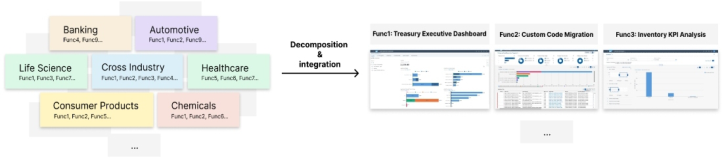
In the field of technology, engineers have long faced the challenge of complex systems. They have used techniques such as decomposition and integration to solve complex problems and improve efficiency. SAP, a well- known provider of enterprise software solutions, holds a prominent position in the global enterprise software market, occupying 92% of the market share. Their core business ERP software helps organizations manage their business processes, data analysis, and decision-making. The difficulty of such software lies in handling multiple stakeholders, diverse types of employees, complex system interactions across multiple devices, and data processing. The various complex relationships pose significant challenges for SAP engi- neers and designers, consuming a considerable amount of time. By integrating modular standardized software packages for similar functions across dif- ferent domains (see Figure 1), the large-scale issues of enterprise software systems can be transformed into executable specific problems. This approach minimizes development costs and enhances the design efficiency for handling complex systems.
Interweaving Design and Computing: Addressing Systemic Challenges 213
Figure 1: SAP disassembles and integrates enterprise software functionalities across multiple domains, forming a modular software package library.
During SAP’s early exploration, as they catered to the diverse business requirements of numerous industries, they discovered that their customers were developing similar or identical computer programs. They realized the need to provide standardized software that could integrate business proces- ses and facilitate real-time data maintenance. SAP consolidated the enterprise software requirements of various industries, such as retail, healthcare, tran- sportation, and logistics, into functional modules like procurement, analytics, asset management, and human resources. These modules were then integra- ted into modular standard software packages, facilitating the development of new enterprise software in the future.
Decomposition and integration are natural choices for technology and cost reduction, and they are also methods that can be borrowed to address systemic problems. SAP’s interface design guidelines follow the principles of decomposition and integration. For different functional components and page layouts, designers gather and categorize them, establishing design rules for modules of the same type.
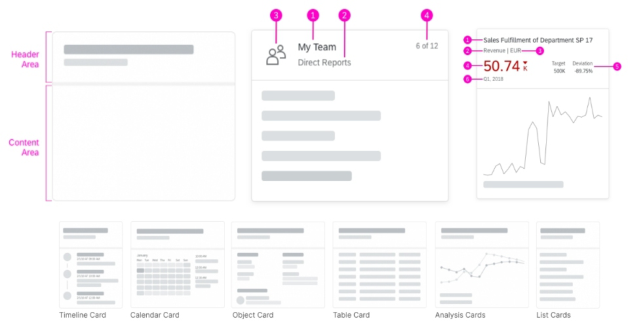
Taking card modules as an example (see Figure 2), which are important units for presenting interface content, although each card focuses on diffe- rent aspects of content, through analysis, it was found that the majority of cards can be divided into a title area and a content area. Designers sepa- rate them using dividing lines and establish guidelines for the use of elements such as icons, text, spacing, and borders. This ultimately achieves consistent
Figure 2: SAP analyzes “Card” components used in different pages to derive the layout patterns of card components. (SAP Fiori design guideline, 2023.)
design across the vast interface ecosystem of SAP to B (business-to-business) applications.
By standardizing the design rules and components within different modu- les, SAP ensures consistency in the user interface, which improves user experience and facilitates efficient navigation and interaction. This approach allows for scalability and ease of development for new modules and features within the SAP ecosystem.
Integration of Designerly Thinking and Computational Thinking Design, by its nature, is an innovative discipline that has always been at the forefront of addressing the challenges brought about by the changing times. As a creative and generative thinking process, design not only responds to the continuous changes in societal issues but also forms a system and methodo- logy of designerly thinking. It has even extended its influence to fields such as management and business.By examining the historical background of design, we can understand the problems that designerly thinking has addressed in different eras and how it has been defined.
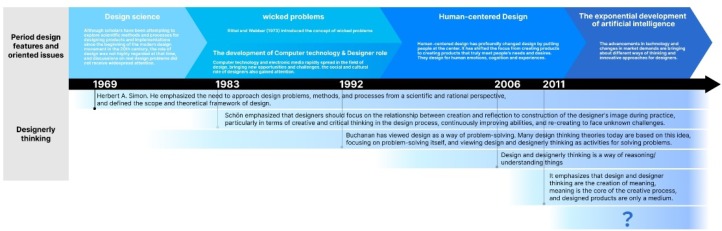
Designers’ thinking evolves with the characteristics and challenges of their time (Simon, 2019; Schön 1983; Rittel and Webber 1973; Buchanan, 1992; Wylant, 2010; Lawson, 2006; Cross, 2006, 2011; Krippendorff) (see Figure 3). In the intelligent era, the fusion of computation and design, par- ticularly with the advancement of artificial intelligence, has become increa- singly significant. Computational thinking, introduced by Jeannette M. Wing encompasses problem-solving, system design, and understanding human beh- avior (Jeannette M., 2006). Designers need to incorporate computational thinking abilities into their practice to participate in deep human-computer collaboration.
The traditional waterfall design process is often a top-down approach that fails to address mid-stream changes in a timely manner. It is only at the end of the process that results are seen, and overall iterative adjustments are made. Moreover, some small-scale iterations may not include feedback from subse- quent processes. In contrast, computational thinking emphasizes logical and incremental thinking. Robert Tinker believes that the core of computational thinking is decomposing complex problems into smaller ones and further
Figure 3: Designerly thinking is closely related to the development of the times and reflects the characteristics of the times.
Interweaving Design and Computing: Addressing Systemic Challenges 215
decomposing them until the smallest units of the problem can be solved automatically (NRC, 2011). By leveraging computational thinking and tech- nology, designers can consider encoding the design process, making each step of the design a series of evaluatable and modifiable instructions, allowing for individual and timely iteration at each stage of the design. A good example of integrating computational thinking into design is the use of visual pro- gramming methods (as shown in the diagram) in various design software. In such a process, the important aspect is the creation of links between different modules by the designer. This involves setting design rules where the input data and output results are not the most important aspects; rather, the focus is on the steps required to create those results. Through these rules and their variations, a range of results that meet the requirements can be generated, addressing the vast array of demands in system-level problems.
On the other hand, the integration of designerly thinking should also be considered in the construction of computational thinking. In the development of computational thinking, initially many researchers recognized the humani- stic aspects within computational thinking and began to incorporate factors such as logical thinking or critical thinking into their research. In the pro- cess of deep collaboration between humans and machines, it involves not only human-machine collaboration but also human-human collaboration, such as collaboration between designers, collaboration between designers and engineers. Computational thinking tends to have an engineering per- spective, while designerly thinking tends to have a design perspective. The integration of these two types of thinking is also a solution to the innovation problem that has been criticized in the field of artificial intelligence products.
Close Human-Computer Collaboration One of the core issues in human-machine collaboration is how humans inte- ract with machines. The success of human-machine collaboration depends not only on the rationality of the decision-making basis provided by mach- ine intelligence but also on the timing and manner of human intervention (Kaiquan and Chunxue. 2019). Currently, there is already a certain level of collaboration between humans and machines, and some companies have started to integrate AI tools into their design workflows. Companies like NetEase have implemented AI integration in some aspects of their gaming and e-commerce businesses. In addition, artificial intelligence technologies are
gradually being applied in fields such as autonomous driving, medical image analysis, and financial risk control. However, there is still a considerable gap to achieve true deep collaboration.
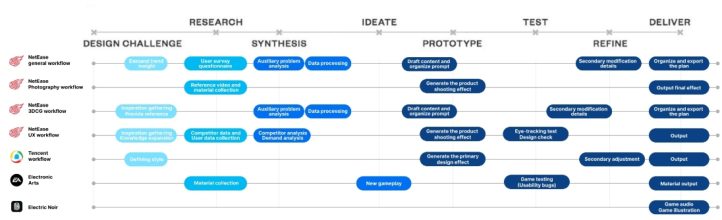
We have compiled and analyzed the workflow of major companies that use AI products for design purposes, (NetEase’s general /photography /3DCG workflow, Tencent’s AI workflow, Electronic Arts workflow and etc.). We visualized the cases where AI is involved in the workflow as data points. We found that the current human-machine collaborative design work mainly focuses on the generation phase (see Figure 5). However, the design process encompasses much more than just this phase. Machines also have potential in research, empathy, definition, ideation, design, prototyping, evaluation, testing, and iteration stages. Whether from the perspective of designers or user experience, there is still a long way to go for deep collaboration betw- een humans and machines. Future development should make full use of the respective advantages of humans and machines. Humans possess judgment, creative thinking, empathy, and aesthetic abilities that machines cannot fully replace. Machines, on the other hand, excel in handling large amounts of data and efficient computation, assisting in the analysis of massive data sets, identifying patterns and trends, and providing humans with more accu- rate information and predictions. Furthermore, machines can help liberate humans from repetitive, dangerous, or monotonous tasks, allowing humans to focus on creative and advanced tasks.
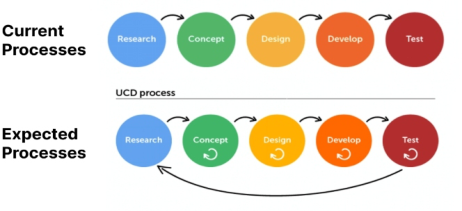
The existing human-machine collaboration is limited to specific domains and tasks (see Figure 5), and it cannot cover the entire design process. Intel- ligent systems struggle to consider requirements based on context and have difficulty engaging in meaningful deep communication, thus failing to achi- eve a high level of deep collaboration. Based on the traditional design process model (IDEO), we integrate the collaborative stages analyzed from existing cases, allocate different design stages between humans and machines based on their respective advantages, and iterate in a continuous loop to pro- vide a smooth human-machine collaboration experience. We believe that future workflows for human-machine collaboration should not be limited to coarse-grained division and collaboration between stages, but should instead involve real-time and close interaction. It is necessary to integrate different design stages and allocation methods to create a seamless workflow and experience.
Figure 5: Different companies’ human-machine workflows.
Interweaving Design and Computing: Addressing Systemic Challenges 217
CONCLUSION
This article focuses on the changes and characteristics of intelligent era design, discussing the mindset, tools and methods that designers need to master intel- ligent era design. It explores how designers can adapt to the transformation of design objects and address complex systemic issues. Furthermore, it exami- nes the historical background of the development of design, understanding the problems solved by designerly thinking in different eras, and explores new trends in designerly thinking in light of the characteristics of the intel- ligent era. Finally, by summarizing and analyzing existing AI-assisted design cases, it discusses the ideal timing and methods for deep human-computer collaboration in the design process.
However, the analysis and summarization of existing cases in our work are not yet comprehensive, and in future work, we will increase the number and scope of samples. It can be determined that as computation and design become more deeply integrated, the requirements on designers will conti- nue to rise. Emerging roles such as prompt engineers and machine trainers will also emerge. In the future, designers will need to constantly improve their skills and knowledge, have a profound understanding of language com- prehension, domain knowledge, artificial intelligence, and related fields in order to adapt to the changes brought about by the integration of artificial intelligence into the design field.
ACKNOWLEDGMENT
This work is supported by the National Social Science Fund of China, Art Project (19BG127).
REFERENCES
Buchanan R. (1992) Wicked problems in design thinking[J]. Design issues,: 5–21. Chen Kaiquan Zhang Chunxue. (2019) Multi-modal Learning Analysis, Adaptive Feedback and Human-computer Coordination of Artificial Intelligence inEduca- tion (EAI). Guanzhong Liu. (2011). Design Methodologh. Beijing. pp. 224–226 Irwin, Terry (2019) Terry Irwin: Transition design: Designing for Systems-Level
change and transitions toward more sustainable futures. In: Relating Systems Thinking and Design (RSD8) 2019 Symposium, Oct 13–15 2019, Chicago, USA. Krippendorff K. Design research, an oxymoron?[M]//Design research now: Essays and selected projects. DE GRUYTER, 2007: 67–80. NRC. (2011) Report of a Workshop on the Pedagogical Aspects of Computational
Thinking [M]. Washington DC: National Academies Press. SAP SE. (June 9, 2023) SAP Fiori Design Guideline Website: https://experience.sap.c om/fiori-design-web/. SAP SE. (June 9, 2023) The SAP Fiori Apps Reference Library Website: https://fioriappslibrary.hana.ondemand.com/sap/fix/externalViewer/#/homePage Simon H A. (2019) The Sciences of the Artificial, reissue of the third edition with a
new introduction by John Laird[M]. MIT press. Ulla Johansson-Sköldberg, Jill Woodilla, ed. (2013) Design Thinking: Past, Present and Possible Futures.
Wylant B. (2010) Design thinking and the question of modernity[J]. The Design Journal. 217–231. Zan’an Chen, Li Ningyu. (2021). From Algorithm to Participation in Building
Computational Model: The Connotation Evolution and Ability Structure of Computational Thinking from the Perspective of Human-Machine Collaboration.
LISTED IN THE AHFE DIGITAL BOOKSTORE CATALOGUE
Explore the complete digital volume
Human Factors in Communication of Design
Read this individual research paper free through the original publisher, or explore the full digital proceedings book.
ISBN 978-1-958651-66-7
Explore this ISBN in the AHFE Bookstore ↗Listed in the July 2026 bookstore catalogue; search by ISBN to confirm current availability · Digital book purchase optional