Roberto Venditti, Narek Minaskan, Evmorfia Biliri, Miguel Villegas, Barry Kirwan, Carl Westin, Jekaterina Basjuka, Simone Pozzi (2025). Construal Level Theory (CLT) for Designing Operational Explainability for Human-AI Teaming Interfaces in Aviation Contexts. In: Human Interaction and Emerging Technologies (IHIET-AI 2025): Artificial Intelligence and Future Applications. AHFE Open Access, vol. 161, pp. 268–276. https://doi.org/10.54941/ahfe1005918
Explainability is essential to fostering trust, transparency, and effective Human-AI Teaming (HAT) in high-stakes operational contexts where humans interact with complex AI systems. This paper presents the application of Construal Level Theory (CLT), a psychological framework, to design explainability interfaces in safety-critical contexts where the quantity of information and the time required to process it are critical factors. The CLT was originally developed to explain how individuals mentally construe objects and events at different levels of abstraction based on psychological distance (temporal, spatial, or social). The CLT has since been applied in the design of user interfaces, where it serves as the theoretical framework to structure information retrieval systems so that users can progressively query data at different levels of abstraction. Building on this foundational work, our contribution extends the CLT’s application to design explanation interfaces tailored to operators of AI systems used in six aviation use cases, including cockpit, air traffic control tower and airport operations. Our use of the CLT framework addresses key explainability questions in such systems: What information should be presented? When should it be shown? For how long? and At what level of detail? This paper outlines the design methodology and demonstrates its application in one Use Case where an Intelligent Sequence Assistant (ISA) is being developed to support and enhance decision-making for Air Traffic Controllers. ISA optimises runway utilisation in single-runway airports, providing real-time sequence suggestions for arriving and departing aircraft. These operational suggestions are accompanied by text-based explanations for all the sequence changes, structured according to the CLT in various levels of detail. Controllers can progressively query these explanations (e.g. by interacting with dedicated sections of the interface) to access the desired level of detail, build situational awareness, and understand the assistant’s reasoning. While the CLT provides a framework for structuring the information and the interaction with the system, it does not prescribe how the information should be visually presented on the Human-Machine Interface (HMI), leaving this decision to the designer.
Construal Level Theory (CLT) for Designing Operational Explainability 269
INTRODUCTION
When AI systems produce outputs, end-users may not always understand why the system produced them. Although Explainable AI (XAI) is often mentioned as a crucial building block for AI applications, it may be less relevant in general-purpose applications where explanations for outputs are not necessary. However, as AI becomes increasingly integrated into high- stakes operational contexts - such as aviation or defence - explainability may become critical to support informed and effective human decision- making during operations. One of the earliest research efforts in XAI can be traced back to the DARPA (Defence Advanced Research Projects Agency) XAI program (Gunning and Aha, 2019), which aimed to develop defence AI systems capable of providing meaningful explanations for their decision-making processes. The program highlighted objectives such as enhancing trust, transparency, and accountability in AI systems by enabling human users to understand the rationale behind AI-generated outputs. Later, The European Union Aviation Safety Agency (EASA) introduced new dimensions to XAI, such as “level of abstraction” and “time required to obtain an explanation”. As defined in EASA’s Guidance Paper (EASA, 2024), Operational Explainability (OpXAI) refers to the need for end users to receive clear, relevant, and reliable information on how an AI system reaches its conclusions. Operational explainability, distinct from technical explainability, is an emergent requirement for Human-AI Teams where humans collaborate with Intelligent Assistants. It emphasises the delivery information at the right level of detail and timing, ensuring that explanations are clear, actionable, and tailored to real-world operational needs. Table 1 summarises the differences between the two types of Explainability.
Table 1. Differences between technical and operational explainability.
Table available in the original PDF paper.
Characteristic Technical Explainability Operational Explainability Focus Model-centred: technical and architectural aspects User-centred: human factors in the context of Human-AI Teaming configurations Objective To make the system inherently interpretable or provide post-hoc explanations
To present the explanations produced by the system to the operator Key Question(s)
What explanations do the operators need? How (at what level of abstraction) should they be presented? When? For how long?
What architecture and model should be used? Which XAI techniques (e.g., LIME, SHAP) should be applied to explain the AI system’s outcomes?
When this type of explainability is used
At the beginning of the AI design process, when the system architecture is being developed
At the end of the AI pipeline, when the explanations have already been produced, and the challenge is how to present them to the operator
Construal Level Theory (CLT) (Trope and Liberman, 2003), is a psychological framework that provides insights into how individuals mentally represent and interpret events, objects, and information based on
their psychological distance. CLT argues that an individual’s construal or mental representations of their experiences are influenced by factors such as temporal distance (how far into the future an event is perceived), spatial distance (how physically close or distant an object or event is perceived), social distance (how close or distant a person or group is perceived), and hypotheticality (how likely or certain an event is perceived to occur), which results in an individual interpreting objects and events at different levels of abstraction. In the high-level construal abstraction, an object or event is perceived as distant, and people tend to think of it abstractly, focusing on its general characteristics and overarching goals. In the low-level construal abstraction, an object or event is perceived as near, thinking becomes more concrete, with attention shifting to specific details and immediate features. This theory was applied by McDermott and Folds (McDermott and Folds, 2022) in the context of Human-Machine Teaming to Command & Control (C2) systems. According to them, the CLT provided a theoretical foundation for hierarchically structuring information within user interfaces in operational military environments. The theory allows for the adaptation of the quantity and type of information based on users’ psychological distance from objects or events, thereby influencing the level of abstraction and detail with which the information is presented during missions. The original CLT model provides information representation based on six levels, as shown in Table 2, which summarises how information about a “past event” can be organised structurally at increasing levels of details.
Table 2. Six-layer model of CLT for informational systems (McDermott and Folds, 2022).
Table available in the original PDF paper.
CLT Level What Information Should Be Presented?
Content and Level of Detail Assimilation Time ∼10 seconds
1 Executive summary/main claim
This key outcome was/will be achieved as shown by these [key indicators] ∼30 seconds
2 Executive mission review/the main reason
CLT1 + because of these [key causal effects] ∼5 minutes
3 Mission summary/the justification
CLT2 + because in the [full causal model] these paths are of greatest importance (magnitude) ∼30 minutes
4 Mission brief/the basis of justification
CLT3 + because here is the [full measurement model] ∼60 minutes
5 Mission plan or report/a full summary of the data
CLT4 + because here is the time-step history of [all the measurements] >60 minutes
6 Mission details/all the data
CLT5 + and here are [all the anomalies and alternatives] considered
A key contribution of this work is the integration of time to assimilate information as a design consideration. As outlined by McDermott and Folds, the time needed to process information increases with the level of detail provided in the CLT hierarchy. At CLT1 and CLT2, information is designed for near-instant comprehension—typically within 10–30 seconds— using concise text and simple pictograms. Conversely, CLT5 and CLT6
Construal Level Theory (CLT) for Designing Operational Explainability 271
require much longer processing times, ranging from several minutes to hours, often utilising complex visualisations. Intermediate levels (CLT3 and CLT4), which require a few minutes to absorb, balance detail and complexity through a combination of images and more elaborate text.
Applying CLT to the design of OpXAI systems offers insights into how explainability can be tailored to the users and their operational needs when working with AI systems in safety-critical situations. The approach (in this paper) to design OpXAI systems consists in establishing a framework for information delivery, adapted to the domain applied, and then developing targeted explanation interfaces. Through this process, explanation interfaces are created that address users’ specific needs for clarity and detail, ultimately making AI systems more comprehensible and effective during operations.
APPLICATION OF CONSTRUAL LEVEL THEORY TO DESIGN THE OPERATIONAL EXPLAINABILITY IN AN AVIATION USE CASE The EU-funded project HAIKU (https://haikuproject.eu/) is developing six prototypes of Intelligent Assistants for six aviation use cases (UCs) and applies the CLT to guide the design of their OpXAI. This paper presents the application of the CLT to UC4. UC4 is developing the Intelligent Sequence Assistant (ISA), an AI-based system to support air traffic controllers (ATCOs) in the Alicante Tower in Spain during high-traffic situations. ISA aims to optimise runway use, enhance traffic sequencing, and reduce stress and potential errors by providing intelligent recommendations for traffic sequences. By the end of 2025 ISA is set to reach Technology Readiness Level (TRL) 6, demonstrating its integration into the Alicante simulation system for real-world applicability. UC4 stands out as an exemplary application, as the CLT directly guided the definition of abstraction levels and timing for information delivery, playing a pivotal role in shaping the final Human Machine Interface (HMI) design. To apply the CLT framework effectively, we followed these steps:
1. Task Analysis: Identified ATCO workflows regarding sequencing and key moments for information delivery. 2. Information Prioritisation: Determined the critical information required for decision-making encompassing the key AI outputs and explainability levels needed for effective operation. 3. CLT Structuring: Organised the explanations for the AI outputs using the original CLT levels to align AI outputs with explainability needs. 4. Model Adaptation: Adapted the McDermott & Folds model to tailor information quantity and assimilation time for this use case. For example, by looking at the original model, we determined which CLT levels were needed and we adapted the time required to acquire information for each of them. 5. Initial Validation: Conducted an initial validation session with ATCOs, streamlining the design by removing unnecessary levels based on feedback.
The final CLT-based structure for ISA is presented below.
Table 3. CLT levels for the intelligent sequence assistant (ISA).
Table available in the original PDF paper.
CLT Level
What Information Should Be Presented?
When Should It Be Shown?
Level of Detail Assimilation Time Pre-Op/During operations Extremely low Less than 5 seconds
1 Overview of the expected traffic (arrivals and departures).
During operations
Low Less than 10 seconds
2 This level contains CLT 1 plus the immediate solution for a sequence change.
During operations
Medium/Low Less than 1 minute
3 This level contains CLT 2 plus the complete data leading to the sequence changes.
Post Operations
Medium Between 1 and 5 minutes
4 This level contains CLT 3 plus useful information regarding all the sequences changed during the session (changed sequence, essential sensor data) for debriefing for the next shift.
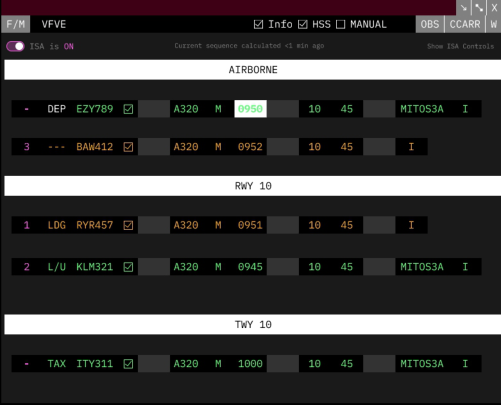
This CLT structure laid the foundation for concrete HMI requirements. The HMI implements this approach by displaying ISA’s real-time recommendations on the electronic bay on the left side of ATCOs’ screens. The electronic strips include connection status and sequence details, with magenta numbers highlighting each aircraft’s position within the current sequence (Figure 1). This color-coding distinguishes ISA-related features from other elements.
Figure 1: ISA HMI overview.
Construal Level Theory (CLT) for Designing Operational Explainability 273
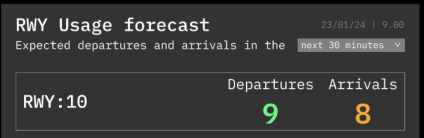
The CLT levels implemented within ISA are as follows. Level 1: Displays the mission status, showing main Key Performance Indicators for an overview of traffic patterns. Designed for instant acquisition of information.
Figure 2: ISA CLT level 1.
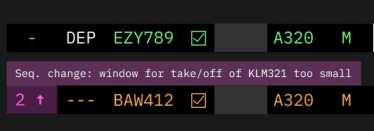
Level 2: Provides initial explainability, showing aircraft sequence positions with quick hover-over information about their placements in the sequence, and main reason why a sequence was changed.
Figure 3: ISA CLT level 2.
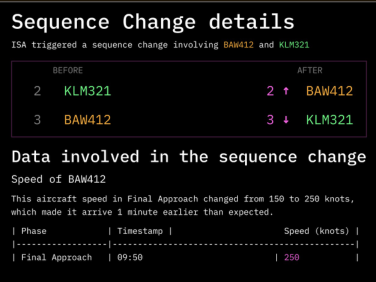
Level 3: Offers detailed explainability. ATCOs can click on an aircraft’s sequence number for a deeper explanation of the AI’s decision-making steps, including the data leveraged.
Figure 4: ISA CLT level 3.
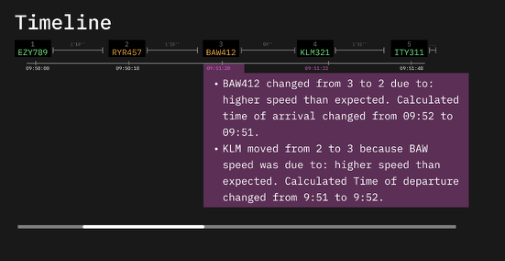
Level 4: Provides post-operation explainability with a timeline showing a log of all sequence changes during the mission, useful for supervisors conducting detailed reviews and for training purposes.
Figure 5: ISA CLT level 4.
Early consultations with ATCOs highlighted the need for progressive disclosure, enabling operators to access varying levels of detail based on traffic demands. During peak periods, ATCOs may only need the final sequence recommendation and a brief explanation (e.g. CLT level 2), while calmer moments allow for reviewing detailed steps behind the AI’s suggestions (e.g. CLT level 3 and 4). This design allows ATCOs to dynamically engage with the system’s explanations, potentially increasing trust in the AI over time if it proves its reliability.
Sequence and Explanation Generation The HMI displays data processed by the system’s backend. Calculating optimal aircraft sequences in a complex environment such as the Alicante Airport involves integrating data from multiple sources, including:
Flight (aircraft) data, including static information (arrival/depar- ture/overflight indication, aircraft type and model, wake turbulence, flight type, callsign), potentially dynamic information (assigned parking stand, EOBT or CTOT for departures, emergency flight indication, flight rules) and fully dynamic information (positions, track, and true airspeed) received every second.
Flight (aircraft) events, e.g. clearances, landing & take-off confirmation, status changes.
Airport information, including both static information (parking stands, coordinates) and dynamic (active runway and runway status).
Other variables, e.g. the time separation between consecutive flights. There is a predefined value for this, but it is also adjustable by the user.
ATCOs usually combine this data with experience-based knowledge, such as expected landing or taxi times, to mentally calculate optimal sequences. The system complements this by automating sequence calculations using context-aware services:
A service that computes in real time the estimated arrival time for arrival flights. This is done by applying a trained XGBoost (2022) regression model, whose output is the remaining time in seconds until the aircraft lands.
Construal Level Theory (CLT) for Designing Operational Explainability 275
A service that configures and applies an optimisation (Mixed Integer Linear Programming, MILP) algorithm using the current set of active aircraft, e.g. the aircraft that the controller needs to consider for sequencing. The model returns the flight sequence (including arrivals and departures) that minimises the total runway usage time, e.g. the sequence that ensures the last flight of the sequence will depart/land as soon as possible. To provide the necessary input to the optimisation, the system leverages all available information, including the arrival time estimations and other pre-computed properties, e.g. taxi and pushback times. The model’s constraints are based on input provided by ATCOs of Alicante Airport.
Regarding explanations, the system implements a rule-based approach to generate explanations that would cover the ATCOs’ needs under different scenarios and across the different CLT levels. Explanations at CLT2 will be the most leveraged, and are offered across two main axes.
Explanations for the sequence. After considering several variations of what information would be adequate for an ATCO to understand why each aircraft is given its order in the sequence, the simplest solution was selected as the most concise, e.g. the phrase “Expected time to use the runway: XX:XX”. This time is the output of the optimisation algorithm, whose inputs essentially include all static and dynamic information for the airport and the departing and arriving aircraft.
Explanations for sequence changes, e.g. when two subsequent runs of the optimisation algorithm provide a different output, not caused by an aircraft finishing its operation (landing or departing) or an explicit ATCO action. Reasons why this can happen include an unexpected change of speed of an arriving aircraft or a departing aircraft entering the calculation (e.g. starting its engines or its pushback operation). To maintain a consistent view for the ATCOs so that they can quickly locate the information they need, the phrasing for this case is similar to the previous. For example, assuming that the first two aircraft in the sequence swap places, the explanations would be as follows: “Expected time to use the runway: XX:XX. Z’ before Callsign_B” for the new aircraft in position 1 and “Expected time to use the runway: XX:XX. New #1: Callsign_A.” for the aircraft now in position 2 (and previously in 1).
The explanations for levels 1, 3 and 4, are provided in separate sections on the interface upon the ATCOs’ request (mouse click) and the information they provide ranges from a simple aggregation in the case of level 1 to more details in the underlying information (e.g. which steps led to the sequence change).
CONCLUSION
This paper presents a CLT-based approach to design OpXAI interfaces, rooted in human factors to enhance user experience and trust in high-stakes environments, aligning with EASA’s guidance. By structuring explanations at multiple levels of detail and allowing context-specific data queries,
this approach supports decision-making in dynamic contexts by adapting information to users’ needs. As demonstrated in this study, CLT provides a robust framework for both high-level conceptual design and detailed HMI requirements. The model has been validated in early sessions with users using low-fidelity prototypes, providing initial insights into its effectiveness. A final validation session, scheduled for the end of this year, will test the model with a high-fidelity prototype within the HAIKU project, confirming its robustness in realistic settings. Future work could expand this approach through multisensory design, distributing information across visual, auditory, and tactile channels to match cognitive load and further enhance operational explainability. AI could even be used to assess the ATCO’s mental load and deliver the most appropriate level of detail at the right time. The CLT framework also offers valuable training applications, enabling operators to progressively explore AI decision-making processes before deployment. In conclusion, a CLT-informed framework provides a versatile, scalable model for designing explainability interfaces, adaptable to real-time and pre- and post-operational needs in safety-critical domains such as aviation.
ACKNOWLEDGMENT
This publication is based on work performed in the HAIKU Project which has received funding from the European Union’s Horizon Europe research and innovation programme, under Grant Agreement no 101075332. Any dissemination reflects the authors’ views only, and the European Commission is not responsible for any use that may be made of information it contains.
REFERENCES
EASA (2024). EASA Artificial Intelligence Concept Paper Issue 2 - Guidance for Level 1 & 2 machine-learning applications: https://www.easa.europa.eu/en/document-l ibrary/general-publications/easa-artificial-intelligence-concept-paper-issue-2 Gunning, D. and Aha, D. (2019). DARPA’s Explainable Artificial Intelligence (XAI)
Program. AI Magazine, [online] 40(2), pp. 44–58. doi: https://doi.org/10.1609/ai mag.v40i2.2850. McDermott, T. and Folds, D. (2022). Construal level theory in the design of informational systems. Frontiers in Physics, 10. doi: https://doi.org/10.3389/fp hy.2022.958450. Trope, Y. and Liberman, N. (2003). Temporal construal. Psychological Review,
110(3), pp. 403–421. doi: https://doi.org/10.1037/0033-295x.110.3.403. XGBoost Developers (2022). XGBoost Documentation — xgboost 1.5.1 documentation. [online] xgboost.readthedocs.io. Available at: https: //xgboost.readthedocs.io/en/stable/.
LISTED IN THE AHFE DIGITAL BOOKSTORE CATALOGUE
Explore the complete digital volume
Human Interaction and Emerging Technologies (IHIET-AI 2025): Artificial Intelligence and Future Applications
Read this individual research paper free through the original publisher, or explore the full digital proceedings book.
ISBN 978-1-964867-37-3
Explore this ISBN in the AHFE Bookstore ↗Listed in the July 2026 bookstore catalogue; search by ISBN to confirm current availability · Digital book purchase optional