Tarika Kumar, Matteo Zallio (2025). Unpacking the Invisible: Human Factors in a Data-Driven World. In: Human-Computer Interaction & Emerging Technologies. AHFE Open Access, vol. 195, pp. 261–268. https://doi.org/10.54941/ahfe1006244
Design, at its core, is fundamentally concerned with human experience—shaping perception, environment, and behavior. In an increasingly interconnected and digital world, design ethnography and human factors research must evolve beyond traditional, verbally focused, and localized studies to incorporate innovative, technology-driven methodologies. This paper explores emerging approaches to human factors in design, with a focus on data ethnography and entangled ethnography as methods for gaining deeper insights into the complex interplay between perception, behavior, and technological ecosystems. Through the lens of Globally Inclusive Design, we examine the opportunities and ethical challenges these methodologies present, particularly in relation to AI systems. Ultimately, this paper demonstrates how advanced ethnographic methods can inform the development of human-centered AI systems that enhance usability, resilience, and well-being. By bridging methodological innovation with ethical considerations, it contributes to the ongoing discourse on human factors in complex technological and design ecosystems—advocating for design practices that reflect the diversity, complexity, and interconnectedness of human experiences.
Artificial intelligence is fundamentally reshaping human interactions with technology, giving rise to increasingly complex digital ecosystems that seamlessly bridge physical and virtual spaces. While traditional design methodologies remain foundational, they often fall short in capturing the dynamic interplay between human behavior, culture, and emerging technologies. Ethnographic research—with its emphasis on context and lived experience—has evolved to meet these challenges. In this paper, we provide a comprehensive literature review and critical synthesis of ethnographic methods as they apply to AI system design. We examine how traditional ethnography, data ethnography, and entangled ethnography, alongside theoretical perspectives such as new materialism, enhance our understanding of human–AI interactions. By highlighting methodological innovations and
evaluating current practices, we propose a pathway for developing AI systems that are both ethically sound and globally inclusive.
Background: Theoretical Foundations Early ethnographic inquiry into human–technology interactions has its roots in human–computer interaction (HCI) research. Suchman (2007) demonstrated the value of immersive fieldwork in uncovering the situated nature of human–machine encounters. Over time, theoretical frameworks have evolved to capture the complexity of our increasingly interconnected and multimodal digital environments. For instance, activity theory (Kaptelinin & Nardi, 2006) emphasizes that human actions are mediated by tools and shaped by socio-cultural contexts, providing a robust framework for understanding interactions in technologically rich settings. Meanwhile, actor-network theory (Latour, 2005) challenges conventional boundaries between human and non-human agents by asserting that technological artifacts actively shape social reality.
In recent years, new materialism has emerged as a critical lens for examining the active role of matter and materiality in digital infrastructures. Scholars argue that materiality is not passive but vibrantly active, influencing how hardware, network infrastructures, and even AI algorithms mediate user experience (Barad, 2007; Bennett, 2010; Murray-Rust et al., 2019). Complementing this perspective, Aurenhammer et al., (2021) has explored how human-centered design is a discipline that can inform the development of ethical and resilient emerging technologies. His work highlights that the physical constraints of technological systems and the embeddedness of data are essential factors that traditional discursive approaches might overlook.
Collectively, these theoretical perspectives provide a multidimensional framework for analyzing the complex, reciprocal relationships between humans and AI systems. They underscore the need for innovative ethnographic methodologies that not only consider cultural and behavioral dimensions but also account for the tangible, sometimes unpredictable, influence of materiality—an approach that is critical for the design of globally inclusive, ethically sound AI systems.
ETHNOGRAPHIC METHODS This section critically reviews the principal ethnographic approaches applied to AI system design, examining their methodologies, contributions, and limitations, while drawing on a broad range of literature.
Traditional Ethnography Traditional ethnographic methods—including participant observation, in- depth qualitative interviews, and contextual inquiry—have long been used to capture the nuanced practices underlying technology use. Such approaches excel at uncovering rich, contextualized data and revealing the tacit social norms that shape human–machine interactions (Suchman, 2007; Geertz, 1973). However, their localized and time-intensive nature can be a significant limitation when studying AI systems, which operate in distributed and
Unpacking the Invisible: Human Factors in a Data-Driven World 263
hybrid digital environments. The scalability of traditional ethnography is constrained, making it challenging to address the rapid evolution and global reach of contemporary AI technologies.
Data Ethnography In response to the limitations of traditional ethnography, data ethnography leverages digital traces—such as sensor data, social media interactions, and online behavioral logs—to map user interactions at scale. Researchers like Kozinets (2015) and Hine (2015) have illustrated that computational analysis of digital footprints can reveal aggregate patterns of behavior that are not easily observable through direct fieldwork. Data ethnography provides a macroscopic view of how users interact with AI systems, offering statistically robust insights into trends and anomalies. Given the vast amounts of data now available, in use, and generated by human interactions with digital and physical systems, these methods promise to uncover unseen, undetectable, and unreported facets of human behaviour in complex environments. It offers a means by which design researchers may uncover human factors beyond what can be collected via self reported and observational analyses. Nevertheless, while its quantitative nature expands the scope of analysis, data ethnography may fall short in capturing the deep, contextual subtleties that explain why users behave in certain ways.
Entangled Ethnography Entangled ethnography represents a paradigm shift that rejects the traditional dichotomy between observer and observed. Grounded in actor- network theory (Latour, 2005) and informed by new materialism (Barad, 2007; Murray-Rust et al., 2019), this approach treats technological systems as active participants that both shape and are shaped by human behavior. Chen et al. (2020) argue that entangled ethnography allows researchers to explore the dynamic, reciprocal relationships inherent in human–AI interactions by considering feedback loops and emergent practices. This methodology provides micro-level insights into how cultural practices and perceptions are co-constituted by technology and human interaction. However, it also introduces complex ethical questions regarding agency and the blurred boundaries between researcher, participant, and system. The reflexivity required by entangled ethnography demands rigorous methodological design and a continuous critical engagement with its own processes (Sengers, 2007).
SYNTHESIS OF THE LITERATURE Foundational Works: Suchman’s Human-Machine Reconfigurations (2007) and Geertz’s The Interpretation of Cultures (1973) provide the theoretical underpinnings of traditional ethnography in understanding human interactions with technology. Data Ethnography: Kozinets (2015) and Hine (2015) have pioneered methods for analyzing digital traces, offering a framework for large-scale behavioral analysis in digital environments.
Actor-Network and New Materialism: Latour’s Reassembling the Social (2005) and Barad’s Meeting the Universe Halfway (2007) challenge
264 Kumar and Zallio
conventional separations between human and nonhuman actors, while Murray-Rust et al. (2019) explore the tangible impact of materiality in digital systems.
Emerging Approaches: Chen et al. (2020) illustrate the potential of entangled ethnography in capturing the iterative interactions between users and AI systems, emphasizing the need for methodological innovation to address the ethical dimensions of these engagements.
Critical Perspectives: Sengers (2007) and other scholars call for a re- examination of ethnographic practices to ensure that they adequately address the evolving landscape of AI and digital interaction.
Together, these approaches form a multidimensional framework for understanding and designing AI systems that are both effective and ethically robust. By integrating traditional and novel ethnographic methods, researchers can capture the full complexity of human–AI interactions and inform the development of systems that are sensitive to both contextual and material influences.
Traditional ethnography provides deep contextual insights, data ethnography offers breadth and scalability, and entangled ethnography unveils the dynamic interplay between human and non-human agents. When combined with the theoretical insights from new materialism, these methods form a complementary toolkit that is well-suited to the challenges of studying AI in diverse, globally inclusive contexts. The integration of these approaches can yield a more holistic understanding of both the quantitative and qualitative dimensions of human–AI interaction, ultimately informing the design of systems that are both user-centered and ethically responsible.
EVALUATION OF ETHNOGRAPHIC METHODS A critical evaluation of the reviewed literature highlights several dimensions in which ethnographic methods can be assessed: methodological integration, validity and reliability, ethical considerations, and practical design implications.
Methodological Integration One of the central challenges in ethnographic research on AI is reconciling the strengths and constraints of qualitative and quantitative methods. Traditional ethnography offers deep, context-rich insights, yet struggles with scalability. Data ethnography can analyze massive datasets but often lacks the nuanced understanding provided by qualitative methods. Entangled ethnography, while offering a balance between data-driven and context-rich approaches, makes it difficult to separate observer, observed, and artifact. The literature emphasizes the potential of hybrid methodologies that combine digital analytics with immersive fieldwork to provide both breadth and depth. Successful integration requires interdisciplinary collaboration, innovative research designs, and the willingness to traverse methodological boundaries.
Unpacking the Invisible: Human Factors in a Data-Driven World 265
Validity and Reliability Ethnographic research is often criticized for its potential subjectivity and limited generalizability. Traditional approaches rest on the validity of prolonged engagement and the degree to which an ethnographer is embedded in the context of choice. Data ethnography benefits from statistical rigor and reproducibility. Entangled ethnography challenges conventional methods by emphasizing context-dependent interpretations of behavioural phenomena. The literature calls for the establishment of standardized protocols and the evaluation frameworks that can help reconcile these differences. Combining qualitative insights with quantitative validation may improve overall reliability and ensure that findings are both robust and contextually grounded.
Ethical Considerations The ethical dimensions of ethnographic research on AI are multifaceted. For instance, data ethnography raises significant concerns about privacy and consent, especially given the potential for pervasive surveillance and data misuse, as noted by Boyd and Crawford (2012). In the context of emerging technologies like the metaverse, these concerns are amplified; immersive virtual environments collect extensive behavioral, biometric, and interaction data, creating risks around user privacy and the potential for manipulation. Additionally, entangled ethnography complicates traditional ethical frameworks by attributing agency to technological artifacts, thereby challenging established notions of informed consent and accountability.
Emerging fields such as metavethics (Zallio et al., 2022; Zallio et al., 2023) further interrogate these issues by questioning the moral underpinnings of digital interactions and the values embedded within AI systems. For example, in the metaverse, ethical considerations include not only data protection but also fairness in algorithmic decision-making and the preservation of cultural and social diversity (Floridi, 2013; Crawford, 2021). These studies underscore the critical need for transparent, multidisciplinary ethical guidelines that protect participant rights while enabling innovative research. A comprehensive approach that integrates insights from ethics, law, and technology is essential to develop protocols capable of addressing these complex challenges in digital and immersive environments.
SYNTHESIS AND DESIGN IMPLICATIONS The synthesis of the reviewed literature reveals that ethnographic methods, when used in concert, provide a robust framework for understanding and designing AI systems. The integration of traditional, data-driven, and entangled approaches—with the added lens of new materialism—enables researchers to capture both the macro-level patterns and micro-level nuances of human–AI interaction. This integrated framework aligns closely with the principles of Globally Inclusive Design, ensuring that technological innovations are adaptable across cultural, social, and material contexts.
266 Kumar and Zallio
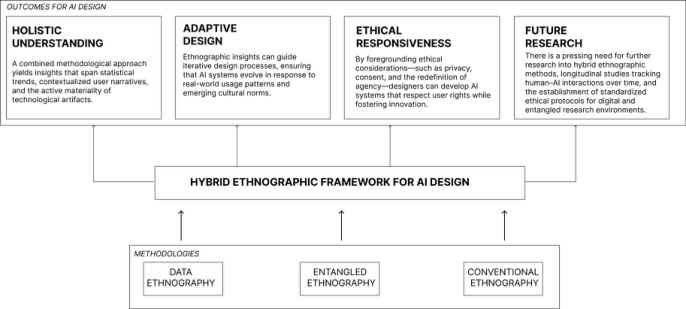
Figure 1: Infographic depicting the AI system design implications for a hybrid ethnographic approach at the intersection of reviewed ethnographic methods.
Key implications for AI system design include:
Holistic Understanding: A combined methodological approach yields insights that span statistical trends, contextualized user narratives, and the active materiality of technological artifacts.
Adaptive Design Processes: Ethnographic insights can guide iterative design processes, ensuring that AI systems evolve in response to real- world usage patterns and emerging cultural norms.
Ethical Responsiveness: By foregrounding ethical considerations—such as privacy, consent, and the redefinition of agency—designers can develop AI systems that respect user rights while fostering innovation.
Future Directions: There is a pressing need for further research into hybrid ethnographic methods, longitudinal studies tracking human–AI interactions over time, and the establishment of standardized ethical protocols for digital and entangled research environments.
CONCLUSION AND FUTURE DIRECTIONS This review has examined the evolution and application of ethnographic methods in AI system design. Traditional ethnography, data ethnography, and entangled ethnography each contribute unique insights into the complex, distributed nature of human–AI interactions. Our evaluation reveals that while each approach has its limitations, a hybrid methodology that leverages their complementary strengths can provide a more complete understanding of user behavior and technological dynamics.
Moving forward, research should focus on developing standardized protocols that integrate qualitative and quantitative insights, ensuring methodological rigor and ethical transparency. Longitudinal studies will be critical in capturing the evolving nature of human–AI interactions and informing adaptive design strategies. By embracing interdisciplinary collaboration and continually refining research methods, the field can
Unpacking the Invisible: Human Factors in a Data-Driven World 267
advance toward AI systems that are not only functionally robust but also deeply aligned with the diverse, ethical, and cultural realities of their users.
ACKNOWLEDGMENT
Author Tarika Kumar conducted the research, wrote the ‘Introduction’, ‘Ethnographic Methods’, ‘Evaluation of Ethnographic Methods’, co-wrote ‘Synthesis of the Literature’ and ‘Ethical Considerations’, and developed the figure. Dr. Matteo Zallio co-wrote the ‘Synthesis of the Literature’ and ‘Ethical Considerations’ and supervised the research. All authors have read and agreed to the published version of the manuscript.
REFERENCES
Atkinson, P., Coffey, A., Delamont, S., Lofland, J., & Lofland, L. H. (2001).
Handbook of Ethnography. Thousand Oaks, CA: Sage. Auernhammer, J., Zallio, M., Domingo, L., & Leifer, L. (2022). Facets of Human- Centered Design: The Evolution of Designing by, with, and for People. In Design Thinking Research. Springer International Publishing. ISBN: 978-3-031-09297-8. https://doi.org/10.1007/978-3-031-09297-8 12 Barad, K. (2007). Meeting the Universe Halfway: Quantum Physics and the
Entanglement of Matter and Meaning. Durham, NC: Duke University Press. Bennett, J. (2010). Vibrant Matter: A Political Ecology of Things. Durham, NC: Duke University Press. Boyd, D., & Crawford, K. (2012). Critical Questions for Big Data: Provocations
for a Cultural, Technological, and Scholarly Phenomenon. Information, Communication & Society, 15(5), 662–679. Callon, M. (1986). Some Elements of a Sociology of Translation: Domestication of the Scallops and the Fishermen of St Brieuc Bay. In J. Law (Ed.), Power, Action, and Belief (pp. 196–233). London: Routledge & Kegan Paul. Chen, Y., et al. (2020). [Entangled Ethnography in AI System Design]. [Publisher/
Journal details pending]. Coole, D., & Frost, S. (2010). New Materialisms: Ontology, Agency, and Politics.
Durham, NC: Duke University Press. Crawford, K. (2021). The Atlas of AI: Power, Politics, and the Planetary Costs of Artificial Intelligence. New Haven, CT: Yale University Press. Dunne, A., & Raby, F. (2001). Design Noir: The Secret Life of Electronic Objects.
Cambridge, MA: MIT Press. Floridi, L. (2013). The Ethics of Information. Oxford: Oxford University Press. Geertz, C. (1973). The Interpretation of Cultures. New York: Basic Books. Haraway, D. (1991). Simians, Cyborgs, and Women: The Reinvention of Nature.
New York: Free Press. Hine, C. (2015). Ethnography for the Internet: Embedded, Embodied and Everyday.
London: Bloomsbury Academic. Kaptelinin, V., & Nardi, B. A. (2006). Acting with Technology: Activity Theory and Interaction Design. Cambridge, MA: MIT Press. Kozinets, R. V. (2015). Netnography: The Essential Guide to Qualitative Social
Media Research. Thousand Oaks, CA: SAGE Publications. Latour, B. (1996). Aramis, or the Love of Technology. Cambridge, MA: Harvard University Press.
268 Kumar and Zallio
Latour, B. (2005). Reassembling the Social: An Introduction to Actor-Network- Theory. Oxford: Oxford University Press. Law, J. (1992). Notes on the Theory of the Actor-Network: Ordering, Strategy, and
Heterogeneity. Systems Practice, 5(4), 379–393. Murray-Rust, P., et al. (2019). [Title/Journal details pending]. Pickering, A. (1995). The Mangle of Practice: Time, Agency, and Science. Chicago, IL: University of Chicago Press. Sengers, P. (2007). [Specific Work on Critical Design]. [Publisher/Conference details
pending]. Spradley, J. P. (1980). Participant Observation. New York: Holt, Rinehart and Winston. Suchman, L. A. (2007). Human-Machine Reconfigurations: Plans and Situated
Actions (2nd ed.). Cambridge: Cambridge University Press. Van Maanen, J. (1988). Tales of the Field: On Writing Ethnography. Chicago, IL: University of Chicago Press. Woolgar, S. (1988). Configuring the User: The Case of Usability Trials. In
A. Collins, K. Evans, & C. G. McCracken (Eds.), The Social Construction of Technological Systems: New Directions in the Sociology and History of Technology (pp. 267–304). Cambridge, MA: MIT Press. Zallio, M., & Clarkson, P. J. (2022). Designing the Metaverse: A Study on Inclusion, Diversity, Equity, Accessibility and Safety for Digital Immersive Environments. Telematics and Informatics, 101909. ISSN 0736–5853. https://doi.org/10.1016/ j.tele.2022.101909 Zallio, M., & Clarkson, P. J. (2023). Metavethics: Ethical, Integrity and Social
Implications of the Metaverse. In T. Ahram, W. Karwowski, P. Di Bucchianico, R. Taiar, L. Casarotto, & P. Costa (Eds.), Intelligent Human Systems Integration (IHSI 2023): Integrating People and Intelligent Systems. AHFE International, USA. http://doi.org/10.54941/ahfe1002891
Read this individual research paper free through the original publisher, or explore the full digital proceedings book.
ISBN 978-1-964867-71-7
Explore this ISBN in the AHFE Bookstore ↗Listed in the July 2026 bookstore catalogue; search by ISBN to confirm current availability · Digital book purchase optional