Spada Stefaniaa, Germanà Danilaa, Ghibaudo Lidiaa, Sessa Fabriziob (2022). An Integrated Approach to Ergonomics in the Design Phase of New Car Models: Virtual Simulation and Physical Validation. In: Advances in Ergonomics In Design, Usability & Special Populations: Part III. AHFE Open Access, vol. 20. https://doi.org/10.54941/ahfe1001302
During the last years, the car market has been characterized by a continuous request to produce new models in few years obliging OEM (Original Equipment Manufacturer) to develop more flexible assembly lines and better methods for job planning on the same lines. New standards on work organization also require new concepts for process design and for production: the human centered approach to improve manual assembly operations. In Fiat Chrysler Automobiles (FCA) this approach has been applied during process design, using “Digital Manufacturing” (DM) techniques and, during Process Industrialization and Production, using the EAWS and ErgoUAS Methods for ergonomic optimization of assembly tasks and for optimal line balancing (distributing the work load in the best way between workers along the lines). The DM approach is based on a detailed “virtual plant” where virtual mannequins interact with digital models of car’s components, equipment, containers, etc. in order to simulate and improve working conditions with many benefits on ergonomics, safety, final product quality, work organization and general production costs. However, to achieve these results, experimental data and physical validation are also necessary. For this reason, an Ergonomics Laboratory (“ErgoLab”) has been built in FCA in order to have a physical validation of design/virtual solutions.
During the last years, the global car market has changed becoming more competitive and unstable due to several factors (legal, financial, environmental, etc.) so that the most important automotive OEM have been obliged to react to this scenario. In terms of general corporate strategies, partner-ships and joint ventures have been established between different groups/brands to ensure: the presence in the emerging markets, a larger products offer in all market segments, the optimization of the support networks: suppliers, resellers, maintenance. In terms of the products offer, designers and engineers have tried to differentiate solutions in order to get closer to the demands of customers trying also to anticipate new trends and future market requests. The continuous request to produce different new models in few years oblige OEM to develop more flexible assembly lines and better methods for job planning on the same lines. In the meantime, safety norms and product quality reasons request to improve working condition also according to international standards. Therefore Ergonomics and work organization concepts have received a very strong development and new organizational models have been created using ergonomics as a guideline to organize and optimize production in the plants. Very important examples in these area are World Class Manufacturing (WCM) for production theories and European Assembly Worksheet (EAWS) for ergonomics and work organization (Ergo-UAS). However, the previous concepts allow to achieve the most important benefits only when they can be applied in the design phase of a new car’s manufacturing process because, in this case, the whole production system can be changed and optimized. On the contrary, applications on already existing systems are less efficient or completely impossible due to technical reasons and to very high costs requested to change physical tools, equipment, etc. For this reason, FCA has created the “Digital Manufacturing” project whose final goal, for manual operations, is to create simulation tool and methods that allow to apply ergonomics and work organization methods in the early phases of a new project development. In order to show how to achieve this result, it important to remember that, generally speaking, ergonomic analyses aim to improve different aspects of the manual work: postures, forces, manual material handling, etc. They have a different complexity level and perimeter of interest, but all of them try to define optimal conditions in order to guarantee fast and comfortable work tasks according to specific numerical ergonomic indices (like the Niosh index for manual material handling) that can be applied on physical existing workstations. The DM approach has been based on the process to adapt these ergonomics methods to the “virtual plant” environment in order to get, already in the design phase, an high correlation between results obtained by the virtual simulation with those obtained on the physical analysis of the work tasks. Thanks to this process, it becomes possible to use ergonomic indices as a “design tool” in order to change/improve project solutions and to distribute the work load in an optimal way between workers. However, virtual simulation do not always allow the solution of all the typical problems related to workstation design because experimental data and physical validations on real components are necessary (for example to evaluate forces, flexible objects behaviors, etc). For this reason, in FCA an Ergonomics Laboratory is now available for experimental data evaluation. In these labs, tools and equipment as well as assembly methods are tested and measured to study all the physical factors influencing ergonomics, quality and efficiency of manufacturing. Through advanced instruments and specific methodologies of analysis, detailed data are measured and gathered. The big amount of information is then analyzed and validated by field test in order to frozen final design solutions.
DIGITAL MANUFACTURING AND ERGONOMICS METHODS One of the most important aspects of the DM project, is the information’s "active management" that allows designers and engineers to make detailed virtual simulations in order to improve the car’s manufacturing process. This concept has requested an important development on the methods used by FCA Manufacturing Engineering to manage all the information related to the production process: technological data are available in an unique simulation environment that contains virtual models of the car components and of the production plant (robots, tools, equipment, etc.). Using this global data management system, product designers save the car models in a shared environment where process designers and suppliers can perform manufacturing simulations in a cooperative working environment using virtual tools working on a completely geometrically faithful representation of the future production plant. The key factor to improve DM simulations has been to insert digital human models and “human centred” simulation methods in the virtual environment in order to perform certified simulations for all the manual operations that are designed for the production process in the future plant.
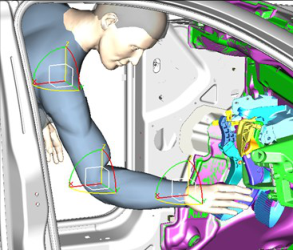
Figure 1: A virtual model of a production plant.
Figure available in the original PDF paper.
Digital Human Models are nowadays a standard in simulations software and many commercial products, like “Jack” by Siemens, are available on the market (Stephens, 2006). They give to designers all the most important facilities in order to perform manufacturing task simulations: different anthropometric and biomechanical models, visibility and reach-ability functions, direct and inverse kinematic algorithms, etc.
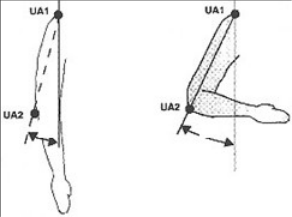
The fundamental development on which FCA has based the Digital Manufacturing project for human simulations, has been the effort to improve standard digital human modeling software (and the related simulation methods) in order to let them be compliant to FGA’s design standards (based on international technical norms - ISO/EN norms -) and FGA’s production standards that are based on European/Italian legal specifications on safety and ergonomics. In this way, designers have not only a virtual representation of the future plant but also the virtual tools to validate design solutions. This is very important for ergonomic problems that are usually discovered in the early production moments when product/process changes on physical objects are extremely expensive and don’t bring to optimal solutions. In order to achieve the above benefits, the first step has been to create virtual mannequins compliant to ISO anthropometric models (ISO 7250/1) and anthropometric measures (ISO 7250/2) for the different populations where FGA production plants are present. Starting from the basic functions to change mannequin’s dimensions, specific sets of virtual humans have been created according to the above measures. Besides, reference frames on these mannequins have been created in order to have specific points on which evaluate body angles, distances, etc. according to the most important ergonomics methods requested by ISO/EN standards (ISO 11226) and by FGA’s standards (like OCRA or EAWS).
Figure 3: Reference points and body angles defined by ISO standards and reproduced on the virtual mannequins.
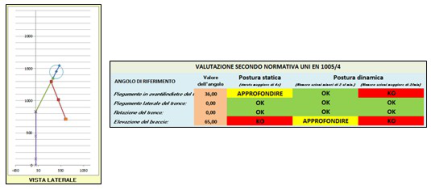
Ergonomic analysis in a virtual environment has the final goal of reaching an ergonomic optimization of the workstation already in the preliminary phases of product process development. These analyses differ for complexity and for area of interest. The most basic checks are related to accessibility and visibility tests of the working area/object. For these applications, standard anthropometric measures are very important because they are references that allow designers and engineers to give a final answer on a design solution acceptability. To achieve this result, mannequins dimensions should be close, as much as possible, to the working population that should have to perform the requested assembly task in the future plant. Another kind of ergonomic analysis is related to the check of body postures assumed by workers during assembly task. These are very important because they allow to avoid musculo- skeletal disorders and safety problems. Many methods are available in the scientific literature to evaluate working postures but FGA references are: the international standard EN 1005/4, OCRA index and the EAWS method. All of them define a set of acceptable, critical and not acceptable body movements, position, angles. Using the DM approach, designers and engineers use the advanced mannequins (those that are most close to the working population of the plant) to evaluate the above standards. To achieve this result, they place the virtual mannequins in the reference posture for the analysed assembly task. This posture can be determined also using virtual reality facilities or inverse kinematics algorithms that allow to forecast the most probable posture the worker can assume during his job (Di Pardo et al, 2008). Specific reference points are defined on the mannequins. These are directly related to the body movements and angles defined in the above ergonomic indices so engineers can immediately have a preliminary evaluation of the desired index. This operation is very important in the early design phases of the car manufacturing process because it also allows to define optimal values for the measures that strongly influence ergonomic conditions during the use of equipment, tools, etc. Even general production lines features could be results of these analyses (like, for example, the car’s height along the assembly line).
Figure 4: Sticky 2D representation of a standard virtual mannequin and its postural evaluation according to EN
1005/4 standard.
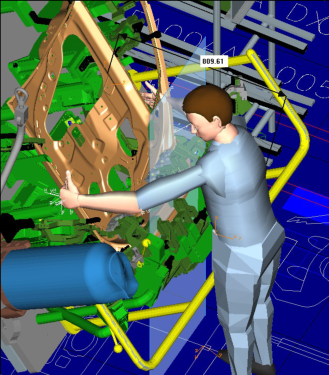
Finally manual material handling (MMH) analyses are described for ergonomic optimization of virtual workstations. This methodology is applied, in FGA, to all those (manual) assembly task where safety risks for manual handling of loads (lifting, carrying) could be present. In order to carry out an optimal simulation to analyze MMH critical issues, engineers use to create, in the virtual plant, one (or more) virtual humans in the most important postures related with the actions / positions that determine critical moments of the MMH assembly task. For example, to simulate a manual lifting of an object, designers can save different postures of the virtual dummy during weights movements. These positions can seriously affect the analysis. In the same way, a correct positioning of the dummy's hands are very important and reference points on them are necessary in order to get results compliant with the ISO standards. With the support of the frames previously placed on the mannequin, it is possible to find the relevant measures for the evaluation of lifting index (NIOSH). Here again, the lifting index is very important in the design phase because checking the results, it is possible to change equipment dimensions in order to improve ergonomic conditions for the worker.
Figure 5: Critical measures for lifting operations according to Niosh index All the methods described before are evaluated in the virtual environment while, since 2008, FCA has introduced the Ergo-UAS system for line balancing on production lines. Ergo UAS system integrates 2 specific methods: MTM- UAS for time measurement and EAWS as ergonomic method to evaluate biomechanical effort for each workstation. For new car models, starting from New Panda, FCA is applying Ergo UAS for workplace optimization. This means that workplace design is optimized on information about new product, new layout, new work organization and is performed by a multidisciplinary team (Work Place Integration Team), focusing on several aspect of product and process: safety, quality, productivity. This allowed to find and solve ergonomic threats before the start of production, by means of a strict cooperation between product development, engineering and design, manufacturing.
ERGOLAB The ErgoLab activities focus on the physical characterization of the following three main areas: Tools, Equipments and Work methods. For these applications, the ErgoLab has been equipped with a webb hook (that allows to simulate work tasks on a real car) and measurement instruments: Electrogoniometers, Motion tracking systems, Linear dynamometers, Force and pressure sensors, etc.
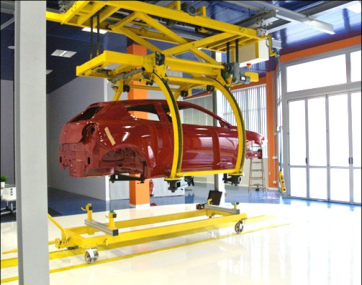
Figure 6: A real car in the ErgoLab
Applications on the ErgoLab mainly deal with posture, forces and pressure investigations so standard methods to perform experimental data acquisition has been developed that allow to acquire data in a scientific and repeatable way. Basically the methods are based on the following steps: Selection of ergonomics methods related to the problem under study; Definition of the workplaces on which to carry out the investigation; Detailed reproduction, in the ErgoLab of the workstation configuration and of the assembly task to study; Definition of the ergonomic parameters to measure; Instruments set-up and calibration; Test description; Assembly task reproduction with skilled workers; Data acquisition; Data optimization and validation.
CONCLUSIONS
In this paper, the authors have shown the approach used in FCA based on simulation methods and experimental facilities to analyse ergonomics aspects of future workcells. The approach is based on virtual and physical methods that can be quickly used by project designers and plant ergonomics experts. Using these tools it becomes also possible to do a preliminary ergonomic analysis of the future workcell according to the most important ergonomics indexes (like OCRA and EAWS) in order to get a preliminary ergonomics optimization of workcells during the initial phases of a new product/process.
REFERENCES
A. Stephens, C. Godin, 2006, The Truck that Jack Built: Digital Human Models and Their Role in the Design of Work Cells and Product Design, SAE Paper n. 2006-01-2314 M. Di Pardo, A. Riccio, F. Sessa, A. Naddeo, L. Talamo, Methodology Development for Ergonomic
Analysis of Work-Cells in Virtual Environment, SAE Paper n. 2008-01-1481 International Standard ISO 7250-1, Basic human body measurements for technological design - Part 1: Body measurement definitions and landmarks. International Standard ISO/TR 7250-2010, Basic human body measurements for technological design -
Part 2: Statistical summaries of body measurements from individual ISO populations. International Standard ISO 11226:2000, Ergonomics - Evaluation of static working postures.
LISTED IN THE AHFE DIGITAL BOOKSTORE CATALOGUE
Explore the complete digital volume
Advances in Ergonomics In Design, Usability & Special Populations: Part III
Read this individual research paper free through the original publisher, or explore the full digital proceedings book.
ISBN 978-1-4951-2108-1
Explore this ISBN in the AHFE Bookstore ↗Listed in the July 2026 bookstore catalogue; search by ISBN to confirm current availability · Digital book purchase optional