Lars Fritzsche, Ricardo Schönherr, Benjamin Illmann (2020). Interactive Simulation and Ergonomics Assessment of Manual Work With EMA – Applications in Product Development and Production Planning. In: Advances in Applied Digital Human Modeling. AHFE Open Access, vol. 11. https://doi.org/10.54941/ahfe100411
The software tool EMA (“Editor for Manual Work Activities”) facilitates digital production planning and ergonomics assessment by providing a more efficient and accurate approach to 3D human simulation. EMA uses a modular system for describing human work activities based on a pre-defined library of “complex operations”, which allows the generation and simulation of human movements with highly-automated algorithms. Moreover, EMA includes standard tools for the assessment of ergonomic strains (EAWS – “Ergonomic Assessment Worksheet”) and production time (MTM – “Methods Time Measurement”). After introducing some basic analysis functions of EMA and their typical use cases, this paper presents an evaluation study that examines the validity of EMA ergonomic evaluations in comparison to paper-pencil-assessments with EAWS. Moreover, this paper shows several use cases of the EMA software application in automotive and aviation industry. These applications illustrate that EMA considerably reduces the effort for preparing human simulations and enables the user to analyze ergonomic conditions (body posture, action forces, manual load handling) and productivity (e.g., walk ways) very thoroughly.
It is common sense among scientists and practitioners that ergonomic measures need to be taken as early as possible in the product development process in order to maintain the work-ability of employees and avoid musculoskeletal disorders in manufacturing (Illmarinen, 2006). This will help to reduce absenteeism and improve quality in the final production line, especially considering the aging workforce in most industrial countries (Fritzsche et al., 2014). Digital human models (DHMs) are considered to have a high potential for facilitating proactive ergonomic work and product design (Duffy, 2009). However, most of them are complicated to use and thus, it is very time consuming to prepare and alternate human simulations of entire work cycles. Moreover, most DHMs do not provide comprehensive analysis tools for assessing ergonomic strains and production time based on industrial standards. Applied Digital Human Modeling & Simulation (2020)
Therefore, DHMs may be common in scientific studies but they are far from being a routine tool in “applied ergonomics” with regard to designing industrial work places. The “Editor for Manual Work Activities” (EMA) is a holistic planning method based on a 3D human model that simplifies the preparation and alternation of digital human work simulations. EMA addresses the need for accurate assessments of expected physical workload in an early phase of production planning by using the EAWS (Ergonomic Assessment Worksheet, Schaub et al., 2012) for ergonomic risk assessment. In addition, EMA uses the MTM-standard (Methods Time Measurement, Maynard et al., 1948) for estimating the expected production time. The following sections provide more details about the functionalities of EMA. An evaluation study examines the accuracy of EMA ergonomic assessments in comparison to paper-pencil evaluations. Finally, some use cases illustrate the application of EMA for industrial work design.
HUMAN WORK SIMULATION WITH EMA EMA approach to human work simulation
In 2011 EMA was firstly introduced as a software tool “that reduces the effort for preparing simulations of human work” (Fritzsche et al. 2011). Over the past three years, based upon experiences from industrial applications and new software developments, EMA has evolved to a holistic software-based planning method that uses 3D-DHM simulations and a standardized “process language” (Illmann et al., 2013).
The EMA process language is very similar to the MTM process language. It is based on a set of predefined modules, so called “complex operations”, containing single motion steps that are needed to complete a more or less simple work task, such as “get and place part”. Using a drag-and-drop mechanism, the software user defines the entire work process by arranging these standard operations in a logical sequence (e.g. “get part – get tool – place part – use tool to assemble part – put away tool”). All standard operations contain a number of parameters that need to be specified by the user in an interactive modus. For example, the user needs to define the part, the tool and the location of assembly by mouse-click in the 3D scene. Now, after all relevant parameters are defined, EMA is able to calculate the necessary human movements using highly-automated algorithms that were collected in various motion studies. This basic function is called “self-initiated motion generation”. It considerably reduces the effort and time to prepare a complete human work simulation by an estimate of about 50% in comparison to any other DHM software.
Another key to increase the efficiency of human simulations with EMA is the continuous use of object references, which are set while the user defines the location of parts and tools by mouse-click. Using this approach, EMA will always find the referenced object, no matter where it has been moved in the 3D-environment. This enables the user to generate alternative design and planning scenarios in a very short time just by moving the referenced object to another location or by changing certain object preferences, such as shape, size, or weight. Unlike other DHM tools, the user only changes the object parameters while the software automatically re-calculates the necessary human motions in the present simulation instead of having to create a new simulation from scratch. This way, multiple planning options regarding the process sequence, product preferences (weight, dimension, etc.), and human resources (5th%ile female vs. 95th%ile male) can be tested in a very time- and cost-efficient manner. Altogether, the effort for scenario alternation is being reduced by about 80% in comparison to any other DHM software.
When EMA was firstly introduced in 2011 it was only available as a plug-in for Dassault Systèmes’ Delmia V5 software suite that is now called “EMA-V5”. Now EMA is also available as a stand-alone software system that includes a digital human model and a 3D graphic engine that is able to handle several common data formats (.jt, dae, etc.). The stand-alone software offers more functions, it is more flexible, easier and quicker to use, and it provides more data interfaces and possibilities for modular expansion. This widens the area of application because it allows more customer-specific adaptations for data exchange and reports. Small and medium-sized companies should be particularly interested in using a lean EMA system without having to purchase a full PLM-system. In summary, there are several advantages that distinguish EMA from other DHM tools: ─Easy to use by drag and drop metaphors ─Self-initiated, parametrical motion generation ─Use of object references enables quick scenario modification ─Use of typical planning language for manufacturing applications
Applied Digital Human Modeling & Simulation (2020)
─MTM-based estimation of production time and added value analysis ─EAWS-based ergonomic risk assessment of full-shift physical workload
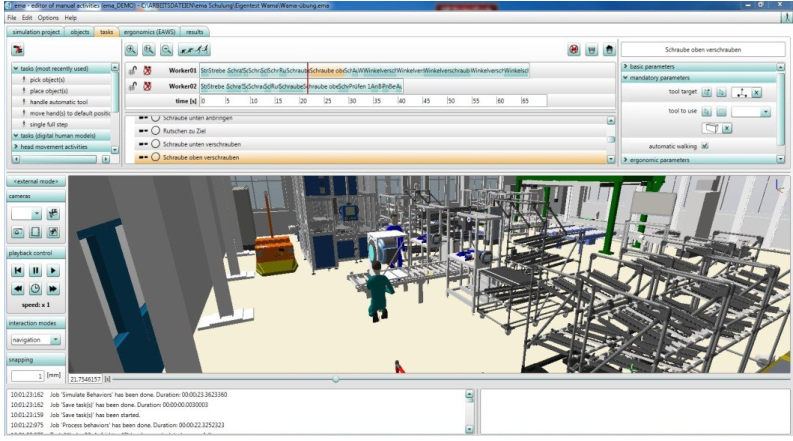
Figure 1. EMA user interface for scenario set-up.
EMA analysis functions for ergonomics and time studies EMA is specifically designed for production planners because (1) it is easy to use by drag and drop interactions; (2) it uses typical planning language based on MTM standards, for instance “pick & place part, use screwdriver”, and (3) it provides a standard screening tool for ergonomic risk assessment, the EAWS. Due to the self-initiated motion generation and the extensive research including motion capturing studies, EMA is able to generate more realistic human motion simulations in regard to task execution and duration independent of the user. This is very important for increasing objectivity and validity of simulation results (for biomechanical studies and future developments see Gläser et al., 2014, in this issue). Based on that, EMA may be used to evaluate some of the most important targets in production planning and compare them by objective figures, in particular with regard to (1) production time and value-added work as well as (2) geometric feasibility and ergonomic risk.
For estimating production time, EMA has included an automatic time calculation that is mainly based on the MTM- UAS standard; for example, placing a part loosely at the table in 20-50 cm reach would be rated as PB2, which equals 30 TMU = 1.08 seconds. However, in some situations MTM-UAS does not provide a proper time code (e.g. for car ingress). In such cases, the more detailed MTM-1 method is used to calculate the standard time for all singular movements that are necessary to carry out the full operation. Using this approach, project experiences have shown that the deviation between EMA production time and MTM-UAS time is less than 5%, which is sufficiently accurate for planning purposes. Furthermore, the development for a data interface between EMA and the MTM standard software system “TiCon” is ongoing and will be available soon. As a result EMA will be able to generate a nearly complete MTM-UAS analysis that can be edited in “MTM-TiCon”. Additional analysis functions of EMA can be used to avoid waste; for instance, by examining walk ways in the so-called spaghetti diagram.
For ergonomic risk assessment, EMA has included a semi-automatic evaluation that is based on the EAWS standard method (Ergonomic Assessment Worksheet, Schaub et al., 2012). EAWS is the only commonly used screening tool that allows the evaluation of physical workload based on the production cycle time. The EAWS covers four sections of relevant physical workloads in manufacturing: Section 1 includes symmetric body postures, such as bending, kneeling, arms above shoulder or head level, etc., and asymmetric body postures, such as lateral bending, trunk rotation, and far reach. Section 2 includes action forces of the fingers (e.g. use thumb to press in clips) and arm- shoulder-forces (e.g. handling of balancers and manipulators). Section 3 includes manual material handling of weights above 3 kg. Section 0 includes specific extra strains (e.g. car ingress/egress, walking during assembly). All Applied Digital Human Modeling & Simulation (2020) four sections are scored based on standard rules in order to calculate a total ergonomic risk score, which indicates areas of low strains (“green”), medium strains with possible long-term risk (“yellow”) and areas of high strain with considerable health risks (“red”). EMA is able to automatically calculate EAWS scores based on the human simulation of the work process and some additional user input (forces, weights, extras). This way, the ergonomic score calculation is fully objective and reliable, independent of the software user.
EVALUATION STUDY OF SEMI-AUTOMATIC ERGONOMIC ASSESSMENT WITH EMA BASED ON EAWS In order to achieve objective results for ergonomic evaluations, EMA contains an implementation of the Ergonomic Assessment Worksheet (EAWS, Schaub et al., 2012) – a screening tool for physical workload, which covers several ergonomically unfavorable conditions such as awkward postures, manual load handling, and action forces. It is important, that this automated risk assessment leads to correct predictions of later workload, given that investment decisions are made on their basis. Previous studies have shown that DHM process simulations may provide adequate estimations of the prospected workload of real-life situations with the use of comprehensive screening methods like the EAWS (Fritzsche, 2010). However, the objectiveness of such paper-pencil tools was sometimes not satisfying as indicated by deficiencies in the inter-rater reliability. Hence, the full incorporation of the EAWS method into DHM software tools may improve evaluation efficiency, objectivity and validity. Still, it has to be assured, that automatic risk assessment delivers reliable results. Thus, the purpose of this study was to investigate if a DHM software implementation of the EAWS allows an adequate prediction of physical workloads.
Method
Twelve planning simulations from a German automobile manufacturer were selected showing assembly operations at vehicles as well as pre-assembly tasks of components. The chosen scenarios were very diverse including different body postures, action forces and manual material handling operations. All scenarios were taken from real planning applications; they had not been prepared especially for this study. The mean duration of a simulation was approximately 90 seconds. The scenes were modeled by different operators, using the software tool EMA. All scenarios contained digital mock-ups of products, resources (tools, fixtures, etc.) and the necessary work environment. The digital manikin used represented the anthropometric model of the 50th percentile of German males according to DIN 33402:2005. As common in real life, weights and estimated forces of parts were given.
Each of the twelve simulations was assessed by three experts with experience on the field of ergonomics risk assessment with EAWS. The scenarios were available to the observers as a video, which allowed them to view the simulation as often as necessary in order to increase the objectivity and inter-rater reliability (Coenen et al., 2013). For the quantitative study of the forecast quality of ergonomic loads, the observers performed a paper-pencil- analysis using the EAWS. Likewise, the EMA software provided an EAWS risk assessment which was exported as an MS-Excel report. This way, the total EAWS scores as well as the detailed scores for each EAWS section were available for each scenario and could be used for comparing risk assessments of real observers vs. simulation results. Thereby, this study focused on the three EAWS sections for postures, action forces and manual material handling. The section for extra scores (e.g., car ingress/egress) was not considered because they are currently defined by manual user input. EWAS-section 4 (highly repetitive tasks for upper limbs) is not yet implemented into EMA and was not considered either.
The agreement of the three experts’ EAWS risk assessment was determined with the help of the intra-class correlation (Bartko, 1966) as a characteristic measure for the inter-rater reliability. The observers’ scores have been averaged and then compared with the automatically calculated score provided by EMA. Due to the small sample, Kendall’s Tau (Arndt et al., 1999) was chosen as indicator for rank correlations. Thereby, every observer worked independently and without comparing with the others. The observers did not know the results of the automatically calculated EAWS-scores beforehand.
Results
For measuring the inter-rater-reliability of the three ergonomic experts the EAWS scores of the observers were compared (Figure 1). The scores were very close in some scenarios, but also very different in other cases. For Applied Digital Human Modeling & Simulation (2020) observers 1 and 2, the categories green, yellow and red matched in 50% of all cases. Between observers 1 and 3 as well as between 2 and 3, a match occurred in 67% of all cases. Differences such as green vs. red did not appear for any pair of observers. The resulting intra-class correlation value of rk = .869 indicates a good agreement between the three experts regarding the EAWS classification. High agreement was also found for the separate EAWS sections; postures correlated with rk = .833, forces with rk = .862 and manual material handling with rk = .964.
160
140
120
100
80
60
EAWS score
40
20
1 2 3 4 5 6 7 8 9 10 11 12 0
Szenario
Observer 1 Observer 2 Observer 3 EMA
Figure 2. Comparison of the EAWS-scores.
Figure available in the original PDF paper.
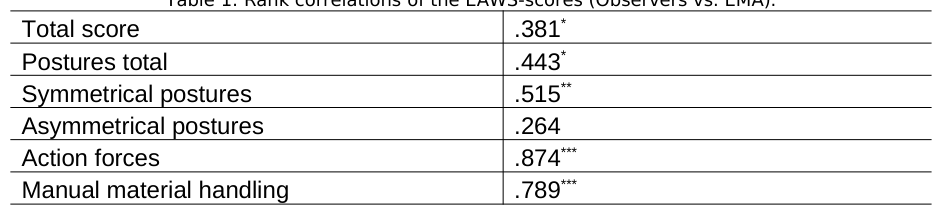
Furthermore, the EAWS total score was compared for each of the twelve scenarios for the three observers and the EMA software assessment. Rarely, there are distinct differences between the observers and EMA; in some cases the EMA-calculated score is considerably higher, whereas other scenarios showed a very good agreement. Kendall’s Tau as indicator for the comparison of the observers’ scores with the automatically calculated EMA-score is shown in Table 1.
Table 1: Rank correlations of the EAWS-scores (Observers vs. EMA). Total score .381* Postures total .443* Symmetrical postures .515**
* significant with p < .05, ** very significant with p < .01, *** highly significant with p < .001 For the total EAWS scores, an average agreement of τ = .381 (p < .05) was found. Postures had a stronger accordance with τ = .443 (p < .05), whereat EMA tends to a higher score, especially for asymmetric postures such as lateral bending, trunk twist and far reach. Thus, symmetrical postures correlated significantly (τ = .515, p < .01), whereas asymmetrical postures showed a non-significant correlation of τ = .264 (p > .05). In contrast to that, both action forces (τ = .874; p < .001) and manual material handling (τ = .789; p < .001) showed very good agreements.
Discussion
The comparison indicated a good agreement between the three experts in ergonomic risk assessment using the EWAS. In most scenarios scores are at a similar level; where a perfect congruence is very unlikely. In general, the results confirmed the use of the EAWS as an objective screening tool for ergonomics risk assessment.
Applied Digital Human Modeling & Simulation (2020)
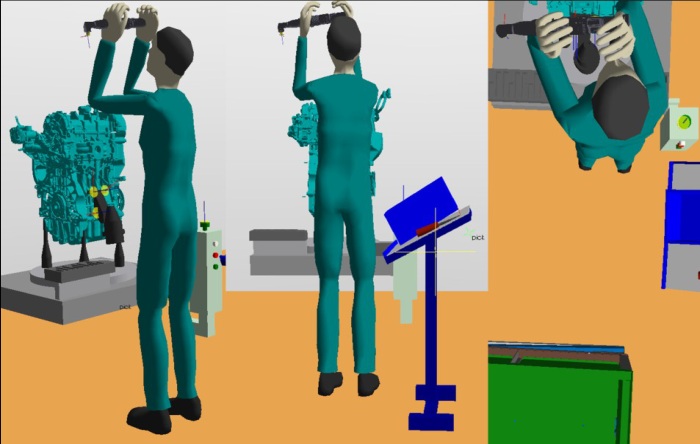
Significant agreements were found for the total score as well as for the three separate EAWS sections comparing the automatically calculated EMA-score with the observers’ assessment. However, EMA tends to reveal higher scores for body postures, which seems to be due to the more correct assessment: EMA registers all body poses automatically and very precisely, whereas the observer needs to “see” critical postures by himself. Especially asymmetric postures, which did not correlate significantly in the study, are sometimes difficult to detect. EAWS scores for lateral bending and twisting already reach their maximum at 30° rotation. Therefore, intermediate twisting of 15° rotation, for example, is hard to detect just by observing a work scenario, no matter if it is a simulation or in real life. Figure 2 shows a scene of a sample scenario with a twisted trunk. In this case, none of the observers identified any asymmetric posture, while EMA scored 13 points, which is correct based on the EAWS regulations. Thus, the difficulty of detecting asymmetric body postures is the main explanation for deviations in EAWS scores between EMA calculations and observer assessments.
Figure 3. Sample-scenario with marginal asymmetric posture.
A revision of the motion generation algorithms might help to prevent some over-scoring as well, as small correction movements of the feet can help to avoid asymmetric postures. Furthermore, the appearance of the used DHM could be modified in a way that trunk rotation or lateral bending are shown more distinct to the observer. Besides these considerations, future research should address the issue of asymmetric body postures. There might be a discrepancy between the qualitative characterization of the asymmetric postures like “medium” and the quantitative angle specifications, “15°” in the given example. If such a marginal deflection is hardly visible, it also seems questionable whether it should be classified as a significant ergonomic strain. As reported in Takala et al. (2010) the observation and correct assessment of movements of smaller body regions seems to be very particularly challenging for observers. In this study, only one video of each scenario with only one view-perspective was available. Thus, the observers might have overseen some ergonomic strains. Merely the software is able to use the exact joint angles for scoring, which may lead to a higher score in some scenarios.
Scenario 6 revealed a larger disagreement. This can be explained by the fact, that all three observers detected a whole body force (average score = 19.2), while EMA indicated a finger force (score = 69.5). This deviation is an artifact that was due to a modeling error. Furthermore, the observers underestimated the duration of certain unfavorable postures, which again led to a lower score compared to EMA. In scenario 12, the three observers have a good agreement but clearly differ from the EMA-score. Again, the single perspective in view might have biased the appearance, so that actual bending postures were classified as upright. The possibility of manipulating the view individually in the EMA software during the assessment instead of having only a video could have enabled higher agreement between manual and automatic risk assessment in this case.
In general, the results demonstrated that the EAWS software implementation into a human simulation system allows Applied Digital Human Modeling & Simulation (2020) reliable results for an early use of the method. Assessment scores were mainly differing in asymmetric body postures, such as lateral twisting and bending, which are hard to detect even for experts. In this regard digital assessment is more precise because it is based on objective data of joint angles rather than visual judgment. Both the EAWS and the application of DHM simulations illustrated some potential to increase objectivity and reliability of ergonomic risk assessments. In conclusion the study confirmed the suitability of EMA in practical applications for the validation of planning alternatives as well as for the preventive ergonomics risk assessment. Of course, ergonomic experts are still needed to check and verify the ergonomics design at the real workplace during pre- production workshops and after start of serial production because some issues can only be detected in real life.
APPLICATIONS OF EMA IN PRODUCT DEVELOPMENT AND PRODUCTION PLANNING In the past three years EMA has been successfully introduced at different German companies. Some of the main customers are AIRBUS, AUDI, BMW, DAIMLER and VOLKSWAGEN. The industrial application of EMA has been a key element to facilitate further improvement. Especially the wide range of industries and tasks has offered significant inputs for improving motion generation, software usability and analysis functions. This section will give an overview about the general approach of using EMA in early phases of product development and production planning in order to evaluate and modify the ergonomic design of products, in terms of feasibility and buildability, as well as entire work processes and shopfloor layout. Figure 4 illustrates how EMA may be used at different stages of the product development process (PDP).
Figure 4. Application of EMA throughout the product development process (PEP).
Figure available in the original PDF paper.
EMA can be used throughout the entire product development process. Generally, the earlier EMA is used in analyzing product concepts and production layout, the more costs for re-design may be saved. However, EMA may also be used to improve pre-production planning, prepare pilot workshops and support pre-series production trails.
During the concept design the focus of application is on investigating buildability and plausibility checks. At this point, the EMA simulation and analysis functions offer an early estimation of bottle-neck-processes in regard to physical workload and manufacturing time. These early assessments have a strong product-reference; however they could also be used to evaluate concepts for facilities, equipment, and production layout.
In pre-production planning the focus of application is on the definition of standard work sequences. Thereby, EMA Applied Digital Human Modeling & Simulation (2020) can display its full potential in defining and evaluating the entire work process and layout design, particularly by testing various alternatives in the 3D environment. This phase has a strong process focus and lays the foundation for the following pre-series planning. The ergonomic assessment and time analysis now requires greater detail.
Pre-series production trails offer a last chance to optimize product, process and resources before the start of series production (SOP). This requires simulations and analysis to be very detailed and accurate. EMA now offers the possibility to virtually test late design changes without expensive tryouts. In that phase EMA may also be used for qualification matters. Previously prepared simulations may now be used for explaining the new standard work process to management and workers. EMA may also serve to support communication between planning and production by illustrating how the ideal process was intended to run.
After start of production, EMA is particularly useful to investigate layout optimization and the integration of new tools or machinery in running production lines, before they actually exist. This may save costs for redesign to fit new equipment into the existing assembly line. Similarly EMA could be used to support the continuous improvement process to visualize possible process optimizations without interruptions of the running production.
The following examples of application demonstrate how EMA may be used for different tasks throughout the product development process and show how application projects contribute to further EMA improvement.
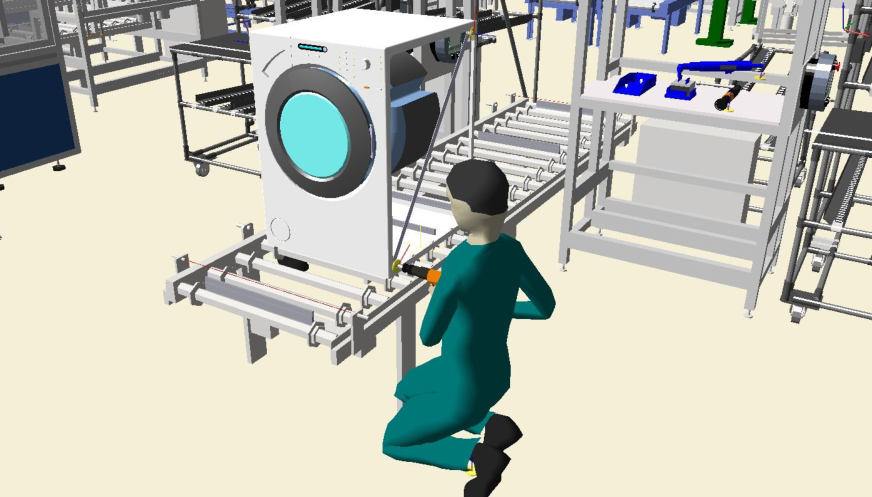
Application I: Planning Assembly Operations with Hand Tools Accurate simulation of tool handling has been a big issue during the development of EMA. In order to be effective in creating the simulation, tools like screwdrivers need to be handled by EMA without further user input. Applications at Daimler (Mercedes-Benz Manufacturing Hungary) and Volkswagen (Kaluga plant in Russia, Zwickau plant in Germany) have offered a variety of scenarios to use specific hand tools. Particularly, the use of welding tongs and different pistol-grip tools have shown the most important determinants for tool handling. Firstly a tool-center point (TCP) needed to be defined, which describes the place and orientation of the application point. Secondly each tool needed a special gripping point to ensure correct hand-wrist-orientation. Thirdly, specific body movements had to be created depending on the tool trajectory; EMA nowadays automatically follows the tool step by step and always finds the optimal posture in reference to the place of application (Figure 5). In the near future the tool-objects will inherit more information about the process, such as involved body forces and necessary movements. This way, manual and automatic tools will cause a different task execution.
Figure 5. Application of EMA in white-goods production using a hand tool. Applied Digital Human Modeling & Simulation (2020)
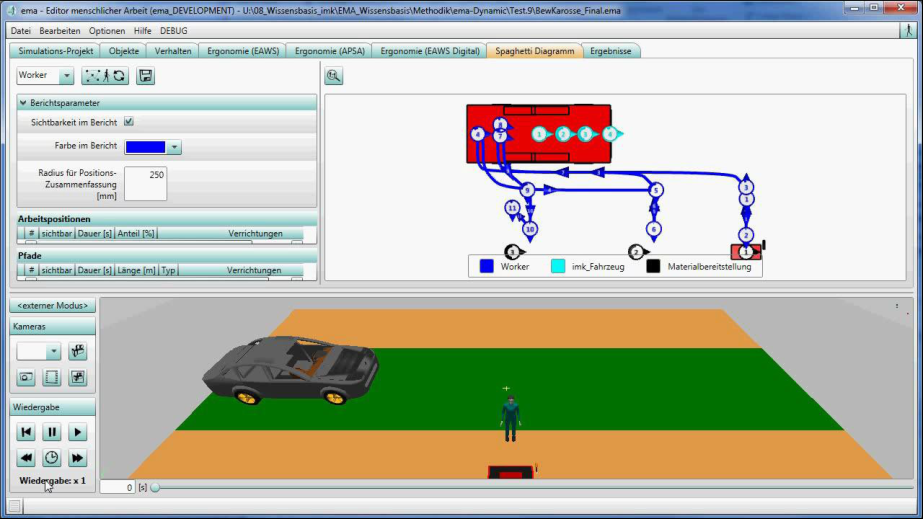
Application II: Moving Assembly Line with Analysis of Walkways In previous EMA applications all elements of the 3D-environment have been regarded as static which means that no other object except the human model could be animated. A new functionality (“emaDynamics”) now allows assigning tasks for nearly all kinds of objects. Therefore, a specific set of complex tasks was designed for planning objects movements and interactions. Moreover, the EMA simulation capabilities needed to be extended by adding dynamic walk path calculation, dynamic collision prevention and advanced synchronization features. Finally, also a new report was created, the so-called “Spaghetti diagram”. It shows the walk ways and work positions in the layout as bird view and allows analyzing the exact walk distances. The new dynamic function may be applied, for example, in all situations with moving assembly lines to determine walk ways considering the actual movement of the dynamic assembly line and the relative position change of the static lineside logistics area.
Figure 6. Analyzing walkways on a moving assembly line (“Spaghetti diagram”).
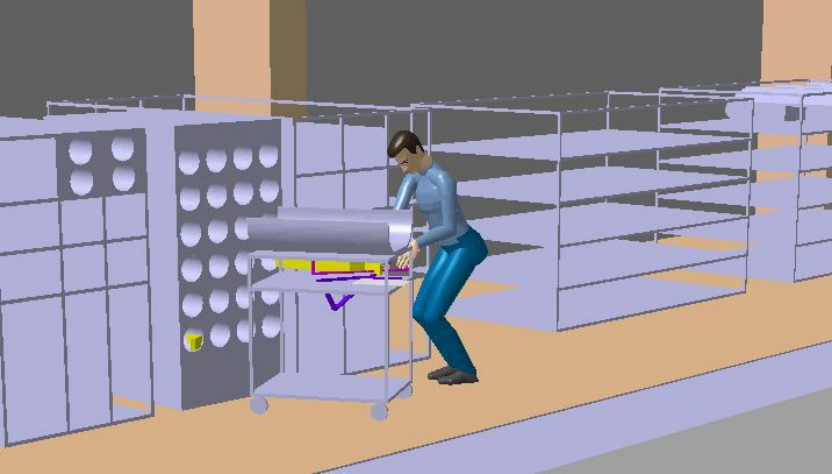
Application III: Designing Logistics Areas An early application of EMA was the design of a logistics supermarket area for an automobile assembly line (see Figure 7). EMA had several problems simulating material handling tasks, for example with picking and moving multiple parts at the same time. Therefore, the whole operation of material handling needed to be remodeled. Furthermore, the operation for pushing and pulling trolleys and carts needed to be implemented for the purpose of accurate simulation and correct ergonomic assessment using the EAWS.
Applied Digital Human Modeling & Simulation (2020)
Figure 7. Pushing and pulling during commissioning tasks in a supermarket area.
CONCLUSIONS
In the past years EMA has evolved from a planning tool that uses an innovative approach for human motion generation to an entirely new planning method. This paper has shown that industrial applications have greatly contributed to the improvement of movement-accuracy and planning-efficiency. A main focus during development was put on motion generation, however also the performance of different assessment methods, such as EAWS for ergonomic assessment and MTM for time analysis, greatly benefited from the requirements that were defined by various EMA customers. Through the use of EMA in the automotive industry, aviation industry, white goods and other industries the range of possible tasks and the system performance vastly increased and created many ideas for future developments. Especially in terms of data exchange of the software and interaction with the surrounding 3D- environment, EMA will soon allow more applications in all phases of the product development process.
REFERENCES
Arndt, S., Turvey, C., Andreasen, N. C. (1999), “Correlating and predicting psychiatric symptom ratings: Spearmans r versus Kendalls tau correlation”, JOURNAL OF PSYCHIATRIC RESEARCH, Volume 33 No. 2, pp. 97-104. Bartko, J. J. (1966), “The Intraclass Correlation Coefficient as a Measure of Reliability”, PSYCHOLOGICAL REPORTS,
Volume 19, pp. 3-11. Coenen, P., Kingma, I., Boot, C. R. L., Bongers, P. M., van Dieën, J. H. (2013), “Inter-rater reliability of a video-analysis method measuring low-back load in a field situation”, APPLIED ERGONOMICS, Volume 44, No. 5, pp. 828-834 Duffy, V.G. (2009). “Handbook of Digital Human Modeling. Research for Applied Ergonomics and Human Factors
Engineering”. Boca Raton, Florida, USA: CRC Press, Taylor & Francis Group. Fritzsche, L. (2010), “Ergonomics risk assessment with digital human models in car assembly: Simulation versus real life”, HUMAN FACTORS AND ERGONOMICS IN MANUFACTURING AND SERVICE INDUSTRIES, Volume 20 No. 4, pp. 287-299. Fritzsche, L., Jendrusch, R., Leidholdt, W., Bauer, S., Jäckel, T., Pirger, A. (2011). “Introducing ema (Editor for Manual Work
Activities) – A New Tool for Enhancing Accuracy and Efficiency of Human Simulations in Digital Production Planning.” In: V.G. Duffy (Ed.), Digital Human Modeling, HCII 2011, LNCS 6777 (pp. 272–281). Berlin, Heidelberg: Springer. Fritzsche, L., Wegge, J., Schmauder, M., Kliegel, M., Schmidt, K.-H. (2014). ”Good ergonomics and team diversity reduce absenteeism and errors in car manufacturing“. ERGONOMICS (in press). Illmann, B., Fritzsche, L., Leidholdt, W., Bauer, S., Dietrich, M. (2013). “Application and Future Developments of ema in
Digital Production Planning and Ergonomics.” In: V.G. Duffy (Ed.), DHM/HCII HCII 2013, LNCS 8026 (pp. 66–75). Berlin, Heidelberg: Springer Illmarinen, J. (2006). “ The ageing workforce—challenges for occupational health”. OCCUPATIONAL MEDICINE, Volume 56 Applied Digital Human Modeling & Simulation (2020)
No. 6, pp. 362-364. Maynard, H. B., Stegemerten, G. J., Schwab, J. L. (1948). “Methods-time measurement”. New York: McGraw-Hill. Schaub, K., Caragnano, G., Britzke, B., Bruder, R. (2012), “The European Assembly Worksheet”, THEORETICAL ISSUES IN ERGONOMICS SCIENCE, doi:10.1080/1463922X.2012.678283 Takala, E.-P., Pehkonen, I., Forsman, M., Hansson, G.-Å., Mathiassen, S.E., Neumann, W.P., Sjøgaard, G., Veiersted, K.B.,
Westgaard, R.H., Winkel, J. (2010), “Systematic evaluation of observational methods assessing biomechanical exposures at work”, SCANDINAVIAN JOURNAL OF WORK, ENVIRONMENT & HEALTH, Volume 36, No. 1, pp. 3-24.
Applied Digital Human Modeling & Simulation (2020)
LISTED IN THE AHFE DIGITAL BOOKSTORE CATALOGUE
Explore the complete digital volume
Advances in Applied Digital Human Modeling
Read this individual research paper free through the original publisher, or explore the full digital proceedings book.
ISBN 978-1-4951-2094-7
Explore this ISBN in the AHFE Bookstore ↗Listed in the July 2026 bookstore catalogue; search by ISBN to confirm current availability · Digital book purchase optional