Charles Butler (2020). Investigating the Effectiveness of Priming in Virtual Environments. In: Advances in Applied Digital Human Modeling. AHFE Open Access, vol. 11. https://doi.org/10.54941/ahfe100419
This paper considers the usefulness and possibility of using virtual environments for the advancement of priming research. First, the background and foundational research and experiments are considered. Next, the benefits and drawbacks of utilizing virtual environments is examined. Finally, the paper considers the potential of utilizing virtual environments in an attempt to replicate the existing studies to further establish the validity of virtual environments in priming research and then the potential of these methods to push the boundaries of the field.
Priming can have a considerable, though often unnoticed, effect on our behavior in any number of day-to-day situations. The awareness of this possibility can be useful both to those who seek to influence the behavior of others as well as those who would prefer to resist such influence (or at least be aware that someone may be attempting to influence them). However, as spending time in virtual and augmented environments becomes more common, it becomes ever more important to study the extent to which these environments can exert influence over their users. In the real world, priming attempts can require a great deal of control over the situation in which the attempt takes place. However, in a virtual environment, the developer’s control over the experience is only bounded by the expectations of the users, expectations which have often been pre-conditioned to accept unexpected or unusual stimuli in such a setting.
The effectiveness of the concept of priming itself is a primary concern, so the sections that follow outline a number of foundational studies in priming research. A discussion of virtual environments follows, addressing the fundamentals of using such an environment in a research setting in addition to the human factor issues involved. Further complications that warrant mention include issues with the design and implementation of virtual environment as well as the potential effect of varying degrees of experience using virtual environments among research participants. Also included is a discussion of potential virtual world implementations intended to gauge the efficacy of priming within virtual environments by adapting the priming experiments outlined in the Background section to function within a virtual environment.
BACKGROUND
Priming Priming refers to the incidental activation of knowledge structures, such as trait concepts and stereotypes, by the current situational context (Bargh, Chen, and Burrows, 1996). This activation of certain knowledge structures has the potential to affect our behavior to some extent. It may seem obvious that various details about our environment, or our perception of it, can alter our behavior in various ways, but the intriguing (and potentially disturbing to some) aspect of priming is that both this activation and the potential effect on behavior can happen entirely below our conscious awareness. However, these outcomes can be difficult to engineer and test directly, especially without the awareness of the test subject.
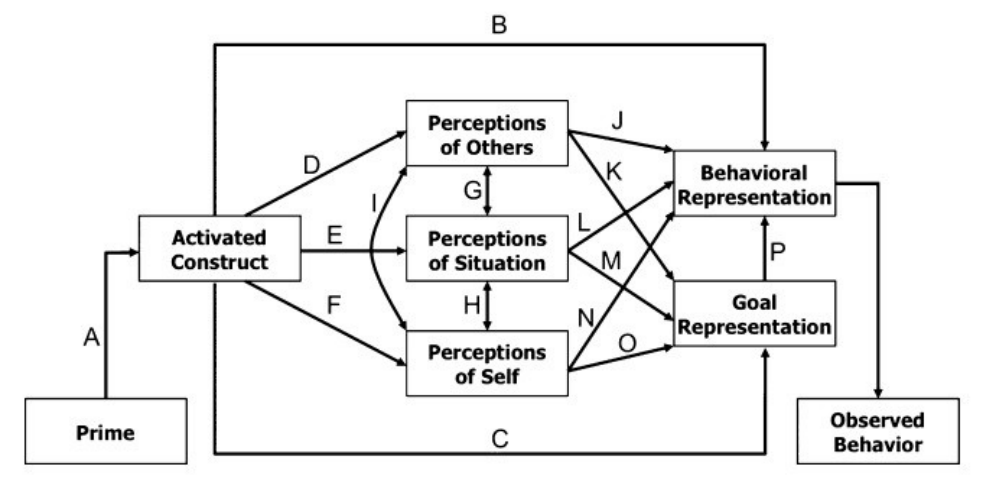
It can be additionally complicated by the various ways in which individuals may perceive and react to a certain situation. As illustrated in Figure 1, Wheeler and DeMaree show the various mechanics of prime-to-behavior effects. A subject first encounters a prime, which activates a knowledge construct. Then the subject's individual perceptions are activated, which can act as potentially encouraging or inhibiting agents before the subject represents some behavior which is then observed. One challenge, then, is selecting a priming mechanism and the surrounding environment that would affect the test subjects both sufficiently and consistently for the results to be measurable and significant.
Figure 1. Proposed mechanisms for prime-to-behavior effects. (Wheeler and DeMarree, 2009)
Experiments Bargh, Chen, and Burrows conducted a set of foundational priming experiments which seemingly overcame the challenges listed above (Bargh, Chen, and Burrows, 1996). Two of these are especially relevant to the discussion of virtual environments, as they both rely on the physical environment and interaction within the space.
In the first experiment, a group of students at New York University were given a test involving the unscrambling of sentences. However, there were three different versions of the test. One version of the test attempted to prime a polite condition in the students by including words such as patiently and courteous. Another version of the test attempted to prime a rude condition by including words such as intrude and interrupt. A third version of the test was intended to be a neutral control with words considered to be neither polite nor rude.
After taking the test, the student was instructed to procure the next task from a researcher in a nearby room. When the student approached the room in question, the researcher was deliberately (but non-obviously) appearing busy or otherwise engaged. The true test of the experiment was the amount of time it would take each student to interrupt the researcher. The researcher would ignore the student until either interrupted or a hidden 10 minute time limit had elapsed.
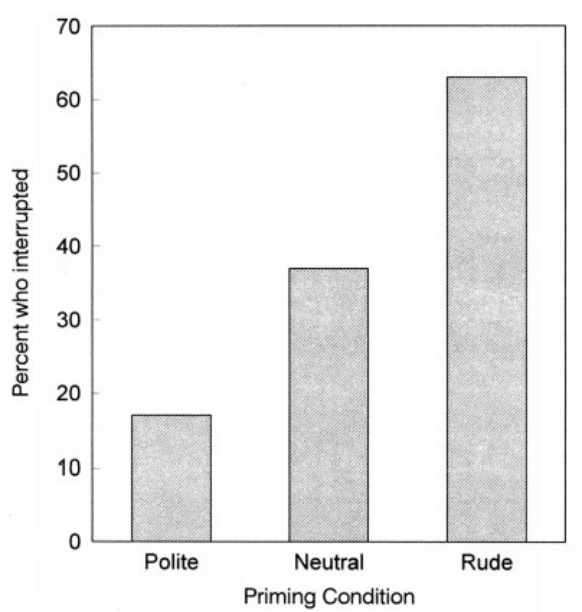
The results were quite striking as shown in the graph below. Of the students primed with the polite test, fewer than 20% of them interrupted the researcher before the 10 minute time limit was complete. In contrast, over 60% of the students primed with the rude test interrupted before the time limit had expired. In addition, the mean number of seconds elapsed before students of each group would interrupt was considerably different as well, with 326 seconds for the rude group and 558 seconds for the polite group. Note that the mean for the polite group was so close to the 600 second time limit that the difference would likely have been even more stark had there not been a time limit on the experiment.
Figure 2. Percentage of participants who interrupted the experimenter . (Bargh, Chen, and Burrows, 1996)
In their second experiment, Bargh, Chen, and Burrows invited students from New York University to participate in a study in which the participants were given a scrambled word sentence test. There were similar to the test from the previously mentioned experiment, though this test only had two versions. One version was a neutral control, and the other attempted to prime the participants for the elderly condition by including words such as old, retired, and forgetful. The actual metric in play with this experiment was the amount of time it took the students to walk a fixed distance down the hall after completing the task and exiting the room.
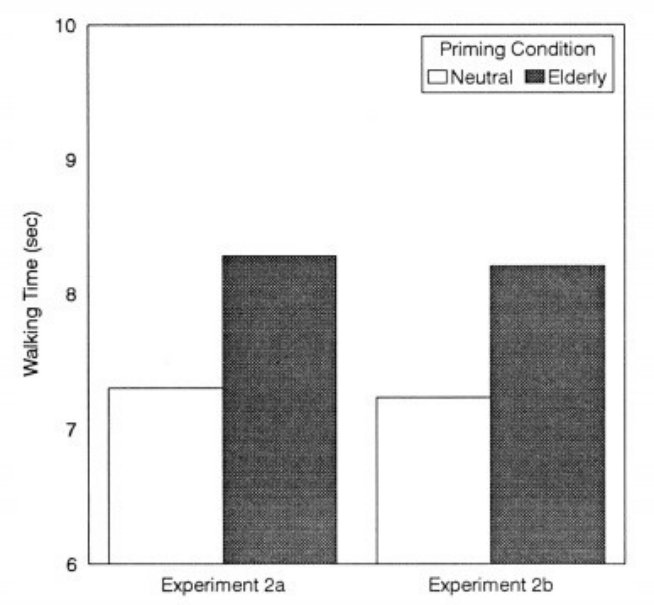
The results of this experiment, though not as obvious as in the previous experiment, show significant differences in the control and primed groups. In addition, this experiment was repeated two times (shown in the graph below as experiment 2a and 2b) with very similar results. The students in both sets of the experiment who were primed with the elderly condition covered the specified distance approximately one second more slowly (approximately 12%) than the students taking the neutral test.
Figure 4. Mean time (in seconds) to walk down the hallway . (Bargh, Chen, and Burrows, 1996)
VIRTUAL ENVIRONMENTS Important Considerations
Virtual environments present researchers with a number of potential benefits when compared to setting up experiments that require the coordination and control of both people and physical spaces. First, depending on the type of experiment in question, the researcher may need control of a considerable amount of space as well as personnel for an extended period of time. In addition, if the experiment has certain physical requirements for the space, it may be inconvenient or even impossible to gain access to a space that meets the requirements. In the experiment above, the researcher required a room with an exit to a hallway which presented the students with only one option for leaving the area so their traveling time across the distance could be tracked. This is a simple enough requirement, but even that simple requirement might be difficult to fulfill in many buildings.
Consider the suspension bridge experiment intended to test the misattribution of arousal (Dutton and Aron, 1978). This experiment required a researcher to be stationed on two different bridges (an anxiety-inducing suspension bridge and a relatively non-threatening bridge) to interview people as they crossed each bridge. This could be potentially very difficult to set up and control in the real world. However, these environments could be created trivially and at will through the use of virtual environments, and the researchers tasked with interviewing the subjects could potentially be replaced by a scripted non-player character within the virtual environment.
To take the benefits even farther, this could allow a much broader sample of participants (as it wouldn't be limited to the types of people who would be crossing a scary suspension bridge at a time when a researcher happened to be on it asking questions), and it would allow people to engage with the task in any place and at any time. It could even allow the localization of research tasks to take place with relative ease so that researchers could more readily examine cross-cultural effects.
Of course, there are drawbacks to the use of virtual environments as well. First, researchers are likely not experienced developers of virtual worlds, so while certain types of resource savings may be possible, these savings may come at a considerable expense in other areas. Developers and designers may have to be hired or recruited. However, new tools such as Unity 3D or the Unreal Development Kit are now allowing even novices to create impressive 3D virtual environments, there can still be a considerable barrier to entry and time investment involved. To further compound the potential problems, even if a developer is available, eliciting the desired reactions and behaviors from participants in a virtual world can be more difficult than simply implementing the physical area. This approaches the territory of game design, and while many lessons can be learned from popular games, adapting those lessons to a non-game context can be incredibly challenging, even for experienced industry practitioners.
In addition, there are considerable human factor issues to consider, especially if the research may be dealing with participants who may not be very familiar with virtual environments, though this problem will likely lessen as more and more people engage with video games and simulations of various types; however, this does bring up the additional problem of gauging the different perceptions of participants based on the direction and extent of their experience with virtual environments.
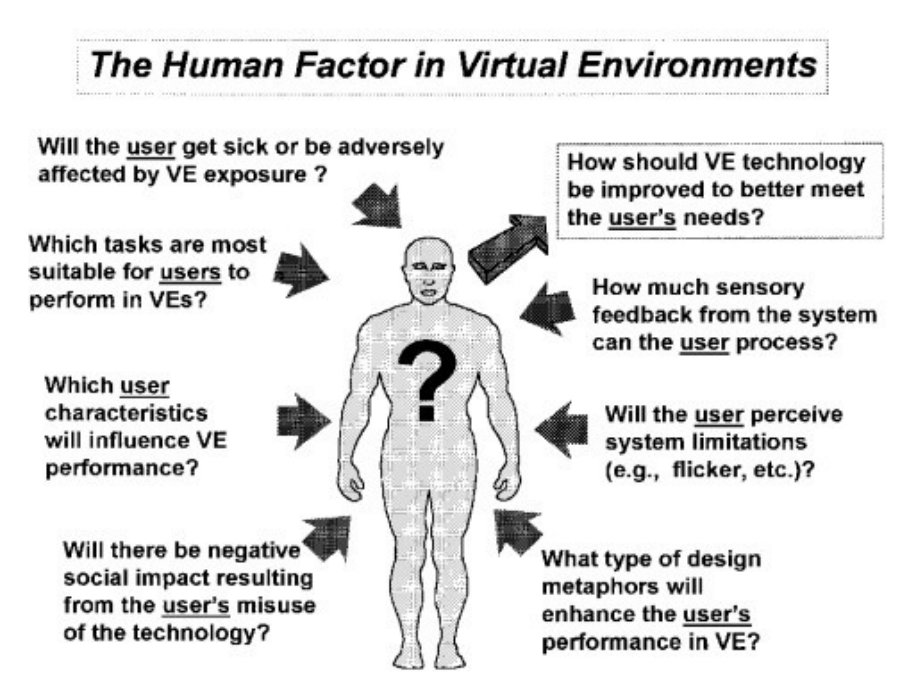
Figure 5. The human factor in virtual environments. (Stanney, Mourant, and Kennedy, 1998)
For example, Stanney, Mourant, and Kennedy list a number of human factor concerns that one should consider when utilizing virtual environments (Stanney, Mourant, and Kennedy, 1998). Some people who are less familiar with technology may find some aspects of virtual environments unsettling or discomforting, even becoming disoriented or nauseous. Screens and the action taking place on them can give certain people headaches or even seizures in extreme cases. Though likely less serious for the users, possibly the most important concern for the researcher is that some tasks just don't lend themselves to being carried out within a virtual environment. Additionally, there could be some tasks which are trivial to design and implement in the real world which would be enormously expensive and time consuming to implement in a virtual environment, and regrettably, it may not always be immediately obvious which tasks are which.
Potential Implications The true potential here is to simply do work that would be impossible or prohibitively difficult or expensive in the real world. This encompasses both research tasks and the scale of the testing. In a virtual environment, almost any situation that can be conceived can be created. Depending on the complexity, it may still be expensive to implement, but there are numerous things that just couldn't be done at any price in the real world, if for no other reason than ethical concerns. In addition, the scale at which research could be done in a virtual environment exceeds what could be done otherwise. Web-based environments are now easily creatable and accessible, opening up the potential for literally millions of users to participate in a study.
FUTURE WORK
Method for Further Establishment of Efficacy A key question that will likely remain for some time is the extent to which a virtual environment can replicate the results of a real environment among participants of a study. This can be quite a difficult thing to test, both for the issues with virtual environments listed above, and also simply because we tend to perceive some things in virtual environments in a very similar manner to those in the real world, while others are perceived very differently. To make it more complex, different people likely have very different experiences even within the same environment based on their individual experiences, perceptions, and preferences.
While a considerable barrier, the research could be served by an attempt to replicate a number of the foundational priming studies, such as the two listed previously, in virtual environments, to see if the effects are reproducible. While this may only provide evidence that these specific instances are effective (or ineffective) in virtual environment, it would help provide a base from which other research could be informed.
REFERENCES
Bargh, J.A., Chen, M., Burrows, L. (1996), “Human Automaticity of Social Behavior: Direct Effects of Trait Construct and Stereotype Activation on Action”, in: Journal of Personality and Social Psychology, Volume 71 No. 2: pp. 230-244 Dutton, D.G., Aron, A.P. (1974), “Some evidence for heightened sexual attraction under conditions of high anxiety”, in: Journal
of Personality and Social Psychology, Volume 30: pp. 510-317 Stanney, K.M., Mourant, R.R., Kennedy, R.S. (1998), “Human Factor Issues in Virtual Environments: A Review of the Literature”, in: Presence, Volume 7 No. 4: pp. 327-351 Wheeler, S.C., DeMarree, K.G. (2009), “Multiple Mechanisms of Prime-to-Behavior Effects”, in: Social and Personality
Psychology Compass, Volume 3 No. 4: pp. 566-581
LISTED IN THE AHFE DIGITAL BOOKSTORE CATALOGUE
Explore the complete digital volume
Advances in Applied Digital Human Modeling
Read this individual research paper free through the original publisher, or explore the full digital proceedings book.
ISBN 978-1-4951-2094-7
Explore this ISBN in the AHFE Bookstore ↗Listed in the July 2026 bookstore catalogue; search by ISBN to confirm current availability · Digital book purchase optional