Arno Hartholt, Andrew Leeds, Ed Fast, Edwin Sookiassian, Kevin Kim, Sarah Beland, Pranav Kulkarni, Sharon Mozgai (2024). Multidisciplinary Research & Development of Multi-Agents and Virtual Humans Leveraging Integrated Middleware Platforms. In: Intelligent Human Systems Integration (IHSI 2024): Integrating People and Intelligent Systems. AHFE Open Access, vol. 119, pp. 330–340. https://doi.org/10.54941/ahfe1004497
The current pace of technological advancements has led to an ever-increasing availability of technologies to investigate and help address the challenges that contemporary society faces today. However, while this trend increases the potential for creating more relevant, effective, and efficient solutions, it also inherently increases the complexity of realizing that potential. Our work aims to manage this complexity through the creation and dissemination of integrated middleware platforms that enable researchers and developers to rapidly prototype novel solutions within the areas of modelling & simulation, virtual humans, and virtual worlds. In this paper, we discuss two related platforms: the Rapid Integration & Development Environment (RIDE) and the Virtual Human Toolkit (VHToolkit). Specifically, we explore two use cases: 1) the development of an authoring tool aimed at domain experts to rapidly create low-echelon military training scenarios, and 2) the development of a virtual human led mHealth wellness and suicide prevention app for veterans.
With the ever-increasing pace of technological advances there is a need to be able to rapidly explore, evaluate, and validate new technologies. Addressing this need is a complex endeavour. It requires systems that provide rich, rel- evant contexts and the ability to rapidly integrate novel technologies, which is challenging due to the inherent combinatorial complexity of system inte- gration. Furthermore, both the growing diversity and level of sophistication of technologies lead to an increase in specializations, which in turn leads to growing team sizes in order to provide broad coverages of all necessary disciplines, each with their own specialized background, language, and cul- ture. Finally, in order to appropriately apply technologies to human needs, cognitive, physical, social, and organizational sciences are required, further exacerbating this interdisciplinary challenge.
Multidisciplinary Research & Development of Multi-Agents and Virtual Humans 331
Our work aims to address this complexity by creating approaches and platforms that combine novel research with robust development to enable interdisciplinary teams to design, develop, and deploy engaging, efficient, effective, integrated systems. In this paper we discuss two related such plat- forms: the Rapid Integration & Development Environment (RIDE) and the Virtual Human Toolkit (VHToolkit).
We first provide a general background of both platforms, including their aims, capabilities, and architectures. We then describe two use cases: 1) create military simulation scenarios, and 2) develop a virtual human mobile health (mHealth) app.
BACKGROUND: MIDDLEWARE PLATFORMS FOR SIMULATION, MODELING, AND VIRTUAL HUMANS Rapid Integration & Development Environment (RIDE)
RIDE1 is a research & development platform that initially grew out of the US Army’s desire to prototype the next generation training and simulation system (Hartholt et al., 2021). As such, RIDE combines many simulation capabili- ties into a single framework, including synthetic real-world terrain, support for artificial intelligence (AI) and machine learning (ML) frameworks, net- worked multiplayer, Experience Application Programming Interface (xAPI) logging, Distributed Interactive Simulation (DIS) messaging, a unified web service interface, and multi-platform support. Many of these capabilities sup- port rapid prototyping needs beyond the military, in particular for creating scenarios with multiple scripted agents embedded in synthesized terrain as a starting point to train more advanced behavior models.
RIDE has been developed from the ground up to facilitate rapid proto- typing specifically for simulation researchers and developers, following these guidelines:
Leverage real-time game engines for core capabilities (e.g., rendering).
Abstract away from specific game engines in order to provide simulation researchers and developers with the concepts they are most familiar with.
Provide a drag-and-drop development environment that offers reusable blueprints of commonly used functionalities.
Integrate into a common framework to add combinatorial value.
Offer all through a principled Application Programming Interface (API).
Virtual Human Toolkit Virtual humans (VHs) are interactive, digital, embodied characters that per- ceive real humans and respond both verbally and nonverbally. They act as social interface agents that add a social component to the environments in which they are embedded. They provide a standardized experience across users and can be omnipresent and indefatigable in their roles. VHs have been shown to improve user’s perception of their environment (Johnson et al., 2000), increase interaction time (Lane et al., 2011), and improve learning
1https://ride.ict.usc.edu
outcomes (Schroeder et al., 2013). VH tools and platforms continue to grow in both number and capability (Hartholt & Mozgai, 2022).
USC ICT has widely been recognized as one of the leaders in virtual human research and development, including basic research in cognitive architectures (Rosenbloom et al., 2016), audio-visual sensing (Scherer et al., 2012), and character animation simulation (Shapiro, 2011), as well as applied prototypes for leadership development (Campbell et al., 2011), information dissemina- tion (Rizzo et al., 2016), job interview training (Hartholt, Mozgai, & Rizzo, 2019), and life-long learning (Swartout et al., 2016). Virtual humans are excellent tools for exploring social sciences, including morality, negotiation, and emotions (Chu et al., 2019; Mell et al., 2018, 2020; Mozgai et al., 2017; Neubauer et al., 2017, 2018). Our approach is highly interdisciplinary with a strong focus on integrating both theory and technology into common frame- works (DeVault et al., 2014; Hartholt et al., 2009). This has resulted in the Virtual Human Toolkit2, a collection of modules, tools, and libraries designed to aid and support researchers and developers with the creation of virtual human conversational characters (Hartholt et al., 2013). Recent efforts have resulted in the ability to develop virtual humans for a range of hardware plat- forms (Hartholt, Fast et al., 2019), including mobile (Mozgai et al., 2020), AR (Hartholt, Mozgai, Fast et al., 2019), and VR (Gordon et al., 2019), together with native support for AI cloud services (Hartholt et al., 2022).
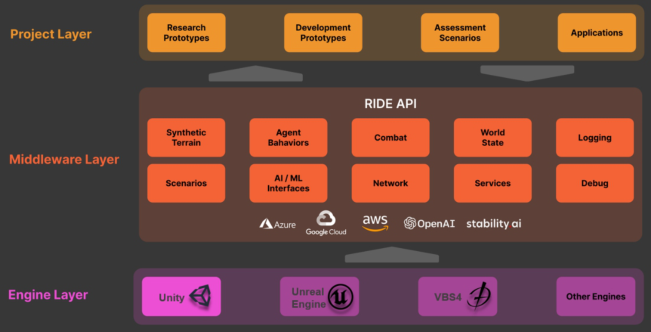
Architecture and Capabilities Earlier work described ongoing integration work between the VHToolkit and RIDE, which will result in a common base between both platforms and a shared set of capabilities researchers and developers can leverage (Hartholt & Mozgai, 2023). In order to support a large ecosystem that contains many dif- ferent developers, researchers, technologies, applications, and organizations, the platforms follow a layered architecture, based on RIDE (Figure 1).
Figure 1: The RIDE architecture.
2https://vhtoolkit.ict.usc.edu
Multidisciplinary Research & Development of Multi-Agents and Virtual Humans 333
The Engine Layer allows RIDE to leverage robust gaming technologies that provide common capabilities, including rendering, physics, animation, pathfinding, User Interface (UI), audio, and network protocols.
The Middleware Layer abstracts and augments the Engine Layer with simulation-specific capabilities, including 3D geospatial terrain, AI agent behaviors, combat, scenarios, machine learning (ML) interfaces, cloud ser- vices interfaces, and networked multi-user. The RIDE API encapsulates these available capabilities in a well-designed suite of systems and services.
The Project Layer allows researchers and developers to leverage RIDE as a foundation for their own projects. RIDE provides common functionality through a drag-and-drop interface in combination with the API. This enables researchers and developers to rapidly create new scenarios as a starting point for their specific needs. The Project Layer acts as an incubation area, where new technologies and approaches can be explored safely, with mature results moving back to the Middleware Layer in order to advance RIDE and benefit all of its users.
This architecture, combined with a rapid prototyping approach, enables researchers and developers to:
Evaluate individual technologies within a common context and use case.
Compare and contrast alternative technologies in order to identify pros and cons for certain intended outcomes.
Rapidly prototype novel solutions leveraging the integrated technologies.
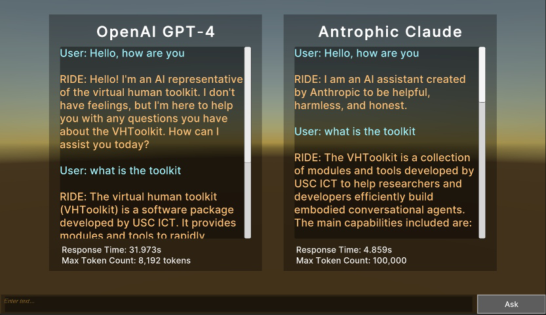
These are facilitated by the common API that provides a principled way to access and expand capabilities through systems that are grouped concep- tually (e.g., agent behaviors, natural language processing). Once established for a single technology, alternative implementations can be added with rela- tive ease. A web interface API offers native support for AWS, Anthropic AI, Azure, Google, HuggingFace, OpenAI, and Stability AI. Services range from data storage and Lambda services to generative AI, including image genera- tion and large language models (LLM). These can be mixed and matched into the real-time game environment. See Figure 2 for an example, comparing in real-time OpenAI’s ChatGPT with Anthropic AI’s Claude.
Figure 2: Comparison of OpenAI’s ChatGPT vs. Anthropic’s Claude LLMs.
USE CASES Military Scenario Authoring
Military simulation prototyping requires proper context, including environ- ment, agents, and military doctrine. Reinforcement learning in particular requires the ability to rapidly set up new scenarios, run experiments, and collect data. See (Hartholt et al., 2021) how RIDE has been used to learn agent behaviors through TensorFlow, a machine leaning platform by Google.
We describe here our efforts to facilitate these experiments by developing dedicated scenario creation tools aimed at reducing the required effort to set up and maintain military simulations. The target audience is researchers and developers familiar with RIDE, using the Unity Editor. We followed a human- centered design process, that included working closely with 3 AI researchers and 2 AI and game developers who were familiar with RIDE and its systems. Over the course of three one-hour long interviews, which included deep dives in their approach, tasks, and needs, we identified the following desiderata for the scenario creation tool:
1. Preview runtime content during editing 2. Toggle any RIDE system on/off 3. Make any agent configurable for new use cases 4. Mix and match RIDE objects with custom objects 5. Configure network synching per object 6. Allow for visual fidelity scalability 7. Support higher military echelons Development efforts initially focused on refactoring existing RIDE sys- tems to remove assumptions made for earlier use cases, resulting in a more flexible approach to system interdependency, agent setup, object setup, and networking, satisfying Desiderata 2, 3, 4 and 5. Desiderata 1, combined with the expertise of our end users, pointed us towards creating additional Unity Editor authoring tools as opposed to creating a separate authoring tool.
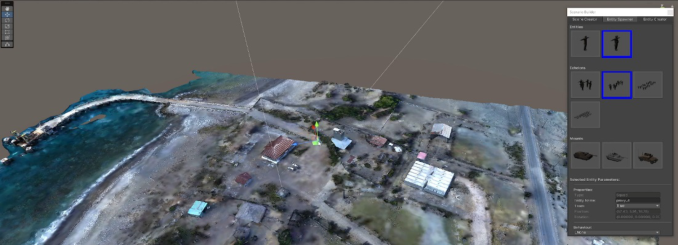
We leveraged Unity’s ability to extend the Editor and created custom visual views and authoring flows based on end-user input. The first step in authoring is setting up the environment, in particular selecting the 3D geospatial terrain on which agents will be placed. These are large data sets, hence Desiderata 6: scalable visual fidelity. To address this, dur- ing the authoring phase, a low resolution version of the terrain is loaded as a placeholder abstraction, allowing the author to use landmarks for placing agents. During runtime, the higher resolution version is loaded instead. Finally, systems were created to organize agents into Fireteams, Squads, Platoons, and Companies, addressing Desiderata 7. Initial tests are promising and future work includes evaluating the authoring tool more formally.
Multidisciplinary Research & Development of Multi-Agents and Virtual Humans 335
Figure 3: RIDE scenario authoring with low-fidelity 3D geospatial abstraction.
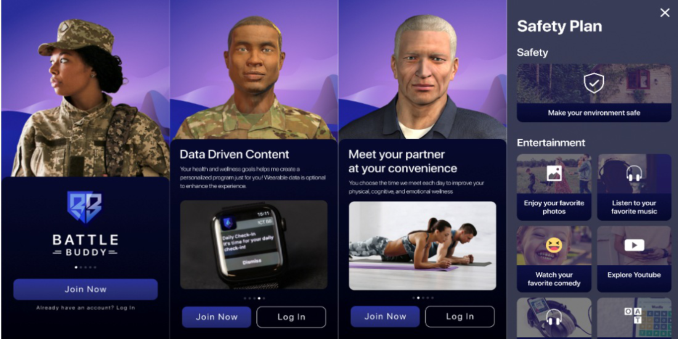
Virtual Human Mhealth App RIDE and the VHToolkit form the basis for development of the Battle Buddy mobile app (see Fig. 4). Battle Buddy is a specialized AI-driven mobile health (mHealth) application tailored exclusively for suicide prevention in Veterans developed at USC ICT sponsored by the US Army DEVCOM Soldier Center and the Department of Veterans Affairs (VA), in collaboration with Soldier- Strong. Battle Buddy’s comprehensive approach aims to establish a suicide prevention ecosystem that can be customized to meet the unique needs of individual users (Mozgai et al., 2020). Battle Buddy not only provides valu- able in-app health and wellness resources, it also acts as a springboard to real-world support networks, including friends, family, and various resources provided by the VA and the VCL (Veterans Crisis Line). Battle Buddy is cur- rently in the prototyping phase. See (Mozgai et al., 2023) for details on the human-centered design processes followed. In this section we describe the technical approach in realizing the design.
While a host of advanced AI technologies are integrated with RIDE and the VHToolkit, given the sensitivity nature of the suicide prevention domain we employ extreme caution in which technologies Battle Buddy leverages. Here, we focus on two main development objectives: 1) Scale content creation, and 2) retain editorial control of content.
Figure 4: Battle Buddy mHealth mobile app prototype.
Scale content creation. All content in Battle Buddy is created by a multidis- ciplinary team, consisting of computer scientists, social scientists, clinicians, designers, visual artists, writers, game developers, and veterans. Verbal vir- tual human content (i.e., what the character says) is written and reviewed by this team of experts and entered into the system as individual lines. These lines are processed to automatically generate: 1) audio files through text-to-speech services, 2) lip-sync schedules to drive the mouth shapes when the character speaks the line, and 3) nonverbal behaviors to accompany the speech (e.g., head nods, conversational gestures). This enables the team to rapidly add new lines, see it spoken and acted out by the virtual human, iterate, and polish. Once the script is locked, the lines are recorded by a professional voice actor, which replace the generated text-to-speech audio files.
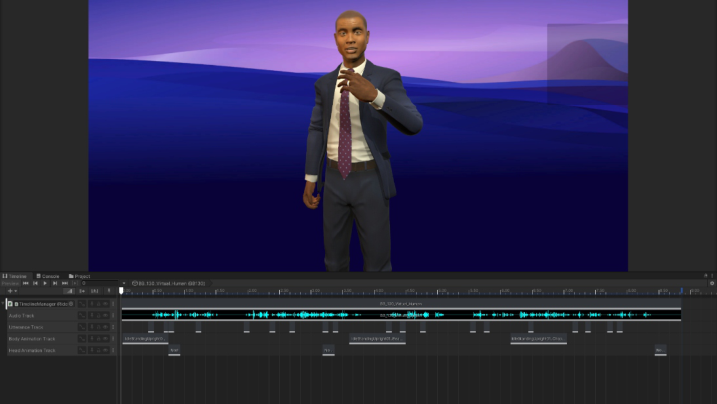
Retain editorial control of content. While the verbal content is created explicitly by the team, the associated nonverbal behaviors are generated auto- matically. This process consists of two parts: 1) the generation of a high-level behavior schedule that includes head nods and shakes, gaze, facial expres- sions, and conversational gestures, based on a semantic and syntactic analysis of the character utterance, and 2) the realization of this schedule in the real- time game engine Unity, using a mix of procedural approaches (e.g., head nods, gaze) and artist created animations (e.g., conversational gestures). To retain editorial control, we developed an authoring tool in the Unity Editor that generates the nonverbal behavior content and automatically places this on a visual Unity timeline, where they can be manipulated by a human author. This includes moving behaviors around, deleting them, or adding new ones.
Figure 5: Virtual human timeline authoring with custom populated tracks.
This authoring tool was developed following a human-centered design approach with a team that included 3 end users (researchers and designers) and 3 developers. The tool was developed iteratively, showing incremental
Multidisciplinary Research & Development of Multi-Agents and Virtual Humans 337
progress to stakeholders, gathering and analysing feedback, and address- ing these in subsequent iterations. Development took 6 weeks, with weekly reviews. Key lessons learned include:
Keep all common user actions in one place: previous iterations of the tool excluded a small amount of common actions due to technical limitations. This required users to switch between the main timeline authoring tool, other parts of the Unity Editor, and script files. The current version unifies many of these actions so users require less context switching.
Provide visual context: authors need to see the context in which they are making changes. For instance, if an emphasis gesture needs to be moved in order to better match the verbal performance, authors need to know where exactly in the character utterance this behavior is occurring. To facilitate this, the tool enables users to zoom in and out, see the utterance words with the correct timing, and see a visualization of the audio file.
Facilitate rapid iteration: authors need to be able to quickly see whether their change had the desired effect. This requires the ability to edit behaviors during runtime and save changes when desired.
FUTURE WORK
The work described here is currently in the prototyping stage. In the future, we aim to enhance RIDE’s fidelity abstraction systems in order to speed up execution time in support of reinforcement learning experiments. Fur- thermore, we will explore creating and executing group behaviors at higher military echelons.
One of our areas of focus for virtual humans is exhibiting real-time backchanneling behaviors (e.g., nodding in agreement, smiling in return), which have been shown to help in establishing rapport (Devault et al., 2014). With permission from the user, a mobile app will be able to capture and process the user’s face and voice using their mobile phone’s camera and microphone. For instance, when the user is talking, the character can per- form listening behaviors (e.g., perform an encouraging head nod when the user pauses), similar to how real people converse. These behaviors are made possible by the same nonverbal behavior generation system described above, translating high-level stage direction to a specific performance.
Finally, we will continue to evaluate and enhance the discussed authoring tools per user feedback.
CONCLUSION
We presented an overview of the combined capabilities of the Virtual Human Toolkit and RIDE, demonstrating the ability to create interactive virtual humans within virtual worlds. The modular architecture, human-centered development approach, visual authoring tools, and interfaces to commodity AI web services enable interdisciplinary teams to design, develop, and deploy engaging, meaningful, efficient, and effective integrated systems, including military training scenarios and mobile health wellness apps.
ACKNOWLEDGMENT
Part of the efforts depicted were sponsored by the US Army under contract number W911NF-14-D-0005. The content of the information does not nec- essarily reflect the position or the policy of the Government, and no official endorsement should be inferred.
REFERENCES
Campbell, J., Core, M., Artstein, R., Armstrong, L., Hartholt, A., Wilson, C., Georgila, K., Morbini, F., Haynes, E., Gomboc, D., Birch, M., Bobrow, J., Lane, H. C., Gerten, J., Leuski, A., Traum, D., Trimmer, M., DiNinni, R., Bosack, M., … Yates, K. A. (2011). Developing INOTS to support interpersonal skills practice. IEEE Aerospace Conference Proceedings. https://doi.org/10.1109/AERO.2011. 5747535 Chu, V. C., Lucas, G. M., Lei, S., Mozgai, S., Khooshabeh, P., & Gratch, J. (2019).
Emotion Regulation in the Prisoner’s Dilemma: Effects of Reappraisal on Behav- ioral Measures and Cardiovascular Measures of Challenge and Threat. Frontiers in Human Neuroscience, 13, 50. https://doi.org/10.3389/fnhum.2019.00050 DeVault, D., Artstein, R., Benn, G., Dey, T., Fast, E., Gainer, A., Georgila, K., Gratch, J., Hartholt, A., Lhommet, M., Lucas, G., Marsella, S., Morbini, F., Nazarian, A., Scherer, S., Stratou, G., Suri, A., Traum, D., Wood, R., … Morency, L.-P. (2014). SimSensei kiosk: A virtual human interviewer for healthcare decision support. 13th International Conference on Autonomous Agents and Multiagent Systems, AAMAS 2014, 2. Devault, D., Artstein, R., Benn, G., Dey, T., Fast, E., Gainer, A., Georgila, K., Gratch,
J., Hartholt, A., Lhommet, M., Lucas, G., Marsella, S., Morbini, F., Nazarian, A., Scherer, S., Stratou, G., Suri, A., Traum, D., Wood, R., … Morency, L. (2014). SimSensei Kiosk : A Virtual Human Interviewer for Healthcare Decision Support. 2014 International Conference on Autonomous Agents and Multi-Agent Systems. International Foundation for Autonomous Agents and Multiagent Systems, 1, 1061–1068. Gordon, C., Leuski, A., Benn, G., Klassen, E., Fast, E., Liewer, M., Hartholt, A., & Traum, D. (2019). PRIMER: An Emotionally Aware Virtual Agent. Intelli- gent User Interfaces (IUI). https://research.ibm.com/haifa/Workshops/user2agent 2019/pdf/PRIMER An Emotionally Aware Virtual Agent.pdf Hartholt, A., Fast, E., Li, Z., Kim, K., Leeds, A., & Mozgai, S. (2022). Re-
architecting the virtual human toolkit: Towards an interoperable platform for embodied conversational agent research and development. IVA 2022 - Proceed- ings of the 22nd ACM International Conference on Intelligent Virtual Agents. https://doi.org/10.1145/3514197.3549671 Hartholt, A., Fast, E., Reilly, A., Whitcup, W., Liewer, M., & Mozgai, S. (2019).
Ubiquitous virtual humans: A multi-platform framework for embodied ai agents in xr. Proceedings - 2019 IEEE International Conference on Artificial Intelligence and Virtual Reality, AIVR 2019, 308–312. https://doi.org/10.1109/AIVR46125. 2019.00072 Hartholt, A., Gratch, J., Weiss, L., Team, G., & Rey, M. (2009). At the Virtual Frontier : Introducing Gunslinger, a Multi-Character, Mixed-Reality, Story-Driven Experience. Proceedings of the 9th International Conference on Intelligent Virtual Agents (IVA), 2009, 5–6. Hartholt, A., McCullough, K., Fast, E., Leeds, A., Mozgai, S., Aris, T., Ustun, V., Gor-
don, A., & McGroarty, C. (2021). Rapid Prototyping for Simulation and Training with the Rapid Integration & Development Environment (RIDE). I/ITSEC.
Multidisciplinary Research & Development of Multi-Agents and Virtual Humans 339
Hartholt, A., & Mozgai, S. (2022). Platforms and Tools for SIA Research and Development. In The Handbook on Socially Interactive Agents: 20 years of Research on Embodied Conversational Agents, Intelligent Virtual Agents, and Social Robotics Volume 2: Interactivity, Platforms, Application (pp. 261–304). ACM. https://doi.org/10.1145/3563659.3563668 Hartholt, A., & Mozgai, S. (2023). Creating Virtual Worlds With the Virtual
Human Toolkit and the Rapid Integration & Development Environment. Intel- ligent Human Systems Integration (IHSI 2023): Integrating People. https://doi.or g/10.54941/ahfe1002856 Hartholt, A., Mozgai, S., Fast, E., Liewer, M., Reilly, A., Whitcup, W., & Rizzo, A. S. (2019). Virtual humans in augmented reality: A first step towards real-world embedded virtual roleplayers. HAI 2019 - Proceedings of the 7th Inter- national Conference on Human-Agent Interaction, 205–207. https://doi.org/10. 1145/3349537.3352766 Hartholt, A., Mozgai, S., & Rizzo, A. (2019). Virtual job interviewing practice for
high-anxiety populations. IVA 2019 - Proceedings of the 19th ACM International Conference on Intelligent Virtual Agents. https://doi.org/10.1145/ivade780 Hartholt, A., Traum, D., Marsella, S. C., Shapiro, A., Stratou, G., Leuski, A., Morency, L.-P., & Gratch, J. (2013). All Together Now: Introducing the Virtual Human Toolkit. Intelligent Virtual Agents; IVA 2013, 368–381. https://doi.org/ 10.1007/978-3-642-40415-3_33 Johnson, W. L., Rickel, J. W., & Lester, J. C. (2000). Animated Pedagogical Agents:
Face-to-Face Interaction in Interactive Learning Environments. In International Journal of Artificial Intelligence in Education. https::: www.isi.eduuisddcarte Lane, H. C., Noren, D., Auerbach, D., Birch, M., & Swartout, W. (2011). Intelligent tutoring goes to the museum in the big city: A pedagogical agent for informal sci- ence education. Lecture Notes in Computer Science (Including Subseries Lecture Notes in Artificial Intelligence and Lecture Notes in Bioinformatics), 6738 LNAI, 155–162. https://doi.org/10.1007/978-3-642-21869-9_22 Mell, J., Lucas, G. M., Mozgai, S., & Gratch, J. (2020). The Effects of Experi-
ence on Deception in Human-Agent Negotiation. Journal of Artificial Intelligence Research, 68, 633–660. https://doi.org/10.1613/JAIR.1.11924 Mell, J., Lucas, G., Mozgai, S., Boberg, J., Artstein, R., & Gratch, J. (2018).
Towards a repeated negotiating agent that treats people individually: Cooper- ation, social value orientation, & Machiavellianism. Proceedings of the 18th International Conference on Intelligent Virtual Agents, IVA 2018, 125–132. https://doi.org/10.1145/3267851.3267910 Mozgai, S., Hartholt, A., & Rizzo, A. S. (2020). An adaptive agent-based interface for personalized health interventions. Proceedings of the 25th International Conference on Intelligent User, 37(111), pages. https://doi.org/10.1145/3379336. 3381467 Mozgai, S., Lucas, G., Gratch, J., Mozgai, S., Lucas, G., & Gratch, J. (2017). To
Tell the Truth: Virtual Agents and Morning Morality. In Proceedings of the 17th International Conference on Intelligent Virtual Agents (pp. 283–286). Springer International Publishing. https://doi.org/10.1007/978-3-319-67401-8_37 Mozgai, S., Rizzo, A. S., & Hartholt, A. (2023). Human-Centered Design for a Virtual Human Led mHealth Intervention for Suicide Prevention. Proceedings of the 5th International Conference on Human Systems Engineering and Design (IHSED2023): Future Trends and Applications.
Neubauer, C., Chollet, M., Mozgai, S., Dennison, M., Khooshabeh, P., & Scherer, S.
(2017). The relationship between task-induced stress, vocal changes, and physio- logical state during a dyadic team task. ICMI 2017 - Proceedings of the 19th ACM International Conference on Multimodal Interaction, 2017-January, 426–432. https://doi.org/10.1145/3136755.3136804 Neubauer, C., Mozgai, S., Chuang, B., Woolley, J., & Scherer, S. (2018). Manual and automatic measures confirm-Intranasal oxytocin increases facial expressivity. 2017 7th International Conference on Affective Computing and Intelligent Inter- action, ACII 2017, 2018-January, 229–235. https://doi.org/10.1109/ACII.2017. 8273605 Rizzo, A., Shilling, R., Forbell, E., Scherer, S., Gratch, J., & Morency, L.-P. (2016).
Autonomous Virtual Human Agents for Healthcare Information Support and Clinical Interviewing. Artificial Intelligence in Behavioral and Mental Health Care, 53–79. https://doi.org/10.1016/B978-0-12-420248-1.00003-9 Rosenbloom, P. S., Demski, A., & Ustun, V. (2016). The Sigma Cognitive Architecture and System: Towards Functionally Elegant Grand Unification. Journal of Artificial General Intelligence, 7(1), 1–103. https://doi.org/10.1515/JAGI-2016- 0001 Scherer, S., Marsella, S., Stratou, G., Xu, Y., Morbini, F., Egan, A., Rizzo, A., &
Morency, L.-P. (2012). Perception Markup Language: Towards a Standardized Representation of Perceived Nonverbal Behaviors (pp. 455–463). Springer, Berlin, Heidelberg. https://doi.org/10.1007/978-3-642-33197-8_47 Schroeder, N., Adesope, O. O., & Gilbert, R. (2013). How effective are pedagogical agents for learning? A meta-analytic review. Journals. Sagepub. Com, 49(1), 1–39. https://doi.org/10.2190/EC.49.1.a Shapiro, A. (2011). Building a character animation system. Lecture Notes in Com-
puter Science (Including Subseries Lecture Notes in Artificial Intelligence and Lecture Notes in Bioinformatics), 7060 LNCS, 98–109. https://doi.org/10.1007/ 978-3-642-25090-3_9 Swartout, W. R., Nye, B. D., Hartholt, A., Reilly, A., Graesser, A. C., VanLehn, K., Wetzel, J., Liewer, M., Morbini, F., Morgan, B., Wang, L., Benn, G., & Rosenberg, M. (2016). Designing a Personal Assistant for Life-Long Learning (PAL3). The Twenty-Ninth International Flairs Conference. https://www.aaai.org/ocs/index.p hp/FLAIRS/FLAIRS16/paper/view/12793
LISTED IN THE AHFE DIGITAL BOOKSTORE CATALOGUE
Explore the complete digital volume
Intelligent Human Systems Integration (IHSI 2024): Integrating People and Intelligent Systems
Read this individual research paper free through the original publisher, or explore the full digital proceedings book.
ISBN 978-1-958651-95-7
Explore this ISBN in the AHFE Bookstore ↗Listed in the July 2026 bookstore catalogue; search by ISBN to confirm current availability · Digital book purchase optional