Huang Chao, Ameersing Luximon, Kwok-Wing Yeung (2020). Thermal Human Modeling: A Design Tool for Functional Clothing. In: Advances in Applied Digital Human Modeling. AHFE Open Access, vol. 11. https://doi.org/10.54941/ahfe100420
Functional and smart clothing has been an up-and-coming products for fashion industry. The human model or mannequin, which is a bridge between customer's physical information and design utilization, has vital importance as primary design tool. The physiological messages of human body may have growing needs for design. The traditional geometric human models (G-model), which convey surface anthropometric data, such as shape, volume and size, may be advanced to functional model. Thermal function is highlighted in this study, based upon an emphasized potential of developing new thermal functional clothing for health enhancement and rehabilitation purpose. After reviewing theoretical basis on thermoregulation and body temperature, as well as the future application in fashion industry, the methodology of developing thermal human model (T-model) is introduced, including experiments, data pre-processing and modeling process. The T-model originated from relatively accurate 3D body scanning data has visualized and quantified skin temperature data obtained from thermographs, which may be adopted to 3D fashion design system, e.g. designing, patternmaking, pattern revision, virtual fitting and grading for functional clothing.
In recent years, with the revolutionary changes and remarkable innovations on functional and intelligent materials, a growing trend on functional and smart clothing has been introduced and accepted by designers, producers and consumers (Fan & Hunter, 2009; Mattila, 2006). For some fit or tight fit functional clothing, more design elements on human anatomy, physiology and biomechanics have been undertaken by them to enhance the special functions such as body protection, recovery, rehabilitation, shaping and performance (Jayaraman, Kiekens, & Grančarić, 2006; Wang, 2008) As one of the efficient design tools, mannequins, also known as human model, are frequently-used by fashion designers, patternmakers and manufacturers, which equip them with tangible or virtual 3D model (Stott, 2012; Wang, 2007). Besides, digital 3D human models are increasingly adopted to enhance the efficiency and sustainability in these human centered disciples (Chintala, 2011; Fletcher, 2008; Gray, 1998). In front of these new revolutions on design and technology trends, the traditional geometric human models may not answer the needs of design and manufacturing from the emerging new branch of functional clothing industry. The digital human model applied to fashion and functional design and manufacturing need be endued with more efficient and internal information of human body. There is a necessity toward launching functional human modeling, as an accelerating,
enhancing and inspiring tool for fashionable and functional clothing design.
In this paper, to commence the functional human model design, the study of thermal functional model will be highlighted. Body temperature decides if human being is healthy and comfort. Human body requires to be maintained in a thermoregulatory status (Weller, 2005; Werner, 1980). Clothing is the second skin of human body, which can fulfill the functions to balance the heat and moisture conditions and keep thermal comfort (Hollies & Goldman, 1977). Besides, due to the significant importance of body temperature to human health emphasized by medical researchers, functional clothing with thermal focus like rehabilitation will be a meaningful, practical and innovational functional product to strength human body.
THERMAL FUNCTION AND CLOTHING The structures and functions of human beings are exceedingly complicated. The components construct human body with various body dimension, body shape and coordinating internal functions. As one of the warm-blooded animal, the main function of human body is to keep the body temperature in a constant status (Goyal, 2013). Clothing takes a significant function of the human body protection and keeps it within a thermal comfort, which have been studied more than decades of years (Fourt & Hollies, 1970; Hollies & Goldman, 1977; Newburgh, 1950; Song, 2011). To clarify the relationship between thermal function and clothing is the theoretical basis for this research.
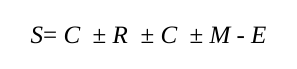
Heat Generation and Loss The majority of heat generated from energy metabolism process maintains normal body temperature and excess heat eliminates to the environment by conductivity, convection, radiation, evaporation (Blatteis, 1998; Johnson & Byrne, 2003). Heat exchange between skin surface and the environment can be fulfilled by convention, conductivity, radiation and evaporation. Human body can radiate infrared rays to outside and absorb heat radiation at the same time. By conduction, heat exchange with air or objects close to skin surface but which is often assumed to be negligible. Water vapor evaporated from skin surface and respiratory systems takes away heat. When the air flows, heat also will get lost by convention. To understand thermoregulation of human body, a lot of scholars had set up heat balance equations in different conditions (Cena & Clark, 1981; Jessen, 2001; Parsons, 2002; Wilmore, Costill, & Gleim, 1995). One of the standard heat balance equation in normal rest condition (Marino, 2008; Piantadosi, 2003) is shown below:
Equation reproduced from the original PDF.
The gain and loss of heat is presented in the equation, where S is heat storage, C is convention and conduction, M is metabolic heat, R is radiation, E is evaporation. When S is positive, the body temperature will rise and negative S result lower body temperature. The balance of heat generation and loss keeps human body in a normal thermoregulation status and retain it in a healthy and comfortable condition (Benzinger, Pratt, & Kitzinger, 1961; Johnson & Byrne, 2003; Parsons, 2002). One of the clothing's functions is to dramatically change the heat exchange relationship by clothing materials. All the parameters in heat balance calculation will directly connect to properties of clothing (Fourt & Hollies, 1970), such as the thermal insulation of clothing.
Features of Human Body Temperature Core temperature and skin temperature or shell temperature are used to quantify the body heat status. The normal body temperature of human body is 37°C, which can be measured from rectum, esophagus and tympanic membrane and fluctuate a little bit during exercise and illness (Heymsfield, 2005; McCall, 2010). Body temperature can only be kept in a narrow range from about 97.5°F to 100.4°F (36.4°C to 37.3°C) in core temperature and from about 96.6°F to 99.3°F or 35.8° to 37.4°C in skin temperature (Hall, 2010; Timby, 2009). Big change on body temperature will directly result in human function disorder or even death (Goyal, 2013; Piantadosi, 2003). The hypothalamus is the temperature control centre to protect body from cold and hot conditions by physiological and psychological reaction, such as shivering, increasing activity and metabolism to produce heat and sweating, reduce activity and decreased appetite to lose heat (Bijlani & Manjunatha, 2010; Eysenck, 2004). In fact, the thermoregulation of human being has been studied for more than one hundred years and still under research due to the complicated structure and functions of human body. The physiological role and process of heat production are known but the exact contribution of each heat generating organs may not have a very clear concept (Malan & Canguilhem, 1989).
From present studies, heat generated by metabolism coming from major organs such as brain, heart, liver, kidneys and skeletal muscles (McCall, 2010). Many properties of the organs and tissues, such as the density, heat conductivity, blood flow and metabolic rate are quite different from each other (Juergen Werner & Buse, 1988). Even the relative stable core temperature varies from organs and tissues. Internal heat conductivity, blood circulation and other physiological reaction helps to maintain the core temperature in a dynamic balance. Even these complicated process may not be clearly monitored, the general understanding can be reached is that the thoracic and abdominal organs such as liver and heart, may have higher temperature in rest, as well as the headquarter of human body brain and, and skeletal muscles may make highest contribution to heat production when doing excise (McCall, 2010; Sherwood, 2011).
Skin temperature distribution may vary with each individual's height, weight, age, gender, skin color, and body fat. The seasonal and environmental changes result in skin temperature fluctuation. The internal metabolic rate, human body structure, tissues properties and heat transferring mechanism may affect the skin temperature map (Sherwood, 2011; Wright, 2000). Skin temperature ranking of different body parts and weighting systems of mean skin temperature had been emphasized by many researchers with different protocol and methods (Jones & Plassmann, 2002; Ramanathan, 1964; Young, Hand, Oatridge & Prior, 1994). Skin temperature is a medical diagnose signal for diseases and chronic disorders of human body (Barnes, 1963; Wunderlich, 1871).
Clothes are the covering of human body, like the second skin. On the basis of thermal function previously mentioned, clothing may has vital importance and great potential to have more functions and donations to human health.
Thermal Function and Clothing These microenvironment bridges human body and out environment. Clothing physiological researchers have been trying to know the theory mechanism and necessarily taking the relationship between thermal function and clothing as first priority for years (Gonzalez & Sawka, 1988; Newburgh, 1950; Renbourn & Rees, 1972). Numerous thermal models and mannequins had been designed based on the heat generation balance principles and tried to predict and simulate human body physiological reaction to clothing and outer environment (Huizenga, Hui, & Arens, 2001; Li, Li, Liu, & Luo, 2004). Functional thermal clothing had been developed to protect human body from unusual environment and occasions (Buijs & Oosten, 1997; Nelson & Henry, 2000; Sheffield, 2013; Shishoo, 2005; Stanton, 1998), for instance fire-protection suit, Arctic clothing, army uniform, space suits, sportswear, etc.
Among the recent developments, new class of materials such as functional and intelligent materials has been introduced. These smart materials together with other technology such as sensors have been used to make smart and intelligent clothing. The garment construction can make use of elements that bringing flexible functional properties to broaden their utility range. Sensors and electronics can be incorporated monitor the user's physiological state, the environment conditions etc (Mattila, 2006).
For normal people and their ordinary life, is it possible to design new thermal function clothing or products, for medical usage such as diseases monitoring and chronic disorders' rehabilitation? What tools may be needed for these kind of functional design? How to provide accurate and fast design tool for functional designs from the viewpoint of customization and mass-production? The questions may not be answered in one word but can rouse the brand new thinking for design concept cultivation and design tools development. Design should be with a view to future. It's necessary to ascertain the prospective design tool for fashion industry. Human models, the linkage of designers and users may be a feasible exploration.
3D HUMAN MODEL APPLIED TO COMPUTER-AIDED-DESIGN FASHION DESIGN SYSTEM CAD in Fashion Industry
The clothing industry has been changed profoundly in recent years. Globalization, speed of information and communication has stimulated competition. While manufacturers offer unlimited designs, the problem is how to bring products to the market quickly and achieve up-to-date information that is easily obtainable. Fashion CAD systems are now the essential tools required to integrate and achieve success taking the role of the configuration
between manufacture and retail. Utilizing a full range of electronic tools, the powerful CAD systems can deliver clothing at relatively short cycles. Integration and communication utilizing the internet become the new systems designed to achieve this (Beazley & Bond, 2003; Burke, 2006; Pundir, 2007).
Some typical commercial software include Toray-Acs (Japan) , Gerber (USA), PGM (USA) , Investronica (Spain), Lectra (France), Asahi Kasei (Japan), PAD (Canada), Nac (China), Iecho (China), Arisa (China), Richforever (China), Tupo (China), Docad (China), Syscad (China), ET (China), Right-hand (China), Bili (China), Modasoft (China) are popularly used by the industry and creating efficiency every day. From fashion design, patternmaking to grading, and then to marker, cutting, the fashion CAD system integrated with CAM (Computer Aided Manufacturing) fulfills the whole process of the making of fashion products. Fashion style design, its computer aided design process depends on 3D human model which demonstrating the body shape, dimension and even size messages to designers. These kinds of human models are usually in a geometric format.
Furthermore, 3D CAD is gradually emerging to the fashion design and manufacturing applications. It may be anticipated that 3D design tools will be the next evolving technology for the apparel industry. The ultimate goal is to design and produce customized clothing for individuals, and the 3D approach is the most adaptable approach to make it come into reality (Wang & Yuen, 2005). 3D geometry model developed from 3D body scanner or 3D design software are the main stream to join the 3D design and manufacturing in fashion industry. The trendy and leading techniques in this area include 2D pattern generation from 3D space and 3D draping simulation or called virtual try- on clothing.
2D Pattern Generation from 3D Space Interactively design can be done to achieve 3D garment with the flattening 3D shape to 2D pattern (3D-2D process) (McCartney, Hinds, Seow, & Gong, 2000). 2D pattern design systems have been used to help designers simplify their work for many years and a looking into 3D features has just been started (Fontana, Rizzi, & Cugini, 2005). Wang's system constructs garments directly in 3D space and then flattens the designed 3D surfaces to obtain 2D patterns (Wang, Wang, & Yuen, 2003). These patterns, however, may not yet directly be adopted for industrial use (Wang, Smith, & Yuen, 2002). Hu et al. employed pattern expert's knowledge to control the process of clothing design with interacting process (Hu, Ding, Zhang, & Yan, 2008). Their system supports collaboration between designers and experiences.
Fuhrmann et al. (2003) proposed another interaction method by geometric pre-positioning of single pieces of clothing patterns with respect to a human body. This approach makes use of developable surfaces such as cylinders or cones, to position clothing patterns around the virtual human. A purely geometrical method was proposed to put clothes on 3D virtual characters by operating clothing on digital human body surfaces (Igarashi & Hughes, 2003). Cho developed a method of individual pattern making method by modifying a traditional draping system with five steps, including defining the surface shape, setting grain lines, fitting the fabric to the surface shape, cutting of the three dimensional surfaces and developing the three dimensionally fitted fabric into 2D patterns. This method was used to make patterns for a tight-fit skirt and could easily create patterns automatically (Cho et al., 2006). To do pattern flattening, material properties had been taken into account which was motivated by the mathematical properties of developable surfaces (Carmo, 1976).
These approach combines the whole process of garment design and display with user interaction, and their work have great contribution to speed up 3D pattern design approach for industrial application. Some commercial software of 3D garment systems had started their industrial trial, such as Assyst-Bullmer (German), Dessingsim (Japan) and LookStailorX (Japan). 3D geometric human model is commonly used in the 2D pattern generation from 3D space process.
3D Draping Simulation/Virtual Try-On Clothing The research interest of computer graphics had been shown to clothing simulation in the late 1980s and output has bloomed since then. Terzopoulos and his team would be the pioneer to use physical models for cloth simulation (Terzopoulos & Barr, 1987). Zhou et al. had investigated the structure of woven fabrics and simulated its mechanical behavior based on the thin-shell theory (Zhou, Jin, & Wang, 2008a). They also proposed a novel physical model to solve the vibration problem from large rotation (Zhou, Jin, & Wang, 2008b). Their technique can work well with major methods for simulating internal dynamics. Meng and his colleagues brought forward a method by using a geometrical scheme by correction of position to handle collision response, which ensured good stability
of simulation without re-computation of dynamic equations (Meng, Mok, & Jin, 2010). Other progress can be reached in (Choi & Ko, 2005), and some textbooks have even been written (House & Breen, 2000; Volino & Magnenat-Thalmann, 2000). In these 3D draping systems, human models, also called avatars, have been developed and garments can be virtually tried on these model (Kang & Kim, 2000a; Yang, Magnenat Thalmann, & Thalmann, 1992; Zhang, Hou, Zhou, & Yoshio, 2000). The 3D shape of a garment can be estimated by sewing its 2D pattern up on a 3D mannequin (2D-3D process) (Fan, Newton, Au, & Chan, 2001; Kang & Kim, 2000b; Okabe, Imaoka, Tomiha, & Niwaya, 1992).
Commercial fashion CAD software have integrated this function to, such as Gerber, Lectra and PAD. Pad's modular-based software allows 2D patterns to be modified by following sew points. The draping appearance on a digital human model can be created with fabric models and can be linked to measurement data. Gerber's draping system provides the functions to verify fit and ease allowance. The modification results in either 2D or 3D model can be quickly realized and displayed based on 3D human model. The advanced technologies on internet, intranet and virtual reality allow Lectra to incorporate pattern design module with E-Design, E-Manufacturing, E-Sales and Lectra on-line, which may help the users fast react from market need and design. The system makes it become possible to watch garment collection on a virtual reality catwalk.
3D geometric human model is a key component to support the computer-aided 3D fashion design and manufacturing, which is becoming the trendy efficient tool. For thermal functional clothing development, a thermal human model is essential to be created serving as an effective design tool. In the following part, the thermal modeling process will be introduced and illustrated by steps.
THERMAL HUMAN MODELLING Experiment and Data Pre-Processing
The developments of medical imaging and anthropometry technology, an in-depth and specific foundation have been taken to further understanding human body in physical and medical aspects. This has enabled the development of thermal human models for function clothing design. In this study, under thermoneutral condition (temperature: 24±1°C, relative humidity: 60±5%), male and female subjects at rest had been scanned by a 3D body scanner system in a naturally standing gesture. Surface data of human body have been collected in a digital format, which will help to set up the basic geometric model (G-model) from cloud point data of scanned human body. The noninvasive thermography technique have been adopted by an infrared camera to capture thermal imaging which can record the skin temperature distribution of subjects in real time.
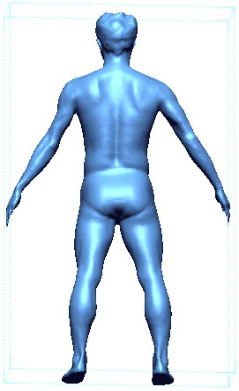
To put all the 3D human body in the same coordinate system and run modeling function synchronously, the original G-model after scanning need to be alignment by mathematical and statistical methods, such as principle component methods (Luximon & Chao, 2013). Most of the 3D body scanned data may possibly be noised by the environment and should be cleaned and smoothed by 3D software such as Rapidform and Meshlab or using algorithm methods such as Adaptive Moving Least Squares method (Dey & Sun, 2005). The aligned and cleaned human body will enhance the quality of thermal modeling, which is shown in Figure1.
Figure 1. Pre-processed G-model: front and back
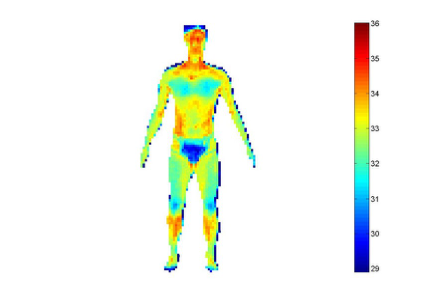
Thermal imaging records real skin temperature distribution of human body. These kind of invisible information may be captured by IR camera and presented in images. In thermal human modeling process, the IR data pre-processing assists to understand temperature's distribution and features of subjects by mathematical plotting methods such as Matlab software. Different temperature range and color palettes can be set to display the temperature information. In Figure 2, the subject's IR images have been pre-processed in a ‘Jet’ palette with a temperature range of 29°C to 36°C, from front and back side. Red and yellow is the relatively high temperature, blue and green represents the low temperature. The data plotting technology is necessary to interpret the biological messages with various functions.
Figure 2. Pre-processed IR data: front and back
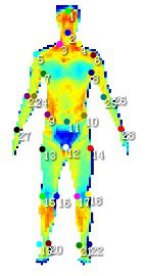
Modeling Process Corresponding points should be sorted out between IR image and G-model. In this study, 28 sets of points were selected for both front and back view. As human body has unique and symmetrical shape, characteristic points should be selected to make sure the exact mapping from 2D IR picture and 3D human model. The distribution of these points may cover all the featured position in the profile of human body. For example, anatomical points in forehead, chin, acromion, arm pit, crotch, knee cap, back of knee, ankle, cubital fossa, elbow, wrist would be chosen. The only body covering underwear has obvious lines to be observed, which also should be highlighted. In the mapping process, the closer corresponding relationship is set, the better matching would be.
Figure 3. Corresponding points of IR picture and 3D geometric model: front and back Results and Discussions
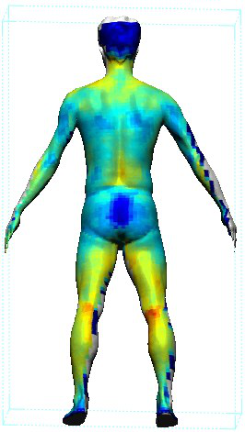
Utilizing 3D design software, such as Rapidform, or mathematical programming with Matlab software, the thermal human model (T-model) can be achieved, see Figure 4. The skin temperature data of subjects were transferred to exact 3D human body, the temperature distribution and features can be clarified easily for design and manufacturing process. The T-model has been created, including both accurate human body's dimensional data and real subjects' skin temperature distribution. It may be optimistically conclude that the thermal functional model can be constructed and realized by means of effective experiment design and latest thermal imaging technologies. Due to human body's complicated shape, as well as the accuracy limitation with current facilities, some minor parts of the mapping may not be perfect which would be polished in further research.
Figure 4. T-model: front and back
CONCLUSIONS
Multidisciplinary studies lead innovations and revolutions. Comparing to single, isolated dimensional information presented by traditional geometric models, T-model reproduce both spatial information and real thermal characters of human body, which is groundbreaking to understand skin temperature of human body from a visualized, quantitative and practical aspect. That means, when the fashion insiders use T-model for functional clothing
development, they will easily find out the precise position of high skin temperature or low skin temperature areas and the accurate size of the skin temperature areas, which will greatly upgrade the accuracy and efficiency of functional thermal design and implement using 2D and 3D software for patternmaking, pattern revision, virtual fitting and grading. Furthermore, as an potential useful design tool. a digital T-model can be further developed into an estimative mannequin by means of 3D printing or other mannequins making techniques. Functional human model is a new thinking for fashion and functional product development. The method to create T-model is a concept display. More details should be considered to improve this model and more ideas would be actualized in further research work.
REFERENCES
Barnes, R. B. (1963). Thermography of the Human Body Infrared-radiant energy provides new concepts and instrumentation for medical diagnosis. Science, 140(3569), 870-877. Beazley, A., & Bond, T. (2003). Computer-aided pattern design and product development: Blackwell Pub. Benzinger, T., Pratt, A., & Kitzinger, C. (1961). The thermostatic control of human metabolic heat production.
Proceedings of the National Academy of Sciences of the United States of America, 47(5), 730. Bijlani, R. L., & Manjunatha, S. (2010). Understanding Medical Physiology: A Textbook for Medical Students: Jaypee Bros. Medical Publishers. Blatteis, C. M. (1998). Physiology and Pathophysiology of Temperature Regulation: World Scientific. Buijs, C., & Oosten, J. G. (1997). Braving the Cold: Continuity and Change in Arctic Clothing: Research School
CNWS, School of Asian, African, and Amerindian Studies. Burke, S. (2006). Fashion Computing: Design Techniques and CAD: Burke Publications. Carmo, M. P. D. (1976). Differential Geometry of Curves and Surfaces. Englewood Cliffs, NJ: Prentice-Hall,. Cena, K., & Clark, J. A. (1981). Bioengineering, Thermal Physiology and Comfort: Elsevier Science. Chintala, G. (2011). Trends in CAD/CAM: To Capture Global Markets: Lambert Academic Publishing. Cho, Y., Komatsu, T., Inui, S., Takatera, M., Shimizu, Y., & Park, H. (2006). Individual pattern making using computerized draping method for clothing. Textile Research Journal, 76(8), 646-654. Choi, K.-J., & Ko, H.-S. (2005). Research problems in clothing simulation. Computer-Aided Design, 37(6), 585-
592. Dey, T. K., & Sun, J. (2005). An Adaptive MLS Surface for Reconstruction with Guarantees. Paper presented at the Symposium on Geometry Processing. Eysenck, M. W. (2004). Psychology: An International Perspective: Psychology Press. Fan, J., & Hunter, L. (2009). Engineering Apparel Fabrics and Garments: Elsevier Science. Fan, J., Newton, E., Au, R., & Chan, S. C. F. (2001). Predicting Garment Drape with a Fuzzy-neural Network.
Textile Research Journal, 71(7), 605-608. Fletcher, K. (2008). Sustainable Fashion and Textiles: Design Journeys: Earthscan. Fontana, M., Rizzi, C., & Cugini, U. (2005). 3D virtual apparel design for industrial applications. Computer-Aided Design, 37(6), 609-622. Fourt, L. E., & Hollies, N. R. S. (1970). Clothing; Comfort and Function: M. Dekker. Fuhrmann, A., Groß, C., Luckas, V., & Weber, A. (2003). Interaction-free dressing of virtual humans. Computers &
Graphics, 27(1), 71-82. Gonzalez, R. R., & Sawka, M. (1988). Biophysics of heat transfer and clothing considerations. Human performance physiology and environmental medicine at terrestrial extremes, 45-95. Goyal, M. R. (2013). Biofluid Dynamics of Human Body Systems: Apple Academic Press. Gray, S. N. (1998). Cad/Cam in Clothing and Textiles: Design Council. Hall, J. E. (2010). Guyton and Hall Textbook of Medical Physiology: Enhanced E-book: Elsevier Health Sciences. Heymsfield, S. (2005). Human Body Composition: Human Kinetics. Hollies, N. R. S., & Goldman, R. F. (1977). Clothing comfort: interaction of thermal, ventilation, construction, and
assessment factors : the Fiber Society, Inc. Comfort Symposium proceedings: Ann Arbor Science Publishers. House, D., & Breen, D. E. (2000). Cloth modeling and animation: A K Peters. Hu, Z.-H., Ding, Y.-S., Zhang, W.-B., & Yan, Q. (2008). An interactive co-evolutionary CAD system for garment pattern design. Computer-Aided Design, 40(12), 1094-1104. Huizenga, C., Hui, Z., & Arens, E. (2001). A model of human physiology and comfort for assessing complex
thermal environments. Building and Environment, 36(6), 691-699. Igarashi, T., & Hughes, J. (2003). Clothing manipulation. Paper presented at the Proceedings of the15th ACM symposium on user interface software and technology. Jayaraman, S., Kiekens, P., & Grančarić, A. M. (2006). Intelligent textiles for personal protection and safety: IOS
Press.
Jessen, C. (2001). Heat Production and Heat Balance of the Body Temperature Regulation in Humans and Other Mammals (pp. 27-36): Springer. Johnson, L. R., & Byrne, J. H. (2003). Essential Medical Physiology: Academic Press. Jones, B., & Plassmann, P. (2002). Digital infrared thermal imaging of human skin. Engineering in Medicine and
Biology Magazine, IEEE, 21(6), 41-48. Kang, T. J., & Kim, S. M. (2000a). Development of three-dimensional apparel CAD system Part 1: Flat garment pattern drafting system. International Journal of Clothing Science and Technology, 12(1), 26-38. Kang, T. J., & Kim, S. M. (2000b). Development of three-dimensional apparel CAD system Part II: Prediction of
garment drape shape. International Journal of Clothing Science and Technology, 12(1), 39-49. Li, Y., Li, F., Liu, Y., & Luo, Z. (2004). An integrated model for simulating interactive thermal processes in human– clothing system. Journal of Thermal Biology, 29(7), 567-575. Luximon, A., & Chao, H. (2013). Shape Modeling: From Linear Anthropometry to Surface Model. Paper presented
at the ACHI 2013, The Sixth International Conference on Advances in Computer-Human Interactions Malan, A., & Canguilhem, B. (1989). Living in the Cold: 2nd International Symposium : Proceedings of the Second Symposium on Living in the Cold, Held in Le Hohwald (France), April 23-29, 1989: John Libbey. Marino, F. E. (2008). Thermoregulation and Human Performance: Physiological and Biological Aspects: Karger. Mattila, H. R. (2006). Intelligent Textiles And Clothing: Woodhead Publishing Limited. McCall, R. P. (2010). Physics of the Human Body: Johns Hopkins University Press. McCartney, J., Hinds, B. K., Seow, B. L., & Gong, D. (2000). Dedicated 3D CAD for garment modelling. Journal of
Materials Processing Technology, 107(1-3), 31-36. Meng, Y., Mok, P. Y., & Jin, X. (2010). Interactive virtual try-on clothing design systems. Computer-Aided Design, 42(4), 310-321. Nelson, C. N., & Henry, N. W. (2000). Performance of Protective Clothing: Issues and Priorities for the 21st
Century. Seventh volume: ASTM. Newburgh, L. (1950). Physiology of heat regulation and the science of clothing. Academic Medicine, 25(2), 158. Okabe, H., Imaoka, H., Tomiha, T., & Niwaya, H. (1992). Three dimensional apparel CAD system. Computer Graphics (ACM), 26(2), 105-110. Volino, P., & Magnenat-Thalmann, N. (2000). Virtual Clothing: Theory and Practice: Springer. Parsons, K. (2002). Human Thermal Environments: The Effects of Hot, Moderate, and Cold Environments on
Human Health, Comfort and Performance, Second Edition: Taylor & Francis. Piantadosi, C. A. (2003). The Biology of Human Survival : Life and Death in Extreme Environments: Life and Death in Extreme Environments: Oxford University Press, USA. Pundir, N. (2007). Fashion Technology: Today and Tomorrow: Mittal Publications. Ramanathan, N. (1964). A new weighting system for mean surface temperature of the human body. Journal of
applied physiology, 19(3), 531-533. Renbourn, E. T., & Rees, W. H. (1972). Materials and clothing in health and disease: history, physiology and hygiene: medical and psychological aspects: HK Lewis. Sheffield, C. (2013). Space Suits: Being the Selected Legal Papers of Waldo Burmeister and Henry Carver,
Attorneys-At-Law: Orion. Sherwood, L. (2011). Fundamentals of Human Physiology: Cengage Learning. Shishoo, R. (2005). Textiles in Sport: Elsevier Science. Song, G. (2011). Improving Comfort in Clothing: Elsevier Science. Stanton, S. L. (1998). U.S. Army Uniforms of the Cold War, 1948-1973: Stackpole Books. Stott, M. (2012). Pattern Cutting for Clothing Using CAD: How to Use Lectra Modaris Pattern Cutting Software: Elsevier Science. Terzopoulos, J. C. P., & H. Barr. (1987). Elastically deformable models. ACM SIGGRAPH 1987, 205-214. Timby, B. K. (2009). Fundamental Nursing Skills and Concepts: Wolters Kluwer Health/Lippincott Williams &
Wilkins. Wang, C. C. L., Smith, S. S. F., & Yuen, M. M. F. (2002). Surface flattening based on energy model. CAD Computer Aided Design, 34(11), 823-833. Wang, C. C. L., Wang, Y., & Yuen, M. M. F. (2003). Feature based 3D garment design through 2D sketches.
Computer-Aided Design, 35(7), 659-672. Wang, C. C. L., & Yuen, M. M. F. (2005). CAD methods in garment design. Computer-Aided Design, 37(6), 583-
584. Wang, R. (2007). CAD Technology for Clothing Biomechanical Engineering Design: Hong Kong Polytechnic University (Hong Kong). Wang, S. (2008). Intelligent Thermal Protective Clothing: Hong Kong Polytechnic University (Hong Kong). Weller, A. S. (2005). Body temperature and its regulation. Anaesthesia & Intensive Care Medicine, 6(6), 206-209. Werner, J. (1980). The concept of regulation for human body temperature. Journal of Thermal Biology, 5(2), 75-82.
Werner, J., & Buse, M. (1988). Temperature profiles with respect to inhomogeneity and geometry of the human body. Journal of applied physiology, 65(3), 1110-1118. Wilmore, J. H., Costill, D. L., & Gleim, G. W. (1995). Physiology of sport and exercise. Medicine & Science in
Sports & Exercise, 27(5), 792. Wright, D. B. (2000). Human Physiology and Health: Pearson Education. Wunderlich, C. A. (1871). On the Temperature in diseases: The New Sydenham society. Yang, Y., Magnenat Thalmann, N., & Thalmann, D. (1992). Three-dimensional garment design and animation : A new design tool for the garment industry. Computers in Industry, 19(2), 185-200. Young, I. R., Hand, J. W., Oatridge, A., & Prior, M. V. (1994). Modeling and observation of temperature changes in
vivo using MRI. Magnetic resonance in medicine, 32(3), 358-369. Zhang, M., Hou, D., Zhou, A., & Yoshio, S. (2000). Three Dimensional Simulation and Pattern Making of Collar Using Geometric Model. Journal of DongHua University, 18(3), 53-57. Zhou, C., Jin, X. G., & Wang, C. L. (2008a). Efficient and stable simulation of cloth undergoing large rotations.
Computing in Science & Engineering, 10(4), 30-40. Zhou, C., Jin, X. G., & Wang, C. L. (2008b). Shear buckling and dynamic bending in cloth simulation. Computer Animation and Virtual Worlds 19(3), 493-503.
LISTED IN THE AHFE DIGITAL BOOKSTORE CATALOGUE
Explore the complete digital volume
Advances in Applied Digital Human Modeling
Read this individual research paper free through the original publisher, or explore the full digital proceedings book.
ISBN 978-1-4951-2094-7
Explore this ISBN in the AHFE Bookstore ↗Listed in the July 2026 bookstore catalogue; search by ISBN to confirm current availability · Digital book purchase optional