Ameersing Luximon, Yan Luximon, Ravindra Goonetilleke (2022). Infrared thermographic evaluation of facemasks. In: Creativity, Innovation and Entrepreneurship. AHFE Open Access, vol. 31, pp. 141–149. https://doi.org/10.54941/ahfe1001516
In the past only health care professionals wore facemasks daily, but in recent times almost all citizens of many countries are expected to wear facemasks to reduce infection at work and in public. Because of SARS and now COVID-19, facemasks have become an essential personal protective equipment to fight against infectious disease. Frequent use of mask has proven to provide significant protection in reducing infections, even though there are complaints about its long-term usage. Although there are many types of masks, the surgical mask and the N95 respirator are the common ones. In this study, the surgical mask and the N95 respirator were compared with a no-mask condition. Results indicated that participants wearing the N95 respirator had the most significant thermal discomfort. The surgical mask was also significantly uncomfortable when compared to the no mask condition. Infrared thermographic results indicated that the heat retained when wearing a mask is higher than without a mask. Results of this study show the importance in mask design to have sufficient protection, comfort and fit.
Frequent use of face masks, during SARS and more recently COVID-19 pan- demics have proven to give significant protection against such viruses (Seto et al. 2003, Lau et al. 2004, Cowling et al. 2010, Tekalegn et al. 2020). After the SARS outbreak in 2003, people were expected to wear a facemask when in public if they felt sick, and this has somewhat influenced the sociocultural behavior of facemasks (Siu 2016). Both N95 respirators and surgical masks are regularly used in Hong Kong (Seto et al. 2003) and during the pande- mic, the shortage of facemasks worldwide gave rise to some people making their own masks to have some level of protection (Reutman et al. 2021). Even when wearing commercial masks, they must be properly worn to have the intended protection. It is surprising to note that one study indicated that the level of overall correct use of facemask was 10.1% among health care professionals (Tekalegn et al. 2020).
The effectiveness, function and performance of face masks is dependent on factors such as proper usage, duration, time of day, and environment (temperature and humidity). Many studies have been conducted using mea- sures such as temperature, humidity, and breathability to examine the function and performance of the masks (Nielsen et al. 1987, Li et al. 2005, Cowling et al. 2010, Luximon et al. 2016). The temperature and humidity inside the mask were closely associated with exhaled breath temperature (Cherrie et al. 2019). Some people feel that face masks might influence tal- king and singing. The temperature while talking is not significant compared to being silent (Luximon et al. 2016). Furthermore, Collyer and Davis (2006) have found that singing and talking does not affect breathing behaviour when wearing facemasks. In addition, face masks recommended to reduce the spread of SARS-CoV-2, has near-zero risk of pathologic gas exchange impair- ment with cloth masks and surgical masks (Shein et al. 2021). Although the risk of gas exchange impairment is very low, there are differences in tempe- rature, humidity, and perceived comfort (Luximon et al. 2016, Scarano et al. 2020). There are significant differences among facemasks, including the N95 respirator and the surgical mask (Roberge et al. 2012, Christensen et al. 2012, Luximon et al. 2016). N95 respirators induce higher facial skin temperature, greater discomfort (Luximon et al. 2016, Scarano et al. 2020) and lower wea- ring adherence when compared to the medical surgical masks (Scarano et al. 2020). With children, their perceptions are influenced by aesthetic design, temperature (or hotness) and perceived breathability (Smart et al. 2020).
Most studies on facemasks have been carried out in a lab setting and over a relatively short time. Given that a face mask increases the temperature around the mouth and nose (Luximon et al. 2016, Scarano et al. 2020), it is expe- cted that there will be some risks associated with wearing facemasks for long durations, especially in hot and humid places. During COVID19, health care workers (HCW) needed to wear face masks for very long durations, and recent studies have indicated that acne (on mostly cheeks and nose) is preva- lent in 53.4% of HCW participants in Pakistan. Moderate and severe acne eruption was particularly observed in those wearing N95 and surgical masks, with maximum cases reported in females and doctors (Yaqoob et al. 2021). Another study in south India showed that among HCW, 67.6% had excessive sweating around the mouth, 58.2% had difficulty in breathing, 56.0% had acne and 52.0% had itchy nose while wearing face masks (Purushothaman et al. 2021). Both India and Pakistan have very hot and humid climates. In addition to acne, long-time use of a facemask can cause pressure sores on the ears and nose bridge (Luo et al. 2020).
Although sensors inside a mask have been used for facemask evaluations (Cherrie et al. 2019), use of infrared thermography to measure skin tem- perature has become widespread since it is relatively easy and nonintrusive. Infrared thermography is based on infrared radiation of wavelengths lon- ger than what is visible by the human eye. Since the eye’s sensitivity decreases rapidly after wavelengths exceeding 700 nanometers (nm), infrared radiation ranges from 700 nanometers (nm) to 1 millimeter (mm). Infrared radiation is popularly known as “heat radiation”, and infrared thermal-imaging cameras are used to create images by detecting infrared radiation (heat) that emanates
Infrared Thermographic Evaluation of Facemasks 143
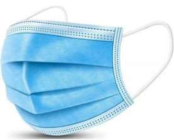
(a) Surgical facemask (b) N95 respirator
Figure 1: Face mask used.
from objects and their surrounding environment. Thermal-imaging cameras are widely used in industrial, scientific, military, commercial, and medical applications (Roberge et al. 2011, Luximon et al. 2016). IR imaging softw- are provides added advantages of allowing the acquisition of thermal profiles, exporting data, and providing videos of thermal data. In this study, the time dependent changes of facial temperature distribution with the surgical mask and the N95 respirator were evaluated using an IR camera.
EXPERIMENTAL METHOD Ten Chinese participants (five male and five female) with a mean age of 31.7 and standard deviation (SD) of 11.9 years (female: mean = 24.2, SD = 2.49 years; male: mean = 39.2, SD = 13.14 years) were recruited to participate in this experiment. Their mean weight and height were 171cm (SD=7.48cm) and 66 kg (SD=11.5kg) (height: female (mean = 166cm, SD = 4.84cm), male (mean = 176cm, SD = 6.1cm); weight: female (mean = 60kg, SD = 7.76kg), male: (mean = 72.4kg, SD = 11.9kg). A FLIR E33 Infrared Camera (FLIR USA), 3M N95 respirator (3M Korea Ltd.), and surgical masks (US Secure Co. Ltd.) were used. The video recording function of the infrared camera was used to record the temperature distribution changes during the entire experiment. The three conditions were: (1) sitting silently with no mask; (2) sitting silently with a surgical mask (Figure 1a); (3) sitting silently with a N95 respirator (Figure 1b). The dependent variables were thermal images of facial temperature during five minutes and the participant’s perceptions related to the subjective ratings of ‘Humid’, ‘Hot’, ‘Difficult to breathe’, and ‘Overall discomfort’. Perceptions were gathered using an 11-point Likert scale (0 = “not at all noticed” and 10 = “strongly noticed”). Facial tempera- tures were video recorded with the infrared camera. The temperature of the room was around 23.4°C (SD=1.24°C) and relative humidity was around 29.5% (SD=8.82%). The core temperature of the participants was 36.6°C (SD=0.58°C). The data was processed using custom programs developed in Matlab.
RESULTS
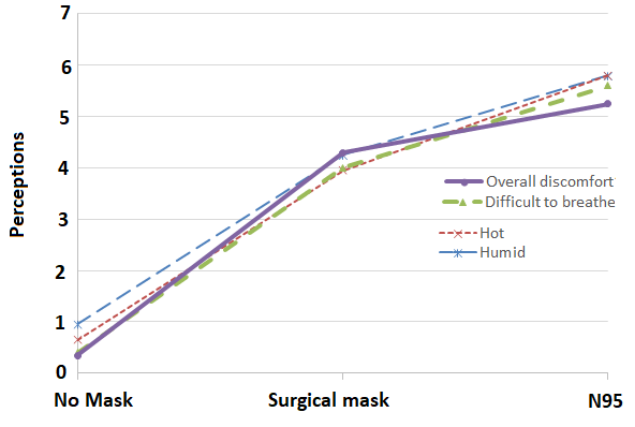
Subjective perceptions A T-Test showed that there is significant difference (p <0.05) in gender for the ‘Humid’ rating (Means: Male = 3.3, Female = 5.2) and ‘Hot’ rating (Means:
Figure 2: Subjective perceptions of the three different conditions.
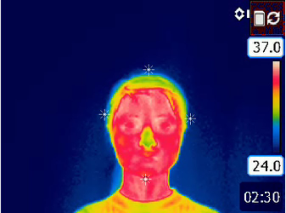
(a) Extracted InfraRed Image with Temperature
(b) Four reference points to indicate approximate
scale
location of face
Figure 3: Extracted Infrared image from video file.
Male = 3.0, Female = 4.9) when wearing a surgical mask. For the other con- ditions and subjective ratings, there were no significant differences in gender. A T-Test also showed that there is significant difference (p <0.05) between condition 1 (No mask) and condition 2 (Surgical mask) for all the subjective rating. A T-Test showed a significant difference (p <0.05) between condition 1 and condition 3 for all the subjective rating. When considering condition 2 and 3 (N95 respirator), T-tests showed significant differences for ‘Hot’ (p< 0.05) and ‘Difficult to breathe’ (p< 0.05) but marginally different for ‘Humid’ (p=0.09). There is no significant difference for ‘Overall discomfort’ when wearing either mask. The perception data are shown in Figure 2.
Infrared data analysis First an image at 2 mins 30 s (150 s) representing the middle of the video file was used as a reference (see Figure 3a). Four points indicating the maximum head position, chin position, maximum lateral head position and minimum
Infrared Thermographic Evaluation of Facemasks 145
(a) Extracted data from the selected region
(b) Color matching for indexed image
(c) Converted data into indexed image
Figure 4: Converting color image into indexed image.Figure 5: Absolute difference of images from the reference image.
lateral head position were manually located on the reference image (see Figure 3b). Using the 4 extracted points as a reference and a tolerance of 10 pixels, the expected location of the head in the video frame was obtained and the image extracted. Given that different extracted image may have diffe- rent sizes for different participants, all extracted images were converted into a fixed 400x300 pixel canvas (see Figure 4a). The color image was converted into an indexed image at 100 levels (Figure 4b). The indexed image is shown in Figure 4c. From the indexed image, the temperature values can be obtained based on the minimum and maximum value of the temperature scale value for each image in the video file.
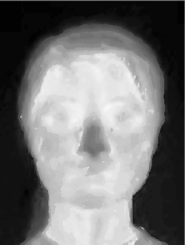
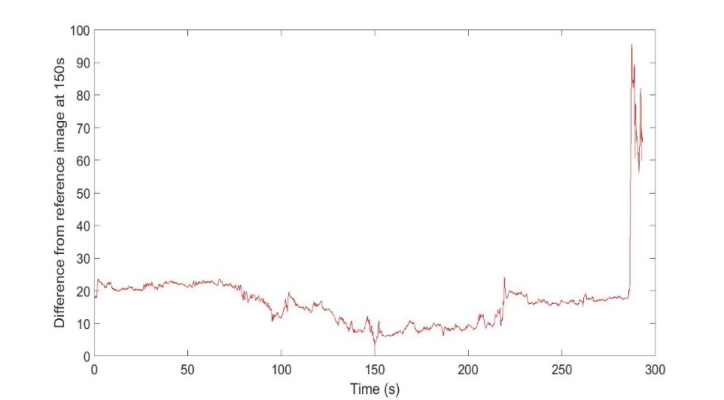
Although the experimenter had requested the participants to remain still throughout the experiment, some participants moved slightly for very short periods. Also, the video recorded the mask donning and doffing process. Based on the reference image, the absolute differences between the images are calculated (imabsdiff function in Matlab was used and the data is shown
Figure 6: Discarded images.Figure 7: Region of interest (without mask, surgical mask and N95 respirator).
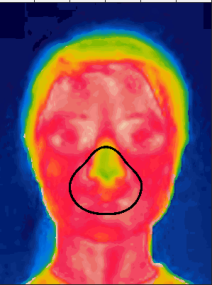
in Figure 5 for one video file). Generally, an image difference error of more than 35 indicate the subject has moved. Figure 6 shows sample images that were discarded and not used in further analysis. Given that temperature chan- ges mainly occur at the nose and mouth region, a region of interest (radius around 50) is created using splines around the mouth and nose as shown in Figure 7.
The simple statistics are shown in Table 1. An ANOVA was performed to find the effects of the independent variables on the dependent variable, mean temperature within the region of interest. The independent variables were “Mask” (no mask, Surgical mask and N95 respirator), Before and After doffing mask (Before/After), Gender, Start/End (Start - consider data within the first 30 second, End - consider data the last 30 seconds) of the 5 minutes video recording.
ANOVA analysis showed significant differences for Mask (F(2,105) = 84.29; p < 0.05), Before/After doffing (F(1,105) = 430.12; p < 0.05), Star- t/End (F(1,105) = 7.04; p < 0.05), and interaction (Setting* Before/After) (F(1,105) = 109.72; p < 0.05). Since there was an interaction, an ANOVA was performed separately for data Before and After doffing. ANOVA analysis results for before doffing the face mask shows significant differences for Mask (F(2,50) = 147.7; p < 0.05). Post hoc comparison of means using Tukey indi- cate that the mean temperature on the face mask surface (Mean temperature for surgical mask = 28.92°C, Mean temperature for N95 = 28.34°C) was lower than the no mask setting (Mean temperature = 33.81°C). ANOVA s for
Infrared Thermographic Evaluation of Facemasks 147
Table 1. Mean temperature within the region of interest.
Table available in the original PDF paper.
Gender Setting Before / After Start/End Temp (oC) Mean SD Min Max Male Before doffing No mask Start 34.03 0.60 33.29 34.92 End 34.20 0.66 33.32 35.01 Surgical Mask Start 28.81 0.86 27.73 30.14 End 29.05 0.94 27.79 30.44 N95 respirator Start 28.59 1.18 26.51 29.50 End 28.56 1.74 25.45 29.47 After Doffing No mask Start 34.24 0.82 33.07 35.16 End 34.05 0.95 32.51 35.00 Surgical Mask Start 34.58 1.01 32.90 35.62 End 34.19 1.02 32.45 35.07 N95 respirator Start 34.70 0.93 33.33 35.85 End 34.10 1.01 32.75 35.35 Female Before doffing No mask Start 33.55 1.03 32.21 34.98 End 33.48 1.08 32.14 35.01 Surgical Mask Start 28.89 0.94 27.98 30.24 End 28.91 1.17 27.71 30.21 N95 respirator Start 27.83 1.18 26.52 29.30 End 28.40 1.57 26.34 30.58 After Doffing No mask Start 33.49 1.13 31.98 34.94 End 33.44 1.12 31.99 34.93 Surgical Mask Start 34.04 0.17 33.77 34.24 End 33.32 0.13 33.20 33.55 N95 respirator Start 34.31 0.65 33.33 35.14 End 33.81 0.62 32.77 34.33
after doffing face mask showed marginally significant differences for Gender (F(1,50) = 3.45; p = 0.069) and significant differences for Start/End (F(1,50) = 6.94; p = 0.0112) Post hoc comparison of means using Tukey indicated that just after removing face mask, the temperature is higher (34.23°C) than after 5 minutes (33.82°C), Males have higher mean temperature (34.31°C) than Females (33.73°C) after doffing. A separate ANOVA analysis when not wearing mask, indicated that there are no significant difference and interactions among the “Masks” factor.
CONCLUSION
Face masks are an essential component against respiratory disease, especially during a pandemic; however, the usage and function of face masks are heavily influenced by many factors. The choice of face mask is influenced by design and perceived comfort and fitting. Use of face mask increases the temperature around the nose and mouth region. The increase in temperature may cause sweating and acne, especially in hot and humid countries. Furthermore, due to thermal discomfort, people might not wear a face mask properly, reducing its effectiveness. Given that a face mask is essential, and the proper usage is important, more research in materials, thermal comfort, fit, effectiveness,
donning and doffing procedure and sociocultural implications must be car- ried out to design better face masks. In addition, short term and long-term effects of face masks need to be studied.
ACKNOWLEDGMENT
The work described in this paper was fully supported by a grant from the Research Grants Council of the Hong Kong Special Administrative Region, China (Project No. GRF PolyU 15603419).
REFERENCES
Cherrie, J. W., Wang, S., Mueller, W., Wendelboe-Nelson, C., Loh, M. (2019). Inmask temperature and humidity can validate respirator wear-time and indicate lung health status. Journal of Exposure Science & Environmental Epidemio- logy, Volume 29 No 4. Christensen, J., Væth, M., Wenzel, A. (2012). Thermographic imaging of facial
skin—gender differences and temperature changes over time in healthy subje- cts. Dentomaxillofacial Radiology, Volume 41 No 8. Collyer, S., Davis, P. J. (2006). Effect of facemask use on respiratory patterns of women in speech and singing, Journal of Speech, Language, and Hearing Research, Volume 49 No 2. Cowling, B. J., Zhou, Y. D. K. M., Ip, D. K. M., Leung, G. M., Aiello, A. E.
(2010). Face masks to prevent transmission of influenza virus: a systematic review. Epidemiology & Infection, Volume 138 No 4. Lau, J. T., Tsui, H., Lau, M., Yang, X. (2004). SARS transmission, risk factors, and prevention in Hong Kong. Emerging Infectious Diseases, Volume 10 No 4. Li, Y., Tokura, H., Guo, Y. P., Wong, A. S. W., Wong, T., Chung, J., Newton, E. (2005).
Effects of wearing N95 and surgical facemasks on heart rate, thermal stress and subjective sensations. International Archives of Occupational and Environmental Health, Volume 78 No 6. Luximon, Y., Anne Sheen, K., Luximon, A. (2016). Time dependent infrared thermographic evaluation of facemasks. Work, Volume 54 No 4. Nielsen, R., Berglund, L. G., Gwosdow, A. R., Dubois, A. B. (1987). Ther-
mal sensation of the body as influenced by the thermal microclimate in a face mask. Ergonomics, Volume 30 No 12. Purushothaman, P. K., Priyangha, E., Vaidhyswaran, R. (2021). Effects of prolonged use of facemask on healthcare workers in tertiary care hospital during COVID-19 pandemic. Indian Journal of Otolaryngology and Head & Neck Surgery, Volume 73 No 1. Reutman, S. R., Reponen, T., Yermakov, M., A. Grinshpun, S. (2021). Home-
made facemasks: particle filtration, breathability, fit, and other performance characteristics. Journal of Occupational and Environmental Hygiene, 1–16. Roberge, R. J., Kim, J. H., & Benson, S. M. (2012). Absence of consequential changes in physiological, thermal and subjective responses from wearing a surgical mask. Respiratory Physiology & Neurobiology, Volume 181 No 1. Scarano, A., Inchingolo, F., Lorusso, F. (2020). Facial skin temperature and discom-
fort when wearing protective face masks: thermal infrared imaging evaluation and hands moving the mask. International Journal of Environmental Research and Public Health, Volume 17 No 13. Seto, W. H., Tsang, D., Yung, R. W. H., Ching, T. Y., Ng, T. K., Ho, M., ...Advisors of Expert SARS group of Hospital Authority. (2003). Effectiveness of precautions
Infrared Thermographic Evaluation of Facemasks 149
against droplets and contact in prevention of nosocomial transmission of severe acute respiratory syndrome (SARS). The Lancet, Volume 361 No 9368. Shein, S. L., Whitticar, S., Mascho, K. K., Pace, E., Speicher, R., Deakins, K. (2021).
The effects of wearing facemasks on oxygenation and ventilation at rest and during physical activity. Plos One, Volume 16 No 2. Siu, J. Y. M. (2016). Qualitative study on the shifting sociocultural meanings of the facemask in Hong Kong since the severe acute respiratory syndrome (SARS) outbreak: implications for infection control in the post-SARS era. International Journal for Equity in Health, Volume 15 No1. Smart, N. R., Horwell, C. J., Smart, T. S., Galea, K. S. (2020). Assessment of
the wearability of facemasks against air pollution in primary school-aged chil- dren in London. International Journal of Environmental Research and Public Health, Volume 17 No 11. Tekalegn, Y., Sahiledengle, B., Bekele, K., Tesemma, A., Aseffa, T., Engida, Z. T., ...
Legese, B. (2020). Correct Use of Facemask Among Health Professionals in the Context of Coronavirus Disease (COVID-19). Risk Management and Healthcare Policy, Volume 13. Yaqoob, S., Saleem, A., Jarullah, F. A., Asif, A., Essar, M. Y., Emad, S. (2021). Association of Acne with Face Mask in Healthcare Workers Amidst the COVID-19 Outbreak in Karachi, Pakistan. Clinical, Cosmetic and Investigational Dermato- logy, Volume 14.
LISTED IN THE AHFE DIGITAL BOOKSTORE CATALOGUE
Explore the complete digital volume
Creativity, Innovation and Entrepreneurship
Read this individual research paper free through the original publisher, or explore the full digital proceedings book.
ISBN 978-1-958651-07-0
Explore this ISBN in the AHFE Bookstore ↗Listed in the July 2026 bookstore catalogue; search by ISBN to confirm current availability · Digital book purchase optional