Kamrul Hasan, Ameersing Luximon, Yan Luximon (2023). Comparisons of kinesiology tapes: Raw materials, fabric structure, physical strength and comfort properties. In: Creativity, Innovation and Entrepreneurship. AHFE Open Access, vol. 74, pp. 129–137. https://doi.org/10.54941/ahfe1003314
Kinesiology tape is a thin, flexible relatively new intervention for treating a variety of injuries such as relieving pain, reducing swelling and inflammation, and providing support to joints and muscles. However, there is little study to support the material composition and structural properties as well as the physical strength and comfort properties of different kinds of kinesiology tapes. Therefore, in this study, numerous testing was conducted to measure the structural, physical strength, and comfort properties. The experimental results show that kinesiology tapes are non-linear elastic fabric where the backsides of the fabrics are coated with an acrylic adhesive. It was also found that warp yarns of the fabrics are mostly based on core-spun elastic yarns and weft yarns are rigid cotton yarns. The physical strength of the kinesiology tapes were found from 104N to 272N which is unusual due to their structural material properties and fabric thickness. Air permeability, water vapor permeability, and thermal conductivity characteristics are mainly affected by the compact layer of acrylic adhesive on the surface of the fabric that might be significantly increased under tensile extension resulting in air permeability, water vapor, and thermal conductivity properties will be increasing that can positively affect wearer comfort.
Kinesiology tape is an elastic therapeutic tape made with textile fabrics and adhesive that is invented by Dr. Kenzo Kase in 1970 B.C (Mostafa- vifar et al., 2012). Literature studies show that kinesiology tape exerts its effects on the human body in different ways including increasing local circu- lation, improving circulation of blood by facilitating muscle, reducing local edema by decreasing exudative substances, providing proper afferent input to the central nervous system, and providing a positional stimulus to the skin and muscle (GonzáLez-Iglesias et al., 2009). Several names and brands of kinesiology tapes have been found in the current market those are inclu- ding Kinesiotex Tape, K-Tape, Kinaesthetic Tape, K-Tex Tape, Dynamic Tape, Rocktape, and Spidertech Tape (Huang et al., 2011; Hendrick, 2010;
Moore, 2012). Specifically, kinesiology tapes gained huge attention from the world when 58 countries use these tapes during the 2008 Olympic Games because many prominent athletes used these tapes. The reason behind the huge application of kinesiology tapes was to support muscle and joint inju- ries, improve to relieve pain by lifting the skin, and allow improved blood flow (Chang et al., 2010). It is highlighted that the kinesiology tape can be applied to any part of the muscle or joint in the body (Hsu et al., 2009).
Kinesiology tapes are usually textile-based composite materials created by elastic fabrics (knitting or plain weave) with an acrylic adhesive (Poly (methyl methacrylate)). It is highlighted that one side of the kinesiology tape is inde- pendent and the opposite is coated by adhesive (Kumbrink, 2014). Before using the kinesiology tape, the adhesive layer is covered with siliconized paper to be adhesive repellent. It is also noticeable that the kinesiology tape needs to be stretched up to 10–20 % during use in the human body (Wang et al., 2018; Csapo and Alegre, 2015). The kinesiology taping method and its performance have been found in many literature and professional studies. Where they are mainly studied for their therapeutic effects or their effect on athletic performance. From a meth- odological standpoint, these studies are mostly framed as randomized clinical trials with an experimental and control group of probands (Mostafavifar et al., 2012; Kase et al., 2003; Bae et al., 2013). However, these approa- ches do not enable us to explain the material structural properties and effects as well as the physical strength, and comfort properties of kinesiology tapes. Thus, a comprehensive study is needed on kinesiology tape that can lead to the understanding of material structural properties including raw mate- rial properties, fabric structures, and other parameters. Meantime, it is also important to know about their physical strength and comfort properties to understand their application performance (Tunakova et al., 2017). There- fore, this study focuses on the fabric structural material, physical strength, and comfort properties of five different properties-based kinesiology tapes which are decisive for further research in the area of the kinesiology tape.
METHODOLODY Raw Materials and Fabric Structure of Kinesiology Tape
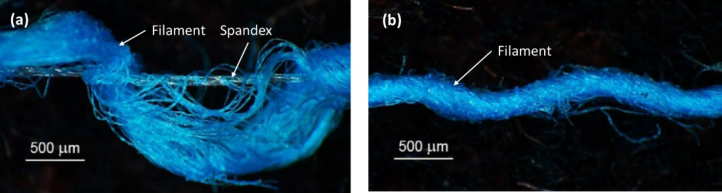
Commonly used techniques and textile testing standards have been used to measure the raw materials and fabric structural properties of kinesiology tape. As kinesiology tapes are made with a combination of core-spun elastic yarn as shown in Figure 1(a), and filament-based rigid yarn is also shown in Figure 1(b). The Optical microscope called “Leica DM2700M” was used to capture the longitudinal view of yarns where spandex and filament yarns are clearly observed in Figure 1. It is highlighted that core-spun yarns bring high performance into the kinesiology tape due to their exceptional strength, outstanding abrasion resistance, elasticity for the stretch requirements, and excellent resistance in perspiration properties.
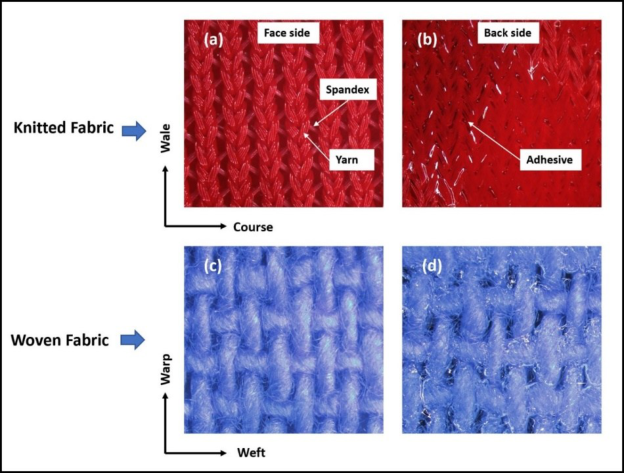
It has been known that kinesiology tapes are developed using textile fabrics coated with adhesive as shown in Figure 2, the Optical microscope named “Leica DM2700M” was used for taking the face and back side images of the
Comparisons of Kinesiology Tapes 131
Figure 1: Raw materials used to produce kinesiology tape: (a) core-spun elastic yarn; (b) spun or filament fiber-based rigid yarn.Figure 2: Fabrics structure of kinesiology tape: (a) developed based on knitted fabric structure showing spandex and filament yarn; (b) fabric back side showing adhesive; (c) developed based on woven structure; (d) back side showing adhesive.
tape. Where Figure 2(a) shows the kinesiology tape was fabricated based on a knitted fabric structure, and Figure 2(b) shows the fabric was coated with acrylic adhesive. Figure 2(c) shows the kinesiology tape was manufactured by plain weave is a woven structure, and Figure 2(d) shows the coated layer of the fabric. Textile fabrics have been used for developing kinesiology tape due to their flexibility to extend under tensile stress and excellent retention properties after stretching. It also highlighted that most of the kinesiology tapes are developed based on plan wave structure due to their excellent tensile strength properties.
Physical Strength and Comfort Properties Analysis of Kinesiology Tape Kinesiology tapes were subjected to numerous tests to measure their physi- cal strength, and comfort properties such as air permeability, water vapor,
and thermal conductivity properties. To measure the tensile strength, the ASTM D5035-95 standard was followed and Instron 5566 tensile testing machine was used to conduct the tensile test with the following parameters: gauge length (150 mm); crosshead speed (50 mm/min); pre-tension (0.2 N); and sample size (100 mm ×50 mm). Three specimens were used for testing in the warp direction with the same parameters until the breaking of the kinesiology tape. The ASTMD737 standard was followed and the TF164B testing machine was used to conduct the air permeability test of the kinesi- ology tape with the following parameters: sample area (5.08 cm2); pressure drop (125Pa). Three specimens were tested from each sample to conduct the test. The “SDLATLAS M261” water vapor permeability tester was used to conduct the water vapor permeability test with the Chinese testing standard GB/T 20463. The thermal conductivity of the kinesiology tape was measured based on the testing standard of ASTM F433-98 where the testing sample size was length 50 mm and width 50 mm.
RESULTS AND DISCUSSION
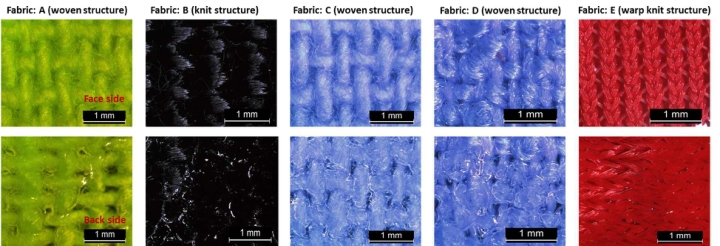
Materials and Structural Properties of Kinesiology Tape In this study, five different types of kinesiology tapes named fabric A to fabric E were collected from the ordinary market and then analyzed for their structural properties are described in detail in Table 1. The technical face is without adhesive and the back side is with adhesive from five diffe- rent types of kinesiology tapes as shown in Figure 3. Among all kinesiology tapes, three types of tapes are fabricated with plain weave structure, and the other two kinesiology tapes are fabricated based on circular and warp knitting are shown in Figure 3(b) and Figure 3(E), respectively. It was obse- rved from Table 1, that different types of raw materials have been used to produce the kinesiology tapes including cotton, polyester, nylon, and span- dex. Whereas polyester and spandex combination-based raw materials were mostly used for producing three types of kinesiology tapes due to their higher deformation, flexibility, tensile strength, and elastic recovery properties. Besi- des, fabric A was fabricated using rigid cotton spun yarns, as rigid and spun technology-based yarns naturally contain less physical strength and elastic recovery properties. The weights of the kinesiology tapes varied from 196 to 351 grams per square meter whereas fabric B had the higher weight and fabric D had the lowest weight. It has been known that textile fabrics weights are related to their thickness properties as well as warp and weft yarn counts
Table 1. Fundamental properties of five different types of kinesiology tapes.
Table available in the original PDF paper.
Kinesiology tape Raw materials Weight (gm/m2) Thickness (mm) EPI/PPI A Cotton 220 0.54 76/54 B Polyester, Spandex 264 0.66 87/69 C Polyester, Spandex 200 0.50 68/54 D Cotton, Nylon 196 0.48 66/48 E Polyester, Spandex 351 0.52 76/62
Comparisons of Kinesiology Tapes 133
Figure 3: Five types of kinesiology tapes showing the technical face and back side of the fabric: (a, c, d) plain wave structure-based woven fabric; (b) plating structure-based knit fabric; (c) bi-stretch structure-based warp knitted fabric.
that can be measured by the ends per inch (EPI) and pick per inch (PPI). Table 1 shows that fabric B has a greater thickness value with the EPI and PPI numbers resulting in a higher weight of the fabric. Compared with small- weight fabric, the fabric with higher weight creates resistance upon tensile extension resulting in a higher load is needed.
The results show as the thickness of fabric B is higher. This may be because of the bulking effect of yarn caused by the compact knitting structure, and adhesive by itself also creates compactness between the yarns as well as the fibers. While fabric mass per unit area (GSM) is greater for samples with polyester and spandex and adhesive than that of samples due to the higher shrinkage properties of yarns. The result indicated that the percentage of lycra in the sample is higher on fabric E and lower on fabric B. Combining these two yarn types increase the ability to stretch, moisture wicking, and comfort properties of the kinesiology tape.
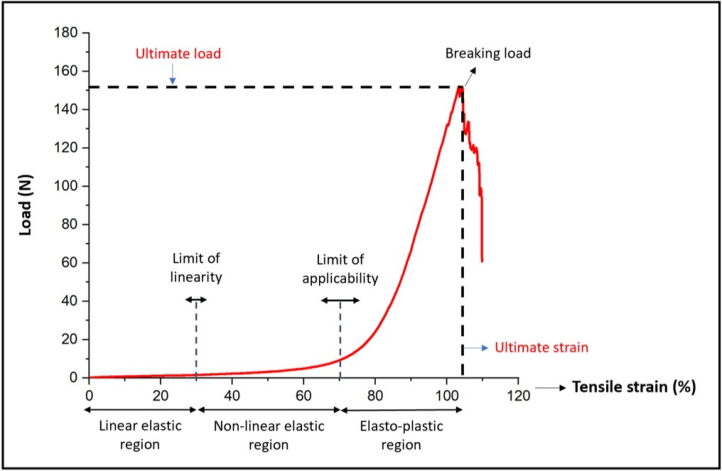
Physical Strength Properties of Kinesiology Tape The tensile tests were performed for all the kinesiology tapes until the breaking strength to measure their physical strength. Figure 4 shows the load- tensile strain curve of the kinesiology tape. This graph is divided into three regions which are as follows (1) linear elastic region that is upper limit cor- responds to 30% tensile strain of the kinesiology tape, then (2) nonlinear elastic region, which expands up to the applicability limit is 55%–65% of the tensile strain, finally (3) elasto-plastic region which is considered after the nonlinear elastic region to breaking strength. It is noticeable that Inside the elastic region where the material completely recovers to its original state upon release of the applied load. Besides, the limit of applicability can be observed at about 55%–65% of the tensile strain. Kinesiology tape beha- ves as an elasto-plastic material beyond the limit of applicability because the viscous component is also applied. However, the extension beyond the limit of applicability is accompanied by large deformations in the material and structure failures.
The tensile test results for five types of kinesiology tapes are shown in Table 2. Specifically, Table 2 shows that fabric D has the highest breaking
Figure 4: Engineering tensile strain versus load curve of kinesiology tape.Table 2. Physical strength properties of five different kinesiology tapes.
load whereas fabric E has the lowest breaking load properties. Conversely, the breaking tensile strain of fabric E is much higher compared to that of fabric C. Fabric E is fabricated based on a warp knitting structure and uses polyester and spandex as raw materials resulting in a higher tensile strain during the tensile test. Besides fabric D is fabricated based on a plain weave structure and they use nylon and cotton as raw materials. It has been known that a plain weave-based structure is a much more compact structure resulting in less breaking strain upon the test. It is also highlighted that fabric A and fabric B show nearly similar breaking loads which are 151N and 161N, respectively. Compared to the breaking load to the tensile strain of fabric A and fabric B, fabric A has a higher tensile strain is 134% whereas fabric B has a tensile strain of 104%. This result is obtained because fabric B is fabricated with core-spun elastic yarn which is easy to deform upon tensile extension. Besides
Comparisons of Kinesiology Tapes 135
fabric A is fabricated based on rigid yarn that created obstacles upon tensile extension.
The results suggested that extending beyond the elasto-plastic region is accompanied by large deformations in the material and structure failures. At about 100% of the tensile strain of the kinesiology tape as well as mate- rial breaks which are accompanied by the maximum load on the engineering load-strain curve. The force coordinate of this point is the ultimate tensile strength and the tensile strain coordinate at this point is the ultimate strain. The results indicated that the extensibility of kinesiology tapes are about 150%–380% which seems too large of the tensile strain. It is accompanied by the fact that physiotherapists suggested developing a kinesiology tape that can have a higher load value at a small value of tensile strain. Therefore, it can be suggested that manufacturers should consider the physical strength properties of the kinesiology tapes before production, and they may also con- sider the physical strength properties of the fabric a vital role in developing a kinesiology taper with excellent tensile strength properties.
Comfort Properties of Kinesiology Tape In this study, three different types of tests are conducted to measure the com- fort properties of kinesiology tapes including the air permeability test, water vapor permeability test, and thermal conductivity test. It has been known that air permeability is significantly influenced the understanding of the com- fort properties of textile material and structural properties. Although several factors depend to increase air permeability, such as fabric structural shape, pore sizes, and raw materials. Table 3 shows the air permeability of five dif- ferent types of kinesiology tape. It was found that fabric C has the highest air permeability properties while fabric B has the lowest. Whereas all kinesio- logy tapes show air permeability from 212 to 386 (l/m2/s). The reason behind obtaining these results is fabric thickness and yarn compact properties under the repeating unit cell of the fabrics. Specifically, the pore size of the fabric is decreased when fabric thickness and yarn compactness are higher resulting in the air cannot passing freely from one layer of the fabric to the other layer. Therefore, these results suggested that kinesiology tape developed with small thicknesses and less yarn compactness brings or enhances comfort properties.
Table 3 shows the water vapor permeability properties of all tested kinesi- ology tapes. As water vapor permeability indicates how quickly sweat away from the human body during activities. It is noticeable that manufacturing
Table 3. Comfort properties of five different types of kinesiology tape.
textile materials with high water vapor permeability can enhance comfort during wearing or applications. Among all tested kinesiology tapes, fabric C shows the highest rate of water vapor permeability properties which is about 35%, whereas fabric B and fabric D show the lowest water vapor permeabi- lity properties such as 21%, and 22%, respectively. However, the total ratio of water vapor permeability of all kinesiology tapes kept on 21%-36%. This result indicated that the tested kinesiology tapes have deficient water vapor permeabilities properties and thus can enables discomfort after using it for a long time which needed to be improved to obtain or increase the comfort properties of kinesiology tape.
The thermal conductivity property of the fabric is another important pro- perty to understand the comfort characteristics of the textile materials as well as kinesiology tape. Since thermal conductivity permits heat transfer from a hot side to a cooler side, such as the cooler side of the human body is the air on the opposite side of clothing. Raw material compositions and fabric structure are mainly responsible to increase or decrease the thermal condu- ctivity properties. Table 3 shows the thermal conductivity properties of all kinesiology tapes. The results indicated that fabric D has the highest value of thermal conductivity properties compared with other kinesiology tapes. Specifically, the thermal conductivity properties of all kinesiology kept from 0.048 (Wm-1 K-1) to -0.057 (Wm-1 K-1) that indicated all the kinesiology tapes have poor thermal conductivity properties. This happened due to the adhesive layer of the kinesiology tapes that can prevent heat transfer from one side to another side of the body resulting in poor thermal conductivity properties which needed to be improved to increase the comfort properties of the kinesiology tapes.
CONCLUSION
The kinesiology taping method has become a popular treatment option in the field of musculoskeletal and sports injuries due to its exceptional properties. The main aim of this paper was to understand the fabric structural, physi- cal strength, and comfort properties of different types of kinesiology tapes. The results of experiments showed that kinesiology tapes are non-linearly elastic and porous composite materials consisting of knitting and woven stru- ctures where they used core-spun elastic yarns or rigid filament-based spun yarns. It was also observed that the breaking strength of kinesiology tapes are significantly different due to their raw materials’ extensibility properties and fabric structural compactness. According to the tensile deformation beh- avior it was found that the physical strength properties of the kinesiology tapes are purely related elastic behavior of its materials. Thickness, fabric structural properties, yarn density, and material characteristics of kinesio- logy tapes are related to the comfort properties which can be improved by combining different parameters such as raw materials and fabric structural combinations. The study will be used to create a highly functional kinesiology tape, will be used for further study of changes in mechanical parameters of kinesiology tape during the application period, particularly viscosity beyond linearity limit, and will also be used to describe tensile strength effect during application.
Comparisons of Kinesiology Tapes 137
ACKNOWLEDGMENT
The work described in this paper was fully supported by a grant from the Research Grants Council of the Hong Kong Special Administrative Region, China (Project No. GRF/PolyU 15607922).
REFERENCES
Bae, S. H., et al., The effects of kinesio taping on potential in chronic low back pain patients anticipatory postural control and cerebral cortex. J Phys Ther Sci., 2013. 25(11): pp. 1367–1371. Chang, H.-Y., et al., Immediate effect of forearm Kinesio taping on maximal grip
strength and force sense in healthy collegiate athletes. Phys Ther Sport., 2010. 11(4): pp. 122–127. Csapo, R. and Alegre, L. M., Effects of Kinesio® taping on skeletal muscle strength— A meta-analysis of current evidence. J Sci Med Sport., 2015. 18(4): pp. 450–456. GonzáLez-Iglesias, J., et al., Short-term effects of cervical kinesio taping on pain and
cervical range of motion in patients with acute whiplash injury: a randomized clinical trial. J Orthop Sports Phys Ther., 2009. 39(7): pp. 515–521. Hendrick, C. R., The therapeutic effects of kinesio tape on a grade I lateral ankle sprain. 2010, Virginia Tech. Doctoral Dissertations. Hsu, Y.-H., et al., The effects of taping on scapular kinematics and muscle perfor-
mance in baseball players with shoulder impingement syndrome. J Electromyogr Kinesiol., 2009. 19(6): pp. 1092–1099. Huang, C.-Y., et al., Effect of the Kinesio tape to muscle activity and vertical jump performance in healthy inactive people. BioMedical Engineersing OnLine, 2011. 10(1): pp. 1–11. Kase, K., Wallis, J. and Kase, T., Clinical therapeutic applications of the Kinesio
taping method. 2003. 2nd Edition, Kinesio Taping Association, Dallas, 12. Kumbrink, B., K-taping: An Illustrated Guide - Basic-Techniues-Indications. 2014: Springer. Moore, R., What is the current evidence for the use of kinesio tape. sportEX
dynamics, 2012. 34: pp. 24–30. Mostafavifar, M., Wertz, J., Borchers, J, A systematic review of the effectiveness of kinesio taping for musculoskeletal injury. Phys Sportsmed., 2012. 40(4): pp. 33–40. Tunakova, V., et al., Material, structure, chosen mechanical and comfort proper-
ties of kinesiology tape. The Journal of The Textile Institute, 2017. 108(12): pp. 2132–2146. Wang, S., et al., Stretchable and wearable triboelectric nanogenerator based on kinesio tape for self-powered human motion sensing. Nanomaterials, 2018. 8(9): pp. 657.
LISTED IN THE AHFE DIGITAL BOOKSTORE CATALOGUE
Explore the complete digital volume
Creativity, Innovation and Entrepreneurship
Read this individual research paper free through the original publisher, or explore the full digital proceedings book.
ISBN 978-1-958651-50-6
Explore this ISBN in the AHFE Bookstore ↗Listed in the July 2026 bookstore catalogue; search by ISBN to confirm current availability · Digital book purchase optional