Carla Guimarães, Maria Cristina Zamberlan, Vitor Balbio, Venetia Santos, Alessandra Paranhos, Flavia Pastura, Gloria Cid (2020). Digital Human Model Applied to Training and Education in Sports. In: Advances in Applied Digital Human Modeling. AHFE Open Access, vol. 11. https://doi.org/10.54941/ahfe100417
The purpose of the study is to present a 3D digital interactive environment that is being developed in a game engine software to work with 3D DHM applied to training and education on Sports. This platform is being developed considering the need to analyze data from the same athletes' movements being repeated in different time or even to compare athletes' movements with different skill levels. The main 3D digital platform advantage is its flexibility to handle motion capture data from different MOCAP systems in order to facilitate kinematic analysis by users of low cost motion capture systems. Another important advantage is its portability that allows it to be used in different hardware platforms, as tablets and cell phones. The 3D platform development followed some specific steps, which make it possible not only to visualize the performed motion but also make the interaction between the user and the 3D character. The first step consists on the automatic reconstruction of the 3D character body segments based on motion capture data. The visual representation has as benefit that reduces noise that may be generated in the process of retargeting the motion capture data to a specific rig and character that differs from the actual bone structure original data. The visual representation is generated based on laser scanning data. This makes the representation to be a precise copy of the original bone position and structure of the athlete' specific movement that is being captured. The second step is to link each bone segment by generating a 3D model with a collision area that is necessary for future interaction with the user. After those steps, the user can select to track and generate data of a specific body segment; to play/pause the athlete movement and to draw graphs of segmental angles, joint angles and angular velocity. This functionality is still under development and test. The first application of the 3D digital platform was the movement analysis of high and low skill level Jiu-Jitsu athletes. This analysis allowed an improvement on the athletes’ performance and skills. In the future the integration between the 3D scanned athlete’s model and a virtual environment will allow to develop a virtual simulator that can be applied to education, training and entertainment.
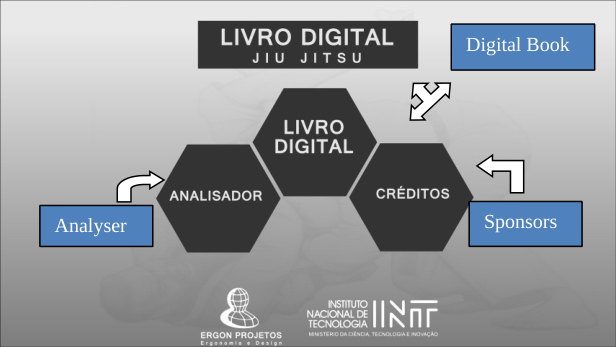
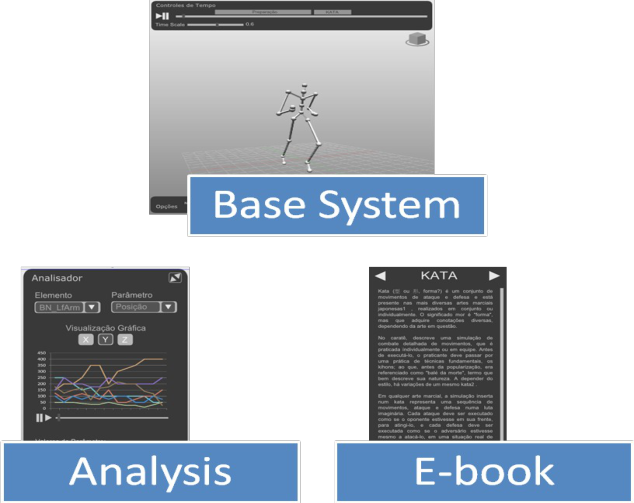
3D INTERATIVE PLATAFORM FRAMEWORK The Ergonomics Laboratory of the National Institute of Technology and the Ergon Projects Enterprise have developed "serious games" platforms and simulation environments applied to ergonomic work analysis and new ergonomic design. The goal of these simulations has been to help designers and employees to understand and implement ergonomic concepts work environment design. Considering that experience, the Ergonomics Laboratory team and Ergon decided to apply that knowledge to sports training, in special to Combat sports. The efforts are being conducted to the development of an 3D interactive environment system that comprises basic jiu-jitsu movements and its definition based on experts Jiu-jitsu players knowledge and on biomechanics analysis. That system consists of Basic System and modular tools described below (see figure 1):
Analysis: Allow to get and to record the "bone" data graph ou diagram or the join movement in 3D
E-Book – consisting of text, images of Jiu-jitsu sport, that can be readable on computers or other electronic devices
Reports: Return reports with graphs and diagram for printing or saving
Export Data: Allow to export the RAW data to XML or other exchange data type.
Figure 1: Flow chart
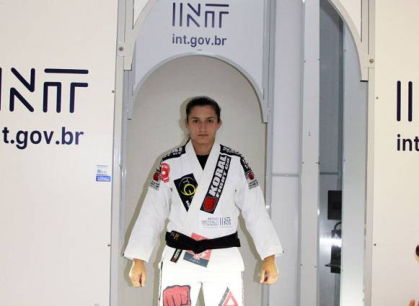
The Analysis stage comprised of two steps before data input in the 3D digital interactive environment: 1º step: athletes scanning and motion capture conducted on the Ergonomics Laboratory. First, the athlete was scanned in a Cyberware WBX 3D whole body scanner (Figure 2 and 3), then the scan file was processed to minimize the number of polygons and to close holes – the retopology process (Lerch et al., 2007). For the motion capture session the athlete wore a special suit from Xsens with 17 inertial sensors (Figure 4). Then the athlete selected and defined some basic jiu-jitsu movements that were captured (Figure 5)
Figure 2: Scanning process Figure 3: Saving the scan file for retopology processFigure 4. Athlete using motion Figure 5. Motion capture session capture sensors 2º step: 3D Simulation and Modeling – the data captured from XSENS MOCAP and the 3D DHM data from scanning process were incorporated by our virtual platform that was developed as a "serious game" interactive 3D software . The visual representation of the 3DHM at the platform was generated based on XSENS MOCAP data, following position and dimension of bone segments of the virtual body. That makes the visual representation an accurate copy of the original bone position and of the specific actor's movements being captured.
Figure available in the original PDF paper.
This stage covered the development of an interactive platform using Unity3D game engine. That platform was developed considering the need to analyze data from different athletes movements being repeated in different moments (Kinematics analysis) (Figure 6). The data analysis will allow the kinematic data to be visualized by means of graphics – angular and linear position, angular displacement, and angular velocity. The graphics information can also be visualized with the 3D digital human model. This kind of visualization makes it easy to analyze the data with athletes and coaches.
E-Book and Reports Stages complete the interactive platform (Figure 7), The E-book features an entry corresponding to the movement currently under analysis (Figure 6) while the Report Module export the Analisys Results to a exchangable and readable data type as a spreadsheet.
Digital Book
Sponsors Analyser
Figure 6. System home screenFigure 7. Example of the proposal flow chart applied to a 3D interactive environment
CONCLUSIONS
The 3D digital interactive environment is still under development. Its analysis will allow to study and to improve athletes’ performance through teaching. In the future the integration between a 3D scanned athlete’s model and a virtual environment will enable the development of a virtual simulator that can be applied to education, training and entertainment.
Sponsor by: Ergon Projetos and FAPERJ The Ergonomic Laboratory researchers would like to thanks Luanna Alzuguir, Jiu-Jitsu European Champions 2014, for taking part and assisting on this research.
REFERENCES
Annetta, L. A. (2010) A framework for serious educational game design Review of General Psychology, Vol 14(3), Sep, 250 Guimarães C. P; Ribeiro, F ; Cid, G.L. ; Streit, P.; Oliveira, J., Zamberlan, M.C ; Paranhos, A.G. and , Pastura, F. (2013) 3D Digital Platform development to analyze 3D digital human models. A case of study of Jiu Jitsu combat sport . Anais do 2nd International Digital Human Modeling Symposium, Ann Habor, Michigan. Guimarães, C., Pastura, F., Pavard, B., Pallamin. N;. Cid, G., Santos, V., Zamberlan, M.C. (2010) Ergonomics Design Tools Based on Human Work Activities, 3D Human Models and Social Interaction Simulation IHC Congress. Miami. James, D.A.; Thiel, D.E.; Allen, K.J.; Abell, a.; Kilbreath, S.; Davis, G.M.; Rowlands, D. and Thiel, D.V. (2012) Technology and Health: Physical activity monitoring in the free living environment Procedia Engineering 34, 367-372 Naumann, A. and Rötting, M., (2007). Digital Human Modeling for Design and Evaluation of Human-Machine Systems. In: Israel, J. H. & Naumann, A. (Hrsg.), MMI Interaktiv - Human: Vol. 1, No. 12. (S. 27-35). Nolte, K .; Krüger, P. E.; Els, P. S. and Nolte, H. (2013) W. Three-dimensional musculoskeletal modeling of the seated row resistance-training exercise South African Journal of Sports Medicine ;25(3):67-73 Senevirathne, S. G; Kodagoda,M.; Kadle,V.; Haake , S.; Senior, T. and Heller, B. (2011) Application of serious games to sport health and exercise. In: Proceedings of the 6th SLIIT Research Symposium, Sri Lanka, 27 January Steinmetz, R. and Göbel, S. (2012) Challenges in Serious Gaming as Emerging Multimedia Technology for Education, Training, Sports and Health, Advances in Multimedia Modeling, Lecture Notes in Computer Science Volume 7131, 2012, p 3 Applied Digital Human Modeling & Simulation (2020)
LISTED IN THE AHFE DIGITAL BOOKSTORE CATALOGUE
Explore the complete digital volume
Advances in Applied Digital Human Modeling
Read this individual research paper free through the original publisher, or explore the full digital proceedings book.
ISBN 978-1-4951-2094-7
Explore this ISBN in the AHFE Bookstore ↗Listed in the July 2026 bookstore catalogue; search by ISBN to confirm current availability · Digital book purchase optional