Many pioneers of Artificial Intelligence used puzzles to explore problem-solving models, such as Herbert A. Simon and Allen Newell. Their favorite puzzles include the Tower of Hanoi, which has been adapted in many textbooks in Computer Science. This paper explores extending classic puzzles to a new level for hands-on training, education, and learning. From the human factors point of view, we redesigned the Tower of Hanoi with compactness, mobility, configurability, reliability, and explainability in mind. We explored 3D printing methods with different materials, colors, and 3D models with usability measurements. We predict that physical puzzles can be used by children, college students, and seniors.
For centuries, humans have invented puzzles as imitation games for mental exercises. Some pioneers even invented abstract “thinking machines.” In 1950, British mathematician Allen M. Turing published a seminal paper “Computing Machinery and Intelligence” (Turing, 1950). He asked a philosophical question: “Can machines think?” Instead of searching for a statistical survey such as a Gallup poll, Turing gave a new form of the problem in the “imitation game.” It is played with three people, a man, a woman, and an interrogator. The interrogator stays in a room apart from the other two. The interrogator is to determine which of the other two is the man and which is the woman by asking a few questions in typewriting. Turing then asked: “What will happen when a machine takes the part of the man in this game?” Turing further developed the infinitely long one-dimensional abstract machine, the so-called “Turing Machine,” as the model of digital computers, which consists of three parts: store, executive unit, and control. The Turing Machine is perhaps the earliest computational puzzle in mankind. Turing’s methodology of imitation games has become the well-known “Turing Test” for validation of Artificial Intelligence.
requiring no further input. One interacts with the Game of Life by creating an initial configuration and observing how it evolves (Gardner, 1970).
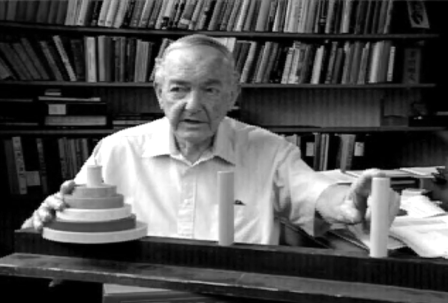
Herbert A. Simon and Allen Newell, pioneers of artificial intelligence, extensively studied ancient puzzles and games in terms of cognitive processes and problem-solving, including the Tower of Hanoi, Chess, Abacus, Chinese Rope puzzle, and Go (game). Regarding classic chess, Simon demonstrated many cognitive scenarios, including the “mutilated chessboard” for first responders’ training. He predicted that AI chess players would beat human players in ten years. It took over forty years to fulfill his prediction.
Figure 1: The AI pioneer Herbert A. Simon studied the Tower of Hanoi extensively in terms of cognitive process and problem-solving (Simon, 2001).
Scientists also develop new puzzles for research and educational purposes. For example, The Tangram is a dissection puzzle game consisting of seven flat shapes that are put together to form millions of shapes. The puzzle originated in the Song Dynasty (960–1279 AC) in China. The author reinvented a nine- piece Tangram by dissecting the diamond and square shapes into triangles. The advantage of the nine-piece Tangram is that all pieces are triangular but have different sizes and orientations. Similar to its ancestor, the nine-piece Tangram can produce millions of different shapes. If we dissect the triangular shape into even smaller pieces, we can then compose figures or objects with even finer details (Cai, 2015).
Here, we explore extending classic puzzles to a new level for hands-on training, education, and learning. From the human factors point of view, we redesigned the Tower of Hanoi with compactness, mobility, configurability, reliability, and explainability in mind. We explored 3D printing methods with different materials and colors and 3D models with usability measurements. We also tested the puzzle with three groups of subjects: children, college students, and senior citizens.
THE TOWER OF HANOI The classic Tower of Hanoi contains several disks on three pegs. The objective is to move all the disks from the left peg to the right peg. There are only two rules: we can only move one disk at a time; the little disk is always on the
70 Cai and Perez
big disk. Herbert A. Simon and Allen Newell used the Tower of Hanoi for their research in Cognitive Science because this can motivate people to think: “What should I move next? Where should I put it?” The process enables the researchers to observe the subject’s problem and problem-solving strategy. For example, the little disks won’t stay at the target peg long because the bigger ones must be moved to the peg. How did the subject learn that? And what the subject learned from the process (Simon, 2001).
The Tower of Hanoi is a challenging puzzle because it is both simple in form and difficult to solve. The puzzle has a time complexity of O(2n), which means that the number of moves required to solve the puzzle grows exponentially with the number of disks. This makes it a challenging puzzle, even for experienced puzzle solvers (Greenwood, 2025). Many classic Computer Science textbooks still use the Tower of Hanoi as an example of recursive algorithms and time complexity calculation. Some classic textbooks on Artificial Intelligence still cite the Tower of Hanoi as an example of problem-solving. However, it started to fade due to the invasion of prevailing deep-learning methods.
Rediscovering classic puzzles enables us to look into the pioneer’s mind and connect the dots to fill the missing puzzles in the massive space of human cognition.
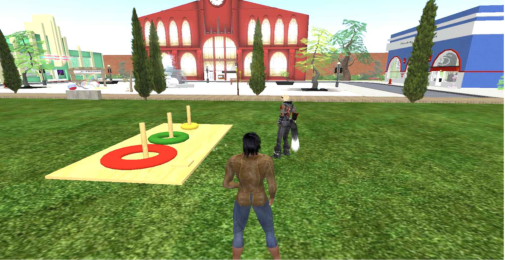
THE VIRTUAL PUZZLE To recreate the Tower of Hanoi, our first thought was to build the 3D model in a virtual world, such as the online game Second Life, where users from different places can collaborate on constructing the imitation game. Figure 2 shows the author from the USA was building the Tower of Hanoi with a student from Australia on the online game Second Life. The three-ring Tower of Hanoi was successfully built after three hours, even though we were on different continents with different time zones. We also discovered the limitation of the virtual puzzle because we did not have the depth perception of the three pegs. The disk would fly to the sky if it were crashed with the peg. A Stereo VR goggle might solve the problem. However, it would add more design efforts to accommodate depth perception and eye-hand coordination.
Figure 2: The Hanoi tower game was developed remotely in second life. The man wearing the leather jacket was the author. The man wearing the wolf tail was an Australian student (Cai, 2015).
Rediscovering Puzzles 71
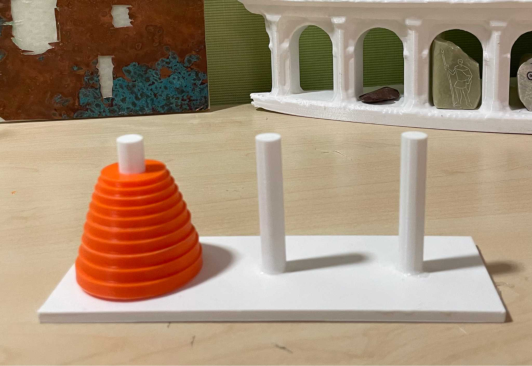
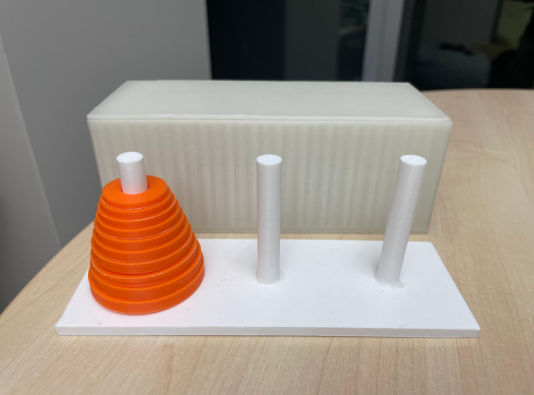
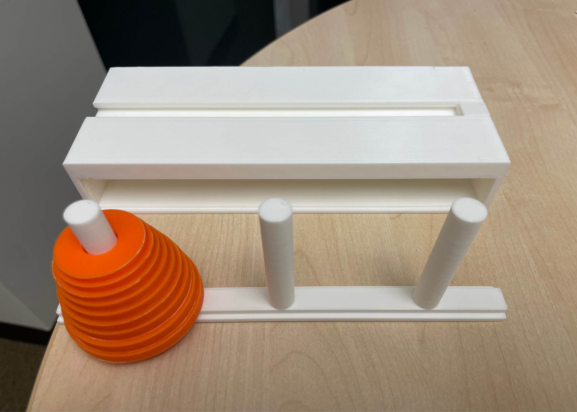
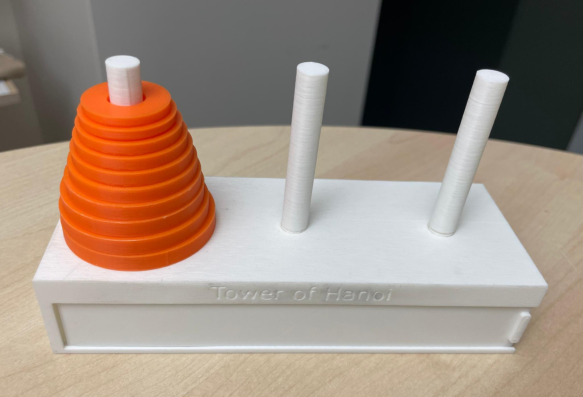
THE PHYSICAL PUZZLE Here we focus on physical prototyping with 3D printing. To print the disks and the base with three pegs is straightforward. However, putting them together in a box for mobility and usability is rather challenging. There are a few classic ergonomic factors to consider. Figure 3 shows the 3D-printed model of the Tower of Hanoi and the original “big box.” It is easy to design and print a box in which we can insert the base with the three pegs and all the disks into the box. However, the box is too big to carry around. It also lacks in visual appeal, as it looks like a coffin.
Figure 3: The 3D printed the tower of Hanoi. Two colors are used to distinguish the disks from the base and pegs.Figure 4: The big box contains the whole base with all the disks. It looks odd and too big to carry.
72 Cai and Perez
HUMAN FACTORS AND ERGONOMIC DESIGN We quickly switched to the design of the carry box with human factors and ergonomy in mind. The first attempt was to design a removable base that could be slid along the guardrails. Visually the removable base is shorter than the guardrails because it has to be stored inside of the box, see Figure 5. We then designed the three pegs with screw threads that can be mounted onto the top of the box with three holes with screw threads, see Figure 6.
Figure 5: The 3D-printed box with the slide rails for the base with pegs.Figure 6: The 3D-printed box with the screw holes and mounted pegs with screw threads.
Rediscovering Puzzles 73
We found that the slide-in design is easy to install and remove. The screw design is relatively challenging mechanically to ensure the installation is smooth without using extra force. The screw-threaded box is the smallest in box size.
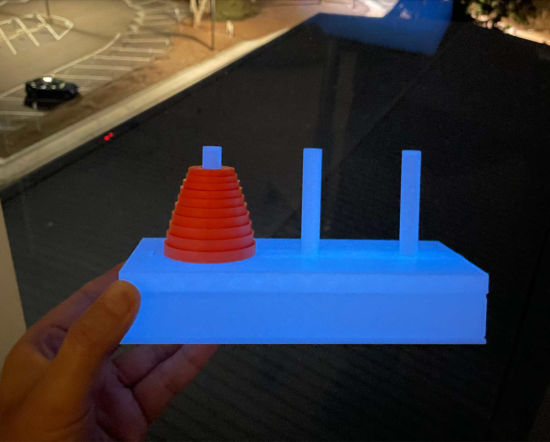
To attract young users, we experiment with the glow-in-dark filaments that can be visible in a dark environment. We found the white-to-blue filament emits the brightest light. Also, a UV flashlight can increase the brightness. Figure 7 shows the Tower of Hanoi at night. Since the disks are easy to fall, we would like to make the disks glow-in-dark to enable the user to find the disks in the dark area.
Figure 7: The 3D-printed Tower of Hanoi with the glow-in-dark filament. It needs exposure to light, including the UV flashlight to glow in the dark.
Table 1 summarizes our usability study regarding box size, mechanical design challenges, installation, mobility, and aesthetics. In general, we think the screw thread design is the best. The glow-in-dark could be an interesting option.
Table 1: Comparisons among the designs.
Table available in the original PDF paper.
Box Design Box Size (mm) Mechanical Design Usability “Big Box” 177 × 71 x 65 Easy Too big and ugly Slide Design 182 × 73 x 35 Moderate Easy to install Screw Design 160 × 60 x 34 Challenging Easy to carry Glow-in-dark 160 × 60 34 Special filament Attractive in dark
74 Cai and Perez
CONCLUSION
Many pioneers of Artificial Intelligence used puzzles to explore problem- solving models, including the Tower of Hanoi. Here we extend classic puzzles to a new level for hands-on training, education, and learning. From the human factors point of view, we redesigned the Tower of Hanoi with compactness, mobility, configurability, reliability, and explainability in mind. We explored 3D printing methods with different materials, colours, and 3D models with usability measurements. Ideally, we want the puzzles to be portable like books. Users can check out from a library and carry them in their backpacks or even in their pocket. We predict that physical puzzles can be used by all ages including but not limited to children, college students, and seniors.
ACKNOWLEDGMENT
We would like to thank the NIST for its support and Professor Mel Siegel of Carnegie Mellon University for his advice.
REFERENCES
Cai, Y. (2015). Ambient Diagnostics. CRC Press / Taylor and Francis Publishing Co. Cai, Y. (2017). Instinctive Computing. Springer-London. Conwaylife (2025). Conway’s Game of Life https://conwaylife.com/. Gardner, M. (1970). The fantastic combinations of John Conway’s new solitaire game life by Martin Gardner. Scientific American. 1970; 223:120–3. Greenwood, M. (2025). Tower of Hanoi Time Complexity: A Detailed Guide.
https://hatchjs.com/tower-of-hanoi-time-complexity/ Simon, H. A. (2001). Tower of Hanoi. Carnegie Mellon University. Recorded video.
http://shelf1.library.cmu.edu/IMLS/MindModels/video4.html Turing, A. (1950). Computing Machinery and Intelligence. Mind 49: 433–460.
https://courses.cs.umbc.edu/471/papers/turing.pdf Turing, A. (1952). The Chemical Basis of Morphogenesis. Philosophical Transaction of the Royal Society B. 14 August 1952. Volume 237, Issue 641. https:// royalsocietypublishing.org/doi/epdf/10.1098/rstb.1952.0012 Wikipedia (2025). Go (game). https://en.wikipedia.org/wiki/Go_ (game)
LISTED IN THE AHFE DIGITAL BOOKSTORE CATALOGUE
Explore the complete digital volume
Training, Education, and Learning Sciences
Read this individual research paper free through the original publisher, or explore the full digital proceedings book.
ISBN 978-1-964867-69-4
Explore this ISBN in the AHFE Bookstore ↗Listed in the July 2026 bookstore catalogue; search by ISBN to confirm current availability · Digital book purchase optional