Dan Gläser, Lars Fritzsche, Sebastian Bauer, Wolfgang Leidholdt (2020). The Quest to Validate Human Motion for Digital Ergonomic Assessment –Biomechanical Studies to Improve the Human-Like Behavior of the Human Model “EMA”. In: Advances in Applied Digital Human Modeling. AHFE Open Access, vol. 11. https://doi.org/10.54941/ahfe100408
Modern digital human simulation tools try to generate motions over an decreased number of input information to pass the method of step-by-step motion generation as it has been common until now. A key feature of EMA is the self-initiated motion generation, which decreases the effort for users in simulation preparation and increases the validity of simulation results in terms of realistic motion trajectories and biomechanical correctness. EMA has been designed for the simulation of human work activities in industrial production. EMA is already capable of reproducing most of common work-related activities, but there is still a need to improve its performance for some specific tasks. With the advancing number of automatically generated movement, the responsibility of the software to produce valid and reliable movement rises to a new level. Furthermore the necessity of valid motor behavior is based on the requirement of a correct assessment of work time and ergonomics in the simulation. Such assessment functions are already implemented using ‘state-of-the-art’ methods like MTM (Methods Time Measurement) for time analysis and EAWS (Ergonomic Assessment Worksheet) for ergonomics risk evaluation. In order to improve the quality of the ergonomic, time-related and visual simulation results, several studies have recently been carried out. The results of these studies show a large range in variation and complexity leading to the question, how to transfer information gained with scientific studies into explicit implementations for digital human modeling software.
Digital human models are established within the field of product development by now. Human models like Ramsis (Human Solutions GmbH) or Santos (SantosHuman Inc.) are indispensable when it comes to designing automotive or aircraft interiors. Another fact about the status quo of digital human models is their very limited capabilities in terms of self-initiated motion generation. Actual models like the Human Builder (Dassault Systemes) have incorporated a human like kinematic structure, but the control of these kinematics is still very complex and time costly. This is due to the current standard process of modelling motions with digital human models in a step-by-step apporach, which includes the manual positioning and alignment of every single body segment or segment groups. Applied Digital Human Modeling & Simulation (2020)
One essential characteristic is the manual modeling of human movements based on user input and thus, the user himself is responsible for the validity of the generated movements. Therewith the software only has to ensure, that the human model comes with a correct kinematic structure and valid ranges of motion. The user is responsible for correct movements in terms of plausibility, ergonomics, time related correctness, and the ‘style’ or appearance of motion.
New systems for holistic simulation of human work activities provide new approaches for more effective and less time consuming methods of planning human behavior. EMA (Editor for Manual Work Activities) is one of these new tools. EMA follows the idea, that the definition of a process should be reduced to a minimum of parameters to decrease the modeling effort for the software user. To fulfill this requirement, EMA uses a task library consisting of parameterized tasks that are common during typical manual work processes (e.g. pick, place, walk) and which are related to the established planning standard MTM (Methods Time Measurement). After the definition of the work activity of the virtual worker, all movements are generated in an analytical way. Due to this self-initiative approach of planning and motion synthesis the responsibility for valid motion generation shifts from the user to the software itself, and therewith to the software developers. To meet this responsibility, imk automotive GmbH carried out several biomechanical studies during the development of EMA, whose results are used to improve the validity of the motion generation.
The following chapter gives an overview about the EMA method before describing two studies about different challenges in the field of human movement modeling and the implementation of the research findings into EMA. At last there will be a call for a scientific discussion about the necessity of future modeling standards in terms of parameters, which have to be prioritized in human movement modeling.
Figure 1. Overview workflow EMA
Figure available in the original PDF paper.
THE EMA APPROACH EMA is a holistic 3D planning method for manual industrial working activities based on a 3D human model. The basic idea behind the method is a definite process language (Illmann et al., 2013) that is used to describe common work activities. The process language is applied to build activity blocks (hereinafter “tasks”) representing common operations like use tool, sit down, walk, but also more specific tasks like ingress car or wipe surface(see “task mapping” in Fig 1.). These tasks are parameterized, which means that a minimum on manual user input is needed (e.g., define location coordinates by mouse-click) in order to reduce the simulation effort. A “pick object” for example requires the selection of an object for right, left, or both hands. Every task also consists of optional parameters, which can be used to adapt the tasks to special circumstances (e.g. block leg movement). For more details about the EMA motion generation please refer to Fritzsche et al., 2011. Before the task definition, there is always a lay out definition (see Fig.1). In ema the lay out definition is comparable with standard CAD/CAE tools. Between the input and the output (ergonomic assessment, time related assessment, spaghetti diagram, etc.) the EMA core calculates the postures and 3D trajectories, which are necessary for a complete representation in the 3D viewer and the assessment tools.
Latest developments The future success of digital humans depends on the continuous improvement of the current systems. One of the latest developments in EMA is the vertical movement system. The vertical movement system is basically a matrix of fundamental body postures like standing, squatting or lying on the back. Furthermore this system provides the ways to get from one posture to another without returning to a basic posture. At first sight, this seems to be trivial, but if one tries to imagine how to get from lying on the back to one-leg kneeling and which postures in between are necessary, the complexity becomes clear.
Other developments have been made in the computational area. The actual ema version is a fully implemented 64 bit system. Furthermore it is possible to import CAD-data in the .jt format, and an export of complete projects in a csv. File is also possible.
An important feature, which was integrated recently, is the upgrade of 3D scene creation. Objects can now be integrated in hierarchical groups. Above that EMA includes the capability of applying motions on objects, as they occur in real scenarios, like assembly lines.
Due to the request of different user groups, an object library including tools, racks, tables and other often needed objects has been implemented lately. Especially this feature is an advancement in terms of usability, since CAD data of industrial facilities are difficult to gather for end users.
Future Challenges By now, EMA is able to reproduce most of common work activities as they occur in typical industries like the automotive industry in areas of assembly or body weld. Nevertheless there are many fields of development and challenges in the future of EMA. Future fields of development are for example:
a complete 3D whole-body collision avoidance
a detailed hand model
aging-related performance changes
simulation of cooperative work
man-machine-interaction (especially with robots)
BIOMECHANICAL STUDIES As discussed before, a valid motion generation system is inevitable because the responsibility of creating valid motions shifts to the software with proceeding automation of movement generation. In the development of EMA this responsibility was fulfilled by conducting several biomechanical studies; two of them are described in the following.
Influences of object mass and geometry on the body posture during carrying (Eske, 2014) Carrying all kinds of different loads is a typical work activity in almost every industrial sector. Thus, carrying represents a significant part of virtual simulated work activities, what qualifies it as relevant research objective for the EMA development. EMA is currently not capable of considering loads in the automated motion generation. In fact loads are considered in the ergonomic assessment with EAWS, but still they have neither influence on movement speed, time or body postures of any simulated task. To close this gap, the first study investigated the most important parameters of carrying activities in a laboratory study.
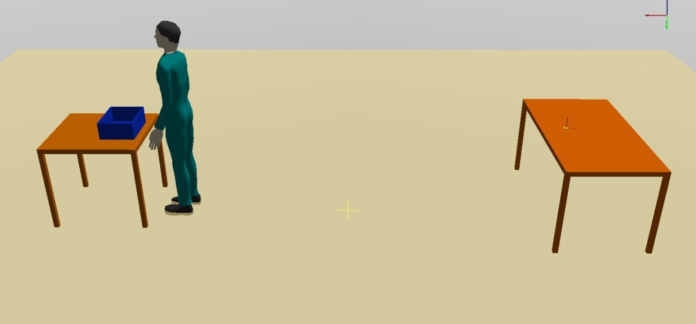
The test setup included a VICON motion capture system, several different load carriers (small to medium-sized boxes), as they are commonly used in industry (see Fig. 2) and a test person sample. The boxes were filled with different loads, varying from 1 to 15 kg. Additionally the boxes had different grasping widths of 30, 40 and 60 cm. The task for a test persons consisted of picking up a box from a table, carrying it over approximately 4 m and placing it on a another table. The considered parameters for the measurement and analysis were step length, arm position (upper arm elevation, elbow angle), upper body position (bending) and walking speed.
The clearest result with the strongest correlation was the negative relation between load and step length; the higher the load, the shorter the steps and the more steps are required to walk from one table to another. Other parameters like the bending of the upper body showed almost no change between the test conditions; this indicates that the maximum load of 15 kg (which is a common limit in industrial work design) was still far from the performance limit of the sample. Another interesting result was related to the walking speed, which was neither influenced by the dimension nor by the weight of the carried object. Therewith the constant speed and the decreasing step length lead to an increased step frequency. These study results are now considered for improving the huma-like behavior of the EMA man model when it comes to carrying loads.
Figure 2. Test setup for load carrying study. Left: marker setup. Right: task setup
Upper extremity collision avoidance on the basis of natural motion patterns (Gläser, 2013) The second study targeted the field of collision avoidance, which has been researched by a number of different scientific areas. Robotics, human kinetics, psychology and information technology are probably the most advanced, in solving the problems of collision avoidance.
The three scientific fields have a different understanding of collision avoidance and focus on different aspects. The information technology started with path finding of points through in a 2D environment, which is the basis of all further development in the 3D space. Modern robotics found algorithms for path or trajectory planning for manipulators, which are easily comparable with the human arm in their complexity or number of links. So basically there are methods, which could be used to control digital human models up to almost any imaginable complexity. The restriction at this point is, that robots miss some of the human given characteristics. Robots usually neither sense discomfort, nor do they have the specific limitations in the range of motion or other biomechanical parameters. At this point psychology and human kinetics are the expected science to fill the gap of knowledge about the human behavior. But both fields concentrated on either rather concrete and limited aspects of the issue or very broad and general models of movement behavior. There is for example a larger number of studies about movements trajectories of end effectors in the 2D space (Nelson, 1983; Hogan & Neville, 1984). On the other side there are general models of human movement planning. Two concepts in this area are Rosenbaum’s (2001) knowledge model and the discomfort model developed through several programs by the Technical University Munich. Rosenbaum’s model states, that movement planning is primarily influenced by the aspired end pose, while the path planning itself is a trade of function between internal and external energetic costs. Comfort plays a minor role in his model. In contrast to that, the discomfort model (Zacher & Bubb, 2004) is a posture based model and therewith mostly based on static parameters like joint angles and impacting forces, which are used to calculate discomfort.
Both models seem logical, as a closed theory and applicable in their individual use cases. But both models show weaknesses, when it comes to generalizability of movement planning as a holistic concept. Due to the conflict of the planning parameters comfort and costs, which were displayed through the comparison of the knowledge and discomfort models, this study tried to research the collision avoidance behavior of the upper extremities from a
holistic point of view.
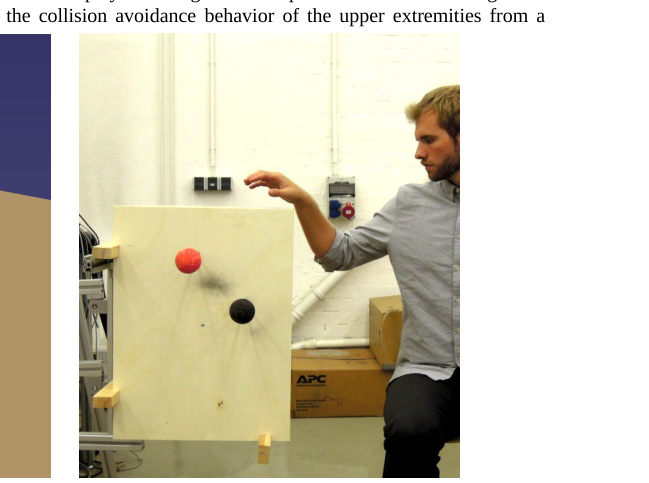
Figure 3. Test setup for collision avoidance study
The study followed a simple collision avoidance setup: Test persons had to move their hand between several targets (see figure 3) and avoid a single collision objects in between. Herein the test persons had to make unconscious or conscious decision about the path they chose. Depending on the task the test person was either faced with a decision between (a.) a short and comfortable versus long and uncomfortable way or (b.) a short but uncomfortable versus a long but comfortable way.
The results showed a variation of avoidance types or characteristics and lead to a classification of four different types: a. COMFORT PREFERRING TYPE
Type a. prefers comfortable avoidance strategies, regardless of the potential longer ways.
b. ADAPTING TYPE Type c. prefers short distances up to a certain limit of discomfort and switches to a comfort related strategy, when a limit of discomfort is reached.
c. SHORT DISTANCE PREFERRING TYPE Type b. prefers shorter distances, regardless of the potential discomfort.
d. UNDEFINED TYPE Type d. doesn’t show a distinct avoidance strategy.
The four types showed an approximated distribution of 40%(a.), 30%(b.), 10%(c.), 20%(d.), which gives comfort a slight advance as primary planning parameter for collision avoidance. Nevertheless cost related parameters can’t be ignored in collision avoidance or motion planning in general. Additionally several avoidance strategies, which are independent from the avoidance type have been identified. These more detailed strategies are for example a tendency for a prevention of elbow movement over shoulder movement or investing in torso movement to save arm movement.
Why these outcomes lead to problems of several layers, will be answered in the next chapter.
IMPLEMENTATION OF SCIENTIFIC FINDINGS The gathering of information and knowledge about human behavior is obviously just the first step to an improved digital human modeling. The second and equally challenging part is the implementation of knowledge into the software. The implementation requires the transfer of implicit information into explicit algorithms. To do this, every study requires a different approach for a successful implementation.
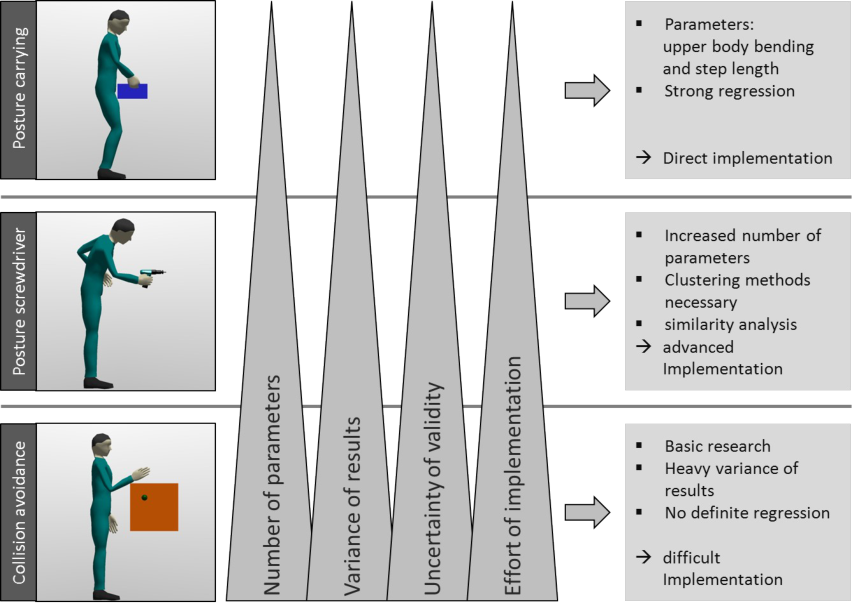
The two presented studies represent both ends of a scale, which refer to the grade of complexity and effort for an implementation into planning software like EMA. While the first study gives results with a clear correlation between parameters like mass and step length, the second study produced more questions than it answered, not to mention applicable functions or algorithms. The implementation of the first example requires a function representing the correlation between the parameter mass and step length. Next to that, there is the technical requirement on the software of recognizing loads. In contrary to that the implementation of a holistic automated collision avoidance algorithm for digital human models is very far from being solved. One just has to consider the result of the related study, which not only examined just a minor part of the possible parameters of collision avoidance, but also showed very little correlation between the tested parameters and the observed behavior.
These two studies and earlier findings lead to the conclusion that three particular circumstances result in a higher effort in implementing scientific findings into existing or future software products like EMA (see figure 4). Especially the number of parameters, the variance of the results and the uncertainty of validity have a strong influence on the implementation of findings.
Figure 3. The differences of study outcomes and the consequences for the implementation in EMA
While the number of parameters is a rather obvious influence, the variance of results and the uncertainty of results lead to a new problem. They do not only restrain the implementation in effort, but also have influence on the reliability and validity of the software product. As mentioned in the introduction, there is a shift of responsibility through automated motion generation. If a planning problem, such as collision avoidance, offers more than one possible and likely way of solving a certain movement task, there will always be a conflict of interests in the simulation. This problem grows with the fact, that different solutions of a simulation may lead to different times and different ergonomic assessment, which could add another dimension to the conflict. One reason is the characteristic of today’s planning approach in the industrial sector. The planning of a process includes usually only one “optimal” planned process. If there is an ergonomically optimized, a time cost optimized and a best-compromise process, the decision for one solution depends on the user or the philosophy of the company behind. In the case of EMA, the software has to make this decision, until there is the option of parameterized simulation, with parameters for weighting ergonomics, productivity, etc.
For the moment industry standards like MTM and EAWS can be used for the determination of planning times and ergonomic risk assessment. In future software products, with a higher quality and performance of movement generation, it will be necessary to create motion generation standards, which determine the role of possible optimization parameters. This is necessary, because there are possible conflicts of interest in different user groups as described above. User groups as companies or unions may have different priorities and requirements. Since companies usually set a higher value on the productivity and unions might demand optimized ergonomics for working places, software developers depend on a solid base of knowledge and industry standards to fulfill the requirements of possibly all user groups.
CONCLUSIONS
EMA is a modern planning tool that enables the software user to simulate most of the relevant working activities in manufacturing industries. Nevertheless it is not yet capable of some advanced functions like 3D whole body collision avoidance, which are requested by todays’ and tomorrows’ users. Due to these requirements and the responsibility that occurs with automated generation of motions, the ongoing process of validating motion generation algorithms is a major topic for digital human modeling research. Since some studies show that human motor behavior isn’t explicit in every aspect and the solving of certain tasks as collision avoidance can be done in several legitimate ways, the development of standards for priorities in motion synthesis is essential. Standards are also needed to establish rules for potential conflicts of interest between different user groups and analysis results, such as ergonomic risks and productivity improvements. However, the most sustainable work design considers both aspects simultaneously and equally – EMA provides a basis to this approach.
REFERENCES
Eske, S. 2014. „Untersuchungen zum Trageverhalten und unter dem Einfluss von Objektdimension und –gewicht“. Bachelor thesis. Technical University Chemnitz Fritzsche, L., Jendrusch, R., Leidholdt, W., Bauer, S., Jäckel, T., Pirger, A. (2011). “Introducing ema (Editor for Manual Work
Activities) – A New Tool for Enhancing Accuracy and Efficiency of Human Simulations in Digital Production Planning.” In: V.G. Duffy (Ed.), Digital Human Modeling, HCII 2011, LNCS 6777 (pp. 272–281). Berlin, Heidelberg: Springer. Gläser, D. 2013. „Untersuchungen zur Kollisionsvermeidung auf Basis natürlicher Bewegungsmuster“. Master Thesis. Technical University Chemnitz. Hogan; Neville. 1984. “An organizing principle for a class of voluntary movements.” The Journal of Neuroscience 4(11): 2745–
2754 Illmann, B., Fritzsche, L., Leidholdt, W., Bauer, S., Dietrich, M. 2013. “Application and Future Developments of ema in Digital Production Planning and Ergonomics.” In: V.G. Duffy (Ed.), DHM/HCII HCII 2013, LNCS 8026 (pp. 66–75). Berlin, Heidelberg: Springer Nelson, W.L. 1983. “Physical principles for economies of skilled movements.” Biological cybernetics 147: 135–147.
http://link.springer.com/article/10.1007/BF00339982 (May 8, 2013). Zacher, I.; Bubb, H. 2004. “Strength based discomfort model of posture and movement.” SAE transactions 113(1): 87–92.
LISTED IN THE AHFE DIGITAL BOOKSTORE CATALOGUE
Explore the complete digital volume
Advances in Applied Digital Human Modeling
Read this individual research paper free through the original publisher, or explore the full digital proceedings book.
ISBN 978-1-4951-2094-7
Explore this ISBN in the AHFE Bookstore ↗Listed in the July 2026 bookstore catalogue; search by ISBN to confirm current availability · Digital book purchase optional