Michihiko Fukunaga (2026). Differences in Mandolin Tremolo Motion between Beginners and Experts: Implications for Skill Acquisition. In: Physical Ergonomics and Human Factors. AHFE Open Access, vol. 223, pp. 50–55. https://doi.org/10.54941/ahfe1007795
Mandolin tremolo is a fundamental technique requiring rapid, high-frequency motion of the elbow and wrist. Understanding the kinematic strategies adopted across different skill levels is crucial for optimizing skill acquisition protocols and potentially mitigating performance-related injuries. This study investigates the differences in forearm and wrist motion between novice and skilled mandolin players to provide data-driven guidance. Ten participants, categorized based on self-reported experience levels (ranging from under 1 year to 6 years), were recruited. Miniature IMU sensors were attached to the hand and forearm. Participants performed tremolo on the open A string at their preferred pace. We analyzed the angular velocity data, computing the vertical velocity of the pick by modeling the hand-forearm kinematic chain. The primary finding was that the symmetry and consistency of the upstroke/downstroke pick velocity exhibited the strongest correlation with skill level. Beginners demonstrated significant velocity decay during the resistive upstroke phase. Intermediate players compensated for this by rigidly coupling the hand and forearm to leverage forearm inertia. Crucially, expert players demonstrated a distinct shift, actively incorporating radial-ulnar wrist deviation to maintain high pick speed and smooth momentum transfer. These findings provide kinematic benchmarks and suggest a progression from gross-motor compensation to fine-motor control optimization for effective skill training.
The mandolin is an accessible fretted string instrument, and the existence of a family of related instruments (mandola, mandocello, etc.) makes it highly suitable for ensemble performance. In Japan, mandolin ensembles are often featured in extracurricular activities at high schools and universities. To facilitate a deep and musically profound experience within a limited period of study, rapid and efficient acquisition of advanced performance skills is essential. While self-directed practice is valuable in settings where the quantity or quality of instructors may be insufficient, it is crucial to establish quantitative, data-driven benchmarks for optimal playing techniques and the progression of skill development.
The mandolin produces decaying tones upon plucking. To realize sustained musical expression, a high-frequency, alternating-stroke technique called Received January 14, 2026; Revised April 3, 2026; Accepted April 19, 2026; Available online July 20, 2026
Differences in Mandolin Tremolo Motion Between Beginners and Experts 51 “tremolo” is widely employed. Mandolin tremolo is executed by rapidly oscillating a pick, held by the right hand, up and down across the string. Mastering this movement is a fundamental milestone for novice players. Furthermore, advanced players must acquire the precise control required to freely modulate the timing and force of plucking for expressive performance.
Research into the biomechanics of musical performance, particularly string instruments like the violin (Tuner-Stokes, et al, 1999) and guitar (Perez, 2019), has advanced significantly, often utilizing optical motion capture systems or electromyography to analyze upper limb kinematics and reduce the risk of performance-related injuries (Visentin, et al, 2003). However, quantitative analysis focused specifically on the high-frequency alternating motion of the mandolin tremolo, and its corresponding skill progression, remains scarce.
Our previous pilot study demonstrated the feasibility of evaluating tremolo characteristics using a single Inertial Measurement Unit (IMU) attached to the back of a single subject’s hand (Fukunaga, 2023). Building upon this, the current study aims to perform a multi-segmental analysis by placing IMU sensors on both the hand and the forearm. This methodological improvement allows us to kinematically separate the contributions of the elbow and wrist joints and to thoroughly investigate their coordination and interaction strategies. Furthermore, by measuring the motion of participants across various experience levels, this research seeks to clarify the quantitative differences in joint movement and pick control between novices and experts, thereby characterizing the objective path of skill acquisition.
MATERIALS AND METHODS
Ten participants, who were currently playing the mandolin in a university club or continued to play after graduation, were recruited for this study. Their experience levels were categorized as follows: two participants each for less than one year, 1–2 years, 2–3 years, and 3–4 years; and one participant each for 4–5 years and 5–6 years.
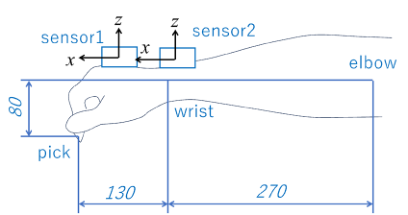
Inertial Measurement Unit (IMU) sensors (LP-WS1104, Logical Products) were fixed to the dorsal side of the participants’ hands and forearms using rubber bands, as schematically illustrated in Figure 1. Participants were instructed to perform tremolo on the open A string for approximately 10 seconds at a self-selected comfortable speed and volume.
The acquired angular velocity data were band-pass filtered (1.5–12 Hz) to eliminate noise, considering that the typical tremolo frequency ranges approximately from 3 to 6 Hz. Low-frequency noise was attributed to gross body movements, while high-frequency noise was assumed to result from slight movement between the bone axis and the sensor placement. The velocity of the pick, p v , was calculated using Equation (1) based on the estimated average posture and dimensions of the participant’s arm while holding the pick (as schematically shown in Figure 1). p v was defined as positive during the downstroke (downward movement of the pick) and negative during the upstroke (upward movement). The entire tremolo motion was segmented at the time instances when the pick velocity transitioned from negative (upstroke) to positive (downstroke). The segmented motions
52 Fukunaga were then time-normalized and averaged to define the characteristic tremolo motion for each participant.
Figure 1: Arm model of the participants and the attached inertia sensors.
Furthermore, the pick velocity ( p v ) was decomposed into components attributable to three specific joint motions: elbow flexion-extension ( ef v ), forearm pronation-supination ( pr v ), and wrist radial-ulnar deviation ( rw v ).
( ) 2 1 2 2 400 130 80 p z z z x pr rw ef v v v v ω ω ω ω = + − + = + + (1) In the context of effective tremolo performance, where uniform execution of alternating upstrokes and downstrokes is desirable, the following evaluation metrics were established to investigate how specific joint motions contribute to the overall pick kinematics:
− . Values closer to 0 (i.e.,
p,min sym
(1) Velocity Symmetry Ratio ( )
v R : log v p,max
p,min p,max v v ≈ ) are considered desirable, indicating symmetry between upstroke and downstroke speeds. (2) Velocity Timing Ratio ( timing R ): The time duration between the timing of p,max v and p,min v as a percentage of the total segment duration ( t ∆).
p,max p,min v v timing
− = × ∆ . Values approaching 50% are considered optimal,
t t R 100% t indicating balanced time allocation for the upstroke and downstroke phases. (3) Pick Velocity Amplitude ( ) p v p,max p,min A : v v − (4) Relative Amplitude Contribution ( joint %A ): The ratio of the amplitude of each joint-specific velocity component ( pr rw ef v ,v ,v ) to the total pick velocity amplitude (
p v A ).
RESULTS
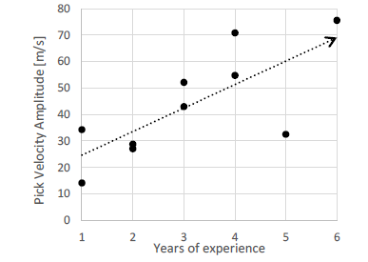
Figure 2 presents the average kinematic profiles of the pick velocity ( p v ) and its decomposed joint components ( pr rw ef v ,v ,v ) for each participant. Furthermore, the relationship between the quantitative evaluation metrics (Section 2.3) and the years of playing experience is illustrated in Fig. 3.
Figure 2: Pick velocity and components derived from each joint movement.
Figure available in the original PDF paper.
(a) Symmetry of up/downstroke (b)Relative amplitude contribution of each
joint
(c)Pick velocity amplitude
Figure 3: Relationship between the quantitative evaluation metrics and the years of experience.
54 Fukunaga DISCUSSION The metric that exhibited the strongest correlation with years of playing experience was the Velocity Symmetry Ratio ( sym R ) defined as
p,min p,max log v / v − (Pearson’s R = −0.87). A stronger correlation indicates greater symmetry between the peak speeds of the upstroke and downstroke, demonstrating enhanced efficiency with skill. Conversely, the Velocity Timing Ratio ( timing R ) showed a weaker correlation, largely due to high inter-subject variability, particularly among novices.
Regarding the strategy of joint utilization, individual differences were observed among novices. However, the contribution of elbow flexion/ extension amplitude to the total pick velocity amplitude exhibited a clear trend: it initially increased from novice to intermediate levels, and then decreased in highly skilled experts. Specifically, in novices, the upstroke motion frequently showed that forearm pronation/supination ( pr v ) and wrist radial/ulnar deviation ( rw v ) acted counter-productively at the minimum pick velocity ( p,min v ). This suggests that beginners often lack the motion stability required to overcome string resistance, resulting in involuntary movement of the forearm and wrist. In contrast, intermediate players appeared to counteract this resistance by stabilizing the forearm and wrist, primarily utilizing elbow flexion/extension ( ef v ) to leverage the inertia of the entire forearm. The most skilled experts, however, displayed a distinct strategy: they actively incorporated radial/ulnar wrist deviation ( rw v ) in synchronization with the elbow motion ( ef v ) to actively maintain high pick velocity during the resistive upstroke phase.
A limitation of this study is that the sampled novices primarily belonged to groups where guidance often emphasizes playing with a fixed wrist initially. Therefore, the observed skill progression (fixed wrist → active wrist) may not represent a universal path. Nonetheless, the tendency for novices to stabilize the wrist and experts to actively utilize its radial/ulnar deviation suggests that the observed kinematic progression appropriately reflects the intent of typical instruction.
For application in mandolin training systems based on inertial sensors, it is advisable to prioritize checking whether the pick decelerates excessively during the upstroke, and if this decay is caused by undesirable movement (e.g., reactive rotation/deviation) of the wrist or forearm. Subsequently, training should focus on gradually integrating active wrist deviation to contribute effectively to pick acceleration and overall speed symmetry.
CONCLUSION
This study conducted a quantitative biomechanical analysis of mandolin tremolo using a multi-segment IMU system, clarifying the kinematic differences between novices and experts and characterizing the path of skill acquisition. The primary finding is that the symmetry of upstroke/downstroke pick velocity ( sym R ) is the strongest predictor of expertise (R = −0.87), indicating that efficient momentum transfer is key to advanced performance.
Differences in Mandolin Tremolo Motion Between Beginners and Experts 55 We identified a clear progression in joint coordination strategy: novices exhibit passive movement due to string resistance, intermediates adopt a compensatory strategy by fixing the distal joints and leveraging elbow inertia, and experts achieve optimization by actively and synchronously utilizing wrist radial-ulnar deviation for high-speed pick control. These results provide objective, biomechanical benchmarks for effective skill training, suggesting that future efforts should focus on integrating these metrics into real-time, sensor-based feedback systems to accelerate the acquisition of precise motor control in musical performance.
ACKNOWLEDGMENT
This work was supported by JSPS KAKENHI Grant Number JP24K06210.
REFERENCES
Fukunaga, Michihiko. (2023). Motion measurement of the hand during playing tremolo on mandolin using an inertial sensor (Difference between tremolo by the wrist and by the elbow), Journal of Biomechanical Science and Engineering, Volume 18, No. 3. Perez-Carrillo, Alfonso. (2019). Finger-String Interaction Analysis in Guitar Playing
with Optical Motion Capture, Frontiers in Computer Science, Volume 1, No. 8. Turner-Stokes, Lynne. Reid, Keith. (1999). Three-dimensional motion analysis of upper limb movement in the bowing arm of string-playing musicians, Clinical Biomechanics, Volume 14, No. 6. Visentin, Peter. Shan, Gongbing. (2003). The Kinetic Characteristics of the Bow Arm
During Violin Performance, Medical Problem of Performing Artists, Volume 18, No. 3.
LISTED IN THE AHFE DIGITAL BOOKSTORE CATALOGUE
Explore the complete digital volume
Physical Ergonomics and Human Factors
Read this individual research paper free through the original publisher, or explore the full digital proceedings book.
ISBN 978-1-964867-99-1
Explore this ISBN in the AHFE Bookstore ↗Listed in the July 2026 bookstore catalogue; search by ISBN to confirm current availability · Digital book purchase optional