Xiaoyi Wang, Calvin Or (2026). An AI-Powered Model for Automatic Real-Time Assessment of Seated Work Postures Using Rapid Upper Limb Assessment (RULA). In: Physical Ergonomics and Human Factors. AHFE Open Access, vol. 223, pp. 93–99. https://doi.org/10.54941/ahfe1007800
Improper seated work postures are common in the workplace and can lead to various musculoskeletal problems, ranging from joint pain to permanent disability. Continuous assessment of seated work postures is necessary to help prevent these risks. However, existing studies have often relied on rule-based methods, which are highly vulnerable to measurement noise from motion capture devices. To overcome this limitation, this study proposes a learning-based approach for posture assessment. Ten participants were recruited to mimic the seven most common awkward and potentially risky seated work postures, while joint angles of their upper body were recorded and computed using both an RGB video-based approach and a Vicon motion capture system-based approach. The RGB measurements were used as features, while the Vicon measurements were used to derive accurate reference labels by comparison against Rapid Upper Limb Assessment (RULA) criteria. A multi-output Random Forest classifier was trained to predict joint-level posture assessment scores, and the model performance was evaluated using a leave-one-subject-out cross-validation scheme. The results provide initial evidence that the model achieved high performance in neck score assessment, while the trunk, shoulder, and elbow scores were more sensitive to posture types and inter-subject differences in posture execution. A larger dataset with more posture types or more subjects would improve the robustness and generalizability of the model.
Work-related musculoskeletal disorders (WMSDs) are among the leading causes of non-fatal occupational injuries, with prolonged exposure to awkward working postures widely recognized as a major contributing factor (Anghel et al., 2007). In modern workplaces, however, workers frequently adopt awkward postures, particularly during prolonged seated work. Continuous assessment of seated work postures and timely identification of hazardous postures are therefore essential for preventing or mitigating the risk of WMSDs.
94 Wang and Or Existing studies on seated work posture assessment have often relied on rule-based approaches. These methods typically quantify body movements using motion capture devices, such as marker-based motion capture systems (Agostinelli et al., 2024), RGB cameras (Agostinelli et al., 2021) or wearable sensors (Peppoloni et al., 2016), and directly compare the measured parameters against established ergonomic assessment frameworks, such as Ovako Working Posture Analyzing System (OWAS) (Karhu et al., 1977) and Rapid Upper Limb Assessment (RULA) (McAtamney & Corlett, 1993). While such approaches allow postures being evaluated in a structured and interpretable manner, they generally apply fixed thresholds to the measurements, making them highly vulnerable to measurement noise.
Marker-based motion capture systems, such as the Vicon system, can provide high measurement accuracy for body movements. However, their high cost, complex setup, and laboratory-bound nature limit their practical use in real-world workplaces (Wang et al., 2022). In contrast, RGB cameras and wearable sensors are more affordable and easier to deploy, but they typically offer limited measurement accuracy. When used in conjunction with the rigid rule-based assessment criteria, these inaccuracies can substantially compromise the reliability of posture assessment in practical settings.
To overcome these limitations, this study proposes a learning-based approach that leverages limited-accuracy RGB video measurements with high-fidelity reference labels to enable low-cost, structured, and robust assessments of seated work posture.
METHOD
Participants Ten healthy adults were recruited via social media advertisements or personal referrals at the University of Hong Kong to participate in the experiment. Eligibility criteria included ages 18 to 65 and the absence of physical or cognitive impairments. All participants provided written informed consent prior to participation, in accordance with procedures approved by The University of Hong Kong Human Research Ethics Committee (reference number EA240158).
Data Collection This study employed one RGB-D camera (Orbbec Femto Bolt, 30fps) and a Vicon motion capture system (30fps) comprising 28 cameras to simultaneously record body movements. The motion capture area was 3.5m*5.5m, with the 28 Vicon cameras strategically deployed around its perimeter. Participants were seated at the centre of the area, and the RGB-D camera was positioned on the left side of the participant at a distance of 1.2m. The camera height was adjusted to match the participant’s eye level.
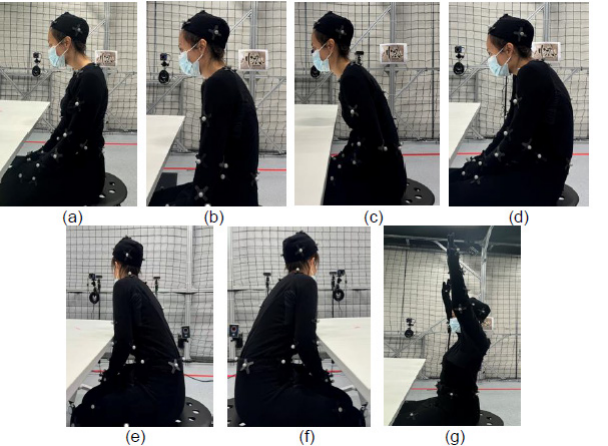
The seven most common awkward seated work postures that may contribute to WMSDs when sustained for prolonged periods were identified and used: forward head, hunched shoulders, lean forward, slouching, twisted torso (left), twisted torso (right), and reaching overhead. The forward head
An AI-Powered Model for Automatic Real-Time Assessment 95 posture occurs when the head protrudes anteriorly, misaligning it with the spine Figure 1(a). The hunched shoulders posture is characterized by elevated and rounded shoulders Figure 1(b). In the leaning forward posture, the entire upper body tilts forward with the head jutting out Figure 1(c). Slouching involves curvature of the lower back, rounded shoulders, and a forward- thrusted head Figure 1(d). The twisted torso (left) posture occurs when the upper body rotates to the left side while the lower body remains stationary Figure 1(e); similarly, the twisted torso (right) posture involves rotation of the upper body to the right with the pelvis stationary Figure 1(f). Finally, the reaching overhead posture involves extending the arms above shoulder height Figure 1(g).
Participants were required to mimic the seven identified postures in a fixed sequence. Following a familiarization trial, each participant assumed and held each posture for 30 seconds. Upon completing each posture, participants rested for 1 minute before proceeding to the next one.
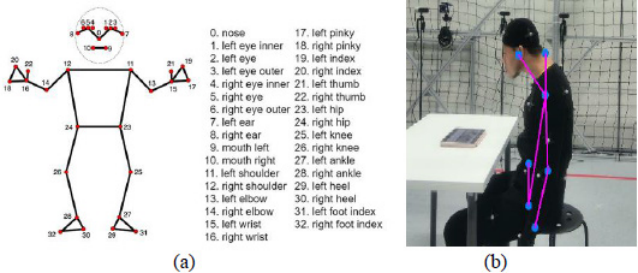
Feature Extraction RGB videos captured by the RGB-D camera were processed using MediaPipe Pose, a lightweight human pose estimation framework that detects 33 skeletal landmarks on the human body (Figure 2(a)). For each video frame, the framework fits a skeleton to the person and returns the x and y coordinates for each skeletal landmark (Figure 2(b)). Joint angles of neck, trunk, shoulder, and elbow were computed from the coordinates of the corresponding
96 Wang and Or landmarks using the vector angle formula (Wang & Or, 2025). These joint angles constitute the features for machine learning.
Figure 2: (a) MediaPipe Pose Model; (b) Pose estimation in the video frame.
Reference Data (Vicon-Based Labeling) Data collected by the Vicon motion capture system were used to generate high-fidelity reference labels. The data were first processed using Vicon data analysis software to compute joint angles of the neck, trunk, shoulder, and elbow for each data frame. These joint angles were then compared with the criteria of RULA, a standardized method for evaluating upper-body working postures. RULA assesses ergonomic risk by evaluating the range of motion of different body joints and assigns an individual score to each joint (McAtamney & Corlett, 1993). The resulting joint-specific RULA scores, including neck, trunk, shoulder and elbow scores, served as ground-truth labels for subsequent machine learning analysis.
Algorithm and Evaluation A multi-output Random Forest classifier was employed to predict joint scores. Specifically, a MultiOutputClassifier wrapper was used to train an independent Random Forest classifier for each joint, and these classifiers share the same input features. Each Random Forest consisted of 300 decision trees with a maximum depth of 10, and class-balanced weighting was applied to mitigate label imbalance. The leave-one-subject-out cross validation strategy was employed to evaluate subject-independent generalization. Accuracy (ACC) and macro-averaged F1-score (macro-F1) were used to assess the performance.
RESULTS AND DISCUSSION
A total of 70,448 frames of data were collected and used for training and evaluation. The results (Table 1) showed the highest performance for neck score assessment (ACC = 0.96 ± 0.10, macro-F1 = 0.93 ± 0.16), while the trunk, shoulder and elbow joints exhibited moderate accuracies (ACC=0.72–0.80). This is likely because neck movement is biomechanically simpler and neck landmarks are estimated more reliably with less occlusion. In contrast, trunk,
An AI-Powered Model for Automatic Real-Time Assessment 97 shoulder and elbow joints involve more complex and multiplanar motions, leading to greater input noise. Furthermore, the macro-F1 scores of the trunk, shoulder and elbow joints were lower, indicating limited performance in discriminating minority RULA score classes in these joints. These minority scores may arise from inter-individual differences in how participants mimicked the awkward posture.
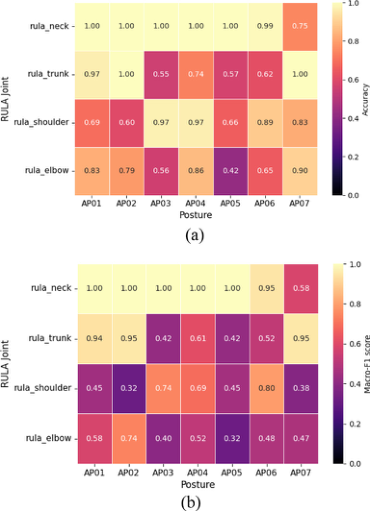
Posture-level analysis Figure 3(a) and (b) showed that the neck scores were assessed consistently in high accuracy and macro-F1 scores across most postures, except for the reaching overhead posture. This may be because, in the reaching overhead posture, the arm obscured the neck from the left-side view, leading to poor joint angle estimation, and thus generating inaccurate features and labels. In contrast, the trunk, shoulder and elbow scores were evaluated in greater variability in both metrics. This suggests that the model predictions are more sensitive to posture types or individual execution styles for these joints.
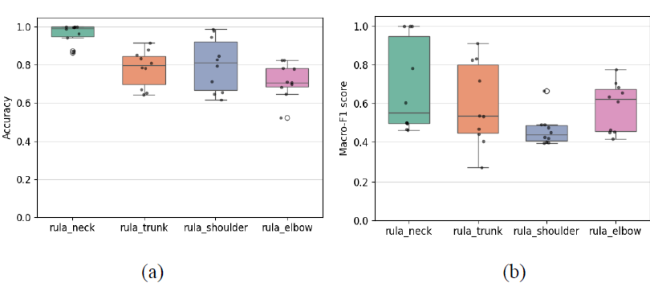
98 Wang and Or Subject-level accuracy analysis Figure 4(a) revealed consistently high performance for neck score assessment across all subjects, while trunk, shoulder, and elbow joints showed moderate performance with larger inter-subject variability. In contrast, the subject-level Macro-F1 score Figure 4(b) analysis indicated neck, trunk, shoulder and elbow scores exhibited substantially low median values and large variability. This suggests that the model has limited performance in recognizing minority RULA score classes in all joints across subjects and is highly sensitive to inter-subject differences in posture execution.
This study trained a multi-output model based on RULA method to enable low-cost, structured and robust seated work posture assessment. The preliminary results showed that the model achieved high performance in neck score assessment across different postures and individuals. While the trunk, shoulder and elbow scores were also assessed with a moderate performance, they are more sensitive to posture types and inter-subject differences in posture execution. Future research could focus on expanding the dataset by including more posture types and more subjects to improve the robustness and generalizability of the model.
ACKNOWLEDGMENT
This study was funded in part by a grant (establish a center for transformative AI/robotics technologies (TRANSART)) from the Innovation and Technology Commission of the HKSAR Government under the InnoHK initiative.
REFERENCES
Agostinelli, T., Generosi, A., Ceccacci, S., & Mengoni, M. (2024). Validation of computer vision-based ergonomic risk assessment tools for real manufacturing environments. Scientific Reports, 14(1), 27785.
An AI-Powered Model for Automatic Real-Time Assessment 99 Agostinelli, T., Generosi, A., Ceccacci, S., Khamaisi, R. K., Peruzzini, M., & Mengoni,
M. (2021). Preliminary validation of a low-cost motion analysis system based on RGB cameras to support the evaluation of postural risk assessment. Applied Sciences, 11(22), 10645. Anghel, M., Argesanu, V., Talpos-Niculescu, C., & Lungeanu, D. (2007).
Músculoskeletal disorders (MSDS) consequences of prolonged static postures. J Exper Med Surg Res, 4, 167–172. Karhu, O., Kansi, P., & Kuorinka, I. (1977). Correcting working postures in industry: A practical method for analysis. Applied ergonomics, 8(4), 199–201. McAtamney, L., & Corlett, E. N. (1993). RULA: a survey method for the investigation
of work-related upper limb disorders. Applied ergonomics, 24(2), 91–99. Peppoloni, L., Filippeschi, A., Ruffaldi, E., & Avizzano, C. A. (2016). A novel wearable system for the online assessment of risk for biomechanical load in repetitive efforts. International Journal of Industrial Ergonomics, 52, 1–11. Wang, X., & Or, C. K. (2025). A Low-Cost and Computationally Efficient AI-based
System for Real-Time Seated Postural Ergonomic Assessment. Proceedings of the 11th World Congress on Electrical Engineering and Computer Systems and Sciences (EECSS’25), Paris. Wang, X., Fu, Y., Ye, B., Babineau, J., Ding, Y., & Mihailidis, A. (2022). Technologybased compensation assessment and detection of upper extremity activities of stroke survivors: systematic review. Journal of Medical Internet Research, 24(6), e34307.
LISTED IN THE AHFE DIGITAL BOOKSTORE CATALOGUE
Explore the complete digital volume
Physical Ergonomics and Human Factors
Read this individual research paper free through the original publisher, or explore the full digital proceedings book.
ISBN 978-1-964867-99-1
Explore this ISBN in the AHFE Bookstore ↗Listed in the July 2026 bookstore catalogue; search by ISBN to confirm current availability · Digital book purchase optional