Rebecca Rack, Anne Keßler, Elias Moos, Matthias Körber (2026). Postural Strategies, Muscle Activation, and Perceived Strain in Drilling Tasks: Implications for Digital Human Model Prediction. In: Human Systems Engineering and Design (IHSED2026): Future Trends and Applications. AHFE Open Access, vol. 237, pp. 609–618. https://doi.org/10.54941/ahfe1008200
Accurately predicting posture in drilling tasks remains challenging for Digital Human Models (DHMs), as individuals differ in how they balance reach, force transmission, and stabilization. This exploratory study investigated how drilling height affects posture, muscle activation, and perceived strain during static simulated drilling. Eleven participants performed the task at four standardized heights while joint angles, EMG activity, and subjective ratings were recorded. Shoulder elevation showed the clearest height-related changes, while elbow, wrist, and trunk adjustments were smaller and more individually variable. Muscle activation patterns broadly reflected these kinematic trends, and subjective strain increased mainly in extreme postures, with only weak links to EMG. Overall, the combination of stable within-individual behaviour and pronounced between-individual differences indicates that the DHMs should incorporate multiple feasible posture strategies. Given the small sample and static, non-vibrating setup, the findings are preliminary but provide a useful basis for refining posture prediction in drilling tasks.
Digital Human Models (DHMs) are increasingly used to support ergonomics evaluations and virtual prototyping by enabling the prediction of working postures, joint loads, and human-tool interactions (Zhang et al., 2025). For many manual tasks, however, accurately predicting posture remains challenging because human movement and stabilization strategies vary widely across individuals and task conditions (Cort & Devries, 2019). This is particularly evident in activities involving hand-held power tools, where users must coordinate force generation, upper-body stabilization, and tool handling in ways that depend strongly on anthropometrics, strength, experience, and perceived comfort (Sänger et al., 2023; Kattel et al., 1996; Hoffmann et al., 2008).
At the same time, the ability to correctly represent such tasks is of considerable relevance from a health and safety perspective. Work-related musculoskeletal disorders (WMSDs) continue to be among the most prevalent
Received April 20, 2026 Revised June 14, 2026 Accepted July 1, 2026 Available online September 25, 2026
occupational health problems in physically demanding sectors (Hulshof et al., 2021). Their development is associated with prolonged static postures, high mechanical loads on the upper extremities, and repetitive or awkward joint positions – factors that commonly arise during tool-based work (Sun et al., 2023). Tasks such as drilling require workers to exert substantial pushing forces, maintain non-neutral arm elevations, and stabilize the trunk against reactive forces. These biomechanical demands contribute to local muscle fatigue, compromised circulation in static postures, and an increased risk of overload in the shoulder and neck regions. Understanding the mechanisms that shape posture and muscular effort in such tasks is therefore essential for both ergonomics research and the design of safer tools and workplaces.
From a modelling standpoint, drilling represents a particularly demanding use case for DHMs. Even when the external parameters, such as the required force of the target position, are held constant, individuals show considerable differences in how they align their joints, distribute muscular load, or adjust their stance (Panariello et al., 2022; Hoffmann et al., 2007; Luque et al., 2025). This variability complicates empirical analysis and raises questions about how DHMs should represent human diversity and task-dependent adaptation. It is unclear which parameters, joint constraints, muscle activation patterns, stabilization strategies, or subjective decisions, such as prioritizing comfort or stability, most strongly influence posture formation during tool- based tasks and should therefore be more explicitly incorporated into future DHM systems.
The present study contributes to closing these gaps by examining static drilling tasks performed at different heights under controlled conditions. To clarify the relationship between task geometry, posture, muscular effort, and subjective experience, the study investigates the following research questions: RQ1: How do individuals adapt their posture under different drill heights
during static drilling tasks? This includes joint configurations, postural adjustments, and the extent of inter-individual variability. RQ2: Which muscle activation patterns are observed during static drilling? RQ3: Which subjective strain perceptions and strategies do participants report, and how do these relate to their posture and muscle activity? RQ4: What implications do these relationships hold for posture prediction
in Digital Human Models? Specifically, which aspects of human variability and task-dependent behaviour should be represented more explicitly to improve model fidelity?
By combining objective kinematic and muscular measures with subjective assessments and reported strategies, this study aims to build a more comprehensive understanding of the biomechanical demands of drilling tasks. These insights serve as a basis for refining DHM-based posture prediction and for informing ergonomic improvements in tool design and workplace layout.
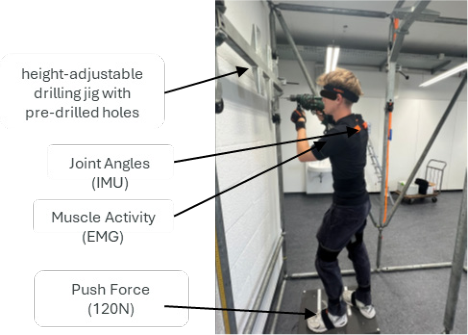
EXPERIMENTAL FRAMEWORK FOR UNDERSTANDING DRILLING POSTURE DETERMINANTS Eleven Participants (7 male, 4 female, age: 24 ± 1,5 years, body height: 180 ± 9 cm) performed simulated drilling tasks at four predefined heights (hip, shoulder, head, overhead) using a real hammer drill (Bosch PSB 500 RE, Robert Bosch GmbH, Gerlingen, Germany) without actively drilling. To ensure posture comparability across participants, the working height was adjusted to each participant’s body height. A height-adjustable test bench (MERO elements, Mero-TSK International GmbH, Würzburg, Germany) and a force plate (Bertex Colombus, USA) ensured controlled conditions with real-time auditory feedback for maintaining a push force of 120 N. All participants volunteered, provided informed consent, and were informed about the experimental procedure in advance. The experiment could be paused or terminated at any time. All collected data were anonymized. Each trial lasted 8 sec and was repeated four times.
Figure 1: Test environment for simulated drilling with a push force of 120 N.
Posture/joint angles were captured via an inertial motion capture system (17 IMUs, XSens Awinda Movella Inc, El Segundo, USA; 60 Hz). Electromyography (EMG) was recorded from the shoulder, torso, and upper arm muscles on the right side using the Cometa Wave X (Cometa srl, Bareggio, Italy; 2000 Hz). The following muscles were measured: anterior deltoid (AD), biceps brachii (BB), triceps brachii (TB), upper trapezius (UT), latissimus dorsi (LD), and pectoralis major (PM). The sensor placement and measurement preparation were based on the SEMIAN guidelines (Hermens et al., 1999). To control muscle-specific differences, muscle-specific maximum voluntary contraction (MVC) tests were performed twice per muscle prior to the drilling trials. Additionally, subjective strain was assessed using Borg CR10 scales, a 5-point Likert scale, and open-ended questions regarding posture optimization and subjective feelings at the end of the drilling trials.
Data Processing Data were synchronized and segmented based on the left hand’s vertical position. The joint angle data were low-pass filtered at 6 Hz (second-order Butterworth). For each trial, the mean joint angle over the segmented interval was computed. EMG was bandpass-filtered at 100 Hz and DC-offset corrected. Their amplitude was quantified as root mean square (RMS) per trial and normalized to MVC by dividing by the muscle-specific maximum MVC RMS (EMG in %MVC). Fatigue effects on EMG were analyzed using the Fourier transform (FFT). Joint angles and normalized EMG were compared across the drilling heights and against literature-based ergonomic limits (Quelle). Joint-specific variability across four repeated trials was quantified by the within-subject standard deviation, calculated separately for each joint and experimental condition. In addition, intraclass correlation coefficients (ICC(3,1), two-way random, absolute agreement) were computed to assess the reliability of the joint angle measurements across repetitions. Perceived strain and subjective ratings were summarized as percentages across categories. All post-processing was performed in MATLAB (R2024b, MathWorks, Natick, MA, USA) and Python (v1.28.0, Python Software Foundation, Beaverton, OR, USA).
EXPERIMENTAL RESULTS AND DISCUSSION Joint Angles
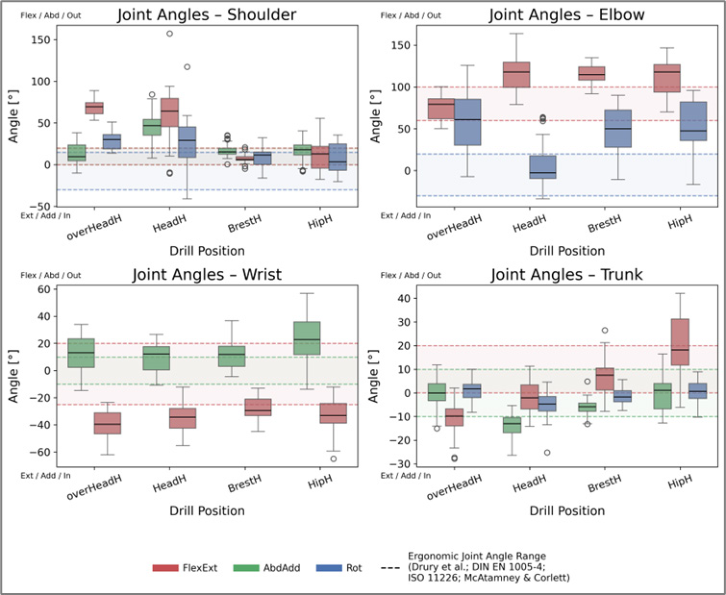
Drilling height elicited systematic adaptations, most prominently in the shoulder, which showed nearly linear increases in flexion and abduction from hip toward overhead height. This confirms that shoulder elevation is the primary compensatory mechanism for aligning the drill with the target height. Elbow and wrist angles changed far less, with elbow flexion remaining stable across the horizontal drill heights and wrist posture dominated by handle geometry rather than task demands. The trunk contributed selectively, showing slight extension for overhead drilling and increased forward flexion at lower heights, with notably high inter-individual variability at hip height.
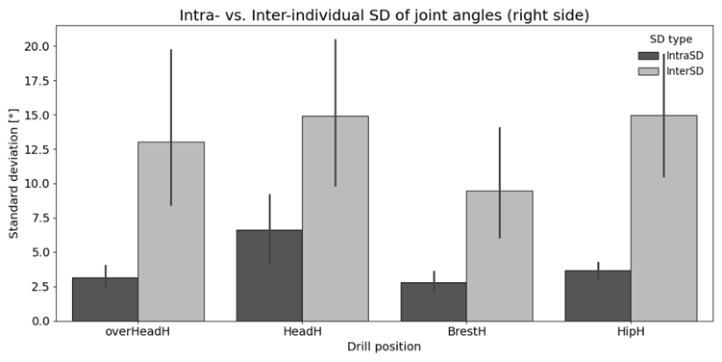
Intra-individual variability across repetitions was consistently low, indicating stable person strategies, whereas inter-individual variability was much higher, especially for trunk posture at hip height. This demonstrates that, while participants reliably repeat their preferred posture, the task allows multiple feasible solutions, highlighting the need for probabilistic or multi- strategy approaches to posture prediction (RQ1, RQ4).
Figure 2: Mean joint angles with standard deviations (n = 10) of the right upper joints (Shoulder, Elbow, Wrist) and the trunk for the drill positions overhead, head, breast, and hip in the movement directions Abduction-Adduction (AbdAdd), Flexion-Exten sion (FlexExt), and Rotation (Rot). The coloured background shows the good ergo nomic joint angle range (defined by BGIA-Report 2/2007).Figure 3: Intra- and inter- individual variability of joint angles across four repeated static drilling trial. Bars show mean within-subject standard deviation (IntraSD) and between-subject standard deviation (InterSD) for the right-side upper extremity joints across drill positions. Low intra-individual variability indicates stable, repeatable pos ture strategies, whereas substantially higher inter-individual variability demonstrates the existence of multiple feasible postural solutions for the same task.
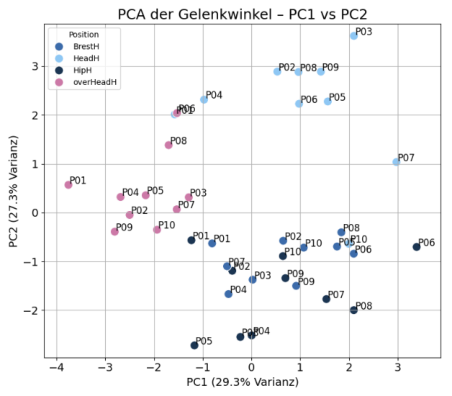
Coordinated Postural Patterns The Principal Component Analysis (56.5% of total variance) confirmed and extended the joint-wise findings by revealing two dominant coordination axes. PC1 (29.3%) distinguished compact, elbow-dominant postures from more open configurations involving shoulder and trunk rotation. PC2 (27.3%) reflected arm elevation, differentiating upward-reaching postures from downward-reaching strategies involving trunk flexion or kneeling. The four drilling heights formed well-separated clusters. Overhead and head height appeared in the high PC2 region, consistent with large shoulder elevation angles. Overhead drilling also showed lower PC1 values, indicating frequent use of shoulder/trunk rotation. Breast and hip height occurred at lower PC2 values, with hip height additionally showing positive PC1 scores reflecting compact arm postures combined with trunk-driven adjustments. Thus, the PCA demonstrates that drill height not only affects individual joint angles but also organizes whole-body coordination strategies, reinforcing the hierarchical control revealed in the joint-wise analysis (RQ1).
Figure 4: Principal component analysis (PCA) plot showing the distribution of individ ual participants in the space of first two principal components. Each point represents one participant, illustration between-subject variation in posture patterns across drill ing heights.
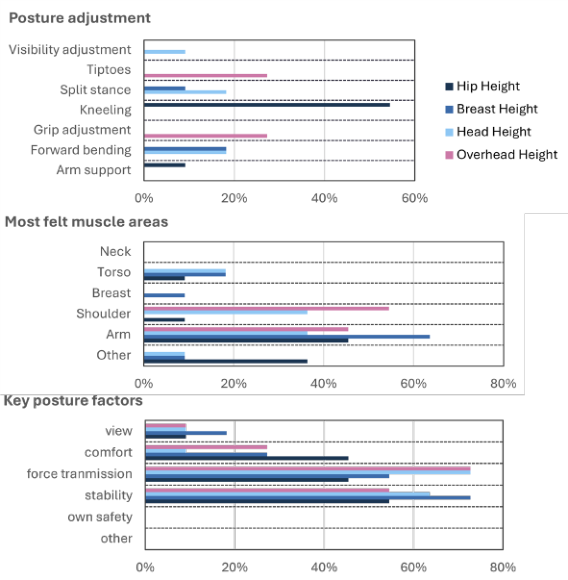
Subjective Ratings Participants’ subjective reports aligned closely with both the joint-angle and PCA patterns. At overhead height, common strategies such as tiptoeing and grip adjustments (both 27%) reflect attempts to increase reach and control, which align with the high PC2 scores and increased shoulder/ trunk involvement. At head height, forward bending (18%) and split-stance adjustments (18%) correspond to the moderate trunk contribution observed in joint-angle data. At hip height, over half of participants (55%) reported kneeling, directly explaining the large inter-individual variability and the PCA cluster characterized by trunk flexion. Breast height was perceived as
Postural Strategies, Muscle Activation, and Perceived Strain in Drilling Tasks 615 most comfortable (64%), while head height was overwhelmingly rated as most uncomfortable (91%), consistent with elevated shoulder angles and the high musculoskeletal demands identified in both joint angle and EMG results. Participants prioritized stability (55-73%) and force transmission (45-73%) across all heights, indicating that posture selection was guided by task efficiency rather than neutral joint configurations. Reported muscle sensations mirrored kinematic demands: overhead drilling was most often felt in the shoulder region (55%), whereas breast and hip heights elicited sensations in the arm or trunk, consistent with the respective kinematic strategies (RQ1-3).
Figure 5: Distribution of open-ended questionnaire responses across drilling heights. The figure illustrates participants’ reported posture adjustments, muscle groups they felt most, and factors they considered most important when selecting their posture.
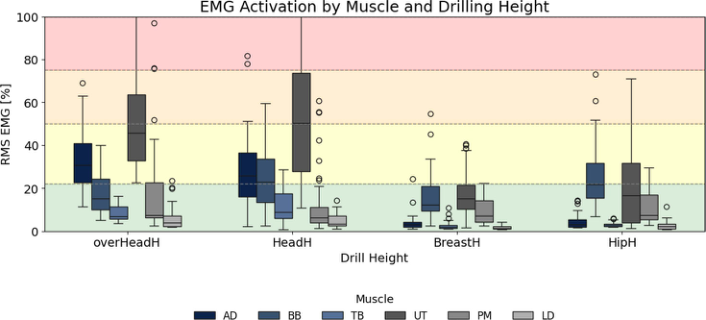
EMG FFT-based fatigue analysis confirmed that short trial durations were sufficient to differentiate activation levels but did not induce measurable fatigue. Height-dependent muscle activation patterns supported the joint- angle findings. Anterior deltoid (AD) and upper trapezius (UT) activation increased with drilling height, reflecting the elevated arm postures used during head and overhead drilling (RQ2). Biceps and triceps activation remained comparatively stable across heights, consistent with the limited influence of height on elbow posture. Latissimus dorsi (LD) and pectoralis (PM) showed task-dependent but inconsistent trends across heights, indicating localized
force contributions that depend on individual strategy rather than fixed height-driven patterns.
Figure 6: Root mean square of MVC normalized muscle activity of right-side shoulder, arm, and torso muscles; color-coded in the background with the criteria of muscle activation: green (low), yellow (moderate), orange (high), and red (very high) (DGUV 2020).
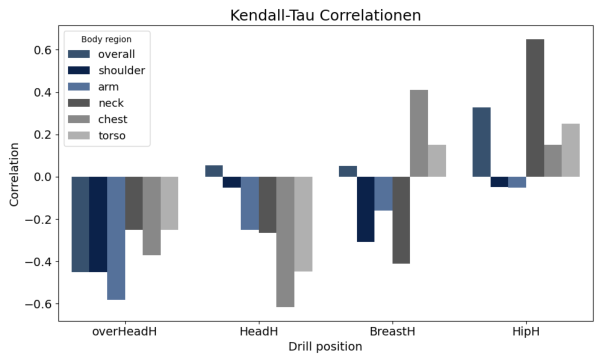
Correlations between EMG amplitudes and subjective strain rating were weak to moderate and varied by height. At higher drilling positions, correlations were predominantly negative, suggesting that discomfort was influenced more by joint loading and elevated posture than by increased muscle activation. At lower heights, correlations became more positive, particularly for the neck region at hip height, where upper trapezius activity aligned with perceived strain. These results indicate that subjective strain reflects a combination of muscular effort and posture-related discomfort and cannot be inferred from EMG alone (RQ2, RQ3).
Figure 7: Kendall-Tau correlations between normalized EMG (%MVC) and subjective strain ratings (Borg CR10 Likert-scale) across drilling heights (overhead, head, breast, hip). Bars show the coefficient correlation for each body region (overall, shoulder, arm, neck, chest, torso).
Postural Strategies, Muscle Activation, and Perceived Strain in Drilling Tasks 617 Overall, the EMG findings reinforce the central role of shoulder elevation as the primary compensatory mechanism for increased drill height and support the need for DHM models to incorporate both posture-dependent muscle requirements and individual strategy variability (RQ4).
CONCLUSION
This exploratory study provides initial insight into how drill height shapes posture, muscular effort, and perceived strain during static drilling. Across all conditions, shoulder elevation emerged as the dominant height- compensation mechanism, whereas elbow, wrist, and trunk adjustments were less systematic and showed pronounced inter-individual variability. This indicates that posture selection results from task-imposed biomechanical constraints combined with individual stabilization preferences when multiple strategies are feasible (States & Wright, 2001). Height-related increases in shoulder muscle activation supported the kinematic patterns, while the weak association between EMG and subjective strain suggests that discomfort reflects both muscular demand and joint positioning rather than activation alone.
These findings have clear implications for DHMs. The coexistence of stable within-individual postures and substantial between-individual differences shows that posture prediction for drilling tasks cannot rely on a single deterministic solution. Instead, DHMs should incorporate variability, multiple plausible strategies, and height-dependent constraints, particularly those governing shoulder elevation and trunk involvement.
The conclusions are limited by the small sample size and the static, simulated task setup, which lacks active drilling or vibration. Nonetheless, the observed variability across joint-angle patterns emphasizes the need for broader datasets to capture the full spectrum of feasible drilling strategies. A subsequent controlled study will build on these observations to systematically evaluate the influence of specific task parameters.
ACKNOWLEDGMENT
The authors would like to thank the Präventionszentrum Core Facilities for providing access to the force plate used in this study. We further thank all participating volunteers for their time and commitment. We would also like to express our sincere appreciation to Susanne Sutschet for her valuable feedback and for kindly proofreading the manuscript. This work was supported by the German Research Foundation (DFG) as part of the funded project (535064559).
REFERENCES
Cort, Joel A.; Devries, Danielle (2019): Accuracy of Postures Predicted Using a Digital Human Model During Four Manual Exertion Tasks, and Implications for Ergonomic Assessments. In: IISE Transactions on Occupational Ergonomics and Human Factors 7 (1), S. 43–58. DOI: 10.1080/24725838.2019.1607630. DGUV: Assessment of physical workloads in occupational activities. Institute for
Occupational Safety and Health of the German Social Accident Insurance (IFA), Sankt Augustin (2020). https://www.dguv.de/medien/ifa/de/fac/ergonomie/pdf/
Hermens, H. J., Freriks, B., Merletti, R., Stegeman, D. F., Blok, J. H., Rau, G., et al.
(1999). European recommendations for surface electromyography: Results of the SENIAM Project. Roessingh Research and Development B.V. (ISBN 90-75452- 14-4). https://www.seniam.org/pdf/contents8.PDF Hoffman, S., Reed, M., and Chaffin, D., “Predicting Force-Exertion Postures from Task Variables,” SAE Technical Paper 2007-01-2480, 2007, https://doi. org/10.4271/2007-01-2480 Hoffman, Suzanne G.; Reed, Matthew P.; Chaffin, Don B. (2008): Postural Behaviors
during One-Hand Force Exertions. In: SAE International Journal of Passenger Cars - Mechanical Systems 1 (1), S. 1136–1142. DOI: 10.4271/2008-01-1915. Hulshof, Carel T. J.; Pega, Frank; Neupane, Subas; van der Molen, Henk F.; Colosio, Claudio; Daams, Joost G. et al. (2021): The prevalence of occupational exposure to ergonomic risk factors: A systematic review and meta-analysis from the WHO/ILO Joint Estimates of the Work-related Burden of Disease and Injury. In: Environment international 146, S. 106157. DOI: 10.1016/j.envint.2020.106157. Institute for Occupational Safety and Health of the German Social Accident Insurance;
Federation of Institutions for Statutory Accident Insurance and Prevention (2007): Musculoskeletal disorders of the upper extremities and occupational activity. Development of a system for recording and ergonomically evaluating complex movements of the upper extremities during occupational activities. 1st ed. Sankt Augustin: HVBG (BGIA Report 2/2007). Available online at http://www.dguv.de/ medien/ifa/de/pub/rep/pdf/rep07/biar0207/rep2_07.pdf. Kattel, Bheem P.; Fredericks, Tycho K.; Fernandez, Jeffrey E.; Lee, Dong C. (1996): The effect of upper-extremity posture on maximum grip strength. In: International Journal of Industrial Ergonomics 18 (5–6), S. 423–429. DOI: 10.1016/0169- 8141(95)00105-0. Luque, Estela Perez; Brolin, Erik; Nurbo, Pernilla; Lamb, Maurice; Högberg, Dan
(2025): A case study of digital human modelling assisted occupant packaging design: Comparing driving posture and position prediction methods. In: IJHFE 12 (5), Artikel 10075068. DOI: 10.1504/IJHFE.2025.10075068. Panariello, D., Grazioso, S., Caporaso, T. et al. Biomechanical analysis of the upper body during overhead industrial tasks using electromyography and motion capture integrated with digital human models. Int J Interact Des Manuf 16, 733–752 (2022). https://doi.org/10.1007/s12008-022-00862-9 States, R. A.; Wright, C. E. (2001): Interplay of biomechanical constraints and
kinematic strategies in selecting arm postures. In: Journal of motor behavior 33 (2), S. 165–179. DOI: 10.1080/00222890109603148. Sun, Yi; Bochmann, Frank; Eckert, Winfried; Ernst, Benjamin; Kaulbars, Uwe; Nigmann, Uwe et al.: Dose-Response Relationship between Hand-Arm Vibration Exposure and Musculoskeletal Disorders of Upper Extremities: A Case-Control Study among German Workers. In: ICHAV 2023. ICHAV 2023. Basel Switzerland: MDPI, S. 22. Sänger, Johannes; Wirth, Lukas; Yao, Zhejun; Scherb, David; Miehling, Jörg;
Wartzack, Sandro et al. (2023): ApOL-Application Oriented Workload Model for Digital Human Models for the Development of Human-Machine Systems. In: Machines 11 (9), S. 869. DOI: 10.3390/machines11090869. Zhang, Mengjie; Nieuwenhuys, Arne; Zhang, Yanxin (2025): Posture prediction models in digital human modeling for ergonomic design: A systematic review. In: Medical engineering & physics 143, S. 104391. DOI: 10.1016/j. medengphy.2025.104391.
FIND THE COMPLETE VOLUME IN THE AHFE DIGITAL BOOKSTORE
Explore the complete digital volume
Human Systems Engineering and Design (IHSED2026): Future Trends and Applications
Read this individual research paper free through the original publisher, or explore the full digital proceedings book.