Onan Demirel, Srinam Srinivasan (2022). A Proactive Ergonomics Framework to Assess A-Pillar Vision Obstruction. In: Digital Human Modeling and Applied Optimization. AHFE Open Access, vol. 46, pp. 16–24. https://doi.org/10.54941/ahfe1001895
Many automobile accidents involving pedestrians in city driving at roundabouts, intersections, and crossings are related to blind spots caused by A-pillars—vertical posts that straddle the windshield and tie the car's body to the roof. Designers have addressed such problems by changing A-pillars' geometry to improve drivers' forward field of view (FoV). Other high-tech solutions include implementing cameras with integrated displays and proximity sensors to enhance drivers' situational awareness. However, these solutions can be expensive and still do not significantly improve the obstruction caused by the A-pillar. There is a need for assessing concept variants and alternate solutions during preliminary design to assess A-pillar vision obstruction. This paper proposes a proof-of-concept proactive ergonomics framework that integrates generative design (GD) and digital human modeling (DHM) to quantify A-pillar obstruction. Overall, this research demonstrates how the proposed framework provides a rapid and rough ergonomics strategy by enabling designers to assess design attributes early in design proactively. We utilized the proposed framework in a generic case study that compares the concept pillar designs and current conventional pillars regarding their performance in reducing vision obstructions.
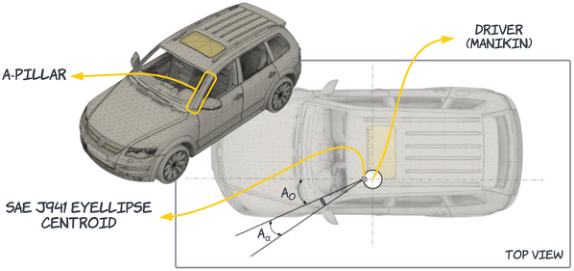
Automobile pillars are a crucial part of vehicle design due to their contribu- tion to aerodynamics, driving dynamics, and, most importantly, occupant safety by protecting drivers and passengers from harm in the event of a car accident, especially in head-on impact or rollover. As the vehicles are getting heavier and larger (e.g., sport utility vehicles (SUVs)), the ever- evolving stringent safety requirements demand engineers to design pillars with thicker cross-sections, which provide the utmost protection (Vaidya et al. 2017). Likewise, the fuel-efficiency concerns also mandate a change in pillar rake angles depending on the aerodynamics design attributes. For example, most modern sports car designs have low A-pillar rake angles to reduce the drag coefficient. Although thicker pillars and low rake angles provide better occupant protection and positively contribute to fuel effici- ency, they increasingly block the driver’s field of view (FoV), making for massive blind spots (Quigley et al. 2001) (see Figure 1). This problem has
A Proactive Ergonomics Framework to Assess A-Pillar Vision Obstruction 17
Figure 1: A-pillar obstruction angles are illustrated on a generic SUV. According to SAE J941 Recommended Practice, the obscuration angle associated with the A-pillar is denoted as Aα, and the angle of the head-turn is referred to as A0.
been a significant concern for pedestrian safety, especially in city driving, where A-pillars cause vision obstruction by not allowing drivers to assess their surroundings accurately (Sivak et al. 2007).
Modern A-pillars make roads safer for occupants. However, the same is not true for pedestrians. Reports show that the blind spots produced by the pillars continue to cause safety issues by contributing to mishaps and acci- dents, particularly those involving pedestrians (Filion, 2021). For example, 2018 was the worst year in the U.S. since the 1990s in terms of pedestrian safety. The research conducted by the Governors Highway Safety Commis- sion estimated that a total of 6,227 pedestrians were killed in motor vehicle crashes, a 4% increase from 2017 (GHSA, 2019). It is challenging to quantify how many of these accidents are solely due to A-pillar obstructions. However, many studies in the past show that body frame elements that block drivers’ forward FoV contribute to looked-but-failed-to-see type accidents (Milling- ton, 2006). For example, a study led by Matthew Reed at the University of Michigan’s Transportation Research Institute (UMTRI) showed that the geometry of the A-pillar has a substantial effect on the obstruction zones depending on the intersection and the vehicle trajectory (Sivak et al. 2007). Other studies bolster this finding by showing that many drivers fail to see the pedestrians because of the obstruction caused by the A-pillar, which produ- ces a blind spot of sufficient size to hide pedestrians who are crossing streets (Wade and Hammond, 2002).
Recent solutions to the ongoing A-pillar obstruction dilemma consist of bringing advanced safety systems to modern automobile design, inclu- ding sensory- or camera-based solutions, image projection onto pillars, radar or proximity sensor networks, and birds-eye view cameras (Beres- nev et al. 2018). Overall, these solutions provide some improvement, but they are either expensive or have limited use when it comes to in city dri- ving. Although a significant amount of research and development effort was put into automobile design, there has been little to no change in the pillar design besides structural changes, like material selection and manufacturing.
18 Demirel and Srinivasan
This paper proposes a proof-of-concept framework that integrates gene- rative design (GD) and digital human modeling (DHM) to quantify A-pillar obstruction. The approach promotes proactive ergonomics by building what- if conditions based on driving scenarios that replicate typical obscuration problems associated with city driving. Different than the other studies, this research demonstrates a rapid and rough computational approach that ena- bles engineers to evaluate design attributes such as vision obstruction during preliminary design—before physical prototyping and human subject studies are initiated.
LITERATURE REVIEW
Proactive Ergonomics with Digital Human Modeling The prototyping stage in the engineering design can be an expensive and extensive process. Additionally, testing different concept variants and making iterations on physical prototypes can be challenging, especially in the tran- sportation design industry. One of the popular design practices conducted in automotive research involves a human-in-the-loop (HIL) approach where designers explore users’ (e.g., drivers and passengers) comfort, usability, and safety-related attributes via human subject data collection on early physical mockups (Demirel et al. 2021). The limitation behind the HIL approach is often the need to have a wide variety of human subjects, observe their intera- ction with the system, and determine the best solution for the broadest range of users. Likewise, engineers can only run a limited number of human subject design experiments due to time, cost, and safety-related constraints.
In contrast, computational models in the early design stage have proven to be an alternative approach to testing and iterating designs based on digital or virtual mockups (Gawand and Demirel, 2020). Within the past decades, computational human modeling research, more commonly referred to as digi- tal human modeling (DHM), has gained popularity in the design of products and processes. DHM uses advanced visualization and analysis approaches based on computer-aided engineering (CAE) techniques and includes com- putational analysis methods such as biomechanics and ergonomics toolkits to predict safety and performance (Demirel et al. 2021). Pairing CAE and DHM early in design becomes more popular. It is a cost-effective method for testing and validating concept variants for ergonomic adequacy and che- cking assumptions about musculoskeletal concerns such as reach, comfort, and fatigue. Thus, DHM is widely recognized as an alternate solution to costly and time-consuming human subject data collection activities. The fle- xibility of running what-if scenarios via digital mockups (i.e., CAE models that represent concept products) and creating digital manikins based on anth- ropometric libraries enable engineers to inject ergonomics early in product development (Ahmed et al. 2021).
Designing with DHM is particularly important for preliminary design acti- vities, in which engineers bridge the gap between ideation and detailed design. The preliminary design phase consists of trade-offs, benchmarking, and quick decision-making regarding concept variants generated. At that stage, any robust human factors engineering (HFE) tools that enable designers to assess
A Proactive Ergonomics Framework to Assess A-Pillar Vision Obstruction 19
human-product interaction and safety can potentially reduce the number of design iterations in the long run, inject quality into the final product, and improve usability (Demirel and Duffy, 2016). Overall, understanding misma- tches and inconsistencies early in design based on computational models or prototypes can reduce the total cost and time to market in the long run (Irshad et al. 2019).
Vision Analysis via Digital Human Models Digital human modeling-based vision assessment has been used to account for and analyze transportation designs such as automobiles (e.g., family cars, trucks), military vehicles (e.g., fighter jets, personnel carriers), and mining and heavy equipment vehicles in the past. The early analysis modules were tailored toward the cockpit packaging of military vehicles. Typical studies include creating simple eye cones based on simplified CAD models to assess whether certain cockpit features are within the binocular vision limits. With the advancement of computer tools and graphical processes, analysis modules to enable engineers to identify peripheral, coverage, and obscuration zone were added to DHM software. Current DHM vision analysis modules include eye view windows, binocular vision tools, visual fields, and obstruction zones. These modules enable engineers to explore vision analysis based on CAD models and digital manikins. For example, Summerskill et al. (2016) used the DHM-based vision volumetric projection approach via the SAMMIE DHM system to assess six top-selling trucks in the U.K. The study takes into account drivers’ anthropometry and mirror designs to explore how design variables affect blind spot formations in the vision of drivers of large goods vehicles. The authors developed a novel CAD-based projection technique that allowed for the identification of key blind spots.
METHODOLOGY
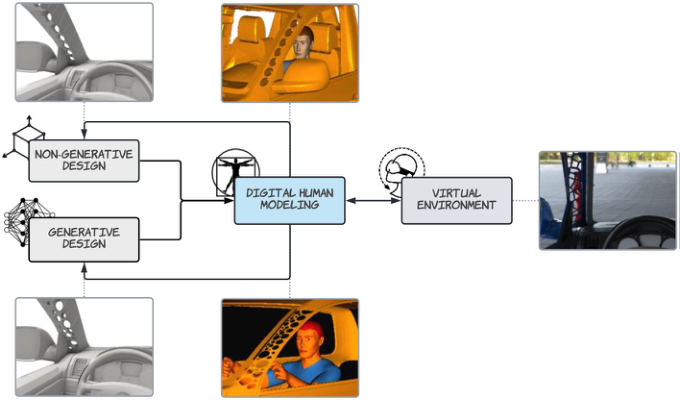
This study proposes a computational framework based on DHM research to assess visual obstruction caused by A-pillars. Unlike prior design studies focu- sing on pillar obstruction with simplified geometries on low-fidelity variants, this research factors into generative design-driven A-pillar concept variants in evaluating obstruction zones. The study aims to explore whether different pillar designs provide better visibility based on a case study that illustrates a typical traffic condition where the A-pillar blocks an object within the dri- vers’ forward FoV. We utilized the proposed framework in a generic case study to compare the concept pillar designs and conventional pillars regar- ding their performance in reducing forward vision obstructions. This paper only focuses on the design and analysis efforts up to the virtual environment (see Figure 2). Our virtual/mixed reality (VR/MR) study, which is currently in development, will enable us to investigate the dynamic and cognitive aspects of the pillar obstruction.
The DHM case study summarized in this paper replicates a typical traffic condition where a pedestrian crosses a two-lane road. In this scenario, pillar designs create blind spots that block drivers’ forward FoV, where the pede- strian is located within the A-pillar obstruction zone. The study includes three
20 Demirel and Srinivasan
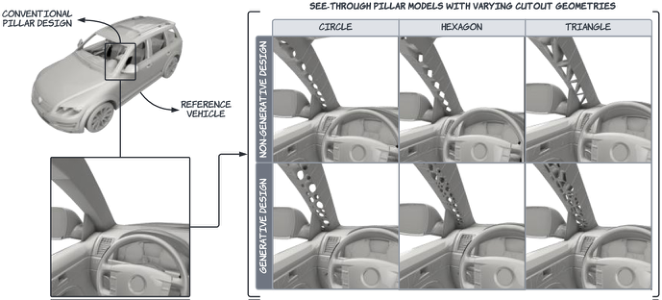
Figure 2: The computational framework proposed in this paper ties concept design and VR by using DHM as a middleware to assess how different see-through (cutout geometries) concept variants affect A-pillar vision obstruction.Figure 3: This figure shows the see-through pillar models with varying cutout geo- metries (circle, hexagon, and triangle) associated with the reference SUV model. The exact cutout sections are also implemented in sedan and pickup truck models.
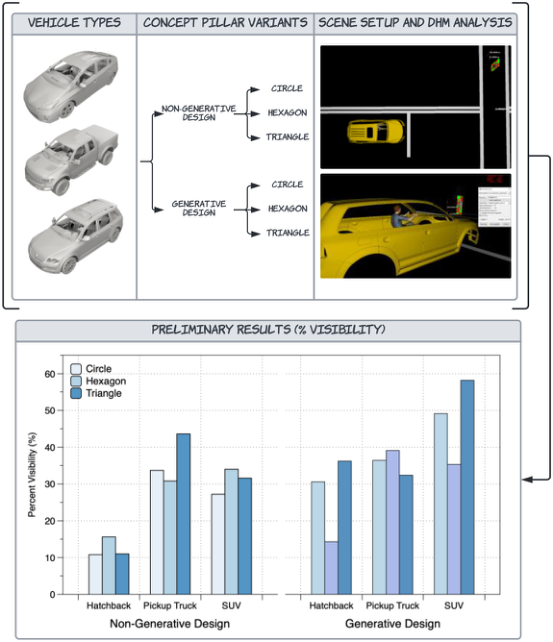
automobile models (hatchback, pickup, and SUV) that represent popular cars on U.S. roads. In addition, a total of six pillar concept variants are introdu- ced, including circle, hexagon, and triangle cutouts. These cutout geometries provide see-through zones to drivers (manikins), enabling increased forward FoV. They are split into two categories. The first three concept variants use regular circle, hexagon, and triangle cutout geometries that are distributed along the A-pillar evenly. The second three concept variants were distribu- ted based on a generative design partition (see Figure 3). A 50th percentile U.S. male manikin based on the Anthropometric Survey of the U.S. Army Personnel (ANSUR) database was used to represent the generic driver and pedestrian throughout the case study.
A Proactive Ergonomics Framework to Assess A-Pillar Vision Obstruction 21
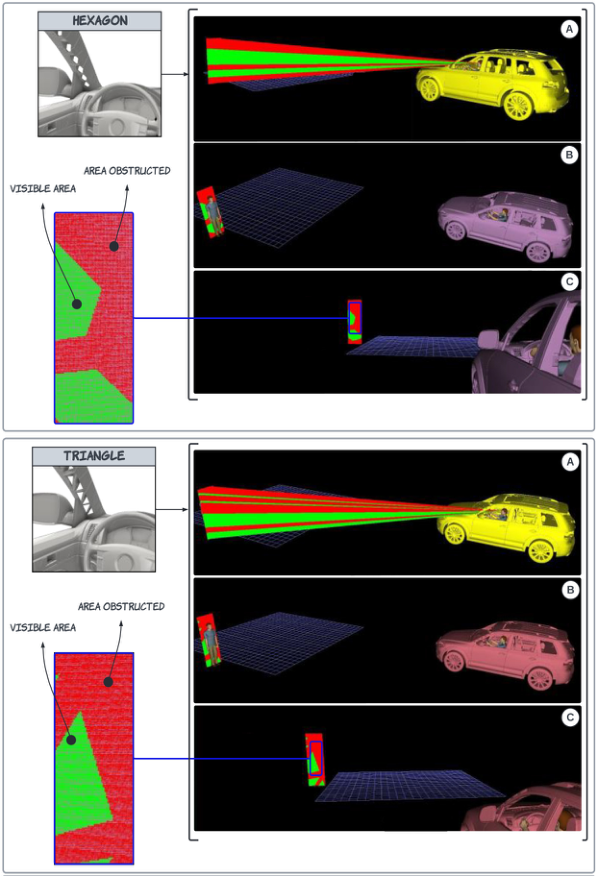
Figure 4: The highlighted green sections of the target plane represent the rays blocked by the pillar models, including hexagonal and triangular cutouts. This image illustrates (A) ray casting from the driver’s eyes to the target plane; (B) ray projections on the target plane; and (C) the visible and obstructed areas on the target plane.
RESULTS
The traffic scene setup (what-if scenario analysis) depicting a two-lane road where a pedestrian is located at the road crossing was created in Siemens Jack — a DHM software. The simulation design includes a target plane that illustrates a bounding box (180 cm in height and 55 cm in width) that roughly encompasses the 50th percentile ANSUR manikin (see Figure 4).
22 Demirel and Srinivasan
Figure 5: Preliminary data shows up to around 60% percent FoV visibility improve- ments associated with see-through pillar variants when benchmarked to conventional pillars with 0% visibility. This data shows visibility improvements based on the traffic scenario where the pillar geometry blocks a pedestrian crossing a two-lane road.
This study employed the coverage zone approach via Siemens Jack softw- are to quantify visibility percentage. The coverage zone approach uses the ray casting technique to project the area obstructed by the vehicle body frame. The rays emitted from the driver’s eyes were projected onto the target plane. Any rays that were blocked by the body frame within the driver’s FoV, inclu- ding pillar structures, become part of the areas obstructed on the target plane. Figure 4 shows an example where the rays passed through two types of pil- lar cutoff geometries, hexagonal and triangular openings, which contribute to the visible areas (not blocked) projected on the target plane. Likewise, the number of rays blocked by the protruding surfaces of the vehicle model con- tributes to the areas obstructed by the solid pillar geometry — highlighted in green color on the target plane. Overall, the percent visibility quantification in this assessment is estimated by dividing areas obstructed by the total target plane area.
From the preliminary study represented in this research, one can see that GD-driven A-pillar concept variants provide fewer obstruction levels (better
A Proactive Ergonomics Framework to Assess A-Pillar Vision Obstruction 23
forward FoV) to drivers (see Figure 5). Compared to the conventional pil- lar design, implementing see-through cutout sections provide around 60% forward FoV visibility improvement.
CONCLUSION
The case study discussed in this paper aims to demonstrate how the propo- sed framework provides a rapid and rough ergonomics strategy by enabling designers to proactively assess design attributes early in design. This preli- minary outcome motivates us to explore future DHM platforms that take advantage of the GD approach. We are currently working on developing a more comprehensive study that focuses on a broad range of drivers to include different anthropometries and seating positions. Another area where we currently develop research is integrating DHM with VR/MR techniques to mimic actual driving conditions with higher fidelity. The immersive nature of VR/MR, including the capability of representing day/night driving, wea- ther conditions, and dynamic aspects of the traffic within computer-generated environments, will enable us to have an additional level of fidelity when eva- luating concept variants early in design. There is also a need to inject cognitive aspects of the pillar obstruction into the early design framework. Our future work will investigate how perception and perceptual characteristics play a role in looked-but-failed-to-see accidents in different scenarios.
Designing with DHM is becoming a popular human-centered design approach that helps resolve ergonomics and HFE issues. Although many companies have adopted the philosophy of using DHM in product deve- lopment, methods or frameworks that injects the DHM approach early in design have not yet reached maturity. This paper provided a brief introdu- ction to evaluating concept product models that include high-fidelity features such as the GD-driven see-through pillars concept variants. By bringing human aspects early into the upfront design generation and selection process, design teams will be assured that ergonomics and HFE issues are discovered and corrective measures are planned by iterating design changes computati- onally during the preliminary design phase. The effective use of DHM-based modeling and applying what-if analysis early and often throughout the design process will contribute to overall product quality and improve safety.
ACKNOWLEDGMENT
The work presented in this manuscript is based upon work supported by the National Science Foundation (NSF) Grant No. 1918847. Any opinions, findings, conclusions, or recommendations expressed in this paper are those of the authors and do not reflect the views of the funding bodies.
REFERENCES
Ahmed, S., Irshad, L., Gawand, M.S. and Demirel, H.O. (2021). Integrating human factors early in the design process using digital human modelling and surrogate modelling. Journal of Engineering Design, 32(4), pp. 165–186.
Development of a detection road users system in vehicle A-pillar blind spots. In IOP Conference Series: Materials Science and Engineering (Vol. 386, No. 1, p. 012008). IOP Publishing. Demirel, H.O., Ahmed, S. and Duffy, V.G. (2021). Digital Human Modeling: A Review and Reappraisal of Origins, Present, and Expected Future Methods for Representing Humans Computationally. International Journal of Human– Computer Interaction, pp. 1–41. Demirel, H.O. and Duffy, V.G., 2016. Building quality into design process through
digital human modelling. International Journal of the Digital Human, 1(2), pp. 153–168. Filion, Nadine. (2021) Thicker, rollover-friendly A-pillars make for massive blind spots. Driving Website: https://driving.ca/features/feature-story/thicker-rollover- friendly-a-pillars-make-for-massive-blind-spots Gawand, M.S. and Demirel, H.O. (2020). A design framework to automate task
simulation and ergonomic analysis in digital human modeling. In International Conference on Human-Computer Interaction (pp. 50-66). Springer, Cham. GHSA, (2019). Pedestrian Traffic Fatalities by State: 2019 Prelimi- nary Data | Governors Highway Safety Association (GHSA) Website: https://www.ghsa.org/resources/Pedestrians20 Irshad, L., Ahmed, S., Demirel, O. and Tumer, I.Y., 2019. Coupling digital human modeling with early design stage human error analysis to assess ergonomic vulnerabilities. In AIAA SciTech 2019 forum (p. 2349). Millington, V.A., Cuerden, R., Hulse, S., Brightman, T. (2006). Investigation into ‘A’
pillar obscuration — a student to quantify the problem using real world data. Quigley, C., Cook, S. and Tait, R. (2001) Field of vision (A-pillar geometry)-a review of the needs of drivers. Sivak, M., Schoettle, B., Reed, M. P., & Flannagan, M. J. (2007). Body-pillar vision
obstructions and lane-change crashes. Journal of safety research, 38(5), 557–561. Summerskill, S., Marshall, R., Cook, S., Lenard, J. and Richardson, J. (2016).
The use of volumetric projections in Digital Human Modelling software for the identification of large goods vehicle blind spots. Applied ergonomics, 53, pp. 267–280. Vaidya, S., Velamakuri, N.S.C., Agarwal, P., Pilla, S. and Schmueser, D. (2017).
Design and Development of a Composite A-Pillar to Reduce Obstruction Angle in Passenger Cars. SAE International Journal of Passenger Cars-Mechanical Systems, 10(1), pp. 150–157. Wade, M.G. and Hammond, C. (2002). Forward looking blindspots: a report of a-pillar induced field-of-view obstruction and driver performance in a simulated rural environment.
LISTED IN THE AHFE DIGITAL BOOKSTORE CATALOGUE
Explore the complete digital volume
Digital Human Modeling and Applied Optimization
Read this individual research paper free through the original publisher, or explore the full digital proceedings book.
ISBN 978-1-958651-22-3
Explore this ISBN in the AHFE Bookstore ↗Listed in the July 2026 bookstore catalogue; search by ISBN to confirm current availability · Digital book purchase optional