Sukru Karali, Diane E. Gyi, Neil J. Mansfield (2021). Better Vehicle Design for All. In: Advances in Human Aspects of Transportation: Part I. AHFE Open Access, vol. 15. https://doi.org/10.54941/ahfe100635
There is a growing population of older people around the world and the population of older drivers is showing a parallel increase. According to 2012 figures of the UK Driver and Vehicle Licensing Agency there are more than 15 million people with a driving license aged over 60; more than 1 million of these are over 80. A questionnaire survey of older compared to younger drivers (n=903) and supplementary interviews with drivers aged ≥ 65 years (n=15) were conducted. The questionnaire survey covered: musculoskeletal symptoms, the vehicle seat, access to specific vehicle features, ingress/egress, driving performance and driving behavior. In terms of musculoskeletal symptoms, significantly more discomfort was reported by older drivers in the hips, thighs, buttocks and knees compared to younger drivers. 10.5% of respondents reported that they were dissatisfied with adjusting specific seat features, namely the head rest height, head rest distance from the head and setting the seat belt height. Females reported more difficulty than males. Older males and females (16.8%) reported more difficulties with parallel parking and driving on a foggy day than younger (12.2%) drivers (p<0.01). Compared to younger drivers, older drivers also reported being less distracted when using navigation systems (25.5% and 19.5% respectively).
Developments in vehicle design and performance are constantly improving. Contemporary vehicles are now equipped with many characteristics formerly confined to the luxury market: for example, technologies to assist the user with specific driving tasks such as intelligent automated parking systems (Bradley et al., 2008). There is a growing population of older people around the world and the population of older drivers is showing a similar increase. According to 2012 UK Government figures there are more than 15 million people with a driving license aged over 60; more than 1 million of these are over 80 in the UK (IAM, 2012). Driving is an important activity for many older people in order to maintain their daily activities and keep their independence such as shopping, attending the doctors’ surgery, visiting friends etc. (Musselwhite and Haddad, 2008).
Although automotive manufacturers have focused some of their research on older users many cars also do not meet the needs of people with age-related disabilities (Herriotts, 2005). Vehicle manufacturers claim to provide a positive driving experience, but do they really meet the requirements of users of all ages? Older drivers want to drive vehicles that demonstrate they are active, but the driving package of most cars is designed to meet the needs of 95% of the non-disabled male driver population (Nicolle, 1995). Older drivers are also not keen on driving cars that specifically designed for them e.g. cars with swivel seats (Nicolle, 1995).
METHODS
The aim of the questionnaire survey reported in this paper was to build on the literature and further understand the experiences of car drivers of different ages and identify some of the key challenges for car design. The questionnaire was available as both paper and online versions; focus areas were selected based on the findings in the literature and included: musculoskeletal symptoms, driving exposure, the vehicle seat, access to in-vehicle controls/features, ingress/egress, driving performance and driving behaviour.
Many factors were considered during the design and development of the survey, for example, questions had to be specific, short and easy to read/understand for older people. Questions from a survey conducted by Sang et al. (2009) were included in this survey with slight modifications. Where appropriate, Likert scales were incorporated with specific statements and tick boxes.
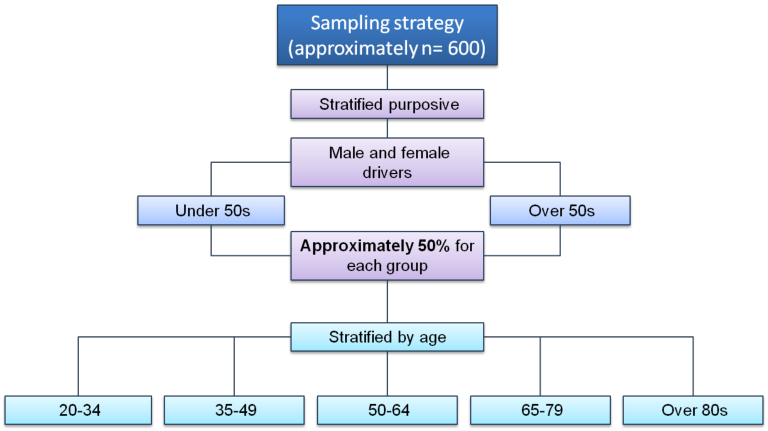
A stratified sampling technique was used, whereby the population is divided into various subgroups/strata. Once the strata are determined, a simple random sample was taken from each stratum individually. For the questionnaire survey, the sample was arranged in a number of sub-groups focusing on age and gender (Figure 1). According to Owen (1996), there is a link between sample size and the accuracy of the collected data, e.g. if the sample size is large, then the data is likely to be more accurate. This author also points out that sample size should focus on a reasonable number, taking time and budget into account. Therefore the proposed sample size for the questionnaire survey was 600; this was thought to be a reasonable number to gain a robust data set for statistical analysis.
Figure 1: Sampling strategy (Stratified sampling)
Major organisations within the UK were consulted for distribution of the questionnaire to the target audience. These were well known institutes, voluntary action groups, charity and motoring organisations. Agreement was obtained for the distribution of questionnaire (data collection from e-mails, interviews and personal contacts). For the on-line survey several techniques were used to increase the number of responses such as snowballing techniques.
Supplementary interviews (n=15) were conducted with a further sample of drivers aged 65 years and over by using the questionnaire in a structured interview format. The sample was identified using purposive sampling techniques and participants only took part in the interview part of the study. Interviews were aimed at specifically obtaining qualitative data and to gain a more in-depth understanding of any issues with the driving experiences of older drivers.
Data were analysed using SPSS and Excel, firstly to gain a general understanding focusing on the whole sample, and then to explore differences between age and gender. Statistical methods such as Chi-squared test, ANOVA, Mann- Whitney-U test and log linear analysis were used for specific data sets as appropriate.
RESULTS
Initially, the target sample size for the survey was 600, however the survey achieved 50% more (n=903). As a result, for the purpose of analysis younger drivers were re-categorised as <65 and older drivers considered as ≥65. Of the 903 people that took part; 53.5% were younger drivers (n= 483, <65) and 46.5% were older drivers (n= 420, ≥65). Drivers over 80 years represented 7.1% (n= 64) of the whole sample. 59% of participants were male and 41% were female. The age and gender distribution of the participants is shown in Table 1.
Age category of participants Age Male Female Total n % n % n %
Younger (<65 years)
20-34
70
7.8
66
7.3
136
15.1
53.5%
35-49
62
6.9
53
5.9
115
12.7
50-64
144
15.9
88
9.7
232
25.7
Older (≥65 years)
216 23.9 140 15.5 356
39.4
46.5% 65-79 ≥ 80
64
7.1 43 4.8 21 2.3
Total 535 59.2 368 40.8 903 100
Table 1: Age and gender distribution (whole sample, n=903)
Table available in the original PDF paper.
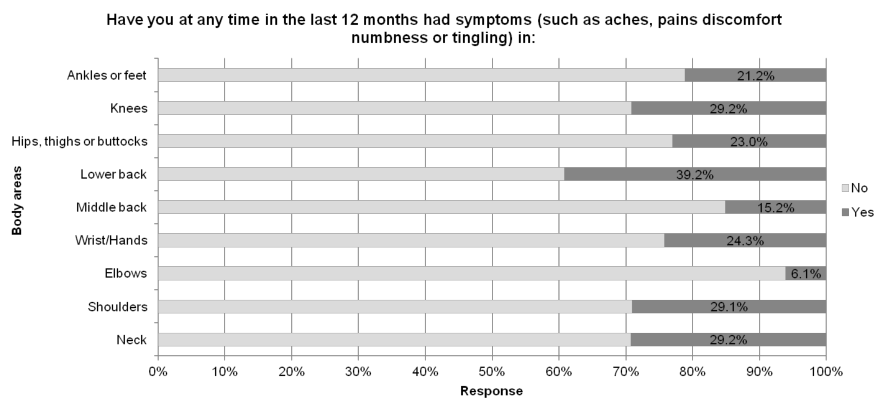
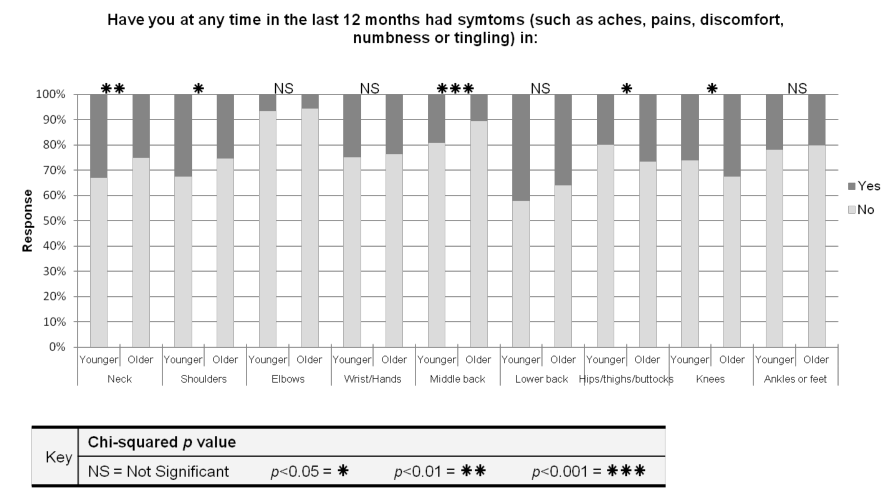
Musculoskeletal symptoms: high levels of musculoskeletal symptoms were reported (Figure 2) in the lower back (39.2%), knees (29.2%), neck (29.2%), and shoulders (29.1%). In general, younger participants reported higher levels of musculoskeletal symptoms in the neck (p<0.01), shoulders (p<0.05) and middle back (p<0.001) compared to older drivers for 12 month period prevalence (Figure 3). These symptoms are likely to be related to their level of activity (e.g. work) compared to older participants. However, significantly more discomfort was reported by older individuals in the hips/thighs/buttocks and knees (p<0.05). Compared to older drivers, younger drivers reported their symptoms were related to their work, particularly for the neck (p<0.001), shoulders (p<0.001), wrist/hands (p<0.001), middle back (0.001), lower back (0.001), hips/thighs/buttocks (p<0.01) and ankles or feet (p<0.01). This shows the level of activity of younger drivers was greater than for older drivers. These results may be related to the driving exposure.
Younger and older drivers were compared for their annual mileage and weekly driving hours and significant differences were found. Compared to younger drivers, older drivers reported lower annual mileage (p<0.001) and weekly driving hours (p<0.001).
Figure 2: 12 Month period prevalence (whole sample, n=903)Figure 3: 12 month period prevalence (older vs. younger drivers, n=903)
In-vehicle controls: in general participants found it easy to operate most in-vehicle controls. Difficulties with pressing the horn were the most frequently reported problem with 7.5% participants finding it difficult or very difficult. Age and gender was also compared for ‘pressing the horn’. No significance was found with age but there were however differences in gender; 10.1% of females compared to 5.7% of males found it difficult pressing the horn (p<0.01). Supplementary interviews indicate that in emergency situations older drivers cannot always press the horn instantly; this was mainly due to the small size of the horn. The angle of the steering wheel and the location of the controls also seem to have an effect, for example, if the horn button is located on both sides of the steering wheel the driver cannot locate it as they are focusing on the road; this causes delay with finding the horn button.
Adjusting the seat features: 10.5% of respondents reported that they were dissatisfied with adjusting specific seat features, namely the head rest height, head rest distance from the head and setting the seat belt height. Females reported more difficulty than males with adjusting the head rest height (p<0.001). No age differences were found with adjusting the seat features. Preliminary interviews found that, females (specifically older females) reported more difficulty than males with adjusting seat features, namely the head rest height/distance and seat belt height, reasons given for this difficulty may include reaching, accessing and operating the controls while seated.
Getting in/out of the vehicle: 9.7% of participants reported being uncomfortable getting out of their vehicle and 6.9% with getting into their vehicle. No age and gender differences were found. Participants were also asked a question based on fall/trip incidents during entering/exiting the vehicles: 94.1% reported never experiencing a fall/trip accident. However, this equates to 1 in 17 of the sample having experienced a fall/trip. Suprisingly, 8.1% of younger drivers reported fall incidents compared to 3.3.% of older drivers (p<0.01). With gender, 7.9% of females reported experiencing a fall incident compared to 4.5% of males (p<0.05).
Driving behaviour: half of all respondents (46.7%) reported that other drivers’ lights restricted their vision when driving at night; more females (53.3%) than males (42.5%) reported this (p<0.001; Table 2). Older drivers (31.7%) reported more difficulties than younger drivers (18.4%) with turning their head and body around during reversing (p<0.001). Similarly, older drivers reported their reactions were slower than they used to be (e.g. braking in emergency situations) compared to younger drivers. Compared to younger drivers, older drivers reported being less distracted operating navigation systems but no significance was found (25.5% and 19.9% respectively). Reasons for this may include that older drivers are more experienced, they know the routes, and they tend to travel shorter distances; therefore they may be less likely to use these technologies compared to younger drivers. The most commonly used entertainment system is the radio among older drivers.
Other drivers’ lights restrict my vision when driving at night 46.7 19.0 34.2 I have difficulty turning my hand and body around when reversing 24.5 14.2 61.4
23.7 38.0 38.3
Operating entertainment systems distract me from driving (e.g. playing radio)
22.9 29.5 47.6
Operating navigation systems distract me from driving (e.g. looking at sat-navigation)
22.8 20.3 56.9
My reactions are slower than they used to be (e.g. braking in an emergency situation)
Table 2: Selected responses for driving behaviour section of questionnaire (whole sample, n=903)
Table available in the original PDF paper.
Driving performance: Interestingly, 25.3% of older drivers compared with 16.8% of younger drivers reported difficulty driving on a foggy day than (p<0.01). Similarly, with parallel parking 16.9% of older drivers compared to 12.3% of younger drivers reported difficulty (p<0.01). With regard to gender, females reported more difficulty than males with parallel parking (p<0.001). The supplementary interviews indicated that older drivers are less likely to drive at night. Also, 29.3% of females compared with 14.8% of males reported difficulty (p<0.001). Similarly, with parallel parking 16.9% of older drivers reported difficulty compared with 12.3% of younger drivers (p<0.01). Considering gender, 20.1% of females reported difficulty compared with 10.5% of males (p<0.001) for parallel parking.
Chi-squared analysis was carried out on both age and gender for driving on a foggy day and it showed significance: more difficulty reported by older drivers (p<0.01) and females (p<0.01). This then motivated the question: is the reported difficulty more common for older females? Further analysis was necessary in order to see if this result was common for older females in the sample. This research question was investigated by combining the three categories variable: difficult (answer option), age and gender. It was found that as age increases, difficulties driving on a foggy day increases for both males and females, with females reporting slightly more difficulty. The results can be Human Aspects of Transportation I (2021) interpreted that older drivers are experiencing more difficulty than younger ones; it is not specifically older females that have difficulty.
DISCUSSION
Interestingly, it has been identified that most of the issues already known and reported in the literature over the last 20 years still exist today and have not been eradicated through improved design. Many issues are common for both older and younger drivers.
Based on the seat features and their adjustability, the top four features that the whole sample were dissatisfied with were: setting the belt height; head rest (distance from the head); head rest (height) and lumbar support adjustments. The analysis of the results showed significant differences by gender but not with age. The location and the reach distance of these adjustments could have an impact on this response and it is a design related issue which requires more focus.
The findings indicate that in general most participants found it easy to operate most in-vehicle controls. The greatest difficulty was reported with pressing the horn by 7.5% of the whole sample; no age and gender differences were found. However the issue related to the horn was not identified in the literature. Depending on the vehicle make/model it is possible that the horn controls are different sizes, forms and are located in different positions on or near the steering wheel. But these may need further exploration in order to determine the requirement for ideal location, size and visibility of these controls in order to prevent the difficulties reported and which may be experienced in the future.
Data based on the driving performance showed similarities with the literature, such as difficulty with driving in bad weather, e.g. foggy day and driving at night (Musselwhite and Haddad, 2008). This was observed for the whole sample, particularly older people. Smith et al. (1993) reported that older drivers avoid driving in bad weather and at night time. Also, the supplementary interviews from the current study found that older drivers were less likely to drive at night. As with the current study, parking and reversing the vehicle were also reported as one of the most difficult tasks to perform by older drivers compared to younger (Bradley et al., 2008). Studies conducted by Bradley et al. (2008) and by Musselwhite and Haddad (2008) indicate that older drivers experience difficulty keeping a constant speed, but the findings of the current study showed that only 1.8% of the whole sample reported this.
Another important finding of this study was related to driving behaviour, for example nearly half of the total sample reported other drivers’ lights restrict their vision when driving at night. This is a common issue for drivers of all ages. 25% of whole sample, particularly older drivers reported difficulty turning their head and body around when reversing; this was also observed by Isler et al. (1997) in a study focused on the age related effects of restricted head movements on the useful field of view of older drivers. This indicates that more data is needed to focus on dynamic and functional anthropometric measurements in vehicle design to accommodate specific needs of older drivers, such as postures for reversing, (Gyi, 2012). Similarly, 21% of older drivers reported their reactions were slower than they used to be compared to 11% of younger. This was also identified in the literature review by Middleton et al., (2005) and by Musselwhite and Haddad (2008).
Regarding the navigation and entertainment systems, older drivers reported having less distraction when using these systems. Reasons for this may include that older drivers are more experienced and they know the routes, they also travel short distances and are less likely to use these technologies. This can also relate to their limited experience and interactions with new technologies, Bhise (2012).
CONCLUSIONS
This study has provided data to understand the key issues experienced by drivers of all ages. Some are common for all ages, and some are age related. The future direction of this research will focus on understanding how design of the vehicle cab impacts on posture, comfort, health and wellbeing in older drivers.
ACKNOWLEDGEMENTS
We would like to acknowledge the EPSRC DTG Fund and Nissan Motor Co. Ltd for funding this research.
REFERENCES
Bhise, V. D. (2012). “Ergonomics in the automotive design process”. Boca Raton, FL: CRC/Taylor & Francis. Bradley, M., Keith, S., Kolar, I., Wicks, C., Goodwin, R. (2008), What do older drivers want from new technologies? SPARC Website: http://www.sparc.ac.uk/media/downloads/executivesummaries/exec_summary_bradley.pdf Gyi, D. E. (2012). “Driving posture and healthy design”, in: Automotive ergonomics: Driver-vehicle interaction, N. Gkikas
(Ed.). pp. 123-131. Herriotts, P. (2005). “Identification of vehicle design requirements for older drivers”. Applied Ergonomics, Volume 36 No. 3. IAM. (2012), More than a million drivers now aged over 80. Institute of Advanced Motorists Website: http://www.iam.org.uk/media-and-research/media-centre/news-archive/983-more-than-a-million-drivers-now-aged-over-80 Isler, R.B., Parsonson, B.S., Hansson, G.J. (1997). “Age related effects of restricted head movements on the useful field of view of
drivers”. Accident analysis and prevention, Volume 29 No. 6. Middleton, H., Westwood, D., Robson, J. and Kok, D. (2005), “Assessment and decision criteria for driving competence in the elderly”, Traffic & Transport Psychology; Elsevier. Nicolle, C. (1995). “Design Issues for Older Drivers”. Ergonomics in Design: The Quarterly of Human Factors
Applications, Volume 3 No.3. Musselwhite, C., Haddad, H. (2008), Prolonging safe behaviour through technology: attitudes of older drivers. SPARC Website: http://www.sparc.ac.uk/media/downloads/executivesummaries/exec_summary_musselwhite.pdf Owen, A. (1996). “Planning a sample survey”, in: Research skills for students, A. Owen, A. Rothwell, T. O'Sullivan, C.
Saunders, J. Rice (Ed.). pp. 27-65. Smith, D.B.D., Meshkati, N. and Robertson, M.M. (1993). “The older driver and passenger”, in: Automotive ergonomics, B.
Peacock and W. Karwowski (Ed.). pp. 453-471. SANG, K., GYI, D. and HASLAM, C. (2009). “Musculoskeletal symptoms in pharmaceutical sales representatives”.
Occupational Medicine, Volume 60 No.2.
LISTED IN THE AHFE DIGITAL BOOKSTORE CATALOGUE
Explore the complete digital volume
Advances in Human Aspects of Transportation: Part I
Read this individual research paper free through the original publisher, or explore the full digital proceedings book.
ISBN 978-1-4951-2097-8
Explore this ISBN in the AHFE Bookstore ↗Listed in the July 2026 bookstore catalogue; search by ISBN to confirm current availability · Digital book purchase optional