Clara Fischer, Patrick Rupprecht, Sebastian Schlund (2023). Different approaches of conducting ergonomic assessment utilizing digital human models and motion capture in industrial site assembly. In: Intelligent Human Systems Integration (IHSI 2023): Integrating People and Intelligent Systems. AHFE Open Access, vol. 69, pp. 348–358. https://doi.org/10.54941/ahfe1002854
The further development of Industry 4.0 to 5.0 focuses even more on human-centred and sustainable production. The ergonomic factor plays a major role, as it is crucial for the well-being and productivity of workers and should already be considered in production planning. One of the most common ergonomic analysis methods is the “Ergonomic As-sessment Worksheet (EAWS)”, which is based on a paper & paper method for assessing human working posture. Currently, there are various approaches to automate this evalua-tion process with the help of digital human models or motion capture systems. All of these methods have their pros and cons; however, companies are faced with the problem of finding the best suited method for their processes. This paper compares three different methods to conduct an EAWS study for industrial site assembly in terms of methodology, effort, and efficiency. For this purpose, an evaluation of the physical movement with the original manual paper and pencil method was created and a generic movement with a digital human model was implemented and automatically evaluated. Furthermore, using motion capture, the automatic recording of physical movement data was carried out, which was computer-assisted evaluated using digital human models. To exclude software-specific inconsistencies, we used two different process simulation tools. As a final result, this paper shows a comparison of different implementation possibilities of the EAWS anal-yses and indicates the effort and efficiency for their use in industry. Furthermore, this initial analysis provides an opportunity for further research on digital human models and motion capture.
According to the Austrian Workers Compensation Board (AUVA), in 2021, more than 6.700 work-related diseases were registered in Austria (AUVA, 2022). The leading cause of long-term work disabilities in Europe is MDS, musculoskeletal disorders, which counted 53% of work-related diseases in Europe 2015 (Bevan, 2015). As humans still have a key role in production and assembly in times of Industry 5.0, the risk of MDS should be elimina- ted (Lotter and Wiendahl, 2012; Schlick et al. 2018; Reinhart, 2017; Breque et al. 2021). For that case, humans and machines should complement each other in a human-centred, cyber-physical world of work (Romero et al. 2016;
Different Approaches of Conducting Ergonomic Assessment 349
Romero et al. 2020). Therefore, it is important to support people with sui- table assistance systems (Schlund and Baaij, 2018) and ensure individual, human-centred workplaces. Furthermore, human-centred design requires sufficient knowledge about people, their psychology and behaviour, as well as the artefacts to be designed (DIN EN ISO 9241-210:2019; Schlund et al. 2018; Rupprecht and Schlund, 2021). This also applies to the prevention of health problems. To prevent MDS or other diseases and risks, an ergonomic risk assessment can be done to evaluate human postures and movements in the work process.
For ergonomic workplace evaluation, suitable methods, such as Auto- motive Assembly Worksheet (AAWS), Ergonomic Assessment Worksheet (EAWS), Rapid Upper Limb Assessment (RULA), Lumar Motion Monitor (LMM) and the method from the National Institute for Occupational Safety & Health (NIOSH), have been developed in recent decades and are used in industry. A comprehensive and often used one is EAWS, which is especially standard in the automotive industry.
If companies want to perform an ergonomic risk assessment, they must first identify the appropriate analysis method for their workplace, e.g. EAWS, and then decide how to carry out this method. This can be done manually, with paper and pencil, or automated. Digital planning software, inclu- ding digital humans, can be used for risk estimation of generic movements (Fritsche et al. 2020). Motion capture methods can be used to assess the movements of the actual worker. Some use wearable inertial sensors (IMU), whose recorded postures can also be applied to digital humans (Caputo et al. 2018,1). Ciccarelli et al., 2022 combined IMUs with a camera vision system for gesture recognition. Currently, there is a lot of ongoing research on marker-less, vision-based pose estimation (Kostolani et al. 2022), which is expected to take less time, as the setup of the markers, IMUs, is avoided.
It turns out that there are various ergonomic evaluation methods. How- ever, there is a lack of overview of the possibilities and the effort involved, as well as the lack of availability of the software and the digital workplace data. On the example of EAWS, we therefore present a comparison of three assessment ways:
Manual evaluation of physical movement, with paper and pencil method
Automated evaluation of the generic movement of a digital human model
Motion capture of physical movement, automatic evaluation using a digital human model This paper is structured as follows: First, the EAWS evaluation is explained in Sect. 2. Sect. 3 describes the use case, the evaluations carried out, and its results. In Sect. 4 we compare and analyse the methods and conclude our paper in Sect. 5.
EAWS – ERGONOMIC ASSESSMENT WOKRSHEET The Ergonomic Assessment Worksheet, short EAWS, which in literature is also often named European Assembly Worksheet (Schraub et al. 2013), is an ergonomic risk assessment method, to evaluate work postures and
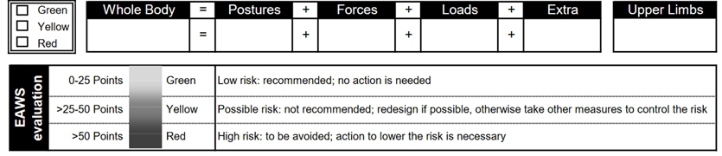
Figure 1: Ergonomic Assessment Worksheet EAWS (Schraub et al. 2013).
movements. It consists of four main sections for the evaluation of the whole body: Postures, Forces, Loads and Extra (Figure 1). In the group “Postures”, different executions of standing and walking, sitting, kneeling or crouching, and lying or climbing are presented, and points are assigned according to ergonomics of the posture and duration per cycle time. The group “Forces”, presents action forces per minute, such as finger forces, and the third one, “Loads”, counts external load for material handling, of two kilograms or more for women, and three or more for men. “Extra” points will be coun- ted if, for example, unergonomic joint positions of the wrist are performed during the task. The sum of these categories delivers the final score of the “Whole Body”. Furthermore, an additional score can be calculated for the “Upper Limbs”, affected by repetitive tasks. The ergonomic risk of the ove- rall task can be evaluated by these two scores, “Whole Body” and “Upper Limbs”, and is rated in a three-zone traffic light system (Schraub et al. 2013).
Literature shows that EAWS is well-established in industry (Spitzhirn et al. 2019). Compared to other methods, it considers biomechanical loads of the full body and is based on the well-established MTM process language (Caputo et al. 2018,2). For these reasons, we have chosen EAWS for our investigation.
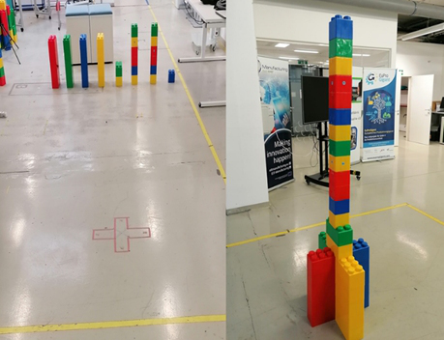
EAWS ANALYSIS OF INDUSTRIAL SITE ASSEMBLY USE CASE According to (Rupprecht et al. 2022), large-scale play blocks represent a good opportunity to demonstrate and analyse industrial site assembly use cases. Therefore, a 5×2.5 m workstation was created in the TU Wien Pilot Factory (Figure 2). The process consists of 35 single parts, recommissioned to eight sub-assembly parts (designated as part P1 to P8) of a maximum weight of one kg. The objects are placed in sequence in the provision area, at the mate- rial provisioning areas behind the working space (left side of Figure 2). The worker has to pick them accordingly to build a tower in the front area of the workstation (right side of Figure 2).
The general steps can be divided into eight similar tasks (i = 1,..,8), one assigned to each part, including four subtasks each:
Ti.1: Go to Pi
Ti2: Pick Pi
Ti.3: Localise assembly position
Ti.4: Place Pi
Different Approaches of Conducting Ergonomic Assessment 351
Figure 2: Demonstrated industrial site assembly use case for EAWS analysis. Initial set up on the left, final assembly on the right (TU Wien).
As this scenario involves whole-body movements, the EAWS method is a well-suited ergonomic risk assessment.
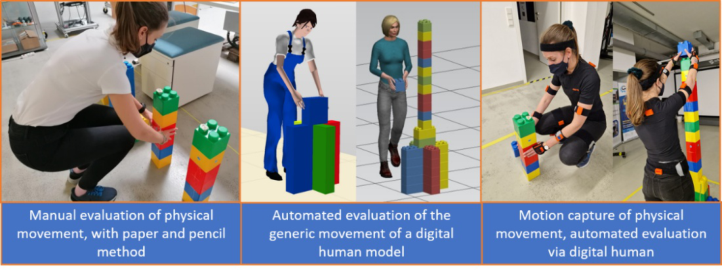
EVALUATION METHODS USED The EAWS analysis was carried out with three different methods: Manual evaluation of the physical movement with paper and pencil method, automa- ted evaluation of the generic movement of a digital human and automated evaluation of the captured physical movement, which was applied to the digital human (Figure 3).
For the manual paper and pencil evaluation, a video stream of the physical movement was recorded. By visual inspection, postures and their time dura- tion were identified. Based on the video a cycle time of 95 seconds was set for all evaluations.
To exclude software-specific inconsistencies, we used the two digital manu- facturing simulation tools, ema imk Work designer1 (ema WD), version 2.0.3.1, and Siemens Tecnomatix Process Simulate2 (Siemens PS), version 17.0. Both have digital human models included, Jack/Jill and ema human model (Bullinger-Hoffmann and Mühlstedt, 2016). Male and female wor- kers with various demographic and anthropometric data can be created and used for different ergonomic analyses. For this purpose, in Siemens PS, human operations are built out of predefined tasks, such as “go”, “get” or “put”, to simulate the process steps. Furthermore, the user can define specific postures for each task, where each body angle and the position of hands can be adju- sted to replicate the movement very precisely. The concept of ema WD is quite similar; a task line can be built out of different predefined work behavior for individual tasks. There are possible transactions for body movements, such as walking, object handling, picking, place, and so on. We have created generic 1https://imk-ema.com/ema-workdesigner.html 2https://www.plm.automation.siemens.com/global/en/products/tecnomatix/
Figure 3: Evaluation methods used for EAWS analysis (TU Wien).
movements of the presented use case in both tools, for a female digital human model with the corresponding body dimensions of the physical operator (see second image of Figure 3, ema WD on the left and Siemens PS on the right).
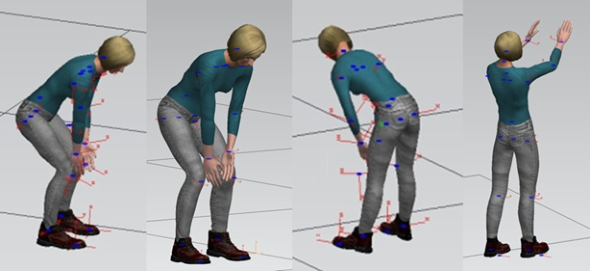
In the motion capture method, we recorded the physical human movement using motion capture and transferred it to a digital human for computer- assisted automatic ergonomic evaluation. As mentioned above, we used a motion capture suit, consisting of 16 IMUs, from XSens3, software version 2019.0.0. All sensors have to be placed correspondingly on the human body: on the head, shoulders, pelvis, upper arms, lower arms, hands, upper legs, lower legs, and in the shoes. Before recording the motion, the motion suit has to be calibrated by walking straight forward in one direction and back, and stranding in a natural pose. After a successful calibration, the task to be evaluated can be recorded (right side of Figure 3). To transfer this motion to the digital humans of ema WD and Siemens PS, the recorded motion file has to be converted into corresponding formats. Ema WD furthermore requires an excel file, which transfers the body model of XSens, with the correspon- ding sensor positions, to the digital human. By uploading this and the motion capture file, a task line of the recorded movement can be created, simulated, and evaluated in terms of ergonomic risk assessment and times. In Siemens PS, the user first has to match the XSens trackers with the joints of the digital human model. Hereby, the position of each tracker is identified as a frame, with coordinates in the simulation space. These frames are represented as small red coordinate systems (shown in Figure 4). After this step, the recor- ded motion can be uploaded in the corresponding format, which applies as a movement of blue marker points in the software (see the blue dots in Figure 4). These marker points have to be matched with the tracker frames, to let the digital human execute the recorded task and automatically calcu- late the EAWS score of the simulation. Please note that we only simulated the recorded motion with the digital human, but not the manipulation of the parts (Figure 4). In our case, we consider this assessment as sufficient, as the weight of the parts is below one kilogram, and has no influence on the ergonomic scores.
3https://www.xsens.com/products
Different Approaches of Conducting Ergonomic Assessment 353
Figure 4: Motion capture data applied on a digital human model in Siemens PS (TU Wien).
RESULTS OF THE EAWS ANALYSIS When applying the EAWS analysis to the use case, postures that occur in the work process, such as bent forward, result in points in the group of postures. Since the weight of the components is less than 2 kg, no loads are manipu- lated and the positions for extra points do not apply either. Furthermore, no repetitive activities are performed during the task, and the score for the upper limbs is zero as well. It can be seen that the sub score of postures results in the overall EAWS score.
All three analysis calculated points for the postures of walking and strongly bent forward. As mentioned above, a decisive factor for the scores is the iden- tified duration of posture per cycle time. Some analysis may have identified additional postures, which do not result in a score. This can be explained on the example of the manual evaluation, where the following postures were identified: Walking, bend forward (20
– 60
), placing P5, strongly bent forward (> 60
), placing P1 – P4 and picking up all parts, working overh- ead, mounting P8 (see Figure 3 on the right). As the duration per cycle time for bend forward and working over-head is too small, these postures are neglected in the total EAWS score.
The total EAWS scores of all analyzes are presented in the green ergonomic region, but the values vary a bit due to different sub scores for strongly bent forward and walking (Table 1). A strongly bent forward posture is considered to be ergonomically negative, and is identified when the upper body is bent forward over 60
. As no other postures count in the total score, the rest of the process time is calculated for walking.
The estimated amount of work, indicated as approximate time effort in the table, is based on the performance of experts, who had experience with both, EAWS and the programs used. It can be seen, that the motion capture evaluation was the fasted, and the generic digital human evaluation the most time-consuming. Although, if changes in the workstation or movements are required, the generic digital human model evaluation is the most efficient one, as the simulation can easily be adapted and no new recordings have to be done, compared to the others one.
Table 1. Overview of the results of conducted EAWS analysis.
Table available in the original PDF paper.
Generic Digital Human
Evaluation Method
Manual Paper & Model Evaluation
Motion Capture and Digital Human Model
Pencil Siemens PS Ema WD Siemens PS Ema WD EAWS Score 17.5 11.5 12.5 4.5 9 Walking 1.5 (64 sec.)
2 (84.6 sec.)
2 (83 sec.)
2 (91.4 sec.)
16 (18 sec.)
2.5 (3.6 sec.)
7 (8.5 sec.)
2 (86.5 sec.) Strongly bent forward
9.2 (10.4 sec.)
10.3 (12 sec.)
45 min 60 min 30 min
Approx. time effort
DISCUSSION AND ANALYSIS OF RESULTS We received the highest score for the paper and pencil method (Table 1). This is mainly due to the points for strongly bent forward postures (> 60 degrees). In comparison to the simulation, the corresponding body angle of this posture cannot be measured automatically. The time to identify strongly bent forward manually might be a bit overrated, as the software evaluated less time. The difference in the score between Siemens PS and ema WD is due to the use of two different human models, whose kinematic movement varies, caused by different structures and compositions (Bullinger-Hoffmann and Mühlstedt, 2016). However, the total difference between the final scores of both pro- grams is only one point, which shows a very good reliability of both tools. The low rating for strongly bend forward identified in the evaluations of the motion capture method is due to the limited number of sensors, we used 16 IMUs. According to the results, more sensors, especially for the torso, are required. A low duration of identifying strongly bent forward results in a higher score for walking, in the motion capture method. The reason for this is that the simulation tools calculate the time during which static postu- res were detected as walking. Clock balancing, between the simulated cycle time and the set value of 95 seconds, is also counted as walking. We haven’t applied clock balancing for the paper and pencil method, since we have iden- tified further postures which are, due to short duration, not included in the evaluation.
For the three different evaluation methods conducted, we have identified some general pros and cons (see Table 2). The manual paper and pencil method does not require any software costs and enables an on-site evalu- ation, directly at the workstation, or by analysing a video stream of the recorded movements. This gives the opportunity to directly implement ergo- nomic adjustments in the workstation. Furthermore, an on-site evaluation allows involving the worker in the ergonomic adjustments. However, even if the evaluation with the paper and pencil method seems very intuitive and self-explaining, please note that knowledge and practice are required to cre- ate a correct and efficient analysis. We noticed this fact when our students did a practical exercise with the paper sheet. Beforehand, they took a theoretical
Different Approaches of Conducting Ergonomic Assessment 355
Table 2. Pros and cons of evaluation methods used.
Table available in the original PDF paper.
Evaluation Pros Cons Manual Paper & Pencil -) No software costs -) On-site evaluation -) Ergonomic adjustments can directly implement in work station -) Worker can be involved in ergonomic adjustments
-) Requires prior knowledge and practice -) Body angle of the postures cannot be measured automatically -) Difficulty of identifying body concrete postures evaluation might be over/undere- stimated -) Adjustments require new evaluations -) No digital data collection or transfer, non-sustainable -) Could cause privacy issues
Generic digital human model evaluation
-) Software costs -) Software knowledge -) Workstation data required (cad files, dimensions, etc.). -) Difficult to involve worker
-) No privacy issues -) Quick and easy adaption of workstation, worker, postures, etc. -) Sustainable digital data collection and further automated recalculation Motion capture and digital human model -) Automated evaluation of real physical movements and motion paths -) Sustainable data collection -) Time efficient for a one-time evaluation
-) Requires additional time for setup and calibration, data conversion, and imple- mentation -) Workstation adaption requires new motion capture -) Could cause privacy issues -) Additional software costs -) Recognised postures related to the numbers of IMU sensors used
lecture on ergonomics, including EAWS analysis, however, the exercise sho- wed very different results and many uncertainties when filling out the sheet. Furthermore, since the body angles of the postures cannot be measured auto- matically, it can be very difficult to identify the concrete posture, for example, distinguish between bent forward (20
– 60
) and strongly bent forward (> 60 degrees). This can lead to an over or underestimation of the evaluation. Addi- tionally, it has to be mentioned, that observing and evaluating the worker may cause privacy issues, as the height of the human, as well as the results, are documented on paper. Here we also like to mention, that the original paper and pencil method does not provide digital data collection or transfer, which is non-sustainable. Finally, it can be said, that the paper method is good for rough quick estimation, as long as it is done by experts. However, the exact results always depend on the personal assessment of the person doing the analysis.
Using a generic movement of the digital human model could solve the men- tioned privacy issues, but it is difficult to involve the worker in the evaluation.
Though, a big advantage of the generic digital human model evaluation is the possibility to quickly and easily adapt the virtual workstation, wor- ker, postures, etc., and revaluate. Individual postures of the digital human model can also be adapted and the body joint angle can easily be changed, to re-produce the individual movement as accurately as possible. Here we identified, that building the movements of the digital human model with the predefined postures represents the worst-case scenario, which should always be considered in ergonomic risk assessment. The collection of digital data and automated further recalculation of the generic evaluation of digital human models are considered very sustainable. However, a lot of workstation data such as cad files and dimensions of the objects and overall workplace is requi- red, which may not be provided for each workstation. Additionally, further software costs and knowledge are required.
Based on the approximate time effort (Table 1), the motion capture method appears to be the most efficient. However, as mentioned above, in our case, it seemed that the number of sensors used is too small, which can result in a wrong or too low EAWS score. This revealed to us the general disadvantage of the motion capture method, that the recognised postures, which in further consequence result in the EAWS score, are related to the numbers of IMU sensors used. Besides that, it has to be mentioned that the motion capture method required additional time for set up, calibration, data conversion and implementation and adjustments require new motion capture. Moreover, additional software costs are required for this method. However, it is the only method that enables automated evaluation of real physical movements and motion paths and provides sustainable data colle- ction. In general, the motion capture method is considered as time-efficient for one-time evaluation.
CONCLUSION
For an industrial site assembly use case, three different methods of conducting the EAWS risk assessment were presented and compared: Manual evaluation of physical movement, with the paper and pencil method, automated evalua- tion of the generic movement of a digital human model, and motion capture of physical movement, automated evaluation with a digital human model. All three methods identified the same postures; however, the overall scores differ (± 59%). In terms of implementation, it was shown that manual evaluation requires previous knowledge from experts, which is not necessarily the case with the other ones. However, automated tools may require software experi- ence as well. In terms of accuracy, it can be said that manual evaluation may overestimate the application, as degrees of body postures, which result in dif- ferent scores, are difficult to estimate. It was shown, that the pose estimation of the captured motion was much more inaccurate compared to the generic movement of the digital human model. Please note that this may change using a different use case or a higher number of motion trackers. Although auto- mated evaluation with a digital human model took the most time, it is the most sustainable, as data is digital collected and adaptations of the worksta- tion, worker, or postures can be easily be done and revaluated. For continuous
Different Approaches of Conducting Ergonomic Assessment 357
ergonomic evaluation, we generally recommend using an automated method, as changes of the workstation and recertifications can be easily performed. To save external software costs or to reduce privacy concerns, an anonymous markerless tool can be used (Kostolani et al. 2022). In future work, the com- parison of different EAWS methods can be extended to multiple use cases, with different sub-cases, to receive use case unspecific results.
ACKNOWLEDGMENT
This research was supported by the Austrian Research Promotion Agency (FFG), the Austrian Federal Ministry for Climate Action, Environment, Energy, Mobility, Innovation and Technology (BMK) and the TU WIEN through the endowed professorship “HCCPPAS” (FFG-852789).
REFERENCES
AUVA. (2022). Auszug aus der Statistik 2020. https://www.auva.at/cdscontent/load?
contentid=10008.633448&version=1628680679. Bevan, S. (2015). Economic impact of musculoskeletal disorders (MSDs) on work in Europe. Best practice & research. Clinical rheumatology 29, 3, 356–373. Breque, M., De Nul, L., & Petridis, A. (2021). Industry 5.0: Towards a Sustainable,
Human-Centric and Resilient European Industry. Bullinger-Hoffmann AC & Mühlstedt J (Hrsg.) (2016) Homo Sapiens Digitalis - Virtuelle Ergonomie und digitale Menschmodelle. Springer Vieweg Berlin, Heidelberg. Springer-Verlag GmbH Deutschland ISBN 978-3-662-50459-8. Caputo, F., Greco, A., D’Amato, E., Notaro, I., & Spada, S. (2018, July). Imu-based
motion capture wearable system for ergonomic assessment in industrial environ- ment. In International Conference on Applied Human Factors and Ergonomics (pp. 215–225). Springer, Cham. Caputo, F., Greco, A., Fera, M., Caiazzo, G., & Spada, S. (2018, August). Simulation techniques for ergonomic performance evaluation of manual workplaces during preliminary design phase. In Congress of the International Ergonomics Association (pp. 170–180). Springer, Cham. Ciccarelli, M., Papetti, A., Scoccia, C., Menchi, G., Mostarda, L., Palmieri, G., &
Germani, M. (2022). A system to improve the physical ergonomics in Human- Robot Collaboration. Procedia Computer Science, 200, 689–698. DIN EN ISO 9241-210:2019_Ergonomie der Mensch-System-Interaktion_- Teil_210: Prozess zur Gestaltung gebrauchstauglicher interaktiver Systeme (ISO_9241-210:2010); Deutsche Fassung EN_ISO_9241-210:2010. Berlin. Beuth Verlag GmbH. Fritzsche, L., Schönherr, R., & Illmann, B. (2020). Interactive simulation and ergonomics assessment of manual work with EMA-applications in product development and production planning. Advances in Applied Digital Human Modeling, 49–58. Kostolani, D., Wollendorfer, M., & Schlund, S. (2022, November). ErgoMaps: Tow-
ards Interpretable and Accessible Automated Ergonomic Analysis. In 2022 IEEE 3rd International Conference on Human-Machine Systems (ICHMS) (pp. 1–7). IEEE. Lotter, B. & Wiendahl, H.-P. (2012). Montage in der industriellen Produktion: Ein Handbuch für die Praxis (2. Aufl.). VDI-Buch. Springer.
Reinhart, G. (2017). Handbuch Industrie 4.0: Geschäftsmodelle, Pro- zesse, Technik. Hanser Verlag. http://dx.doi.org/10.3139/9783446449893 https://doi.org/10.3139/9783446449893 Romero, D., Bernus, P., Noran, O., Stahre, J. & Fast-Berglund, Å. (2016). The Operator 4.0: Human Cyber-Physical Systems & Adaptive Automation Tow- ards Human-Automation Symbiosis Work Systems. In I. Nääs, O. Vendrametto, J. Mendes Reis, R. F. Gonçalves, M. T. Silva, G. von Cieminski & D. Kiritsis (Hrsg.), IFIP Advances in Information and Communication Technology. Adva- nces in Production Management Systems. Initiatives for a Sustainable World (Bd. 488, S. 677–686). Springer International Publishing. https://doi.org/10.1007/978- 3-319-51133-7_80 Romero, D., Stahre, J. & Taisch, M. (2020). The Operator 4.0: Towards socially
sustainable factories of the future. Computers & Industrial Engineering, 139, 106128. https://doi.org/10.1016/j.cie.2019.106128 Rupprecht, P. & Schlund, S. (2021). Taxonomy for Individualized and Adaptive Human-Centered Workplace Design in Industrial Site Assembly. In D. Russo, T. Ahram, W. Karwowski, G. Di Bucchianico & R. Taiar (Hrsg.), Advances in Intelligent Systems and Computing. Intelligent Human Systems Integration 2021 (Bd. 1322, S. 119–126). Springer International Publishing. https://doi.org/10.1007/978-3-030-68017-6_18 Rupprecht, P., Kueffner-Mccauley, H., Trimmel, M., Hornacek, M., and Schlund, S.
(2022). Advanced Adaptive Spatial Augmented Reality utilizing Dynamic in-situ Projection in Industrial Site Assembly. Procedia CIRP 107, 937–942. Schaub, K., Caragnano, G., Britzke, B., & Bruder, R. (2013). The European assembly worksheet. Theoretical Issues in Ergonomics Science, 14(6), 616–639. Schlick, C., Bruder, R. & Luczak, H. (2018). Arbeitswissenschaft. Springer Berlin
Heidelberg. https://doi.org/10.1007/978-3-662-56037-2 Schlund, S. & Baaij, F. (2018). Describing the technological scope of Industry 4.0-a review of survey publications. Logforum, 14(3), 341–353. https://doi.org/10.17270/J.LOG.2018.289 Schlund, S., Mayrhofer, W. & Rupprecht, P. (2018). Möglichkeiten der Gestaltung
individualisierbarer Montagearbeitsplätze vor dem Hintergrund aktueller tech- nologischer Entwicklungen. Zeitschrift für Arbeitswissenschaft, 72(4), 276–286. https://doi.org/10.1007/s41449-018-0128-5 Spitzhirn, M., Kuhlang, P., & Bullinger, A. C. (2018, August). Digitalization of the Ergonomic Assessment Worksheet–User Requirements for EAWS Digital Evaluation Functions. In Congress of the International Ergonomics Association (pp. 272–282). Springer, Cham.
LISTED IN THE AHFE DIGITAL BOOKSTORE CATALOGUE
Explore the complete digital volume
Intelligent Human Systems Integration (IHSI 2023): Integrating People and Intelligent Systems
Read this individual research paper free through the original publisher, or explore the full digital proceedings book.
ISBN 978-1-958651-45-2
Explore this ISBN in the AHFE Bookstore ↗Listed in the July 2026 bookstore catalogue; search by ISBN to confirm current availability · Digital book purchase optional